I've mentioned "tolerance values" for taxa in many blog entries. Where do we find them?
For the tolerance values -- by family -- used by StreamWatch and VA DEQ, go to the StreamWatch website at:
http://streamwatch.org/volunteers/forms-and-documents
For tolerance values by genus, as determined by region of the country, I have used "Appendix B: Regional Tolerance Values, Functional Feeding Groups and Habit-Behavior Assignments for Benthic Macroinvertebrates," which is part of the EPA's Rapid Bioassessment Protocols for Use in Stream and Wadeable Rivers: Periphyton, Benthic Macroinvertebrates, and Fish: Second Edition. This is available on line at:
http://water.epa.gov/scitech/monitoring/rsl/bioassessment/app_b-2.cfm
The "regional tolerance values" I've followed are those posted for the "southeast" -- specifically North Carolina.
Please note that all of these values are up for debate and must be considered tentative. Also, Virginia DEQ is presently developing its own scale of tolerance values by genus and will start using those assessments this year.
__________
(Please see the entry for 6/14 for an update on North Carolina tolerance values.)
Saturday, February 19, 2011


Uenoid caddis: new photo

This is probably the best photo I've gotten all year of a Uenoid case-maker caddis larva -- beautiful case.
Imagine the work that went into making that case. Elk Run, 2/18/11.
Large Winter Stoneflies and Using Voshell

Since I mentioned J. Reese Voshell's seminal work -- A Guide to Common Freshwater Invertebrates of North America -- in my previous entry, I think that two more comments ought to be made.
1) This is clearly a book that should have been on my "simply must have" list of works needed by amateur entomologists and stream monitors everywhere (see "The Amateur Entomologist's Bibliography, 2/11/11). Omitting this was an oversight.
2) The illustration that he provides on p. 134 (Plate 47) of a large winter stonefly essentially matches the photo above -- it's genus Taeniopteryx. Confirming that, he says, "The most common kinds [of large winter stoneflies] in the East have a single, finger-like, segmented gill on the first leg segment closest to the body." (I.e. they have "coxal gills.")
For people who do winter sampling, I think this can be very misleading. True, we see a lot of this genus in early winter, but in February and March, we see few if any at all. Almost all large winter stones that we see at the moment are genus Strophopteryx (photo below).
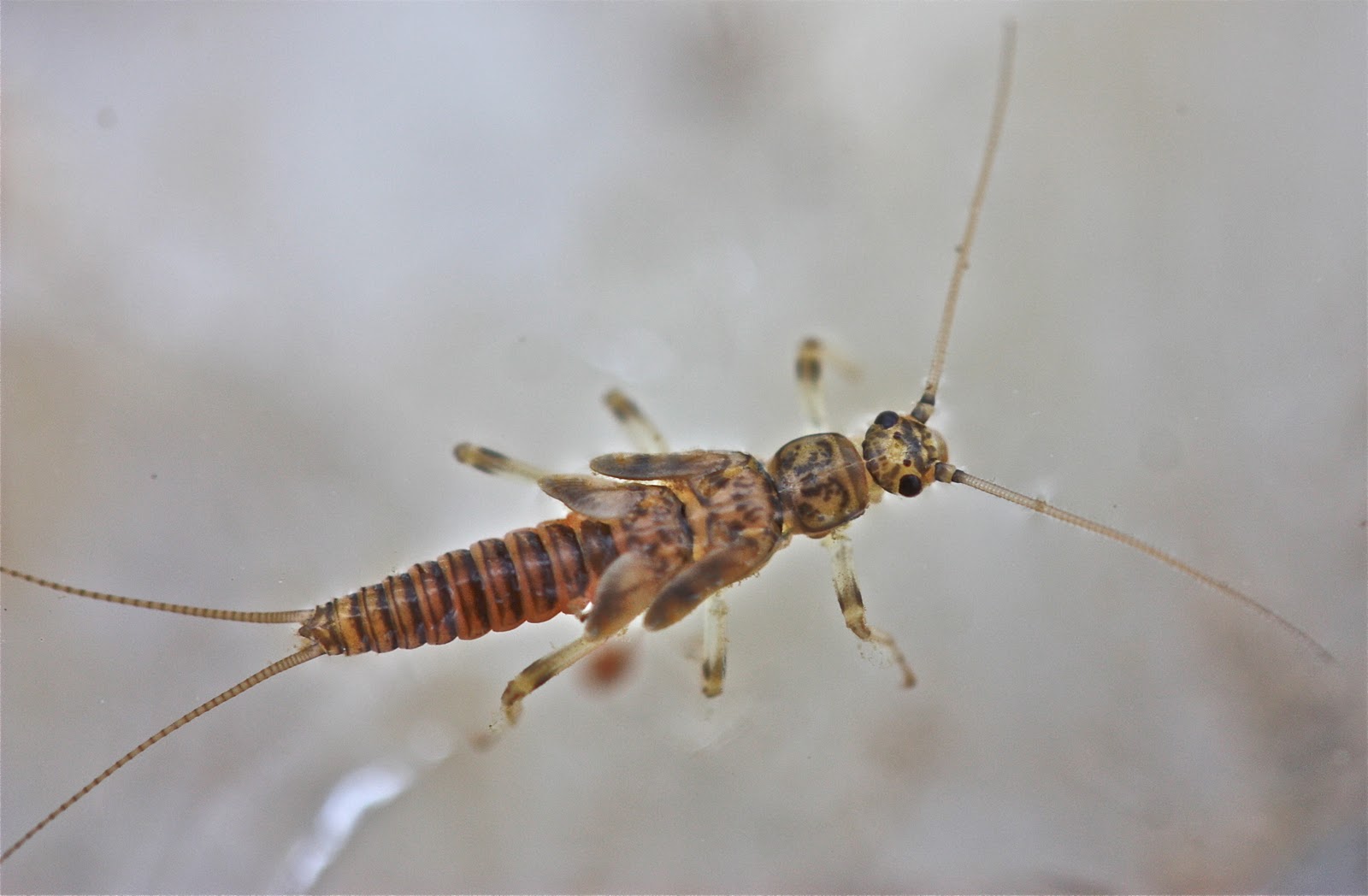
And my own feeling is that, if we look at the season for large winter stones overall, in our watershed we see more Strophopteryx large winter stoneflies than Taeniopteryx large winter stoneflies. Using only Voshell, I don't think someone sampling a stream would conclude that the nymph in the picture above was a large winter stonefly (and he/she sure wouldn't find "coxal gills").
This is one place where I think both genera should have been pictured and discussed.
The "Other" Freeliving Caddisfly

This is a freeliving caddisfly larva (family: Rhyacophilidae) that I found yesterday in Elk Run, a tributary to Buck Mt. Creek.
One of the things that I noticed in working with StreamWatch volunteers was that they invariably expected freeliving caddisfly larvae to be green. Some are (see my photos in the entry for 1/7/11); most that I've seen in our watershed streams are not! They look like the larva in the picture above, or, in some cases they're grayish purple in color. I suspect that a lot of volunteers sampling streams would count the larva above as a "fingernet" caddis, based on the burnt orange colored head. (The mistake of thinking that all freeliving caddis larvae are green is made, I suspect, by relying too much on the illustration that's found on p.164 [Plate 77] of J. Reese Voshell, Jr.'s A Guide to Common Freshwater Invertebrates of North America.)
What are the features we look for in a freeliving larva? First and foremost -- whether they're green, or tan, or gray -- their abdominal segments are deeply incised. We can see that in the photo above -- even better in the photo below of a green one. Rose Brown nailed this perfectly: she always said, "It's the Michelin man!"

Secondly -- and there are exceptions to this -- in most cases, the posterior edge of the pronotum, as in the picture above, looks like a "black collar" in the shape of an inverted "U". This shows up even better in this close-up of the larva I found yesterday.

Be careful -- fingernet caddis larvae also have a black line on the posterior edge of the pronotum -- but it goes straight across. See below.

There are three other features that help in freeliving caddis identification. 1) There are sparse hairs on the abdominal segments.

2) There is a sclerite (brown patch in the photo below) on the top of abdominal segment 9.

And 3) the anal claws are long, curved, and sharp. The first photo below is a close-up of the freeliving anal claw. The second compares the anal claws of the freeliving and fingernet caddis larvae.


(Let me careful to note that of the freeliving features I've noted, "keys" do not mention the "sparse abdominal hairs" and the "black collar" as defining characteristics.)
____________
One final note. When I worked in the lab with Rose Brown and John Murphy, on occasion we'd receive data sheets from volunteers listing large numbers of "freeliving caddis" in streams where it would be very unlikely to find them (remember that the freeliving tolerance value is "0"). While we couldn't be sure, we felt strongly that the larvae in question were, in reality, dark green "common netspinners."
Look at the picture below.

That's a "common netspinner," genus Hydropsyche. It could, indeed, be confused with a freeliving caddis. But, note the lack of "deep incisions" in the abdominal segments (i.e. it's not a "Michelin man"). And, remember, if you look at this with a loupe you'll see three features you will not see on a freeliving caddis larva: sclerotized plates on the pronotum, mesonotum, and metanotum; "fuzzy bellys" (frilly abdominal gills), and hairy tails. E.g. ...

One more look at that beauty from yesterday. The "pattern" on the back is a new one to me.

(For more "colors" of freeliving caddisfly larvae, see the entry below on "Hidden Streams," 3/4/11.)
Thursday, February 17, 2011
Spiny Crawlers: Two More Genera

The photo above was sent in by one of our readers -- who chooses to remain anonymous. This is a spiny crawler mayfly nymph, found in the Moormans River in April, 2005 -- genus Eurylophella.
I did not discuss this genus in my entry of 1/30/11(The "Super Hatches" of Spring: "Spiny Crawlers" and "Nemourids") because I had never seen one, and I did not know they could be found in our streams. I am grateful for this photo, and you can be sure I'll be lifting up rocks in the Moormans this spring!
The spiny crawler genera reviewed in my earlier entry were Ephemerella, Serratella, and Drunella: the most common genus we see is Ephemerella -- and that's in the spring. Ephemerella nymphs -- and this is true for Serratella and Drunella genera as well -- have gills on top of abdominal segments 3-7, though the gill on segment 7 is totally or partially hidden by the gill on segment 6. Here's a photo (Ephemerella) to remind us of the arrangement.

Note that this isn't the case for genus Eurylophella. Eurylophella nymphs have gills on segments 4-7,
but the gill on segment 4 is large and operculate and covers the rest of the gills, save for the bottom edge of the final gill. Let's have another look at the donated photo.

As with the operculate gills on "small square-gill" mayflies and "little stout crawlers," these large, operculate gills on Eurylophella protect the fragile gills underneath and prevent them from silting up. Thus, this is a spiny crawler that has adapted to living in slow moving water.
There is another Ephemerellidae (spiny crawler) genera with a similar arrangement of gills that I found on a recent fly fishing trip to Montana -- this genus, to my knowledge, does not exist in the East. The genus is Timpanoga, and the preserved nymph below is Timpanoga hecuba. Fly fishing guides look to this for the "hecuba" hatch in September.

It's downright scary! And it's large. This specimen is about 3/4" long, not counting the tails. But, look at the arrangement of gills.

Again, there is the single, large, operculate gill on segment 4 that covers everything else save for the bottom of gill number 7.
To match it's short, stubby tails, by the way, it has a weirdly squared off head!

This nymph was on a silted rock in the shallow water at the edge of the Bitterroot River.
Flatheaded Mayflies: Changes and Additions

Judging by the feedback I'm getting from "Blogspot," the most popular entry with readers -- at the moment -- is the one on "Flatheaded Mayflies" (1/8/11). So I thought I might add some comments on this mayfly that a lot of us are so used to seeing.
First of all, I've decided it's time for me to switch from "Stenonema" to "Maccaffertium" for our most prevalent flatheaded genus (in this part of the country at least). If "Troutnut.com" has done it, who am I to keep holding out? Of course, I hate to think of how many fly fishing books are now out of date -- but alas! (By the way, the genus name "Stenonema" has been reserved for a single species of flathead -- Stenonema femoratum.)
Therefore, I think the flathead pictured above -- which I found last week at Lickinghole creek -- is Maccaffertium vicarium -- what fishermen call the "March Brown" (even though it normally hatches in April!). I can't swear to this "species level" identification. And it's based on evidence that is not the best kind to use -- other people's photos from "Troutnut.com" and "Bugguide.net". One of the key features, however, seems to be the "red bands" on the femora. Here's a better look. They're quite unique.

If someone knows that I'm wrong with this identification, please let me know by posting a comment.
The second note I want to add on flatheaded mayflies has to do with a genus that I left out of my earlier entry: the genus Nixe. I left it out because I've never seen it in our watershed streams. Still, Peckarsky, et.al. (Freshwater Macroinvertebrates of Northeastern North America, p. 31) do include it in their key -- so readers in other parts of the state, or elsewhere on the East coast, might encounter this genus.
Nixe, anatomically speaking, is closely related to the genera Heptagenia and Leucrocuta (the reader might want to look again at the entry of 1/8/11). You may recall that the main difference between those two genera is that Heptagenia nymphs have fibrilliform behind the gill on abdominal segment 7; Leucrocuta nymphs do not. Some photos. First, let's look at the nymphs.
Heptagenia:

Leucrocuta:

Now, let's look at the gills on abdominal segment 7. The fibrilliform behind the Heptagenia gill is quite clear: that it's missing from the Leucrocuta nymph might be difficult for us to see: you may have to take my word for it!
Heptagenia:

Leucrocuta:

Best I can do. Now, where does the genus Nixe fit into this mix? Nixe, like Leucrocuta, has no fibrilliform behind the gill on segment 7. But, there are no fine hairs ("intrasegmental setae") on the caudal filaments (tails) of the nymph Leucrocuta; there are on the nymph Nixe. Some photos, and let me start with a photo of a Nixe nymph in its entirety. (The Nixe specimens in my collection were brought back from Montana.)

And here is a look at the gills on segment 7.

Now let's look at the tails (caudal filaments).
Leucrocuta:

Nixe:

The hairs are short and fine -- but they're there. So, you might run into this genus: please let me know if you do.
_______________
A final note about "websites" for macroinvertebrate photos". The three I rely on the most for excellent photos (both of nymphs/larvae, and the adults) are:
1. http://www.troutnut.com/
2. http://bugguide.net/
and
3. http://www.pbase.com/tmurray74/bugs Tom Murray's photos are stunning!
Wednesday, February 16, 2011
Stream Report: North Fork of the Moormans

I did not find that a whole lot had changed in the North Fork since my visit on 1/3 of this year (see previous entry). But I did find a lot of Lepidostomatid case-makers -- as in the photo above -- all of them in the leaf packs. (I picked up a dozen in the first leaf pack that I sorted through.)
As expected, I saw a lot of Epeorus flatheaded mayflies. When I turned over some rocks, I saw at least a dozen scamper in every which direction. (Flatheaded mayflies, by the way, hardly ever (if ever?) move directly forward or backward; they sidle off at an angle, diagonally across the rock -- gives them away every time!) These two pictures will show that the nymphs today were quite a bit bigger than those I found at the start of the year.


It's worth stressing for readers new to sampling that these are MAYFLIES, not STONEFLIES! Too often we rely on the "general" rule that "two tails" = a stonefly; "three tails" = a mayfly. True, all stoneflies have two tails, but so too do a couple of mayflies, at least several genera of mayflies. As noted in the last entry, there are three small minnow genera that have only two tails; the same is true for this flatheaded genus -- Epeorus. With this nymph, the abdominal gills should tell you that it's a mayfly, and the flat head, with eyes that are totally dorsal (on top of its head), indicates that it's a flathead (family: Heptageniidae).
Two other items of interest. One is that I found a very small Perlodid stonefly that I'm quite sure is a baby Isoperla. The features we use for identification make it either Clioperla or Isoperla, and since Clioperlas by now are quite large and Isoperlas are just now appearing, I think this conclusion is sound.
In the photo below, I've placed it next to a mature Perlodid so you can see the difference in size.

Isoperla Perlodids, again, are normally mature in April and May.
The final note is that there are now large colonies of large black flies in the stream -- but I'm finding that to be true almost everywhere that I go. In the photo below, I've tried to show you what this would look like as you look at a rock down through the water. I've drawn arrows to all of the clusters and rows of these ugly black buggers.

If I were out sampling and reached down to rub some rocks, I'd leave this one alone and move on!
Oh, I know, that's not the advice you'll be given -- but there are hundreds, maybe thousands, of black fly larvae on this rock. Do you want to sit and pick them all off of your net?! (I've done it; it's not fun!)
Oh! Almost forgot. The stream was loaded with large winter stoneflies, genus Strophopteryx; I didn't see any small winters; and I only saw two Taeniopteryx large winter stones. Still, one of them was kind enough to lie on its back and let me get this good shot of its "coxal gills," the large, white "telescoping" gills at the base of each leg.

Subscribe to:
Posts (Atom)