Saturday, March 17, 2012

The Common Netspinner "Diplectrona modesta" -- and Other Treasures from Sugar Hollow


I found a lot of nice insects today in the small stream I explore on the south side of the Moormans.  But it's the insect in the photo above that I was after.  The common netspinner (family: Hydropsychidae), Diplectrona modesta.  While stream monitors regard the common netspinner as a fairly tolerant insect, this genus and species is an exception: tolerance value, "2.3".  (At the moment, VA DEQ uses a TV of "6.0" for all common netspinners.)  But this is a species that most monitors never see, since we only find it in streams like the one that I went to today: a small, very clean stream in the mountains.

On Diplectrona common netspinners, the "meso- and meta-notum [are] divided by transverse fracture lines in [the] posterior third," and the "fore trochantin [is] simple" (i.e. not "forked" like those on Hydropsyche and Cheumatopsyche larvae).  (Text is cited from Barbara Peckarsky, et.al., Freshwater Macroinvertebrates, p. 101).    I have posted photos of these features in the entry for 3/4/11 -- please go to that entry to see the detail.  Other features noted in Peckarsky -- "Pronotum lacking transverse groove...constricted only slightly at posterior border; anterior margin of frontoclypeal apotome symmetrical and entire." (pp. 101-102)  These features are actually visible on the larva in the photo at the top of the page.  I've pointed them out in the photo below.


Also note in this photo that the anterior margin of the head is entire, lacking a notch, since that is one of the things that makes this larva Diplectrona modesta.  (On this point, see Steven Beaty's "The Trichoptera of North Carolina.")   The other Diplectrona species found in this part of the country -- Diplectrona metaqui -- is extremely rare.

Two more photos.  In the first, the netspinner has climbed up on the case of a Uenoid caddis; in the second, the larva has turned on its back, showing us the "common netspinner" gills.


___________

A few other treasures from my outing today.

1. A Perlodid stonefly, Malirekus hastatus.  I saw a lot of them -- all of them getting mature.


(Same insect; different lighting conditions.)

2. Two of the many Epeorus pleuralis flatheaded mayflies I saw.  The first has just recently molted and is almost transparent; the second is one that is fully mature (note the black wing pads.)


3. Flatheaded mayfly, Maccaffertium meririvulanum.  They're growing; note the long wing pads.  This was a big nymph: I'd say the body was about an inch long.


4.  Probably the largest spiny crawler (E. dorothea) that I saw today.  Pretty colors and patterns.


5. And a northern case-maker caddisfly larva -- genus Pycnopsyche -- in its 3-sided case made out of sections of leaves.  (Nicely layered -- I might add.)

________

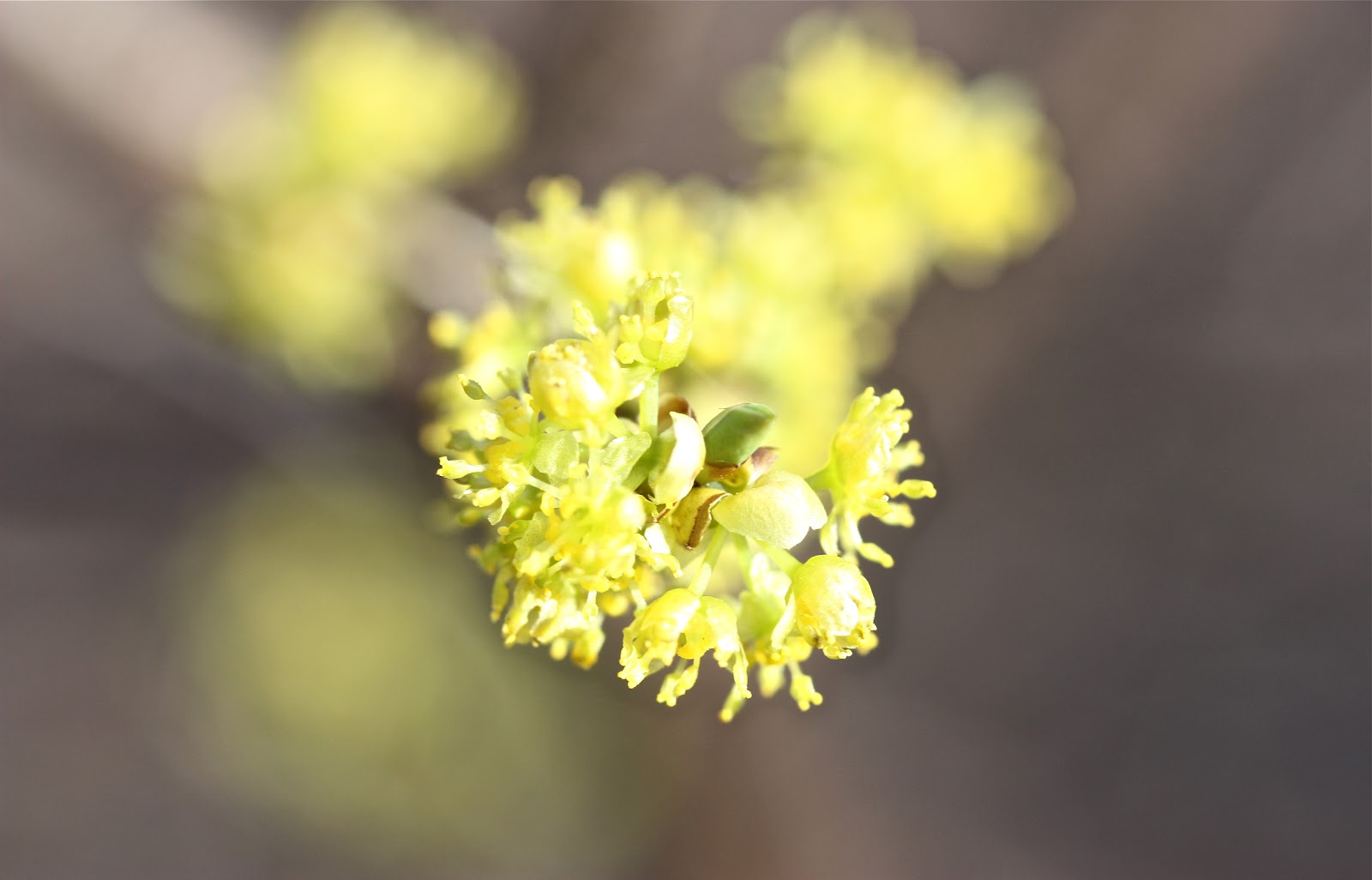
(Below: the wildflowers are blooming and the buds on the trees are opening up.  A nice time of year to go to the woods.)
Thursday, March 15, 2012

The Small Minnow Mayflies Take the Day at Buck Mt. Creek


They're the only small minnow mayflies I see in Buck Mt. Creek in the winter and early spring -- Heterocloeon amplum, and they turned out in large numbers today.  This one is almost ready to hatch -- black wing pads.  But I found them in a variety of sizes and shadings, making the point very well that "hatches" don't occur all at once: H. amplums probably mature and hatch in Buck Mt. Creek from the beginning of March, through April, and possibly into May.

Let's look at the range of development that I saw today, working backwards from the mature nymph in the photo above.

1. A male  -- note the large, red eyes -- that is fully colored, still the wing pads have not started to darken.


2. Holding on to the back of the mature nymph in the photo at the top of the page, another male.  But note the light coloration, and, note how the eyes seem to be part red and part black (!)  I've seen this before in "teen" males, so I guess their eyes change as they mature.


3. Finally, an immature nymph that is still very light in color.  For a moment, I thought this might be an early sighting of the small minnow species Baetis intercalaris -- which I expect to see soon in this stream -- but, only two tails on this one, and the faint tracheation in the gills confirms that it too is H. amplum.


Too bad there are no trout in this stream.  If there were, fishermen could look forward to two months of "Blue-winged Olive" fishing.
___________

As for the rest of my findings today --

1. A real surprise -- a small winter stonefly!  This blew me away.  I was sure they were, by now, completely gone from our streams.  But, still a few late bloomers hanging around.


2. A spring insect that we find in this stream -- the "Net-winged midge," Blephariceridae, genus Blepharicera.  This is a very intolerant insect with a TV or 0.0.  Still, I normally find them -- as I did this morning -- crawling on rocks on which there are large clumps of black fly larvae.  Go figure.  Below, dorsal and ventral views.  Note the "suckers" on the ventral side which they use to cling to the rocks.


3. One of many Perlodid stoneflies, Isoperla namata.  (Two sources confirm the existence of I. namata in Virginia, so I'm dispensing with the tentative Isoperla nr. namata.)  They're showing up in large numbers in this stream as well.


4. And finally, the Perlodid stonefly that I see in this stream in a regular way throughout the winter -- Helopicus subvarians.

Saturday, March 10, 2012

At the Moment, Not Much Diversity at the Rapidan River


Oh, there were a lot of insects today at the Rapidan River, but there was very little see but Isoperla nr. namatas (Perlodid stoneflies, as in the photo above) and Spiny Crawler mayflies, genus Ephemerella (E. subvaria, E. invaria, and E. dorothea, all three).  If you're getting ready to go out and monitor streams -- the spring sampling season is now underway -- then get ready to have samples that are dominated by these two taxa.

I did find other things.  I saw quite a few pronggilled mayflies, including one that was already mature; a couple of Giant stoneflies (P. biloba); a couple of Common stoneflies (Acroneuria abnormis); and a few Baetis tricaudatus small minnow mayflies.  I also saw Epeorus pleuralis flatheaded mayflies on the bottoms of rocks, common netspinners were under there too.  But the number of I. nr. namatas and the various Spiny Crawlers was simply staggering.  Look for big hatches soon of "Yellow Sallies," "Hendricksons," and "Pale Evening Duns"!

Nothing but photos today.

1. The Isoperla nr. namatas, the most common Perlodid stonefly we find in our streams, are rapidly maturing.  So they are very colorful and richly patterned.


2. A mature pronggilled mayfly (genus Paraleptophlebia) -- with a few gills missing, I'm sorry to say.


3. Baetis tricaudatus, the small minnow mayfly we find in the mountains.


4.  One of two Ephemerella subvarias (Spiny Crawlers) that I located today.  These, too, are rapidly getting mature.


5. Ephemerella invaria.


6. And two more Spiny Crawlers, in a photo that sort of sums up what I saw today in my tray.

Thursday, March 8, 2012

Heterocloeon amplum: Our Small Minnow Mayflies Mature


I haven't done much serious fishing since I moved to Virginia (2003), but were I to head to a stream in March and April, I'd be sure that my "Blue-winged Olive" patterns were easy to find in my vest.  Baetis tricaudatus (see the entry posted on 2/23) and Heterocloeon amplum -- the small minnow in the photo above -- are both ready to hatch.  The long, black wing pads are a sure sign of that.  (Cloudy days with sprinkles, probably mid-afternoon, and I'd use a size 14 hook: these are pretty big bugs, and they usually come off in large numbers.)

I finally got back to Buck Mt. Creek.  Rain followed by snow have kept our streams running high and off-color.  The water was still high today -- but clear.  I was hoping -- and expecting -- to find two insects: maturing H. amplum small minnow mayflies -- success; and maturing Nemourid stoneflies -- there I struck out.  I'll be heading up to the Rapidan River this weekend, where I'll be seeing Nemourids for sure.

Actually, I think I found more H. amplum nymphs today than anything else.  Still the collection included 3-4 stunning Clioperla clios (a Perlodid stonefly); some large winter stoneflies -- Strophopteryx fasciata (I was beginning to think they had all hatched); one large Spiny Crawler, a "twin" to the one I found yesterday; a few Diploperla Perlodid stoneflies; and I did find a good Hydropsyche common netspinner larva -- so far, the ID eludes me.
___________

1. A few more pictures of the H. amplum nymphs.  I found both females (above) and males (the one below with the big eyes).


2. Common netspinner larva, genus Hydropsyche: dorsal and ventral views: size about 14mm.


I was hoping that the orange abdominal terminus would help with species ID, but apparently not (using Steven Beaty's "The Trichoptera of North Carolina").  I'll continue to work on this larva and get back to you if I can ID it.

3. A nicely maturing Diploperla duplicata that chose to float on top of the water.


4. And finally two of the Clioperla clios) that I found.  The colors were simply stunning.  The light tipped wing pads on the second nymph is something I've not seen before.


Wednesday, March 7, 2012

The Freeliving Caddisfly Rhyacophila carolina in Whippoorwill Branch


I made a quick trip to the Whippoorwill Branch of the Mechums this afternoon, and while most everything that I found was expected, this one was not: the freeliving caddisfly Rhyacophila carolina -- this is the first time I've identified this species in one of our streams.  And I picked up two of them.  The second was, in comparison with the one in the photo above, shorter, fatter, and darker in tone.


But it's clear that the two are the same; just look at the heads and the pronotums -- golden brown.  Beaty notes that R. carolina is the "second most common Rhyacophila in NC," with the golden brown head being the key feature to see.  The other feature that is key to identification -- there are no ventral teeth on the anal claws.  The photo below bears this out.


This is the fourth freeliving caddisfly species that I've been able to ID in local streams, the other three being R. fuscula (most common), R. nigrita, and R. glaberrima, all of those found in the small stream in Sugar Hollow to which I seem to return a couple of times each month.  Relevant entries on those other species were posted on 11/25, 12/26, and 2/13.

My goal today was to find some common netspinner larvae: I've got the itch to work at species ID on the common genus Hydropsyche.  Well, I did find common netspinners -- a lot of them in fact -- but number one, they were all very small, and number two they were all genus Cheumatopsyche, which Beaty advises us to leave at the level of genus!  So it goes.  A couple of photos of a Cheumatopsyche common netspinner larva.


Like Hydropsyche netspinning larvae, Cheumatopsyche larvae have a "forked fore trochantin."


But we distinguish the two genera by looking at the prosternal plate (under the chin).   Hydropsyche larvae have two small sclerites (dark patches) right below the prosternal plate; Cheumatopsyche larvae do not.  This larva was Cheumatospsyche.


While I can't support this with data, my impression is that the majority of the common netspinners we find are Hydropsyche, but you can't really tell without looking under the chin.

Cheumatopsyche common netspinners are very tolerant, with a generic tolerance value of 6.6.  Odd that I find these side-by-side with the freeliving caddisfly larva R. carolina, which has a tolerance value of 0.4.

__________

The "Spiny Crawler explosion" is well under way in this stream: patches of moss on the rocks (under the water) were loaded with them.  Most were still very small.  But I did find one that I could photo.  This is our common spring species E. dorothea.


And one other interesting photo.  I found a lot of Uenoid case-makers with their little stone cases clinging to rocks.  One of them slipped out of its case and started crawling around on a caddis pupa that I had picked up!


The pupating caddis was either a fingernet caddis or a freeliving caddis -- but I didn't feel like opening up the cocoon so I could find out.

_____________

The two R. carolina larvae come face-to-face in my tray.

Sunday, March 4, 2012

Slammed! By Lepidostomatids and Peltoperlids


This is the kind of silliness that I had to put up with this morning while taking my pictures: it was ridiculous!  And look at these clowns!


Still, you have to admit -- those are some of the prettiest Lepidostomatid cases you're ever going to see.

I used to sample with a local group that monitors our area streams, and when one or two taxa accounted for 1/2 to 3/4 of a 200 bug total, we said that we had been "slammed."   That usually meant something bad.  We might have run into a black fly colony -- there goes the score for that stream -- or in the spring it would probably be spiny crawlers.  If our dominant taxa had low tolerance values, being "slammed" would have a negative impact on the score for that visit.  But even with good tolerance values, insects that show up in numbers that overwhelm the sample will tear down the score because the "variety" that some metrics value just isn't there.

Well this morning I was slammed by Lepidostomatids and Peltoperlids, "Roach-like stoneflies," these little guys.


I'm talking hundreds of both of these taxa.  I've never seen that many Lepidostomatids or Peltoperlids in any one place at any one time.  I spent a lot of time in "search and rescue."  I.e. when I finished looking through leaves, the rock on which I had put the leaf pack would be covered with Lepidos and Peltos.  So, I'd pick and pick and pick to make sure that they all got back into the water!

But I can't say I mind getting slammed with insects like these -- it's the price you pay for going to very clean water in small mountain streams: Lepidostomatids (genus Lepidostoma) have a tolerance value of 1.0, and the tolerance value for Peltoperlids (genus Tallaperla) is 1.3.  This is perhaps the cleanest water I see in all of the streams that I visit.  Back in Sugar Hollow again (not much choice since rain has once again raised and colored the water in most of our streams), this time to the small tributary on the north side of the valley that I get to enjoy.  I did see other insects, by the way: as you would expect, all of them good: Chloroperlids (Green stoneflies), Eccoptura common stoneflies, tiny Leucrocuta flatheaded mayflies, and a few -- but only a few -- spiny crawlers (as opposed to what I just found on the "south" side of the valley).

I also found another Maccaffertium meririvulanum flatheaded mayfly, the flathead that only hangs out in "pristine," headwater streams, and I found a Leuctrid (rolledwinged stonefly).  I'll tie this up with some photos of those taxa -- and add a few more shots of our Lepidostomatids.

1. Maccaffertium meririvulanum.  Note that the wing pads are getting long now (as opposed to the one I found in this stream on 12/11/11), and remember the defining characteristic: pale "V's" on abdominal segments 5, and 7-8 or 7-9 (this one also has one on segment 4).


2. Some good close-ups of a young "Rolledwinged stonefly" (Leuctridae), genus Leuctra.


3. And a couple more looks at our Lepidostomatids.