Monday, July 23, 2012
Looking for Insects in Roaring Creek
I spent the weekend in Pennsylvania -- it was my wife's high school reunion -- and we visited friends who own a cottage on the banks of Roaring Creek. Roaring Creek is a medium-sized stream that flows into the Susquehanna between the towns of Catawissa (my hometown) and Danville (my wife's hometown). On Saturday morning, we had pretty good sunshine so I waded into the stream to see what I could find. For the most part, I saw the same insects I've been seeing in central VA -- flatheaded mayflies, common netspinners, a few common stoneflies, and a handful of small minnow mayflies (Baetis intercalaris and Acentrella nadineae). But there were some surprises.
The most interesting find was the common stonefly (Perlid) in the photo above. I could tell by the colors and the angular shape of the head that this was a genus or species I had not seen before. It turned out to be a new species of Paragnetina -- Paragnetina media. The only Paragnetina I've seen in our streams -- and only in the Rapidan River -- is Paragnetina immarginata, which looks like this.
You might wonder how these nymphs can be the same genus, but genus ID is based on anatomical features. In the case of the two nymphs in our photos, what they have in common are 1) an uninterrupted row of spinules across the back of the head (the occipital ridge), and 2) an absence of subanal gills. These are both obvious in close-ups of the live insect: no microscope photos are needed.
Once I knew this was a Paragnetina common stone, I turned to Steven Beaty's "The Plecoptera of North Carolina" (p. 18) to determine the species ID. In Beaty, the Perlid that I found in PA is identified as Paragnetina ichusa. He notes, however, that P. ichusa and P. media are "inseparable, and since Stewart and Stark (Nymphs of North American Stonefly Genera, p. 353) attest the existence of P. media in Pennsylvania but not P. ichusa (only in NC, SC, and TN), I've decided to use P. media for our identification. (Beaty sometimes uses P. ichusa/media for the species ID.)
For our ID, then, we must look at Beaty's description of P. ichusa.
P. ichusa [or P. media] -- nymphs 15-23 mm; head brown with small, light areas around each ocellus and tentoria; femora brown; abdomen brown sometimes with small light mesal areas on tergites 7-9; terga 4-9 without short, thick intercalary setae; anal gills absent.
Another look: this nymph was ~ 16 mm and is still immature.
Yes, the femora are brown, and yes, the abdomen is brown: on this nymph I do not see "light mesal areas on tergites 7-9." The "small, light areas around each ocellus" are very clear in this close-up of the head.
"Tentoria" normally refers to "an internal skeletal framework in the head of an insect" (online definition) -- which wouldn't be relevant here. I'll have to check with Beaty to see how he's using the word in this context. But, there are certainly a lot of "pale areas" on the head, so we ought to be covered.
Yes, anal gills are absent. Of the missing short, intercalary setae on tergites 7-9, I have not been able to get a usable picture.
I have used two other sources to confirm this identification. One is the online site Troutnut.com on which we can find photos of a P. media nymph that match the one that we've found (see the photos at http://www.troutnut.com/specimen/654); the other is the description of P. media found in the web page "Aquatic Insects of Michigan" (go to: http://insects.ummz.lsa.umich.edu/~ethanbr/aim/Keys/Plecoptera/id_pom_perlidae.html). There we read: "pronotum fringed laterally and posteriorly with short stout bristles interspersed with a few long bristles."
The short and long bristles are visible in this microscope photo of the left rear edge of the pronotum.
So, another new Perlid for me: Paragnetina media. This is a species that is attested in Virginia as well as PA, so we may run into one in the future. Tolerance value in North Carolina -- 0.2.
________________
And now for this odd-looking Diptera larva.
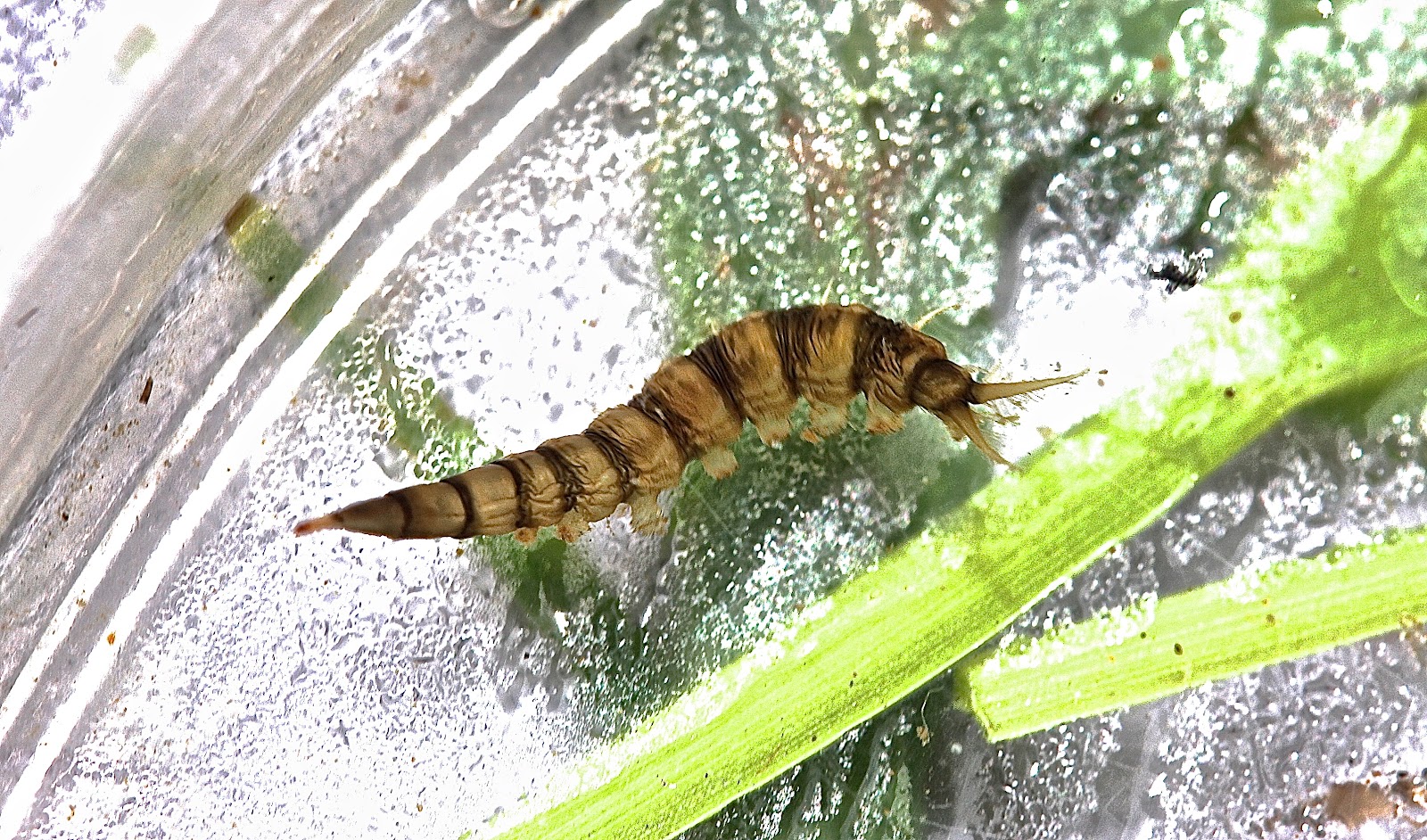
This is another inhabitant of Roaring Creek in northeastern PA -- an "aquatic snipe fly" or "watersnipe fly," family: Athericidae, genus: Atherix. This is only the second time I've found one of these larvae. This is a fairly intolerant insect with a tolerance value of 2. This larva was about 8 mm.
There is good information on watersnipe flies on the website, "Digital Key to Aquatic Insects of North Dakota" (see page: http://www.waterbugkey.vcsu.edu/php/familydetail.php?idnum=7&f=Athericidae&ls=larvae). There we read as follows: "Distinguishing characteristics -- The larvae of the watersnipe flies have abdominal segments containing ventral pairs of prolegs bearing crochets and terminal processes longer than the terminal prolegs. These terminal processes have distinctive hairs on them."
There are pairs of prolegs on the first 7 abdominal segments, but only one proleg on segment 8. Those are pointed out in the following photos.
Even better, a photo in which we can see both of the prolegs.
Finally, in this photo we can see the "fringed" terminal processes and the "crochets" (velcro like hooks) on some of the prolegs.
Let me return to the "Digital Key to Aquatic Insects of North Dakota" for additional information. "Genus Atherix: There is one genus of Athericidae, Atherix, found in North Dakota (and most of North America). The larvae are predators, eating other fly and mayfly larvae. They can be found in the riffle areas of vegetation of rivers and streams. Adults do not bite humans or animals."
From the reading I've done, I can tell you that the larva in the photos above is either A. lantha or A. variegata, but that's as far as I go. I have not located a key with which I could identify this to the level of species.
_______________
I found one other insect of interest in Roaring Creek: a common netspinner. It turned out to be Hydropsyche in genus. But it's a little bit different than the Hydropsychyes that I normally see, so I'm hoping to ID this one to the level of species. I'll let you know if I'm successful.
Sunday, July 22, 2012
Wednesday, July 18, 2012
Back to the Rivanna: Lots of Heterocloeon curiosum
Another day to beat the heat as it again climbs towards one hundred degrees. Tough working conditions, with sweat pooling up in my viewfinder and the humidity fogging my lens. But I hate to miss out on seeing more insects.
Still nothing dramatically new in the Rivanna: I see a lot of silted up common stoneflies, and a lot of silted up flatheaded mayflies, and a lot of common netspinners -- it's their time of year -- and the occasional hellgrammite. Oh, yes, and the odd Giant stonefly here and there. I'm always mystified to find them in this kind of water, but they're here nonetheless.
So, my focus becomes the summer small minnow mayflies, the summer spiny crawlers, and -- when I see them, which ought to be soon -- the "little stout crawler" mayflies: "tricos" to fly fishermen. The main small minnow mayfly I'm finding in the Rivanna at Darden Towe Park continues to be the Heterocloeon curiosum. And I always see, or so it seems, more females than males. This morning, one in particular, posed for some very nice photos.
When she turned on her back, I got a picture that helps us ID these nymphs to the level of species. In this photo, you can clearly see the spots of pigment in the center of each of the gills and the "procoxal" gills at the base of the front legs, both defining characteristics of H. curiosum.
I had only one male in the collection today, and he was not cooperative when it came to my taking photos. This is the best I could (but note the big eyes). The male nymphs are undeniably smaller than the females.
I also found several Serratella spiny crawlers -- Serratella serratoides. I had trouble getting them to pose on their own: they love to cling to vegetation if there's some in the tray.
The dark brown color and the "spiky" tails -- which are banded -- always give this one away.
Finally, I found another Leptocerid, a long-horned case-maker caddis. I'm seeing a lot of these larvae this year, having now found them at three sites on the Rivanna: Darden Towe, Milton, and Crofton.
_________________
We'll be making a quick trip up to PA this weekend where I hope to get into some smaller streams in the mountains.
Saturday, July 14, 2012
Acentrella nadineae: Really No Need to Go Far Away
So, why have I been ignoring the North Fork of the Moormans in my search for the beautiful summer small minnow mayflies? I made up for it this morning. I saw quite a few flatheaded mayflies, including some fairly mature E. vitreus; and there was a surprising number of common stoneflies -- fairly large -- genus Acroneuria; and of course, as I'm seeing everywhere else at this time of the year, there were a lot of common netspinner caddis. But the dominant taxon today was my favorite small minnow mayfly -- Acentrella nadineae!
I spent a lot of time in one of the entries I posted last week working through the species ID for this insect, so there's no need to do that today. I'll just post the better photos I was able to get -- even though the sun had gone missing by the time I got out my camera. In the first, we have a young male at the top and a more mature female at the bottom. The rest are just the female.
I did find a few other mayflies.
1. A very small prong-gilled mayfly, genus Paraleptophlebia:
2. Another small minnow mayfly -- Baetis intercalaris -- with a small A. nadineae at the top of the photo:
3. And one other small minnow mayfly -- Acentrella turbida, or so I assume. But it seems awfully small, so I need to have a close look at this one.
________________
Finally, a couple of photos of small, still immature A. nadineae nymphs:
________________
And this is what the City of Charlottesville, which prides itself on its committment to the environment, considers an adequate "minimum flow" for the Moormans River below its reservoir at the head of the Moormans. I sure see the "minimum" -- but where is the "flow"?! Do they expect this stream to stay healthy? This was once -- and could be again -- a very good trout stream.
Friday, July 13, 2012
Taking Stock: New Taxa Found in 2012 -- So Far...
This is not one of the new taxa that I've found this year -- but of the photos I've taken so far, it's one of my favorites: Baetidae (small minnow mayfly), Heterocloeon amplum, Doyles River, 2/6/12.
At the end of last year, I thought about bringing this blog to an end and moving on to something new. I was convinced that I had seen all of the mayfly (E), stonefly (P) and caddisfly (T) species that I was going to see in our local streams, so in 2012, I would not have too much to say and no new photos to post. I was wrong, and I'm glad I decided to keep going. It's been a year of many discoveries, and I now think there are a lot more EPT species out there to be found and identified. While there's a pause in the action -- heat, drought, lack of rain -- scarcity of "interesting" insects -- I thought I might remind everyone of the new species we've seen so far this year. I will post only one photo per taxon. For more photos, go to:
http://www.flickr.com/photos/aquaticinsects_of_central_virginia.
I. Mayflies (Ephemeroptera)
A. Baetidae (small minnow mayflies)
1. Baetis tricaudatus
2. Plauditus dubius
3. Iswaeon anoka (formerly Heterocloeon anoka)
________________
B. Heptageniadae (flatheaded mayflies)
1. Maccaffertium meririvulanum
2. Maccaffertium vicarium
3. Maccaffertium pudicum
4. Maccaffertium ithaca
5. Cinygmula subaequalis
C. Ephemerellidae (spiny crawler mayflies)
1. Drunella cornutella
2. Teloganopsis deficiens (formerly Serratella deficiens)
________________
D. Ephemeridae (common burrower mayflies)
1. Ephemera guttalata
________________
II. Stoneflies (Plecoptera
A. Perlodidae (Perlodid stoneflies)
1. Malirekus hastatus
________________
B. Chloroperlidae (green stoneflies)
1. genus Haploperla
2. genus Alloperla
________________
C. Capniidae (small winter stoneflies)
1. genus Paracapnia
________________
III. Caddisflies (Trichoptera)
A. Rhyacophilidae (freeliving caddisflies)
1. Rhyacophila nigrita
2. Rhyacophila glaberrima
3. Rhyacophila carolina
________________
B. Philopotamidae (fingernet caddisflies)
1. genus Wormaldia
________________
What next? Stay tuned.
Subscribe to:
Posts (Atom)


