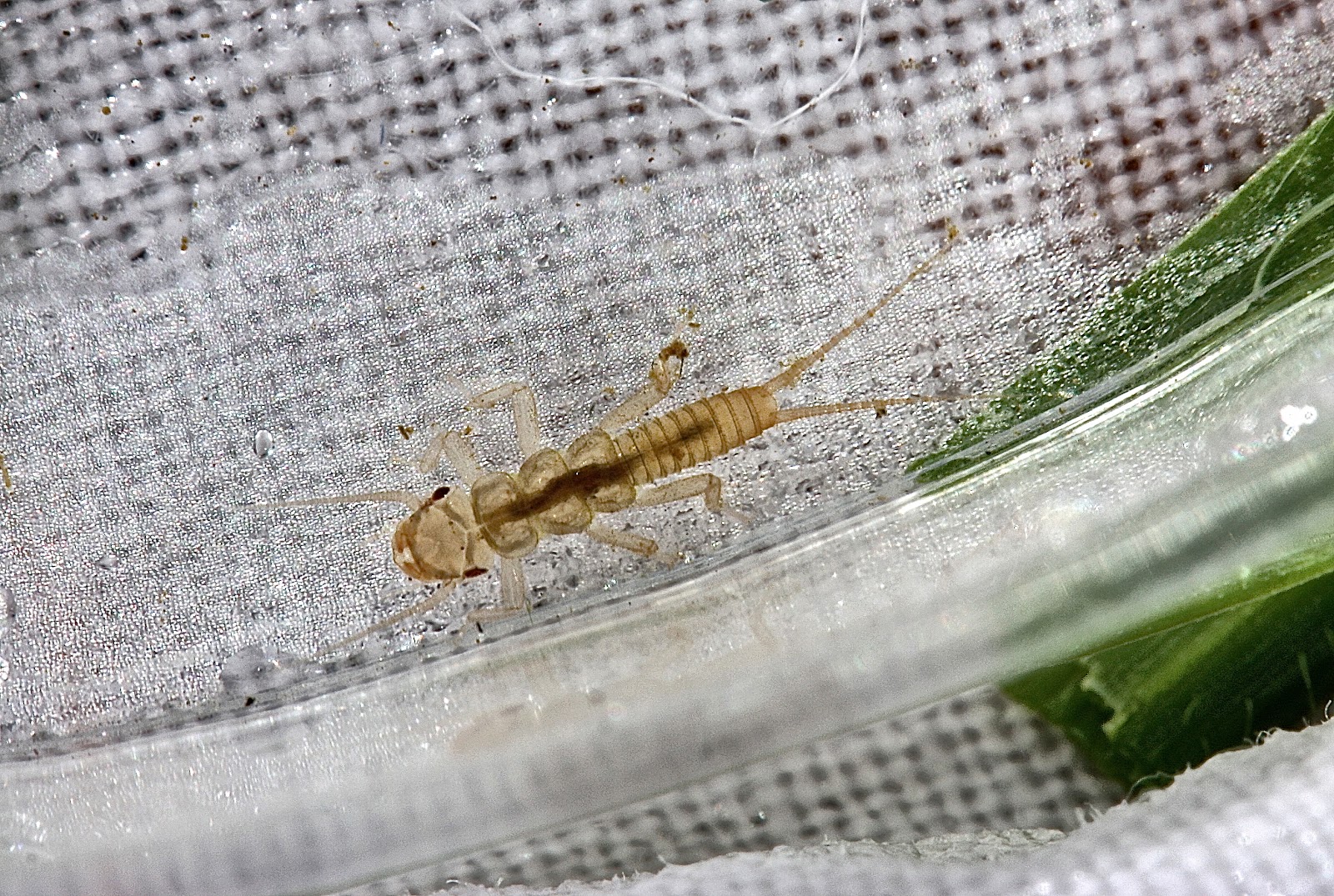
Friday, October 19, 2012

Making the Case for yet Another Common Netspinner: Ceratopsyche alhedra


On 9/12, I posted this photo of what at the time I thought was the netspinner, Hydropsyche betteni.  I'm now pretty sure I was wrong; it was Ceratopsyche alhedra.  C. alhedra is a very intolerant netspinner with a TV of 0.0; H. betteni is a very tolerant netspinner with its TV of 7.9.  This larva was found in very clean water in the South River coming out of the Blue Ridge.  I'm pleased to know that my initial assessment was wrong, and I'm certainly not surprised by the ID.

Having found what I am certain was an H. betteni larva in Mechunk Creek on Tuesday, I decided to compare the two larvae closely today with microscope views.  That's when I discovered a major mistake.  The netspinner found on 9/12 at the South does not have "scale" hairs on the abdominal segments.  Here is a microscope view of the abdomen of a Hydropsyche larva: the "scale" hairs are the short, wide, pointed, very black hairs.


Now look at the abdomen of the larva I found on 9/12:


I just don't see any scale hairs.

Back to the books.  Which Ceratopsyche species has a head that's totally black, that would look like H. betteni?  Steven Beaty, "The Trichoptera of North Carolina," p. 72:

C. alhedra -- larvae large; head uniformly black with posterior margin of head pale.  Prefers clean streams and fast current.  Mountains.  Uncommon.  Very intolerant.

I think that's a match.  But let's look at a source with greater detail -- the EPA Manual on Hydropsyche and Symphitopsyche (now Ceratopsyche) genera by Schuster and Etnier.  The relevant pages are 45-47.  I'll not cite their complete description; I'll just focus on features that I can show you.

Symphitopsyche [Ceratopsyche] alhedra

Description: Head coal black except for circular areas around the eyes and large subrectangular yellow area on posterior lateral aspects of genae. ... Labrum coal black with short, black setae margined by tuft of long, yellow setae.  Mandibles dark brown to black."

In the photo below we can see all three of these features: the "subrectangular yellow area" at the back sides of the head; the black labrum, or at least the top of the labrum covered with setae; and the dark brown/black mandibles.


I think that's a pretty good fit.

My apologies for not being more careful with this ID in the first place.  But, when I make a mistake, I always try to correct it.  And it's always a joy to realize that another species has been found in our streams.
______________

More photos:


Thursday, October 18, 2012

Assigning Tolerance Values and the Common Netspinner Problem


(Above, a common netspinner (Hydropsychidae), genus Hydropsyche, species not yet determined: found this morning at Buck Mt. Creek.)

As I've increasingly focussed on species ID for common netspinners over the summer, I've become more acutely aware of a problem that could develop in the process of monitoring the health of our streams in the state of Virginia.  At the moment, VA assigns tolerance values by family: the TV given to all common netspinners we find -- across the board, irregardless of genus or species -- is 6.0.  But Virginia plans to change at some point in the future to a system of assigning tolerance values  by genus.

In the case of common netspinners this is an important change that has to be made: the common value of 6.0 is really misleading and doesn't give us reliable data to use.  To date, I've found five genera of common netspinners in local streams, and a total of ten different species.  The tolerance values assigned to these taxa in North Carolina differ in significant ways.  Have a look.


Ceratopsyche bronta                    2.3
Ceratopsyche morosa                   2.3
Ceratopsyche slossonae                0.0      
Ceratopsyche sparna                    2.5

Cheumatopsyche                         6.6

Diplectrona modesta                   2.3

Hydropsyche betteni                    7.9
Hydropsyche rossi                       4.8
Hydropsyche venularis                5.1

Macrostemum                             3.4

Now, it will be possible, it seems to me, to assign a single tolerance value to each of these different genera, something like -- for example -- 2.0 for Ceratopsyche; 6.6 for Cheumatopsyche (this is the value used in NC for all Cheumatopsyche larvae); 2.3 for Diplectrona (D. modesta is the only known species at the moment); maybe 6.0 would still be okay for Hydropsyche; and Macrostemum can stay at 3.4 since there are only two species, and they're difficult to distinguish.  (These are only "for examples" -- these are not recommendations.)

Good.  Now here's the problem: can community volunteers distinguish the common netspinner genera, or, in the future will they have to start preserving every netspinner they find for laboratory ID?  (Not something anyone wants to do.)

Some thoughts.

1) Diplectrona and Macrostemum netspinners can, in fact, be distinguished from the rest without a whole lot of work.   Diplectrona modesta larvae can be distinguished by color: they all look like the larva in the photo below -- brown/tan body, brown nota, and an orange/bronze head (at least that's true of every larva that I've seen so far).  Not only that, they are normally found in only one type of stream -- small, mountain streams, clean and cold -- and even then not in big numbers.  (The kind of stream that might be used as a "reference" stream.)


2) Macrostemum larve are also easy to pick out by sight.  They're bigger than most of the netspinner clan, they're fat, they're an odd shade of green, and they've got that oddly sloped head.


3) Cheumatopsyche present more of a problem.  It is true that every C. larva I've seen has been the same color: lime green body with brown nota and head.


But the only safe way to distinguish Cheumatopsyche from Hydropsyche and Ceratopsyche is to look for two distinct physical features: 1) The two large sclerites below the prosternal plate on Hydropscyhe and Certopsyche are either tiny or absent on Cheumatopsyche, and 2) on Cheumatopsyche larvae there is a notch at the front of the head (the frontoclypeal apotome).


I'm not sure that any of us will pick up those features using a loupe: these larvae will have to go to the lab for ID.

And now for the biggest problem of all: Ceratopsyche and Hydropsyche.  These genera MUST BE DISTINGUISHED -- look at the difference in tolerance values!!!  Of the species assigned TV's in the North Carolina list, the average TV for Ceratopsyche is 1.1; the average for Hydropsyche is 4.3.   But, I'm not sure that anyone -- let alone amateur volunteers -- can tell them apart at the stream without looking closely at the abdominal segments, a very time consuming practice.  Hydropsyche larvae have "scale" hairs on at least some abdominal segments; Ceratopsyche do not.  You can see the difference in the photos below.

Hydropsyche venularis: all of the tiny black dots on the abdominal segments are "scale" hairs.


Ceratopsyche bronta: no little black dots.


Hydropsyche betteni: little black dots.


Ceratopsyche sparna: no little black dots.

_______________

So there you have it.  Given the wide range of tolerance values among common netspinner genera, we cannot continue to use a single value of 6.0 for every netspinner we find.  That yields results that are not at all valid.  But when we move to tolerance values by genus, the systems of sampling currently used in the state will require a major adjustment.  I trust that a way will be found to include community volunteers in the work that we do on our streams.  But this is an issue that will not be easy to solve.

Tuesday, October 16, 2012

Finding the "Tubercle" on the netspinner Hydropsyche Betteni


I assure you this is not what I was after today: I went to Mechunk Creek in Cismont in hopes of finding some "baby" Large Winter stoneflies (ours are Taeniopteryx burksi).   Still no luck.  I pretty much saw what I've been seeing everywhere else: brushlegged mayflies and flatheaded mayflies -- lots of them and all very small.

But there was one decent sized common netspinner, so I thought I'd get some photos and see what it was in terms of the species.  Dark head, no pattern: Hydropsyche betteni.  But the neat thing is that in some of the photos I took you can actually see the "tubercle" on the head which Beaty notes in his description.

H. betteni -- larvae 16 mm: has a low rounded tubercle (bump) on back dorsum of head; mature larvae usually have a uniformly dark head while immature larvae may have two light spots or streaks similar to H. venularis.  Widespread.  Most tolerant species.

The tubercle:


Pretty neat.  My friend and I were just lamenting yesterday that on the larvae we've found to date that we thought were H. betteni, we could not see a tubercle at the back of the head.  But, we sure can see it on this one.  And you can make it out on this photo as well.  (Be sure to click on the photos to enlarge them.)


The tolerance value of H. betteni?  7.9.  The EPA Manual on Hydropsyche, by the way, does not mention this tubercle.

The search for large winter nymphs will continue on Thursday.
______________


Sunday, October 14, 2012

The Lynch River "Mirrors" the Doyles


Well, there was one difference: one of the common stoneflies I found was Acroneuria carolinensis -- at the Doyles I only saw Acroneuria abnormis.  In case you've forgotten how we tell them apart, we have to look at the abdominal banding: on A. abnormis the anterior edge of each tergum is dark, the posterior light, with A. carolinensis, just the reverse is true.  I'm partial to A. carolinensis.


The insects I found at the Lynch river this morning were essentially the same insects I found yesterday at the Doyles.   I guess we should not be surprised: the two rivers are much the same size, and they flow through similar types of terrain, and they're both close to the Blue Ridge.

In any event -- lots of small brushlegged mayflies, lots of flatheaded mayflies, and a fair number of fingernet caddisfly larvae.  And, again I found Clioperla clio Perlodids -- actually, I saw quite a few.  Still not a whole lot of color, but these were a bit larger than those I found yesterday.


Now, how at this stage of the game, with a tiny, colorless insect, can we identify the species?  It's not all that easy, and in the end, we have to use the microscope to look for key anatomical features.  Still, the pattern that we see on the head -- faint though it might be -- is a pretty good clue for Clioperla clio.   Here is a C. clio nymph that I found last year on 11/25.


Click on the photo so you can enlarge it.  Note that I've pointed out three features that are characteristic of the C. clio head.  1) The large pale area in the center of the head is surrounded on all sides by a dark border: 2) The figure "M" anterior to the pale area is "exaggerated" -- i.e. the middle dips down deeply, almost in the form of a "U".  And 3) -- and this is not used by entomologists as a key, just something that I've observed -- the space between the lateral ocelli, which are widely separated by the way, is dark.

Now look at the C. clio's that I found this morning.  You can clearly make out all three of those features.


The morphological features for which we need a microscope view are 1) a clearly shaped "Y" in the mesosternum, and 2) a lacinia that has two prominent "teeth" followed by a cluster of setae/spines.

"Y" ridge:


lacinia:


As small as the nymphs were that I found yesterday and this morning, both of these features were clear.

Other photos:

1. Baetis pluto small minnow mayflies, male and female.  (Different colors and different eyes.)  I also saw smallish Baetis intercalaris nymphs -- but no Plauditus dubius.


2.  And sure enough, a tiny small winter stonefly.  (If you look closely, you can make out a wavy line forming at the back of the head.)

_______________

I'm eager to find some large winter stoneflies (Taeniopteryx), even though they're bound to be tiny.  I think I have to head to Fluvanna county this week, where the water will be a bit warmer.  We'll probably see them in that warmer water before we see them up here in the cold mountain streams.
______________
A glimpse of the Blue Ridge from Lynch River valley, early fall, 2012.


Saturday, October 13, 2012

Clioperla clio: Another Perlodid Shows Up for the New Season


I saw a real mixture of insects at the Doyles River this morning, including more, tiny, small winter stoneflies and very small Perlodids, Helopicus subvarians (look at the previous entry).   But this was the new one, making its debut for the season: the Perlodid stonefly, Clioperla clio.  It was a small one, all of 4 mm.

I was not surprised to see this nymph in this river, C. clio Perlodids show up in big numbers here every winter.  They're beautiful stones, but they're vicious:  if you monitor streams, don't put them in the same tray with small minnow mayflies -- they'll gobble them up in the blink of an eye!

So, at the moment they look like this,


but in a couple of months they'll be very colorful insects.  (This photo was taken in December last year.)

_______________

Here's a look at the rest of the day's findings.

A. Stoneflies

1. Perlodid stonefly: Helopicus subvarians.  This one was a little bit bigger than those that I found on Thursday, measuring 4 mm.  And note how the colors and patterns are already starting to change.


2. Common stonefly: Acroneuria abnormis.  A real beauty.


3. And another tiny small winter stonefly -- about 3 mm.  I expected to see a lot of them: this is the only one that I found.

_______________

B. Small minnow mayflies

1. Plauditus dubius, female and male


2. Baetis intercalaris, male.  These seem to be in the streams from the start of the spring 'til the end of the fall.


3. Baetis pluto, male.  The pale color of the 5th tergite gives this species away.


_______________

I should note that I am not taking photos of the most common insects I'm seeing: small brushlegged mayflies (both in Buck Mt. Creek and in the Doyles), small flatheaded mayflies -- no way I could identify them, and fingernet caddisfly larvae, also fairly small at the moment.

Thursday, October 11, 2012

Crossing the Line Between "Macro" and "Micro": The Stonefly Season Begins


The Chinese have a saying -- 說曹操,曹操就來了 -- "Speak of Cao Cao and here he comes," sort of the equivalent of "Speak of the Devil..."!  (Cao Cao was a powerful general in ancient China, AD 155-220).

I told my good friend and bug hunting companion just this morning that we ought to see "tiny" small and large winter stoneflies (Capniidae and Taeniopterygidae) in our streams any day now.   I didn't see any large winters at Buck Mt. Creek, but the leaves were packed with extremely small, small winter stones.  The one in the photo above measured 3mm long and .3 mm wide.  At this stage of the game they look more like midges than stoneflies, and stream volunteers who see aquatic insects 2-3 times a year might not have seen them.  But, if you're out there sampling, they're here!  Fortunately they grow pretty quickly at this time of the year.  Here's the first nymph I found last year -- on 10/24:


And here's one from 11/2:


And, I found this one last year on 11/17 in Buck Mt. Creek.  So they grow up in a hurry!


_______________
I also found, this morning, a bunch of very small Perlodid stoneflies -- Helopicus subvarians -- the smallest I've ever seen.


Length -- about 2.5 mm.  I could have used my more powerful macro lens, but these photos aren't bad for insects that small.   Helopicus stoneflies grow at a much slower pace than the small and large winters: I'll see mature nymphs from February -- April.  This one (below) was collected on April 14th last year.  At maturity, they can be as long as 20 mm!

_______________

I did see some insects that were already mature -- several Baetis intercalaris small minnow mayflies including this beauty.


But it's the new generation of stoneflies that got me excited (I also had a tiny Clioperla clio Perlodid that fell out of my bowl when I stumbled!).    Finally, something in the streams in large numbers, and they'll be getting bigger and bigger in the weeks to come.

But at the moment....easy to miss!