Thursday, November 15, 2012
A "pot pourri" of early winter insects: a trip to the Doyles
I went up to the Doyles River this morning, starting up at the top -- not far from where it exits the National Park -- and then coming downstream 5-6 miles to Blufton Road in Doylesville. I found pretty much what I'd expect to see at this time of year, but the insects at the two sites were really quite different.
At the upper site, where the stream is still pretty small -- and very rocky and clean -- I found 1) Giant stoneflies, lots of them, Pteronarcys proteus; 2) common stoneflies, Acroneuria abnormis and Acroneuria carolinensis; 3) tiny Chloroperlids (Green stoneflies), genus Sweltsa; 4) some fairly large flatheaded mayflies, Maccaffertium pudicum; and 5) some fingernet caddisfly larvae, genus Dolophilodes.
Interestingly, I did not see a single small or large winter stonefly at the upper site, and that's just about the only thing that I found in Doylesville!
________________
Photos:
1. Let me start with my photos from Doylesville, and with two of the large winter stoneflies I found. The first is the one in the picture at the top of the page, and here is the second. Both are Taeniopteryx burksi/maura.
I'm posting both photos because they were two different sizes, and you can see that the one at the top of the page is a bit more mature. The difference is in the spread of the wing pads. As the nymphs mature, the wing pads push further away from the body. I think that shows up in the photos below.
the smaller nymph:
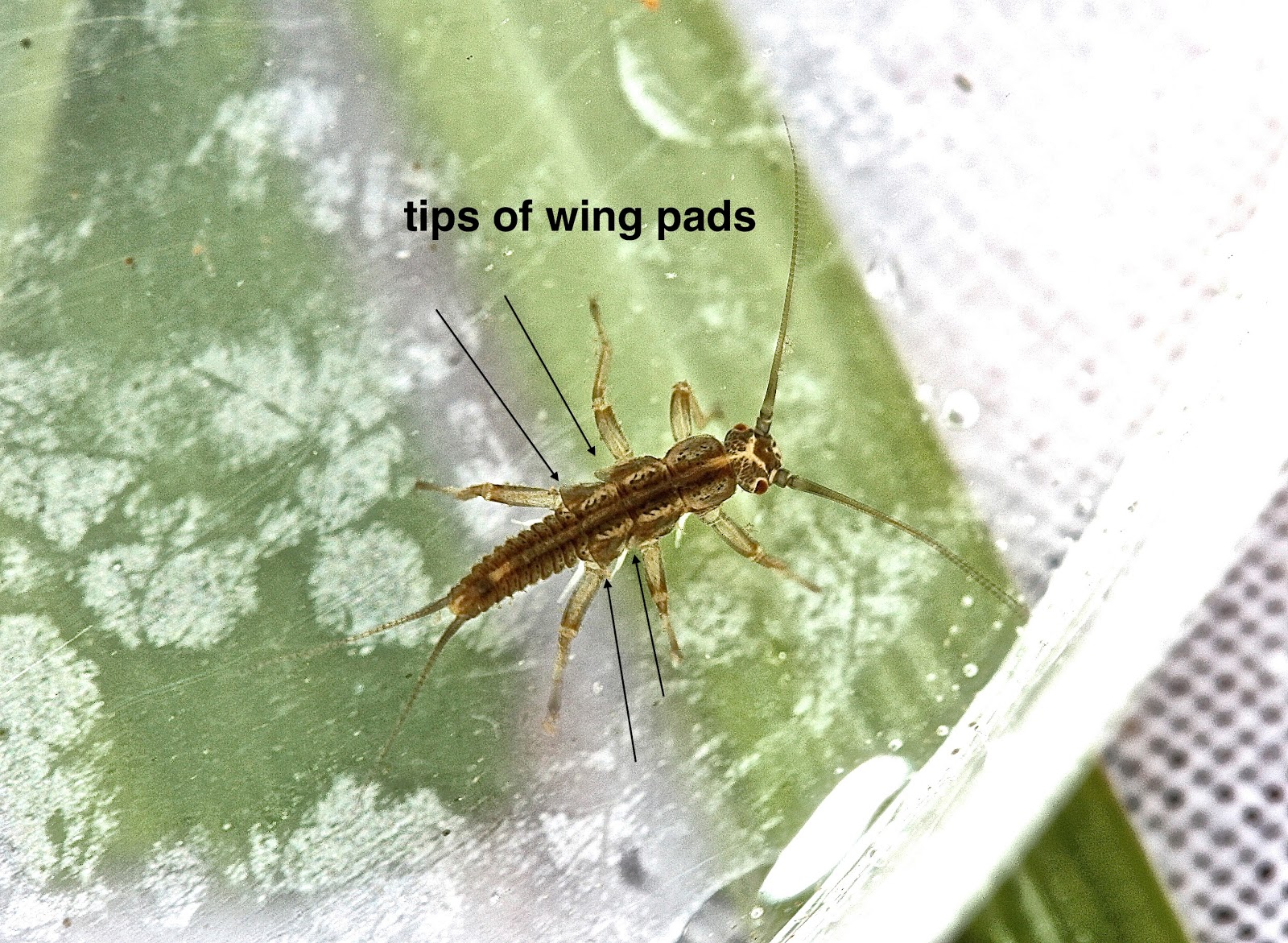
and the larger nymph:
2. A small winter stonefly, Allocapnia pygmaea?
3. And a Perlodid stonefly, Clioperla clio. This is one of many I saw at the Blufton site in Doylesville. It's a beautiful nymph -- but a ferocious predator: keep them in separate containers away from the rest of your insects.
_______________
1. And now from the upper Doyles site -- a Giant stonefly, Pteronarcys proteus, the same species we see in the small streams in Sugar Hollow.
2. One of the common stoneflies, Acroneuria carolinensis. On this species, you'll recall, that the anterior edges of the terga are light and posterior dark: just the reverse of A. abnormis.
3. Two M. pudicum flatheaded mayflies. There were a lot of them in the leaf packs.
4. And finally a fingernet caddisfly larva, genus Dolophilodes. The larvae in this genus are much lighter in color than those of the more common genus Chimarra.
_______________
No sign so far of the Isoperla Perlodid stoneflies, but maybe I'll see some tomorrow at the South River up in Greene county.
Below: a small winter stonefly that I found at Buck Mt. Creek last week -- Allocapnia mystica? Note how the wing pads are starting to darken.
Monday, November 12, 2012
As we enter "Large Winter" season -- can we distinguish Taeniopteryx burksi from Taeniopteryx maura?
Apparently not. Shoot! I thought this ID was a lock. And if you've read my entry for 10/28 you know why. The Taeniopteryx large winter stoneflies I find in our streams -- like the one in the photo above -- are an exact match for Taeniopteryx burksi as that species is described by Steven Beaty ("The Plecoptera of North Carolina," p.8). T. burksi is the first Taeniopteryx species that Beaty describes, so the ID being certain, I failed to read his descriptions of other species. But a good friend of mine did, and on Saturday she texted me to ask how I knew these large winters were not T. maura? Had I seen what Beaty had said on that species?
This is what Beaty says: "(T. maura) -- Male nymphs ~8.7-9.5 mm, female nymphs ~10/12 mm." Those are the same sizes he gives for T. burksi. He continues, "pale abdominal stripe similar to T. burksi; inner margin of hind femur with developing femoral spur of adult." But there's more. In his "Notes," he adds: "...it may be very difficult to separate T. burksi and T. maura nymphs without associated adults. Therefore, it is best to leave Taeniopteryx at genus."
I've examined the nymphs in my collection, and I did not see any "femoral spurs" on the hind femurs.
Still, I decided I had better read more. So I looked at the T. maura description in Peter W. Claassen's Plecoptera Nymphs of North America (pp. 194-195). He says a number of things of importance. 1) "General color yellowish with brown markings." I'm not sure I'd describe our nymphs in that way -- but let's move on. 2) "Head a little narrower than pronotum; entire occiput covered with mottled brown marks; there is also a brown spot each side of the ocellar triangle at the base of the antennae and another in front of the anterior ocellus." Let's have a look:
The occiput (back of the head) is certainly covered with mottled brown marks: I'm not sure about the brown spots at the front of the head, I could go either way on that one. 3) "Pronotum a little wider than long, slightly widened posteriorly; angles rather broadly rounded; a broad, median, yellow stripe, on each side of which the rugose discs are of a darker brown color." But while he notes the yellow stripe on the pronotum, he describes the meso and meta-notums as "brownish," and the abdomen as "more or less uniformly brownish."
T. maura, as Claassen describes it, seemed to me to differ from the nymphs that we find, so I still felt good about the T. burksi ID. But I thought, for good measure, that I'd best look at Stewart and Stark's Nymphs of North American Stonefly Genera, to see what they had to say about the Taeniopteryx species that occur in our state. They discuss Taeniopteryx on pp. 242-246, and on 246, we learn that T. burksi and T. maura are both found in Virginia. But the illustration of a Taeniopteryx nymph that they provide is an illustration of T. maura (p. 243), and it's a dead ringer for the nymphs that you see in my photos: the yellow stripe runs the full length of the body.
Deflated, I turned to my last resort. I sent some photos to Steven Beaty and asked if any recent work had been done that would help us to distinguish T. burksi and T. maura nymphs. As he has done so many times in the past, he kindly responded to this amateur's question, making the same point that he made in his Plecoptera document: you cannot tell them apart unless you have an associated adult. That means, if we want to be sure if the Taeniopteryx nymphs that we find in our streams are T. burksi, we have to collect some adults this winter (January and February) in the same places we've been finding our nymphs and ID the adults.
I don't know if I can do that. But, we do have a key that describes the adults for both of these species:
Bill P. Stark and Brian J. Armitage (Editors), Stoneflies (Plecoptera of Eastern North America, Volume I: Pteronarcyidae, Peltoperlidae, and Taeniopterygidae (Columbus, OH: Ohio Biological Survey, 2000), pp. 63 and 65.
I'll let you know if I'm successful. Until then, I'll refer to our nymphs as Taeniopteryx burksi/maura -- just to be on the safe side.
Saturday, November 10, 2012
The "Giants" that live in our small mountain streams: Pteronarcys proteus, a correction
The Giant stonefly in this picture -- one of the many I found in Sugar Hollow on Thursday -- is the same species that I always find in this small mountain stream. I've found the same species in the upper Doyles River, shortly after it flows out of the Blue Ridge. The one above is still immature, but it will get bigger and bigger as we progess through the winter, as we can see in the photos below taken in the early part of this year (same stream).
12/21/11:
2/2/12:
What is the species? In an entry posted on 2/2 of this year, I concluded -- through a process of elimination -- that this must be Pteronarcys scotti. But if you're a regular reader, you'll know that I've never been totally sure of that ID. So I've continued to work on this problem.
When I was reading Peter Claassen's Plecoptera Nymphs of America last week, looking at his key on Giant species, there was something that caught my eye: "Hooks appressed to body, small on segment seven, and inconspicuous on eight; cerci less than half as long as abdomen [Bold type added for emphasis]; front angles not noticeably produced... proteus." (p. 29) These points were meant to contrast with Pteronarcy biloba, on which the abdominal hooks are certainly not appressed on segments 1-8 -- they really stick out from the body -- on which the cerci are long, and on which the front angles of the pronotum are prominently "produced" (hook). To wit:
But it was the comment on the short cerci that drew my attention. On the cerci of P. proteus nymphs, Beaty comments: "...cerci more than half to three-quarters the length of the abdomen." ("The Plecoptera of North Carolina," p. 28) Hmm..... This is important since, in the entry I wrote on 2/2, my elimination of P. proteus as an ID for the nymphs I'd been finding was primarily made because of these comments on the length of the cerci (tails): clearly the tails on our nymphs are short -- very short.
So I decided to see if others had posted photos of P. proteus nymphs, and they had. There are excellent photos by Jason Neuswanger on Troutnut.com (http://www.troutnut.com/specimen/490), and on Bugguide.net, you can find P. proteus photos by Tom Murray and Donald Chandler (http://bugguide.net/node/view/196714/bgimage). The nymphs in their photos all have short tails -- they're an exact match for the nymphs that I have been finding.
Yesterday, I decided to contact Steven Beaty, seeking clarification. He generously took the time to give me a lengthy response. I won't quote him directly, but here's is the gist of what he had to say. 1) On the length of the cerci, yes, some P. proteus nymphs do have short cerci, and when he has time he intends to revise and re-word the entry on Pteronarcys in his Plecoptera document. 2) The critical difference between P. proteus and P. scotti -- very similar species -- is the ratio of the posterior surface of the "hook" on segment 5 to the width of segment 5. This is a point he had already made in his Plecoptera document: "...the length of [the hooks] on segment 5, as measured on the posterior surface, one-third to one-fourth the length of the tergite." (p. 28) Those on P. scotti nymphs are "one-fifth to one-sixth the length of the tergite."
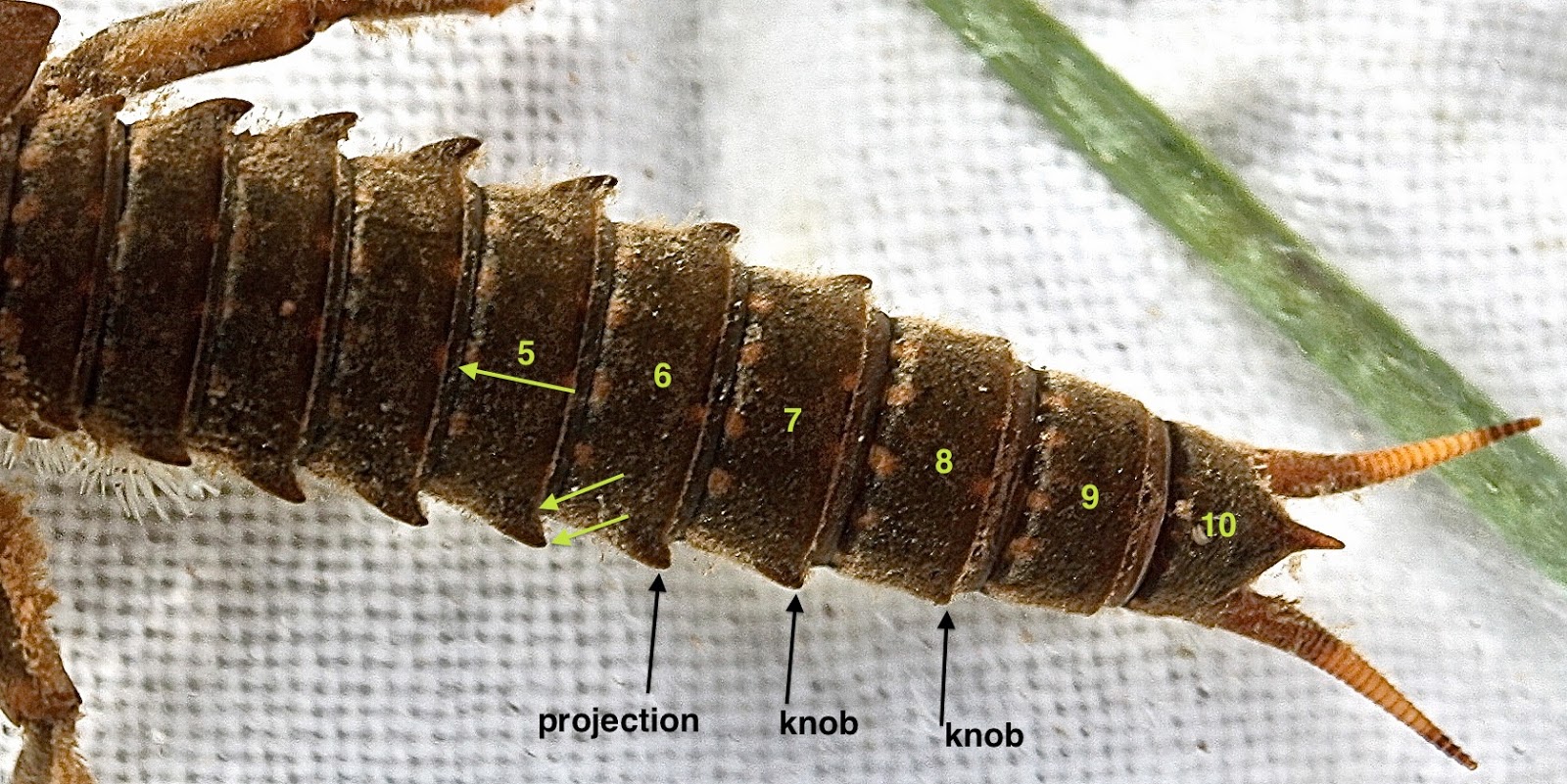
Time to measure. In the photo below, the "posterior surface" of tergite 5 that has to be measured is set off in arrows.
The ratio on the nymph I found on Thursday was .28. Bingo! These are P. proteus nymphs.
But there is additional evidence for us to use. Look at the hooks on segments 6, 7, and 8. While the hook on segment 6 resembles those that precede it, that on segment 7 just barely sticks out from the body, and that on segment 8 is not much more than a bump. Beaty referred to the projections on terga 7 and 8 as "knobs". On P. scotti nymphs the "hook" on segment 6 is also knob-like while that on segment 8 is essentially non-existent.
When I went back to Claassen's lengthy description of P. proteus nymphs (pp. 30-31), I discovered that he said much the same thing about the "hooks" on segments 7 and 8: "...proteus has only a suggestion of hooks on abdominal segment eight, and even on seven the hooks are often inconspicuous, while the remainder of the hooks are always close to the body." (This is again said in contrast to the hooks on P. biloba.)
Point, set, and match. The Giants we find in our small mountain streams are P. proteus Giants. Now I can move on to other things! Oh, one other thing. The "common name" for P. proteus is the "Appalachian salmonfly," and it is primarly found in the northeast from Maine to Virginia (see:http://eol.org/pages/612870/overview): the common name for P. scotti is the "Carolina salmonfly," and it is primarily found in Tennessee, North Carolina, South Carolina, and Georgia (http://eol.org/pages/612869/overview).
(There is a detailed study of P. scotti, with illustrations of the fifth tergites of P. proteus and P. scotti, by Willam E. Ricker. See his Systematic Studies in Plecoptera (Bloomington, IN: Indiana University Publications, 1952, pp. 147-151.)
Thursday, November 8, 2012
Looking For -- and Finding -- Small Perlodids in Sugar Hollow
It was my first trip of the fall to my favorite small mountain stream in Sugar Hollow, one that is filled with quality insects, and I was hoping to find some young Perlodid stoneflies. And I did -- two different species, in fact. The one in the photo above is one that I identified for the first time in January at the Rapidan River: Malirekus hastatus. But I saw a lot of them in the winter in the very stream I went to this morning. Here's a beauty that I found here in February this year.
The other Perlodid nymph that I came up with today was a very small -- 5 mm -- Isoperla similis, the first Isoperla I've seen so far this season.
This too will be a beautiful insect when it's mature. This one is from April of 2011.
When you look at small nymphs of these species, it's not always easy to tell them apart. With a microscope, you won't have a problem -- the mesosternal "Y" ridges are quite distinct as are the laciniae.
I. similis mesosternal "Y" ridge (and yes, they're very hairy):
M. hastatus mesosternal "Y" ridge:
I. similis lacinia:
Then too, there's the fact that Malirekus hastatus nymphs have conical-shaped submental gills.
But, can we tell them apart by simply "looking" at them? Actually, we can. Both have pale "M" marks in front of the anterior ocellus. But M. hastatus nymphs have "two pale, ovate spots lateral to [the] ocellar triangle, and [a] pale interocellar spot." (Stewart and Stark, Nymphs of North American Stonefly Genera, p. 216). These are easy to see on the nymph from this morning.
There is no pale interocellar spot on an I. similis nymph, and the pale spots that are lateral to the ocellar triangle are not "ovate" in shape. These too are features we can detect even on the small nymph from this morning.
Just use your loupe.
_______________
Also found in this small stream this morning ---
1. Free-living caddisfly larva, Rhyacophila nigrita. This is the only place, to date, that I've found this free-living species. The dark front half of the pronotum is one of the keys to species identification.
2. Giant stonefly. I used to think this was P. scotti; I now think it's P. proteus. I must have seen at least a hundred of these this morning of various sizes. They love the leaf packs.
3. And the "Common stonefly" that we commonly find in these small mountain streams -- Eccoptura xanthenses.
_______________
Malirekus hastatus
Monday, November 5, 2012
Photos from the Rapidan River
Nothing but photos today -- my analytical skills were put to the test yesterday! So just sit back and enjoy some beautiful photos of some beautiful insects from the Rapidan River -- taken on a beautiful fall day.
1. Spiny crawler mayfly, Ephemerella subvaria (the "Hendrickson" to fly fishermen) -- maybe the prettiest mayfly nymph that we see. One photo above, two more below. This is the only place where I find them.
2. Giant stonefly, Pteronarcys biloba. Getting bigger, heading for hatch time in March.
3. Green stonefly (Chloroperlid), genus Sweltsa.
4. Flatheaded mayfly, Maccaffertium pudicum, a species we see in good streams in the winter.
5. Large winter stonefly, Taeniopteryx burksi. This one was larger than those we've seen in Albemarle county -- 4 mm. And note that the characteristic light stripe that runs the length of the body, with dark stripes to either side, is starting to show. More colorful too.
6. Small winter stonefly. Judging by the shape of the pronotum and the tiny wing pads I'd say that this one was Allocapnia mystica (if my analysis yesterday was correct). Oh, female.
7. And a common netspinner, Ceratopsyche morosa, but the C. morosa "type" that we find in the Rapidan river -- only two lines in the rear angle of the frontoclypeus instead of the usual three (see the entry for 10/23). You can make out the "checkerboard" pattern on the head in the second photo.
_______________
The valley of the Rapidan River, roughly 5 miles from the entrance to the Shenandoah National Park.
Subscribe to:
Posts (Atom)