Saturday, January 19, 2013

Neophylax ornatus: a high elevation Uenoid caddisfly larva


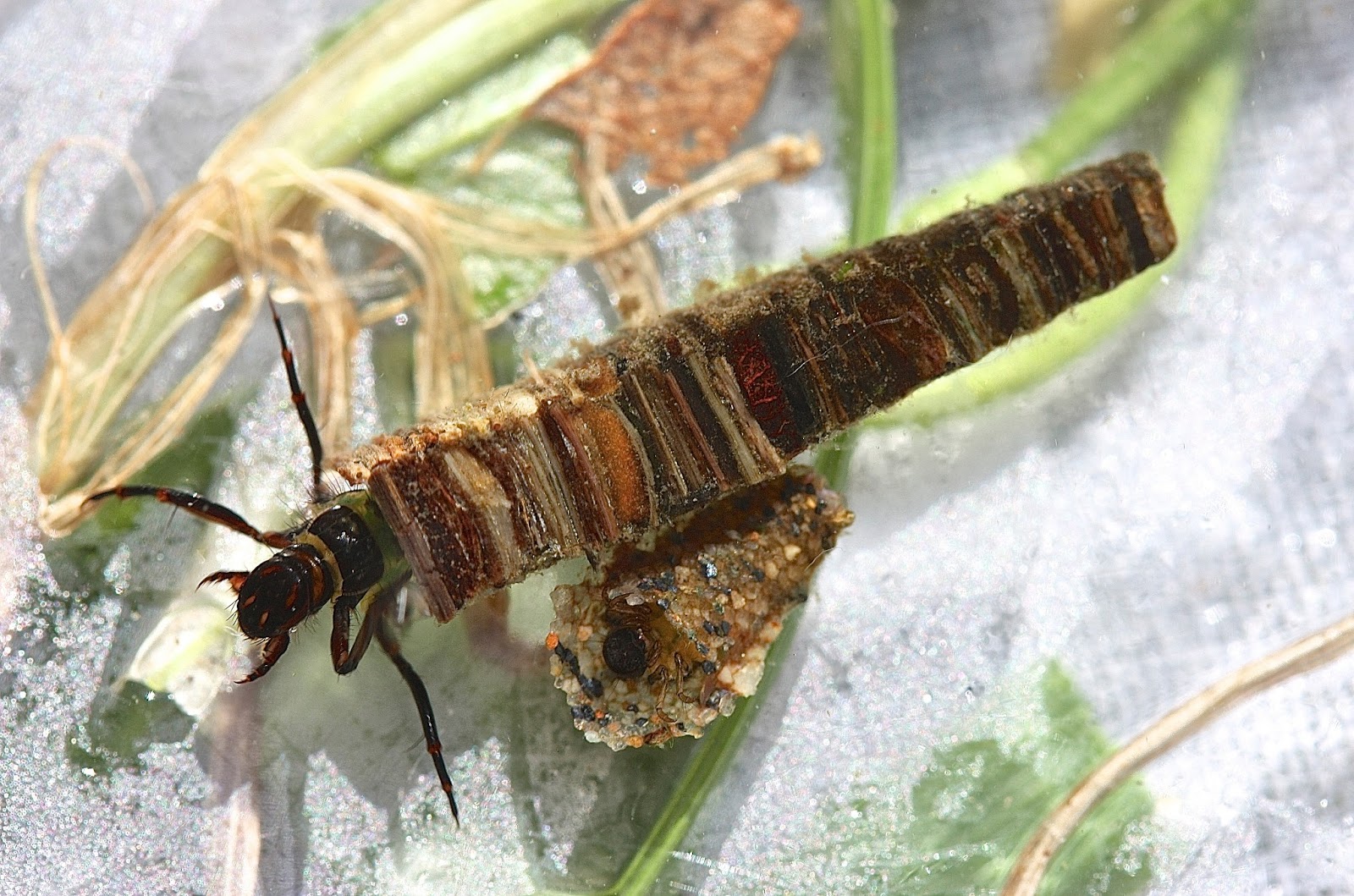
With our valley streams high from four days of rain, I decided to look at a small stream in Sugar Hollow today, one that's higher up than those to which I normally go.  I can drive most of the way -- but there's still a bit of a hike at the end.   It was worth it.  I found two new -- for me -- Uenoid caddisfly species: the one in the photo above is Neophylax ornatus, the second I found is either N. aniqua or N. mitchelli (more on that later).

Here are a few more photos of Neophylax ornatus before we read Steven Beaty's description.

dorsal:


ventral (eye to eye!):


Steven Beaty describes N. ornatus in the following way ("The Trichoptera of North Carolina," p. 87):

N. ornatus -- well developed clavate ventral gill on abdominal segment 1; head yellow to lighter brown sometimes with lighter muscle scars.  Occurs in 1st order Mountain and Piedmont streams.  Uncommon. 

1) The stream that I went to today was a 1st order stream.  2) The yellow/light brown head is clear in the photo at the top of the page: all other Uenoids that I've seen so far have heads that are primarily dark brown to black.  3) For the muscle scars and the clavate gills, we need a microscope view.


For a more complete N. ornatus description, see pp. 61-63 in R.N. Vineyard, et.al.,  The Caddisfly Genus Neophylax (Trichoptera: Uenoidae).   They add that "lateral gills are rarely present," (p. 62), and I saw none on this larva.  On distribution, Vineyard notes that "This species is widely distributed in eastern North America, ranging from Newfoundland to southern Ontario, and south along the Appalachian Mountains into northern Alabama, Georgia, and South Carolina."  It has been attested for the state of Virginia, by the way, in the Shenandoah National Park -- to which I was real close today.

Also of interest in Vineyard -- his comments on the "Biology" (p. 63): "Neophylax ornatus is restricted to springs and small first-order streams.  It is often found in the same habitats as N. aniqua and N. mitchelli."

Which brings us to larva number two.  This Uenoid was extremely small with a case of 3 mm.


This is the first Uenoid I've found that has a "tubercle" (pointed bump) on its head.  Let me point it out in a series of photos.


and a close-up:


The tubercle  -- and lack of a "pale eye stripe laterally" (Beaty, p. 87, on N. toshioi), leads us to two possibilities for the ID: N. aniqua or N. mitchelli.  Neither species has "lateral abdominal gills," but N. mitchelli has clavate gills on abdominal segment 1; N. aniqua does not.

I cannot see clavate gills on this larva, which would lead us to N. aniqua.  However, given the size of the larva, it could be that the gills are too small to see.  Moreover, the case was not only small, it easily fell apart.  Those features point to N. mitchelli: "Case often smaller and more fragile than other Neophylax species." (Beaty, p. 87, on N. mitchelli)  But there is one more thing that points to N. aniqua: the median tubercle on N. aniqua is "stout [and the] distance across [the] base [is] more than [the] distance from [the] base to [the] tip" (Vineyard, p. 42);  that of N. mitchelli is "slender and curved" (Vineyard, p. 56).  At the moment, I'd go with N. aniqua.  Stay tuned.
________________


Sunday, January 13, 2013

The Ephemerella (spiny crawler) sequence: entering the E. invaria phase


There are three spiny crawler mayflies that are of great interest to fly fishermen, and we find all three of them in our streams.  The first to appear -- in terms of the nymphs -- is Ephemerella subvaria, the one that, to date,  I've only seen at the Rapidan River.  It's a real beauty.  This is the first one that I found this season -- on 11/5 -- but you may recall that I saw some last year in September.


And this is the latest one that I saw, on my trip up on 1/4.


E. subvaria hatches as the "Eastern Hendrickson," and it's a big mayfly.  Knopp and Cormier (Mayflies, p. 195) put the hatch in the northeast from mid-April through early June.
_______________

Next in the sequence comes E. invaria, the nymph that I'm now just starting to see.  That's an E. invaria at the top of the page, one that I found at South River last week (1/10).  But I found a number of them at the Rapidan on 1/4, and I found a tiny one at the Doyles -- you may recall -- on 12/21.  This one.


E. invarias hatch as "Sulphur Duns," from mid-May to late June (Knopp and Cormier, p. 203).  Though these can vary a lot in color and pattern, some are spectacular when they mature.  This one was found in the Doyles River on April 8th last spring.

_______________

The third Ephemerella we find in our streams in E. dorothea, a species that I normally see by early March, if not before.  This is the species we see in HUGE numbers in April and May, the one that can dominate "samples" when you monitor streams in the spring.   While not all E. dorotheas can be recognized by color and pattern, some are very distinct.  If your spiny crawler nymph has a "mediodorsal stripe" (Beaty, "The Ephemeroptera of North Carolina," p. 27), chances are good that it's E. dorothea.


Other E. dorotheas tend to be uniform in color, showing no pattern at all.


E. dorotheas hatch as the "Eastern Pale Evening Dun" from late May into early July: best time to fish them -- warm nights in June (Knopp and Cormier, p. 207).
_______________

How do we identify these spiny crawlers as Ephemerella in terms of the genus, and how do we distinguish them in terms of the species?

Ephemerella is the most common spiny genus we see, and all of its species have two things in common.  Let me quote this from Beaty (p. 26): 1) "lamellate gills present on abdominal terga 3-7," and 2) "caudal filaments with heavy intersegmental setae and without whorls of spines at apex."  The gills will look like this (and note that gill 6 covers all but the tip of gill 7):


And here is a close-up of the tails (caudal filaments).


Now, how do we tell our three species apart?   Well, the seasons are different -- but they do overlap.  It is possible to find all three species in a stream at the same time.  Size will help: mature E. subvaria nymphs are always big (8.5-9.5 mm); mature E. dorotheas are 6-8 mm while E. invarias run 6-13.  And then there's the matter of color and pattern:  there is no mistaking E. subvaria, but E. invaria and E. dorothea can be confused.

The best key to use?  You have to look at the abdominal segments -- posterior edges.  Do you see "tubercles" on the terga, and if you do, where do you find them and what is there size?

E. subvaria nymphs have "moderately long, sharp paired submedian tubercles on segments 2-9" (Beaty, p. 28).  They're very clear in this picture.


E. invaria nymphs have "short, sharp, paired submedian tubercles on segments 3-8" (Beaty, p. 27).


Finally, the terga on E. dorothea nymphs are "without dorsal tubercles but may have slightly developed spiculate protuberances."


Oh.  There is one other thing you can look for on E. invaria nymphs, the species that is showing up now.  They have a "pale transverse stripe between [the] eyes [that] may be interrupted medially."  That's visible on all of the E. invarias I've found so far this year.

12/21, Doyles River:


1/4, Rapidan River, number 1

1/4, Rapidan River, number 2

And 1/10, South River:

_______________

So it's Ephemerella time here in Virginia, and the fishing is bound to be good.  My favorite, I have to confess, is E. subvaria: the nymphs are gorgeous, and the Hendrickson hatch, when I lived in Vermont, was one of the best of the year.


Friday, January 11, 2013

"Lumpers" and "Splitters" and the breakup of the Limnephilidae (Northern case-maker) family


(The Limnephilid [Northern case-maker] Pycnopsyche gentilis.)
________________


When I first got into this business and worked with the local group that monitors streams, the director told me that entomologists are a bunch of "lumpers" and "splitters."  Some take several genera, lump them together and give them a family name; others do just the reverse, they split up established families into separate groups.  Actually, the two actions go hand in hand: families are split into groups of genera, groups from which new families are then created.

We've seen a good example of "splitting" and "lumping" in the caddisfly work we've been doing this winter.  In 1977, the Limnephilidae family consisted of 52 genera: it was the largest family of the caddisfly groups.  The genera on which we've recently focussed a lot of attention -- Neophylax, Apatania, and Goera -- were 3 of those 52.  (See Glenn B. Wiggins, Larvae of the North American Caddisfly Genera (Trichoptera), 1977,  pp. 179 - 287.)    That's no longer true.  

1. Neophylax is now one of five genera in the newly created  Uenoidae family: four of those five genera were former Limnephilids -- Farula, Neothremma, Neophylax, and Oligophlebodes.

2. Apatania is now one of five genera in the newly created Apataniidae family: all five genera were former Limnephilids -- Allomyia, Apatania, Manophylax, Moselyana, and Pedomoecus.

3. Goera is now one of four genera in the newly created Goeridae family: all four genera were former Limnephilids -- Goera, Goeracea, Goerita, and Lepania.

And there's a fourth new caddisfly family made up of former Limnephilids -- Rossianidae -- which consists of Goereilla and Rossiana.  But those are genera we will not run into -- they are only found in the West.

The Limnephilidae family, now consisting of 39 genera, is still a very large group.  But, with entomologists, you never know if the "splitting" and "lumping" is over.  Up until now, the splitting and lumping has been done for morphological reasons.  But DNA is the new way to go, and who knows where that will lead?
________________

1. Family Uenoidae, genus Neophylax: Neophylax consimilis


2. Family Apataniidae, genus Apatania: Apatania incerta


3. Family Goeridae, genus Goera: Goera fuscula (?)  (photos used with permission)


Thursday, January 10, 2013

Another new caddisfly family: Goeridae, genus Goera


(Note: I did not take the photos posted in today's entry.  As I've mentioned before, I have a good friend who lives in Sugar Hollow who shares my entomological passion, and the two of us always share photos and information on all of our findings.  This is a caddis larva that she found on Tuesday in a small mountain stream near her home.  All photos are of the live insect, taken with a 65 mm macro lens.  The insect was safely returned to the stream.)

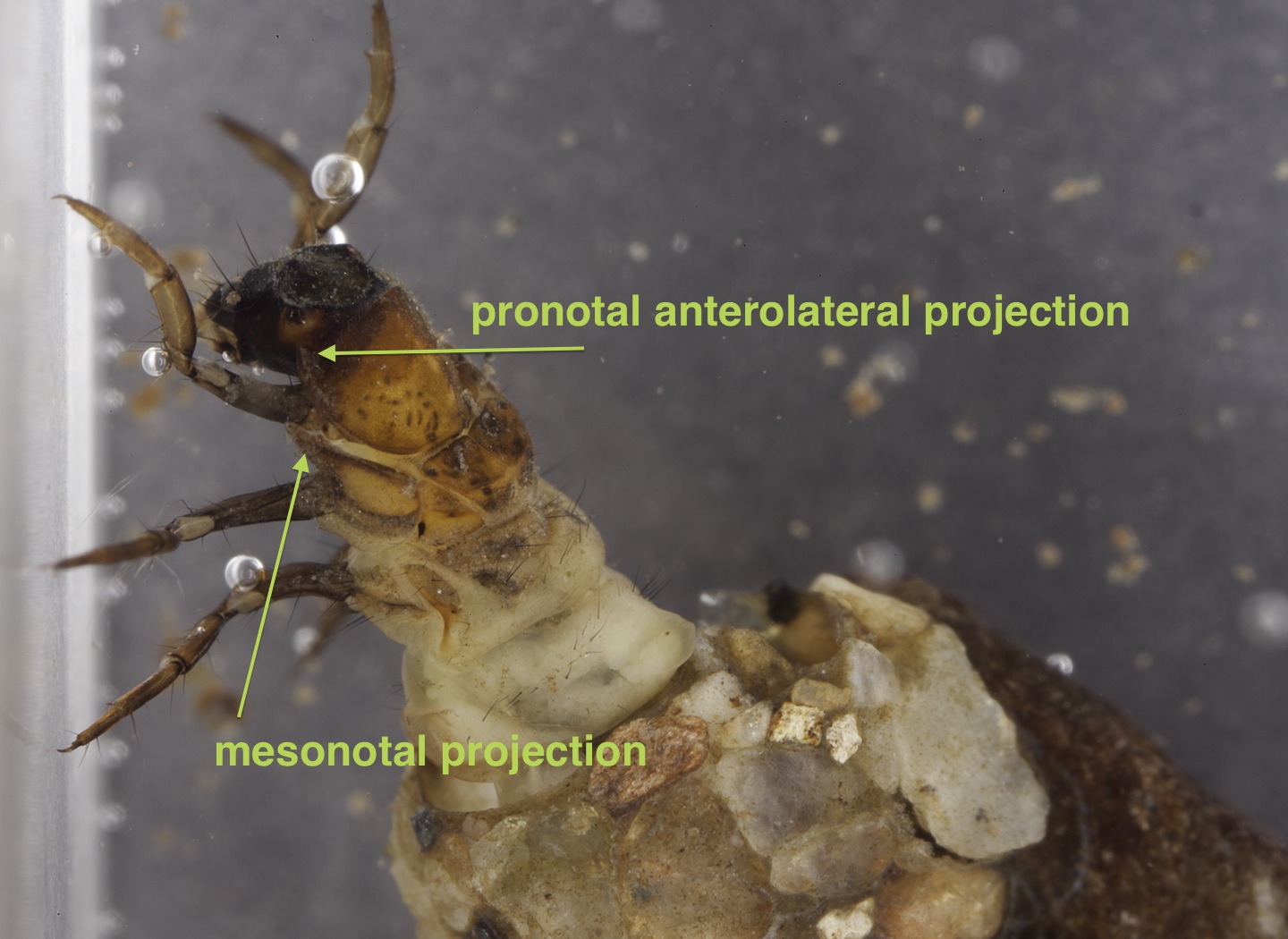
This new -- for us -- caddisfly larva is a member of the Goeridae family, and we're quite sure it's genus Goera.   Goera, like Apatania, was once considered a genus in the Limnephilidae family (The Northern case-makers).   Apatania, you will recall, is now one of five genera in the Apataniidae family, and Goera is one of four genera in the newly created family Goeridae.  (See Glenn B. Wiggins, Larvae of the North American Caddisfly Genera (Trichoptera), 1977, pp. 226-227, and pp. 228-229 in the second edition of that work, published in 1996, University of Toronto Press.)

Beaty ("The Trichoptera of North Carolina," p. 87) describes Goera in the following way:

Genus Diagnosis: Two pair of sclerites on mesonotum; pronotum produced anterolaterally into wide, sharply pointed processes; abdominal gills with up to 3 filaments; ventral and dorsal chloride epithelium present on abdomen; head pointed anteriorly and with many secondary setae.  Small streams to medium sized rivers, in riffles on rocks.

Case: Similiar to that of Neophylax but with a continuous row of larger ballast stones laterally, usually two.  Case also tends to be smoother in exterior texture.

Since this larva was not preserved, it was not removed from its case.  Therefore, we cannot show you the abdominal gills, nor do we have photos of the chloride epithelium abdominal marks.  The presence of the gills is important since Goera has them, Goerita, another genus, does not.  However, Goerita larvae are very small -- 4 - 6 mm -- this larva was in a case that measured 9 mm X 11 mm.
Also, the Goera case illustrated in Wiggins (Larvae, 1977, p. 227) matches the case that we found; that of Goerita (p. 233) does not.  We're convinced that Goera is the right call to make.

Back to our Goera description -- the pointed anterolateral pronotal projections are very clear in the photo at the top of the page, as are mesonotal anterolateral projections.  


For the two pairs of sclerites on the mesonotum, let's use a different view. 


The "pointed" head shows up clearly in the following photo.


Finally, let's have a look at the case.


It seems very clear that this case is damaged: the large ballast stone that ought to be there to match the one on the right has been knocked off.  But, yes, Goera cases have two sizable pebbles on each side: Uenoid cases, remember, have three are four larger side pebbles, but they're not nearly this large.  Ames (Caddisflies, p. 231) uses the common name "Weighted-case maker" for Goeridae, which seems very fitting.  

For those of you out looking for insects in streams, this is very important: Uenoids, Apataniids and Goerids all have these cases of sand grains and pebbles, they're all out there right now, and they often occupy the very same rocks.  Still, the shape of the case, and the number and size of the pebbles on the sides of the case will help you to tell them apart.

Can we ID this to the level of species?  There are two possibilities: G. fuscula or G. stylata.  Both taxa are found in the mountains, both are large (8-11 mm), and both have 4 pairs of sclerites on the metanotum.  That's what we find on our larva.


How do they differ?  G. fuscula -- "...face with central area smooth; posterior carina sharp and high."  G. stylata -- "...face covered entirely with spicules; posterior carina low and broad."  (Beaty, p. 87)  

This is a toughy.  Since the face of our larva looks to us to be pretty smooth, we are tempted to go with G. fuscula.  But we're holding off on species ID for the moment, since we're not yet sure about the shape of the carina.  See what you think.


It's certainly "broad," but to know if it's "sharp and high" or "low," we simply need more information.   We'll certainly be collecting more larvae.  But -- it's Goeridae, Goera, and possibly Goera fuscula.  Another taxon to add to our EPT list of central Virginia.
_______________

Below:  Photos of the stream in which this larva was found.  A small mountain stream, fairly high elevation, a tributary to the Moormans River in Sugar Hollow.


Monday, January 7, 2013

Wrapping things up on the Rapidan findings: Brachycentrids and Apataniids


In the entry I posted on Friday (1/4), I made very few comments on the insects I had found at the Rapidan River choosing to let photos tell the story.  But let me add some notes on the caddisfly larvae I found -- Apatania incerta and Brachycentrus appalachia -- drawing again on the work of Ames (Caddisflies, pp. 173-181 and 229-231).

I. Apataniidae, Apatania incerta.  For the ID of this insect, see the post of 12/9.  You'll recall that I photographed two larvae at the Rapidan River -- though I saw 4-5, all, by the way, on the same rock.
Here are the photos:

larva 1, dorsal and ventral:


larva 2, dorsal and ventral:


Beaty, you might recall, describes the Apataniid cases as "cornucopia-shaped" -- very fitting for larva 1; Ames (p. 230) goes with "tear-drop shaped," which works very well for larva 2.   What's important to note is that these larvae are small: the case of larva 1 was 6 mm long, the larva itself 5; with larva 2, the case was 5 mm while the larva was 4.   You can find them on the same rocks as you find the Uenoids, but the shape and the size, and the smaller pebbles used in their cases, should help you distinguish Apataniids from the Uenoids.

In describing the larvae, Ames notes what we can clearly see in our photos: "The soft parts are bright yellow, the hard parts are dark brown to black." (p. 229) He adds that they pupate in early spring and that "by mid-April the last of them are sealing their cases." (p. 230)

Ames makes an interesting point on the function of the top of the case which is shaped like a hood.  "In the final instar the case is curved so that when the insect is ready to pupate the opening at the front is concealed underneath a hood. ... This design offers some protection as the larva grazes on the surfaces of streambed rocks.  Some biologists believe that the case structure protects the larva from freezing, thus ensuring survival at high latitudes." (p. 230)  Note that the "hood" of larva 1 completely conceals the larva's head and legs, but you can see a bit of the legs sticking out from case 2.

One other point: Ames uses "Little mountain casemaker" as the common name for Apataniidae.  The Apatania incerta adult -- for the fly fishermen -- is an "Early smoky-winged sedge."
______________________

II. Brachycentridae: Brachycentrus appalachia.  


Love those photos!  Some of the best I've taken of the Brachycentrids that abound in this stream.  If you look back to the entry posted on 7/10/12, you'll see how we ID the Brachycentrids we find in the Rapidan River as Brachycentrus appalachia.   This is just a reminder that we find these "humpless" casemakers at two different times of the year since it's a "bi-brooded" insect producing two generations each year.  So, if you go to the Rapidan River where it comes out of the national park, you'll see these cases at this time of the year, but you'll see them again in July.

To fly fishermen, Brachycentrus adults are called the American Grannom, and, notes Ames, "The grannoms are among the first wave of cadddisflies that appears on the mountain streams and tailwaters of the South in early March."  Time to get ready!

One other thing.  I also picked up some common netspinners on Friday -- Ceratopsyche alhedra.


The tolerance value of C. alhedra is 0.0; that of Apatania incerta is 0.6; that of Brachycentrus appalachia is 1.0.  These are very intolerant caddisflies.  Says something nice about the Rapidan River and the quality of the streams that flow out of the Blue Ridge Mountains.