Monday, March 18, 2013

Wrap Up: The Uenoid Caddisfly Species that Inhabit Our Streams


According to Glenn B. Wiggins, Uenoid caddisflies are found in "North America, eastern Asia including Japan and the north-eastern Himalayas, and southern Europe," the family containing five genera.  (Glenn B. Wiggins, Larvae of the North American Caddisfly Genera (Trichoptera), 2nd edition, Toronto: University of Toronto Press, p. 413.)  Of those five genera, only one is found in our part of the country: Neophylax.

One of my goals this winter was to determine the species ID of the Uenoids that we find in local streams.  Since the Uenoid "larval" season is pretty much over -- I'm now finding lots of cases sealed at both ends and clustered together on rocks (i.e. they're pupating) -- it's time to sum up the results.

On Uenoids, Wiggins notes: "At the family level larvae are distinguished by the anteromedian emargination of the mesonotum.  They are also characterized by a wedge -- or T-shaped  ventral apotome of the head." (Wiggins, p. 413)  He adds very little to his description of the genus Neophylax: "...mesonotum with prominent anteromedian notch; case of coarse rock fragments, larger stone along each side." (Wiggins, p. 415)

There are normally three large "ballast" stones on each side of the case for Neophylax (as we see in the photo at the top of the page): the "anteromedian notch" and the "T-shaped ventral apotome" look like this.


I have identified five different Uenoid species in the streams that I explore: Neophylax oligius, Neophylax consimillis, Neophylax mitchelli, Neophylax aniqua, and Neophylax concinnus. There are probably additional species that I haven't found: I'll be looking for them next year.

To identify species of the genus Neophylax, we primarily ask three different questions.  1) Does the larva have "clavate gills" (wide at the tip, narrow at the bottom) on abdominal segment 1?  These:


2) Does the larva have a "tubercle" on the head, and if it does, what is the shape?  One type of tubercle is long, pointed, and slopes to the rear:


A second tubercle is short and blunted at the tip.


And 3) does the larva have "lateral gills," and if it does, where are they found on the abdominal segments?  They will be found along the "lateral fringe."


Some are on the posterior edges (p), others on the anterior edges (a).  They're difficult to see.  Those pointed out on this photo -- at 2p, 3a, and 4a -- are found on N. consimillis.


There are two other details that figure into identification -- color of the head and the legs, and the absence or presence of some kind of pattern on the "face" (frontoclypeus) -- but we can comment on those in relation to individual species.

One other thing -- some Uenoids live in first order streams, others in second order streams.  First order streams, or "headwater streams," lack tributaries that have water in them all year.  They also, generally speaking, flow steeply down mountainsides.  Second order streams are formed when two or more first order streams come together.  For an excellent description of "stream order," see Amanda Briney's "Stream Order: A Classification of the Rank of Streams and Rivers," at http://geography.about.com/od/physicalgeography/a/streamorder.htm.
_________________

Now let's look in greater detail at the five species we've found.

1. Neophylax oligius.  Tolerance value: 2.4.  Commonly found in second order streams (e.g. Buck Mt. Creek and the Doyles River).
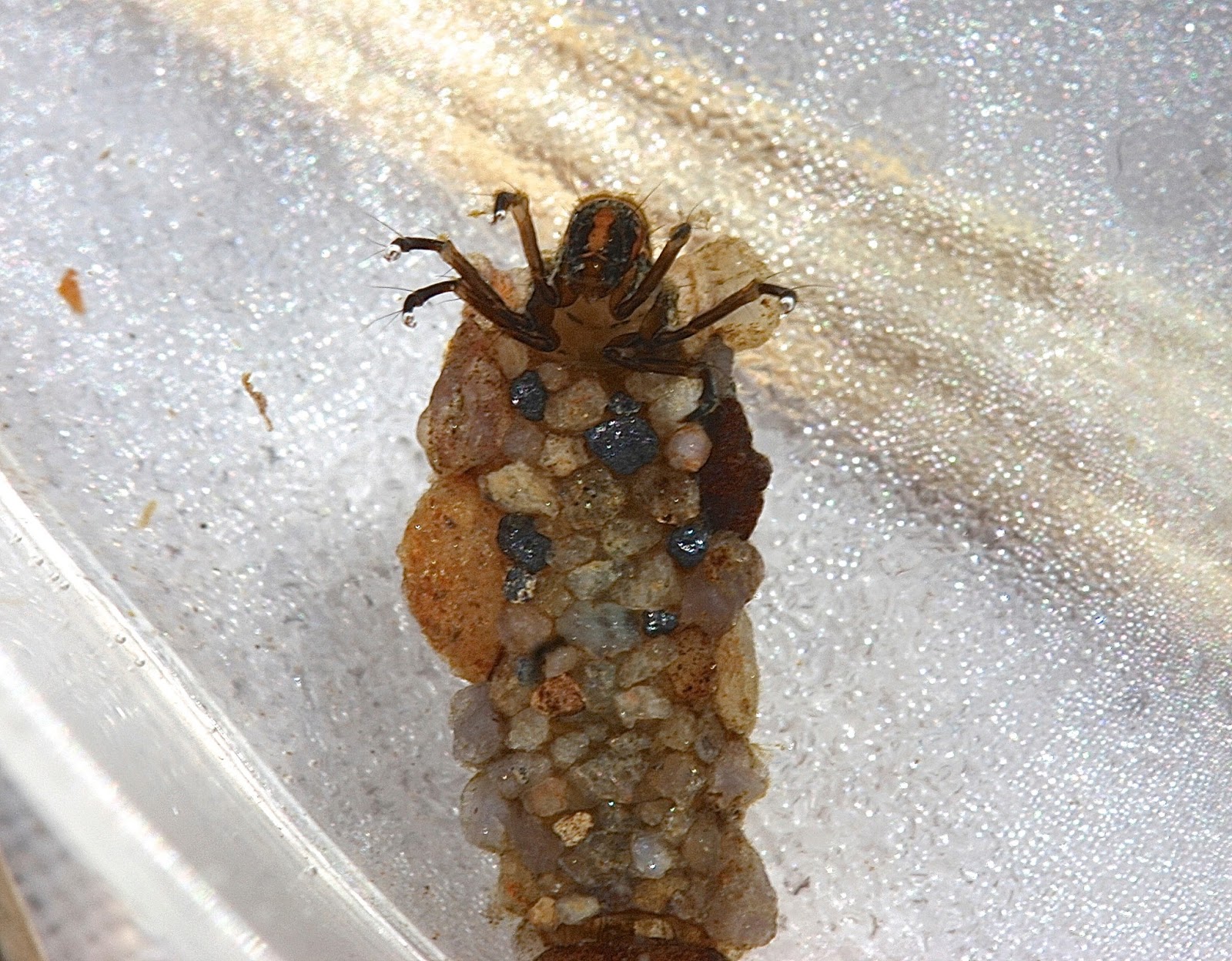


The mature N. oligius larvae I've found have been 8-10 mm long with the cases about 1 mm longer.  N. oligius  larvae do have clavate gills: they do not have a tubercle on the head, and they do not have lateral gills.  But the orange stripe that runs the full length of the face is unique and gives this species away.  You can ID this species at the stream using a loupe.

2. Neophylax consimillis.  Tolerance value 0.3.  Mostly found in first order streams, but I would not be surprised to see them near the beginning of second order streams.


Larvae also in the 8-10 mm range.  N. consimillis does have clavate gills, and it does have lateral gills at positions 2p, 3a, and 4a (as noted above): it does not have a tubercle on its head -- though you might see a slight bump.  Head and legs are dark brown, though pale, reddish spots -- which merge to form a short stripe -- are often seen on the face.

3. Neophylax mitchelli.  Tolerance value: 0.0.  Only seen in first order streams.


The N. mitchellis in my collection are 6-8 mm in length.  They have a very distinct tubercle on their heads: long, thin, pointed, and it tends to slant to the rear.


Head and legs are light brown in color.


Larvae do have clavate gills but no lateral gills.

4. Neophylax aniqua.  North Carolina does not give a TV for this species.  But it is as intolerant as N. mitchelli, perhaps more so.  It is only found in first order streams and is often found with N. mitchelli.


The aniquas I've found have all been small: 4-6 mm.  N. aniqua larvae do not have clavate gills; they also lack lateral gills.  They do have a tubercle on the head which is short, stubby and semi-blunt.  The head is dark brown: color of the legs and pronotum seem to vary.


5. Neophylax concinnus.  This is a larva I've only found in Buck Mt. Creek and the Doyles River, i.e. in second order streams, the same streams in which I find N. oligius.   Size: 8-10 mm.   I do not have very good photos.


Neophylax concinnus does not have clavate gills.  Vineyard et.al. (The Caddisfly Genus Neophylax) say that "lateral gills are usually present, at least at one of the standard positions": I can make out a gill at 2p on the two specimens in my collection.


Spicules at the rear of the mesonotum are a distinguishing feature of N. concinnus, as are transverse row of spicules on the posterior of the pronotum.


________________

That's where things stand at the moment.  But there may be more species to find in streams that I've not yet explored.  The following additional species are noted as being attested in the state of Virginia in "An Annotated List of the Caddisflies (Trichoptera) of Virginia: Part II. Families of Integripalpia," pp. 21-22 (Flint, Hoffman, and Parker, in Banisteria, Number 31, pages 3-23): N. acutus (rare), N. fuscus, N. ornatus (Blue Ridge, high elevations), N. stolus (west-central Virginia), and N. toshioi (west-central Virginia).

Next winter -- back to the hunt.
________________
Neophylax oligius, March 14th, Whippoorwill Branch of the Mechums.  To the right -- spiny crawler mayfly, Ephemerella dorothea.


Saturday, March 16, 2013

The Spiny Crawlers of Spring: Ephemerella dorothea


The spiny crawlers I've seen in our streams starting in late December (12/21, Doyles River) have all been E. invaria in terms of the species (see the entry posted on 1/13/13).  But I've noted a number of times that E. invaria is not the spiny species that shows up in huge numbers in a lot of our streams in the spring: that's E. dorothea.  Well, E. dorothea is here (the PED -- "Pale Evening Dun" for fly fishermen).  I found this one yesterday in the Whippoorwill Branch of the Mechums.  In fact I found a lot of E. dorotheas yesterday in this tiny stream, most of them still pretty small.   Some were in leaf packs, others were crawling around in patches of moss on the rocks -- always a good place to look for nymphs of this species.

The nymph in the photo above is a bit atypical for the species.   It measured 9.5 mm: the usual range for the species is 6-8 mm according to Beaty ("The Ephemeroptera of North Carolina," p. 27).
Many of the nymphs that I saw yesterday fell into that range: this one was 7.5 mm.


Since we're moving into the season for E. dorothea, it might be worthwhile to review the features we use for species ID.  Wherever I can, I'll use close up photos from that large nymph at the top of the page.  In Beaty we read:

E. dorothea -- nymphs 6-8 mm; tarsal claws more gradually curved than in other Ephemerella species.  Let's have a look:

E. dorothea tarsal claw:


E. invaria tarsal claw:


Yes, they're quite different.   Beaty continues:

terga without dorsal tubercles but may have slightly developed spiculate protuberances...lateral margins of terga 4-9 with posterolateral projections; lateral margins with slight, small serrations with numerous setae.  

For the posterolateral projections and the setae on the lateral margins, we do not need a microscope photo:


But the lack of tubercles probably does require a close up:


Paired submedian "tubercles" are present on E. invaria nymphs on segments 3-8: those on segment 5 show up very clearly in this microscope photo:


Back to Beaty.  Thorax and abdomen variable in pigmentation, light brown to dark brown, with or without pale speckles; typically with paired posteromedial pale spots and sometimes with segments 5 and 6 pale mediad of gills; tergites may have a thin, pale mediodorsal stripe in some nymphs; caudal filaments banded.  

Well the pale stripe is very clear on the first nymph that I found yesterday, which was dark brown, while the "speckles" are clear on the second  -- though it could be argued that those speckles are dark!  These photos of nymphs found last year might be better for seeing "pale" speckles.


Our nymph does have "paired posteromedial pale spots" on the tergites, and there are pale areas on the sides of tergite 5 adjacent to the gills (note sure what "mediad" means?).


On the "super-sized" nymph at the top of the page -- dark brown with a prominent stripe -- this is a pattern I've not seen that often (though I found the same type of nymph in this very same stream at this time last year -- entry posted on 3/7/12).  Interestingly, Beaty notes at the end of his E. dorothea description: "Darker, unspeckled nymphs may be a subspecies or possibly a color variant of E. dorothea but DNA analysis and/or associations are necessary to confirm."  Maybe that would explain the unusual size.

While E. dorotheas may seem drab in relation to E. invaria and E. subvaria nymphs (again, look at the entry of 1/13), some do color up as they mature.  Witness this nymph from last year:

_______________

More photos from yesterday:

(Nice view of the "intersegmental setae" on the banded tails/caudal filaments.)


Thursday, March 14, 2013

Tough Conditions: After the Snow and the Rain


A foot of wet, heavy snow followed by 1-2 inches of rain -- our streams and rivers are high, fast, and muddy.  At the moment, there's only one place nearby to find any insects -- Sugar Hollow's small mountain streams.  Even there, as I found out this morning, it's difficult going: they too are high and fast and a little off color.  Still, there were plenty of insects in the leaf packs and on the bottoms of rocks.

Above -- the flatheaded mayfly Epeorus pleuralis.  I didn't see as many this morning as I have in recent trips to this stream.  It's got to be the swift water: even these "clingers" have trouble holding on at the moment.  Still, I did get some nice photos of this one.


2. Green stoneflies -- Chloroperlids -- genus Sweltsa.  I saw quite a few.


Not yet fully mature, but getting close now: note the rounded, dark wing pads.  I was hoping to get some really sharp photos of this particular nymph, but this is one of those miserable insects that never stops swimming around in the tray!   They never pause.  We have about one month to go before they'll start hatching.  This is one of the many adults I saw on the rocks in the Doyles River last April.


3.  A "Rolled-winged" stonefly (Leuctridae), genus Leuctra.


They're getting bigger: we can finally make out the tips of both sets of wing pads.


But these don't mature until late in the spring.  Only then are the wing pads easy to see.  This is a beauty that I found in Sugar Hollow on 5/30 last year.


3.  Prong-gilled mayfly, genus Paraleptophlebia.  Lots of them in the leaf packs.


4. Uenoid caddisfly larva, Neophylax mitchelli.  The sharp tubercle on the head is easy to see in some of these photos.  Note that the ballast stone on one side of the case has been sheared off.


The Uenoids have started to pupate: I saw clusters of cases on a number of rocks.  These larvae  huddle together in groups as they seal up for pupation.

5. And, a "hanger-on" from the winter: large winter stonefly, Taenionema atlanticum.  Still some around, but most have already hatched.

________________

Another nice day tomorrow, before the clouds move in once again.  So I'll be off to another small stream in the morning, one even small than the one that I went to today.