Thursday, June 20, 2013

The Taxa List for Buck Mt. Creek


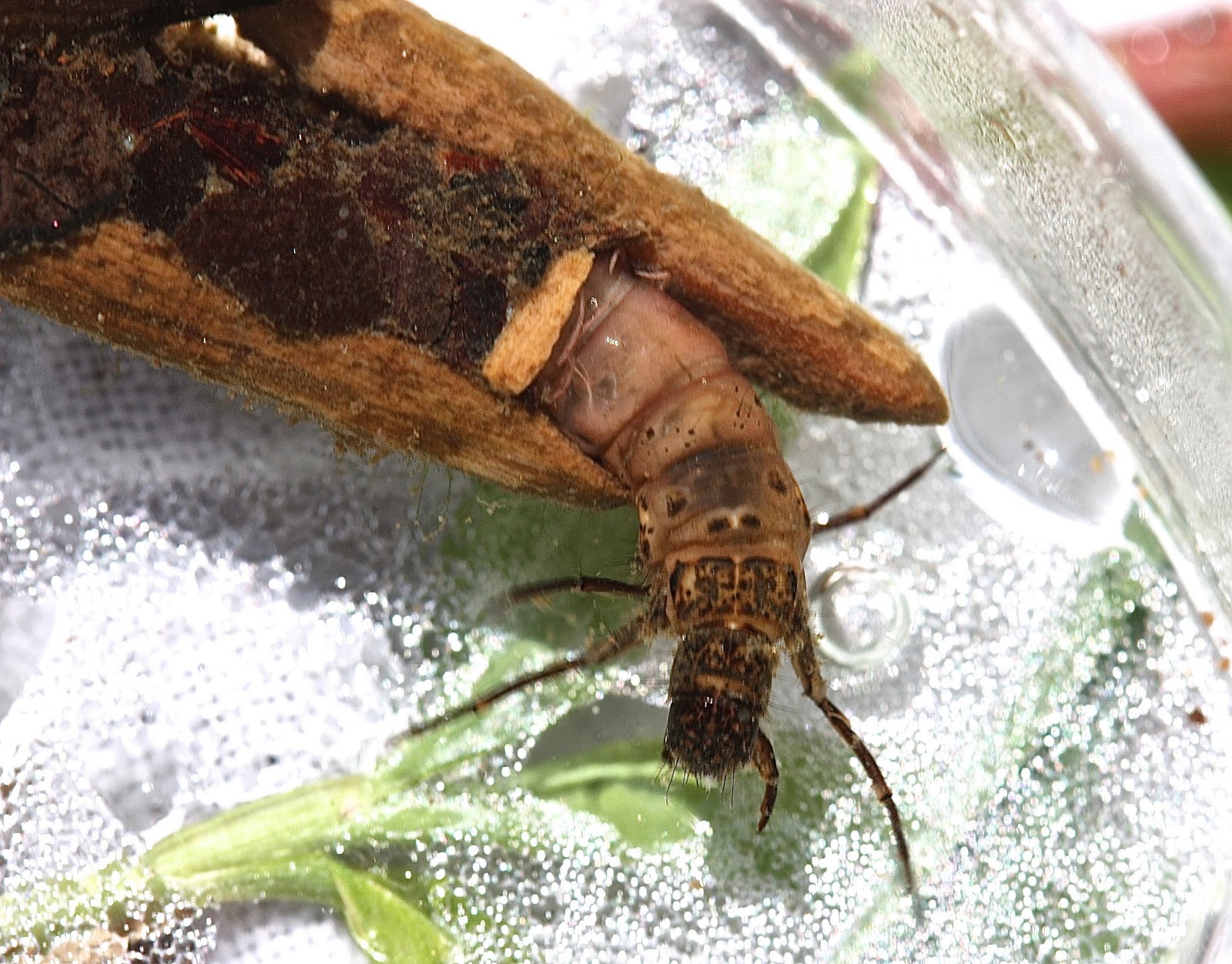
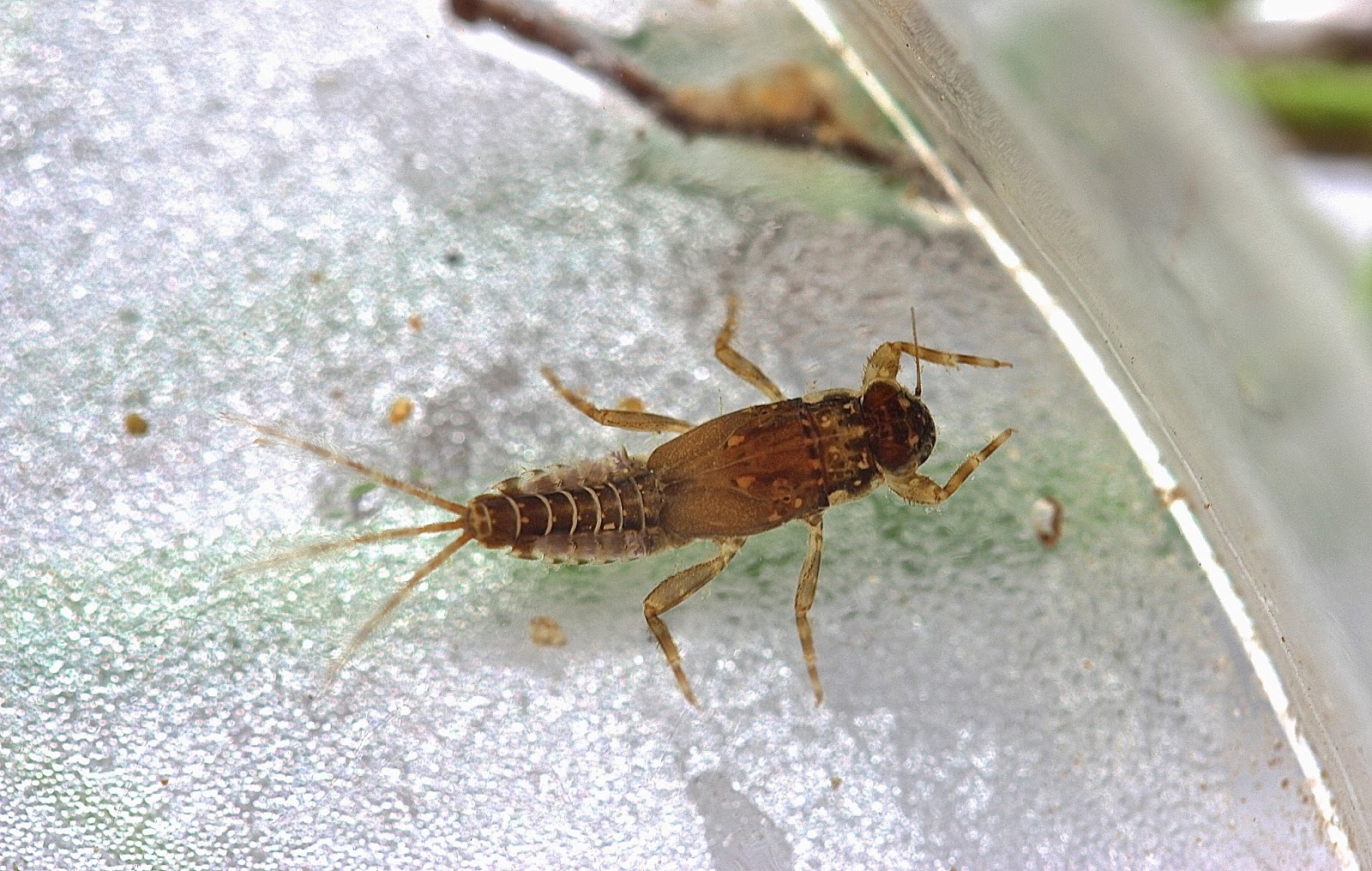
Another gray day after 2-3 more inches of rain.  Still, I thought I'd see what I could find at Buck Mt. Creek.  What I found was high water and, consequently, not a whole lot of insects.  Perlesta common stoneflies in collections of leaves and twigs including the one at the top of the page and the one in the photo below.


Oh yes, some flatheaded mayflies (Maccaffertium modestum), a couple of spiny crawlers (Eurylophella verisimilis), and one "baby giant," a small, immature Giant stonefly.   When they're this small, there's no way to do species ID.


While we wait for the water to drop, I thought I'd post a list I've assembled of the taxa I've found in Buck Mt. Creek.  I've mentioned before that I think this is one of the richest streams I explore -- in terms of the variety of insects calling it home.  Local readers should find this of interest.
_______________________________________________________

                           EPT Species Found at Buck Mt. Creek 
                                    (as of June, 2013)

I. Ephemeroptera (Mayflies)

1. Baetidae (Small minnow mayflies)

1. Acentrella nadineae
2. Acentrella turbida
3. Baetis flavistriga
4. Baetis intercalaris
5. Baetis pluto
6. Heterocloeon amplum
7. Plauditus dubius

2. Isonychiidae (Brushlegged mayflies)

1. Isonychia

3. Heptageniidae (Flatheaded mayflies)

1. Epeorus pleuralis
2. Epeorus vitreus
3. Heptagenia marginalis
4. Leucrocuta hebe
5. Leucrocuta aphrodite
6. Maccaffertium ithaca
7. Maccaffertium pudicum
8. Maccaffertium modestum
9. Rhithrogena

4.  Ephemerellidae (Spiny crawler mayflies)

1. Drunella tuberculata
2. Drunella walkeri
3. Drunella cornutella
4. Ephemerella dorothea
5. Ephemerella invaria
6. Eurylophella verisimilis
7. Serratella serratoides

5. Caenidae (Small square-gill mayflies)

1. Caenis


 II. Plecoptera (Stoneflies)

1. Capniidae (Small winter stoneflies)
1. Allocapnia

2. Leuctridae (Needleflies)
1. Leuctra

3. Nemouridae (Forestflies)
1. Amphinemura delosa
2. Prostoia completa

4. Taeniopterygidae (Large winter stoneflies)
1. Strophopteryx fasciata
3. Taeniopteryx burksi/maura

5.  Chloroperlidae (Green stoneflies)
1. Alloperla

7. Perlidae (Common stoneflies)

1. Acroneuria abnormis
2. Acroneuria lycorias
3. Agnetina annulipes
4. Paragnetina fumosa
5. Perlesta

8. Perlodidae (Springflies and Stripetails)

1. Clioperla clio
2. Diploperla duplicata
3. Helopicus subvarians
4. Isoperla dicala
5. Isoperla holochlora
6. Isoperla montana
7. Isoperla orata (variant form)
8. Isoperla davisi
9. Remenus bilobatus

9. Pteronarcyidae  (Giant Stoneflies)

1. Pteronarcys dorsata
2. Pteronarcys biloba


  III. Trichoptera (Caddisflies)

 1. Glossosomatidae (Saddle-case makers)

1. Glossosoma nigrior

2. Philopotamidae (Fingernet caddisflies)

1. Chimarra

3. Polycentropodidae

1. Polycentropus

4. Hydropsychdae (Common Netspinners)

1. Cheumatopsyche
2. Hydropsyche rossi
3. Hydropsyche venularis
4. Macrostemum carolina

5. Brachycentridae (Humpless case-makers)

1. Brachycentrus appalachia

 6. Uenoidae

1. Neophylax oligius
2. Neophylax concinnus
3. Neophylax fuscus

7. Leptoceridae (Long-horned case-makers)

1. Ceraclea maculata


 IV.  Odonata, Coleoptera, Diptera -- Dragons and Damsels, Beetles, True Flies (not identified to the level of species)

1. Narrow-winged damselflies (Coenagrionidae)
2. Broad-winged damselflies (Calopterygidae)
3. Darner dragonflies (Aeshnidae)
4. Clubtail dragonflies (Gomphidae)

1. Riffle Beetles (Elmidae)
2. Long-toed Beetles (Dryopidae)
3. Whirligig Beetles (Gyrinidae)
4. Water scavenger Beetles (Hydrophilidae)

1. Crane flies (Tipulidae)
2. Net-winged midges (Blephariceridae)
3. Black Flies (Simuliidae)
4. Non-biting Midges (Chironimidae)
5. Biting Midges (Ceratopogonidae)
6. Dance Flies (Empididae)

V. Other

1. Hellgrammites (Corydalidae, Corydalus)
2. Crayfish (Decapoda)
3. Leeches (Hirudinea)
4. Pleurocerid snails (Pleuroceridae)
5. Aquatic earthworms (Oligochaeta)

_______________________________

And it looked just like this this morning.  Well, a little bit higher.


Friday, June 14, 2013

Our summer "annuals" -- Neoperlas and Perlestas (common stoneflies) -- at the Doyles River this morning


I wasn't sure I'd find anything at the Doyles River this morning.  After 7 inches of rain in the last 7 days, I wasn't sure I could even get into the stream.  Well, the water was high and fast, but it was fairly clear.

Most common stoneflies (Perlids) are multivoltine, meaning they mature over 2-3 years.  But there are two "univoltines" (i.e., the life cycle is only one year in duration), and we see both of them mainly in June: Neoperlas and Perlestas.   I've seen very few Neoperlas: before today -- I've only seen them in Powells Creek in Crozet.  Perlestas, on the other hand, are all over the place at this time of year.  This agrees with comments by Beaty ("The Plecoptera of North Carolina," pp. 17 and 19): Neoperlas are "uncommon in the mountains," while Perlestas  are "common and widespread."   Both, by the way, are fairly tolerant: tolerance values are Neoperla, 2.1; Perlesta, 2.9.

Neoperla Perlids are fairly easy to spot and can be identified with a loupe: they have large, lateral ocelli at the back of the head but lack the anteromedial ocellus that we find in the other Perlid genera.  They also have a transverse occipital ridge.


Most Neoperlas have not been described to the level of species (Beaty, p. 17), so our ID remains at the level of genus.   But nymphs of two of our species have been described -- N. clymene and N. carlsoni --so I hope to look further into the issue of the species ID of the nymphs that I find in our streams.
________________


I found Perlesta nymphs of various sizes this morning, but this one was clearly mature.  Perlestas, like Neoperlas, have not yet been ID'd to the level of species, though according to Beaty (p.19) a lot of work is being done on this issue right now.  Like almost all of the Perlestas I see in our streams, this one is very speckled (the abdomen), but there is one thing on this nymph that strikes me as being unique and may be species specific: that's the dark brown/black ocellar triangle.


By way of contrast, take a look at this Perlesta that I found at Powells Creek on June 16th of last year.


And look at the head:


The dark brown ocellar triangle is not distinct from its anterolateral projections.  Quite different.  Something to look for as we move on through June since this is the most common stonefly we are going to see.
_______________

Below -- a "friend" who watched me closely as I was taking my photos.  Can anyone tell me what this might be?  Pretty neat looking bug.


Tuesday, June 11, 2013

New taxa: 2012-2013


When we get into June, I feel like the annual EPT season is over.  Most things are hatching: well, most have already hatched.  Summer, to me, is a season all of its own.  So, it's time to sum up what we found this year for the first time, or, what we've identified to the level of species for the first time.  It's those insects that to me are "new" taxa: I'm not finding insects which no one has named.

What have we found?

I. Mayflies (Ephemeroptera)

1. A pronggilled mayfly -- new genus -- Leptophlebia.  I was hoping to find a mature nymph later on in the season so I could ID this to the level of species -- but it just didn't happen.  Upper Doyles River.


2. A new flatheaded mayfly, Leucrocuta juno (that species ID is a tentative one).  Headwater stream in Sugar Hollow.


3. And another flatheaded mayfly, Epeorus fragilis.  South River.


II. Stoneflies (Plecoptera)

1. Common stonefly, Agnetina annulipes.  Rivanna River.


2. Common stonefly, Paragnetina fumosa.  Buck Mt. Creek.


3. Perlodid stonefly, Isoperla davisi.  Buck Mt. Creek.


4. Perlodid stonefly, Isoperla orata.  Rapidan River.


5. Perlodid stonefly, Isoperla sp. (species not yet identified).  Upper Doyles, Buck Mt. Creek, and the Rapidan River.


III. Caddisflies (Trichoptera)

1. Free-living caddisfly larva, Rhyacophila fenestra/ledra.  Doyles River.


2. Long-horned caddisfly larva, Ceraclea maculata.  Buck Mt. Creek.


3. Humpless case-maker, Micrasema charonis.  Rapidan River.


4. Little mountain case-maker (Apataniidae), Apatania incerta.  Doyles River and Rapidan River.


5. Little northern case-maker (Uenoidae), Neophylax oligius.  Buck Mt. Creek, Doyles River.


6. Little northern case-maker, Neophylax consimilis.  Small mountain streams in Sugar Hollow and South River.


7. Little northern case-maker, Neophylax mitchelli.  Small mountain streams, Sugar Hollow.


8. Little northern case-maker, Neophylax aniqua.  Small mountain streams, Sugar Hollow.


IV.  Additional taxa, found by a friend in the high elevation stream on her land in Sugar Hollow.  (Her photos.)

1. A Nemourid stonefly, new genus, Soyedina.


2. And a new caeddisfly family, Goeridae, genus Goera.

________________________

I no longer think that I'll reach the end of the line in finding new species.  When you look at the same insects over and over, your eye starts to pick up on new features, to notice when something is different.  Those are the insects to keep and examine.

Back to the water sometime soon.  We're waiting for streams to drop and clear after 6.5 inches of rain.

Sunday, June 2, 2013

Rapidan River, Part II.: The Perlodid stonefly, Isoperla orata -- making the case


This is the Perlodid stonefly, Isoperla orata.


This, too, is Isoperla orata.  These are two of the four I. oratas that I found yesterday at the Rapidan River in Madison county.   This is the first time that I've seen this species, and it has been added to our EPT list (see the entries of 9/8/12 and 10/3/12).   This is a very intolerant insect, assigned a tolerance value of 0.0 by the North Carolina Division of Water Quality.

Since I have previously discussed the possible identity of three other nymphs I have found as Isoperla orata (see the entry of 5/8/13), I want to look at the identity of yesterday's nymphs in some detail.  I will return to the identity of those three previous nymphs at the end of this entry.

I will use two sources to establish the identity of Isoperla orata.  1) Steven Beaty's description in "The Plecoptera of North Carolina," p. 24, and 2) the much more detailed description of this species in T. H. Frison, "Studies of North American Plecoptera: With Special Reference to the Fauna of Illinois," pp. 323-325, in the Illinois Natural History Bulletin, 22 (2), 1942.  Frison was the first to describe I. orata as a new species.
________________

I. Steven Beaty

I. orata -- nymphs 11.5-14.5 mm: lacinia with apical tooth as long as sclerite bearing it, with a tuft of setae below the subapical tooth; head with a dark transverse band through the median ocellus and ocellar triangle enclosed with a large pale spot; dorsum of abdomen with three dark, narrow longitudinal stripes, the central stripe often faint of discontinuous.  Nymphs primarily occur in the Mountains in medium to small mid-elevation streams from March through May.  Uncommon.

1. I'm not sure why NC I. oratas are as big as they are.  They nymphs that I found yesterday were ~ 8 mm -- which is exactly what Frison says they should be.  Frison, discussing the nymphs, "Approximately mature specimens with a body length of 8 mm."

2. Here is a microscope photo of the lacinia of one of the nymphs from yesterday.  The long apical tooth is very clear; so too is the "tuft of setae below the subapical tooth."


In private correspondence, Beaty has told me that with all of the I. oratas he's seen, there are exactly three setae in that tuft.  While it's difficult to count the setae using this photo, to me it does look like that there are three.

3.  Here are close-up views of the heads of the two nymphs in the photos above.

#1
#2

All of the features noted by Beaty show up as described.  True, the "pale spot" in the ocellar triangle of nymph #2 is not really "large," but I suspect that is because this nymph is very mature and dark markings tend to get darker as taxa mature.

3.  On the abdominal stripes -- here is a close-up of the abdomen of the nymph at the very top of the page.


The median stripe is not really entirely "faint," though that is true of the bottom of the stripes on terga 6 and 7, and the stripes on terga 9 and 10 are, in fact, discontinuous.

I'd call that a match -- Isoperla orata -- and this ID is even more certain when we look at Frison's description.
________________

II. T. H. Frison (pp. 324-325)

NYMPH. -- General color yellow with dark markings on dorsum of head, thorax and abdomen.  Legs, antennae and anal cerci dominantly pale yellow.  Short, stout, spinelike setae, in addition to longer hairs, present on body and legs...  Pronotum broader than long with dark markings on disk.  Longitudinal dark stripes on abdominal tergites tend to be connected on hind margin of segments by narrow transverse line which gives tergites somewhat the appearance of having cell-like light spots each side of median, longitudinal stripe.

(Note: I have not cited Frison's entire discussion since there are things that don't seem relevant to our purpose [e.g. that the "ocelli are in the same relative position as in the adult"].  Also, I have italicized the discussion of the form of the stripes on the abdominal tergites since it seems to me very important.)

1. The colors and markings of the two nymphs in our photos are as they should be.

2. And, if you enlarge those photos, the "long hairs" on the body and legs show up clearly.  (Look at the photo of nymph #2.)

3. Yes, the pronotum is broader than long with dark markings.

4. On p. 324, Frison provides an illustration of the lacinia.  It looks exactly like the lacinia in the photo provided above, and, there are "three" setae in the tuft of setae below the subapical tooth.

5. On p. 325, Frison provides a full illustration of the nymph, and the head pattern is as Beaty describes -- the pattern we find on the heads of our nymphs.

6.  On the appearance of the abdominal segments -- let's look once again at the abdomen of nymph #1.


Perfect!  The "longitudinal dark stripes on abdominal tergites tend to be connected on hind margin of segments by narrow transverse line [my "dark stripe"] which gives tergites somewhat the appearance of having cell-like light spots each side of median, longitudinal stripe."  This photo looks exactly like Frison's illustration on p. 325.

The nymphs I found yesterday were Isoperla orata.
_______________

Now, where does that leave us with the identity of the three nymphs that we've looked at before?  These.


If you'll look back to the entry posted on 5/8, you'll see why Beaty has reservations about calling these Isoperla orata.  And now having seen the real Isoperla orata, I have reservations as well.  The abdominal markings just aren't the same, and there seem to be 4-5 setae in the tuft of setae on the lacinia (look at 5/8), and there are semi-circular gray spots behind the ecdysial line on the heads of these nymphs that do not show up on I. orata.   While Beaty has not yet expressed his final opinion, he has recommended we leave these at Isoperla sp. -- that is, "Isoperla, species unidentified."  They may be -- and this is me speaking -- close enough to I. orata to be called Isoperla nr. orata -- i.e. an Isoperla that is close in appearance (nr. = "nearly") to Isoperla orata.  That's, of course, unofficial, but it's the designation I'll use in our EPT list.
_______________
More photos of the two nymphs at the top of the page.


Saturday, June 1, 2013

Rapidan River, Pt. I.: everything "but" the Isoperla orata


I have no doubt that I found Isoperla orata -- Perlodid stonefly -- this morning at the Rapidan River.  Actually, I saw 4-5 of the nymphs.  But in this entry let me post photos of everything else that I found: I want to make the full case for the I. orata ID in a separate entry using Beaty and Frison (the entomologist who first described this as a new species).

1. Limnephilidae (Northern case-makers), Pycnopsyche scabripennisis (TV, 2.5).  I was expecting to see them, and I found three.  I was hoping for more elaborate cases, but we take what we can get.  The two in the photos below both constructed the "hot dog" case -- two long twigs on the sides, filled in with bits of wood and bark.  (The I. orata nymph on the back of the case is 8 mm which will give you some sense of the size of the case.)

#1


#2


2. A very nice, very large Epeorus vitreus flatheaded mayfly.  Here as elsewhere they were all over the bottoms of rocks.  Like the orange color.


3.  Spiny crawler mayfly, E. dorothea.  Still a lot of them at the Rapidan river in clumps of twigs, roots and leaves.


4. Perlodid stoneflies - Isoperla holochlora.  The bug of the day without any doubt.  They were simply all over the place.


5. And a common netspinner caddisfly larva, Ceratopsyche slossonae, tolerance value, 0.0.  This is the one that has the single pale dot in the middle of its head -- well, face.


_________________

Now, full attention tomorrow (Part II.) on our new addition to the EPT list, Isoperla orata.