Thursday, August 15, 2013

An unusual find at South River


I wasn't sure where to go this morning since the Rivanna, once again, is high and muddy from recent rains.  But I thought I'd see what I could find in South River up in Greene County even though there's not much going on in the small mountain streams in the summer: the wonderful insects that we find in those streams in the winter and spring are very small at the moment, many of them still calling the substrate home.

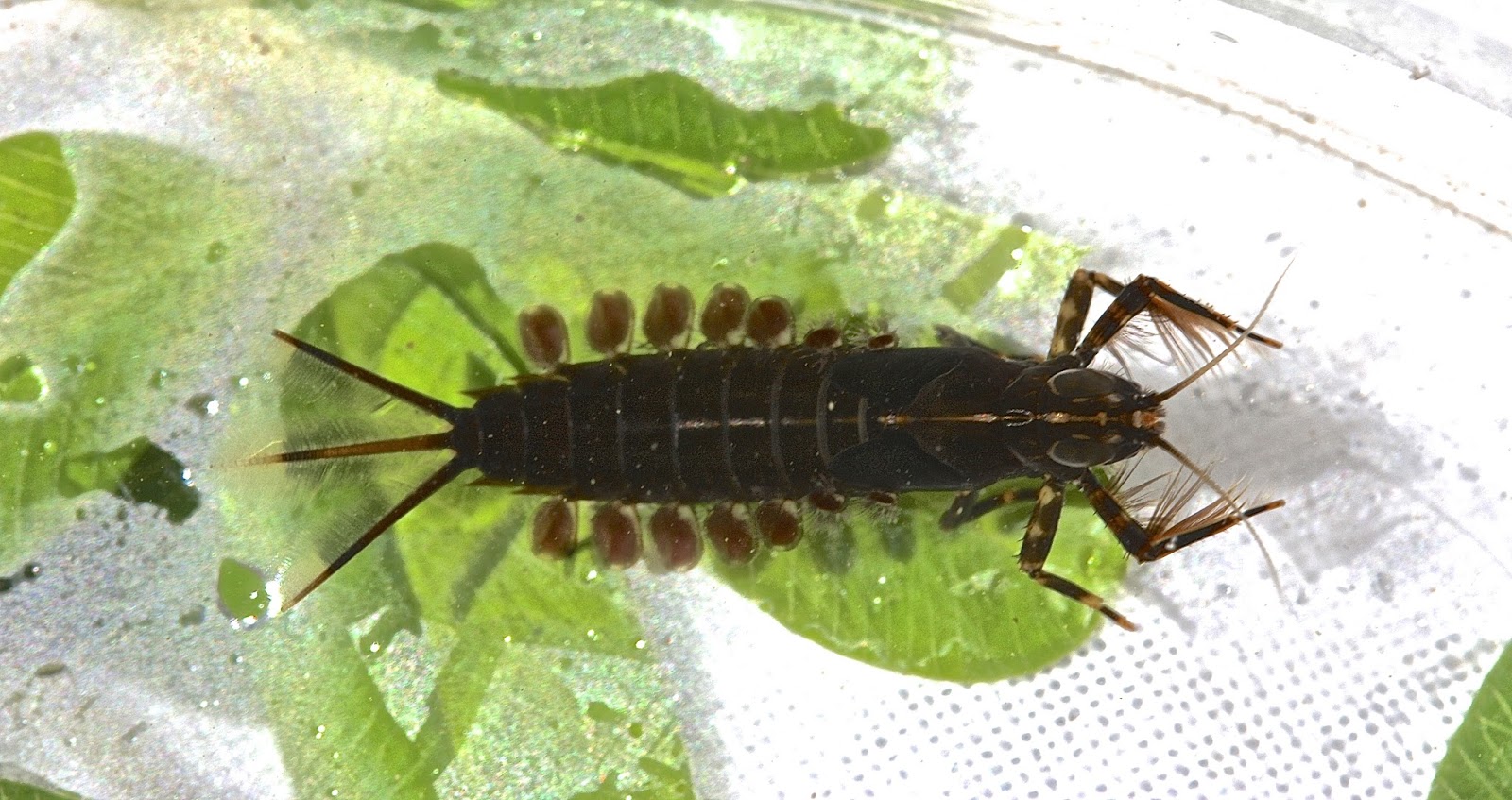
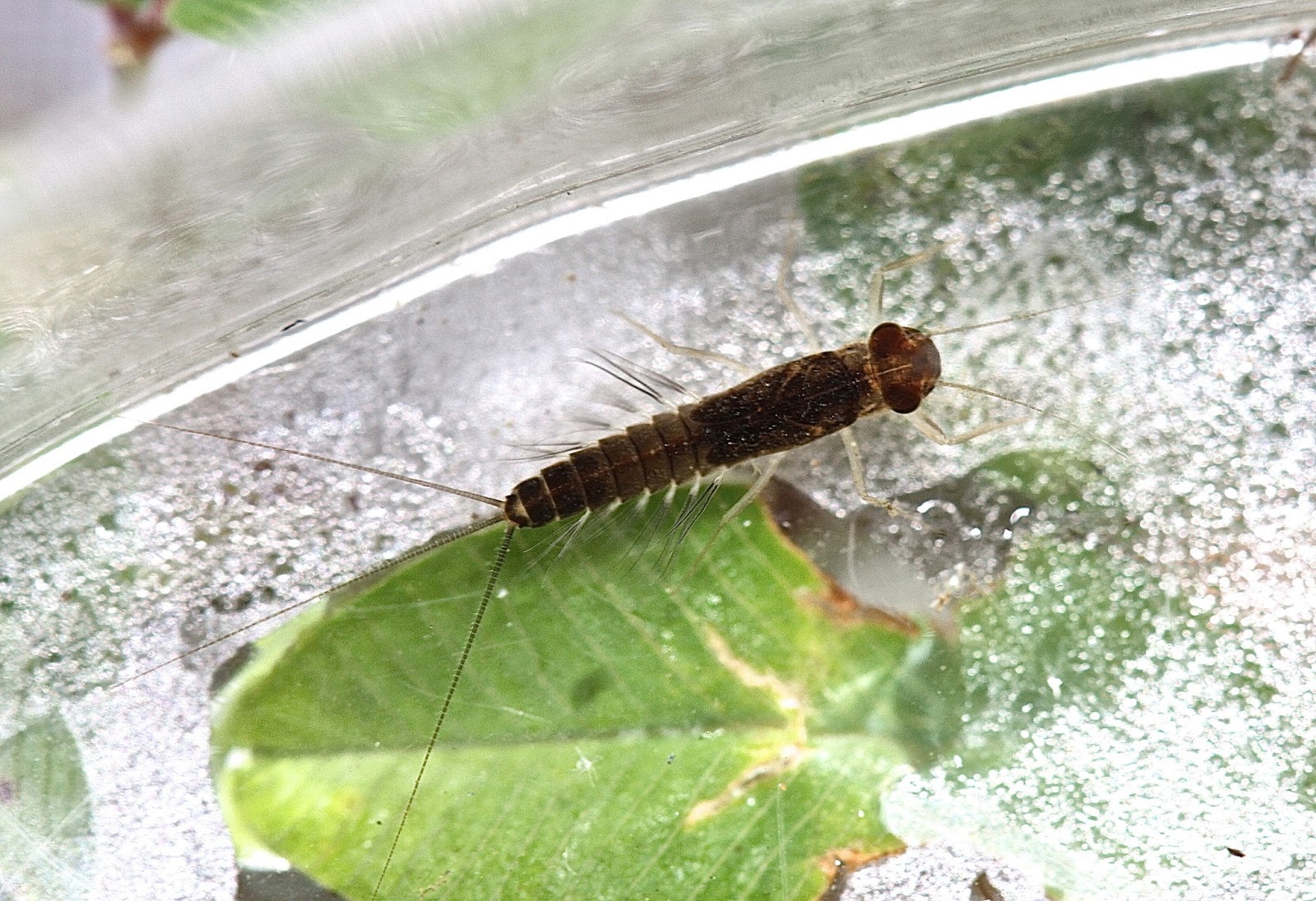
For the most part, I found what I expected to find: lots of small Peltoperlids (Roach-like stoneflies); a number of "tiny" Giants (P. proteus); the odd Epeorus vitreus flatheaded mayfly; and common netspinners -- Ceratopsyche sparna and Ceratopsyche alhedra.  But the very first insect I saw was this Brush-legged mayfly, Isonychia sp.  Why is it unusual?  It's fully mature: in fact, I think it's in the process of hatching!

Evidence.  1) It was lethargic and easy to pick up with my tweezers.  Normally, brushlegged mayflies flip and squirm and bounce off the rocks when you try to get near them.  2) The thorax was bulging, as it would be if the wings were about to emerge.  And 3) the eyes seemed a bit glassy, something I've noticed before on nymphs in the process of hatching, and if you look closely, I think you can see that the thorax is, in fact, splitting open.


One other feature -- in this side view, you can see that the wing pads themselves are pushing up from the body.


Very cool.   Brushlegged mayflies normally hatch at this time of year -- late summer -- and I've been seeing "shucks" on the rocks in the Rapidan River.


________________

A few other photos.

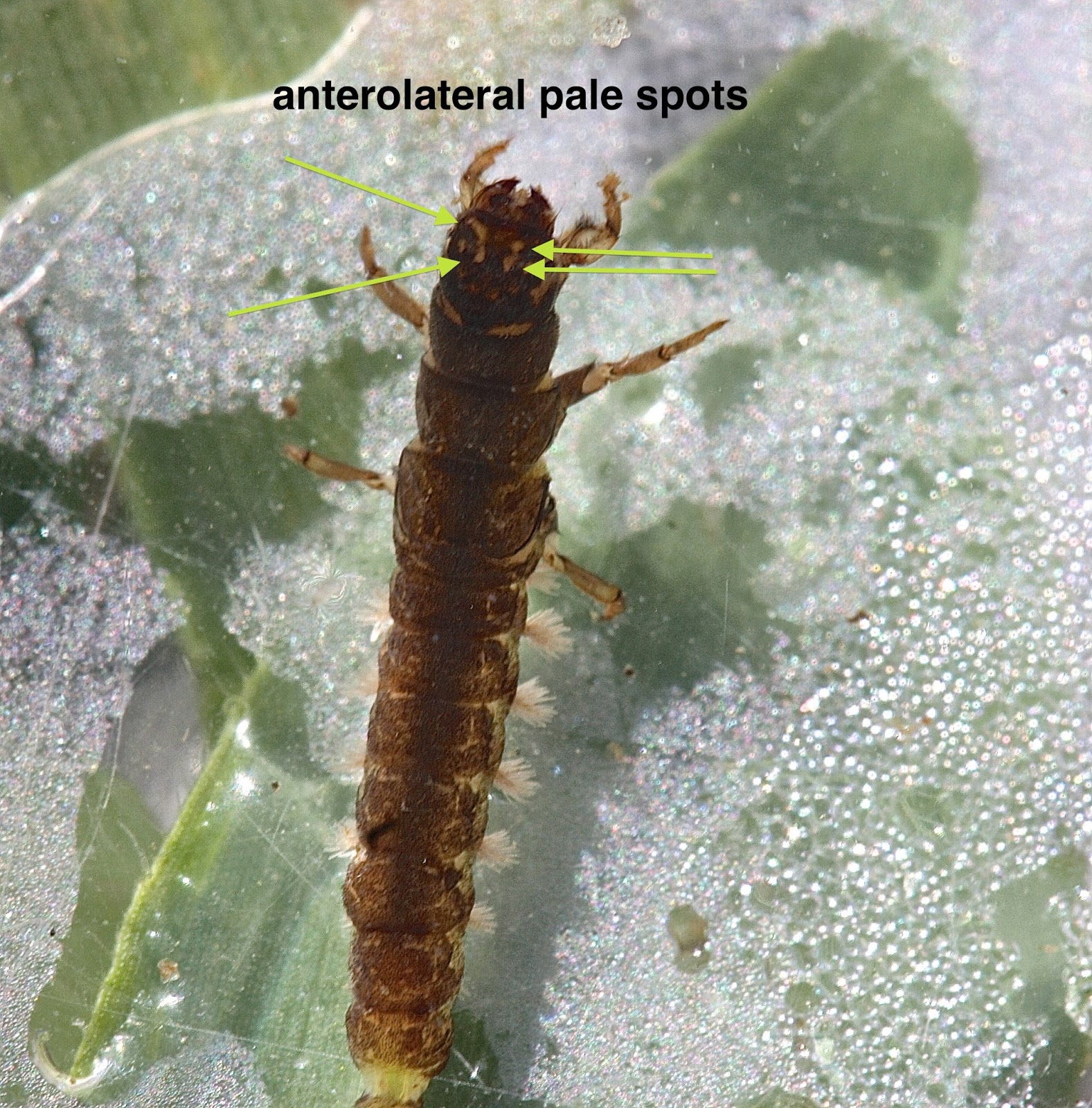
1. Common netspinner, Ceratopsyche sparna. (Bronze head with two anterolateral pale spots.)


2. Common netspinner, Ceratopsyche alhedra. (Head is totally black.)


3. And a common stonefly (Perlid), Acroneuria carolinesis.  (Note that the tergites are banded, light at the front and dark at the back.)


_______________________


Thursday, August 8, 2013

Labiobaetis propinquus: a new small minnow mayfly at the Rivanna


It was a good morning at the Rivanna at Crofton --despite the cloudy, humid conditions that made getting good photos a challenge.  I found a number of small minnow mayflies that appear to be a new species for us -- Labiobaetis propinquus (formerly Pseudocloen propinquum).  I say "appear to be" since THE defining characteristic is one that requires slide mounting of the labrum to look for small setae, something I simply can't do.  Still, there are other key features that we clearly can see, and, L. propinquus was Beaty's guess when he looked at my photos.  (In the first edition of "The Ephemeroptera of North Carolina," this species is identified as Pseudocloen propinquum (p. 13) but that has been changed to Labiobaetis propinquus in the second edition (p. 19).)

Before we look at Beaty's species description, it's important to note that these nymphs come in light and dark forms, and I found both this morning.  Here are two of the dark ones.


Labiobaetis propinquus -- nymphs 4-6 mm; submarginal setae on labrum simple with paired setae; tracheation of gills not extensive; usually has distinct color pattern, often with terga 2, 5, and 10 pale and typically with dark elongated spots down dorsal centerline.  A dark morph exists...with head, thorax and abdomen dark and with sterna 1-4 or 5 with medial area pale. However, labral setation confirms this as L. propinquus.  Most common Labiobaetis in NC furing spring through fall.  Widespread and facultative.  ("The Ephemeroptera of North Carolina," 2nd edition)

1. The nymphs that I found this morning were 4.5 mm and 5 mm.

2. I, unfortunately, have no way to check on the labral setation.

3. The gill tracheation is simple.


4. The pale shading of terga 2, 5, and 10 is most easily seen on the dark nymphs.


5. While the elongated dark spots are more easily seen on lighter nymphs.


6. To see the pale medial areas on sterna 1-5, we need a microscope view.


I think the evidence is pretty convincing though I may send some specimens to Beaty for confirmation.

Labiobaetis propinquus is a fairly tolerant species -- no surprise there -- with a TV of 5.8
______________________

But I was in for another treat at the Rivanna this morning.  I found a fair sized Giant stonefly, and I think I now know the species that inhabits this river: Pteronarcys dorsata.


There are two keys to this identification: 1) the "lateral angles of [the] pronotum [are produced, anterolateral ones almost hook-like," and 2) there are "no lateral projections on [the] abdominal segments." (Beaty, "The Plecoptera of North Carolina," p. 28)


If we want to see lateral projections on the abdominal segments of a Giant stonefly, we look at P. biloba!


Pteronarcys dorsata is the most tolerant Giant stonefly we see with a TV of 2.4.  The other Giants we've seen -- P. biloba and P. proteus -- have tolerance values of 0.0 and 0.4 respectively.

Pretty nice findings today, and I got some nice photos of a male H. curiosum as well as a couple of Tricos (Little stout crawler mayflies -- Leptohyphidae).


________________

Labiobaetis propinquus


Friday, July 26, 2013

Summer insects at the Rivanna: Heterocloeon curiosum (small minnow mayfly) and Hydropsyche venularis (common netspinner)


The Rivanna is still running high and fast -- but it's clear.  So I was able to turn over some rocks -- and sort through vegetation -- close to the shore in Darden Towe Park.

The small minnow mayfly at the top of the page -- Heterocloeon curiosum -- is the most common Baetid we see in this stream in the summer, and this morning there were a lot of them on the rocks.  I now know them by sight, but with a loupe you can pick out a distinguishing feature: the gray pigmentation at the center of each of the gills.


But to be sure of your ID, you have to see the "forecoxal gills," finger-like projections at the base of the front legs.  These:


No need for a microscope if you can get a photo like that!  Like many small minnow mayflies, H. curiosum nymphs are sexually dimorphic -- males and females have different colors and patterns.  That's a male at the top of the page, and this is a female:


Note the pale colored "U" on the thorax of the male.  And here's a photo of male and female together.  (I almost always find them together.)


By the way, don't be mislead by this photo, in which the male is the larger of the two: female nymphs, when mature, are always larger than males.  H. curiosum is an insect I look forward to seeing here in the summer.  I've only seen them in one other stream: the Moormans River, especially at Free Union Bridge.
________________

And of course there were lots of common netspinners around: it's the most common insect we see in the Rivanna in summer.  They love the gnarly vegetation that grows on the rocks in the river, though today I couldn't get out to those rocks.  The netspinner I most commonly see in the Rivanna is Hydropsyche venularis, and that's the one I ran into this morning.


This one we ID by noting two features: 1) the pale, anterolateral dots on the head -- which often merge into a stripe:


And the muscle scars on the side of the head that curve dorsad (upward) at the rear of the head:


H. venularis is a very tolerant caddisfly larva with a TV of 5.1.  But then, it has to be to survive the Rivanna in summer where the water can get very warm (it already is).   That it needs to draw oxygen from water that has little in it might explain why the abdominal gills seem to be so dense and thick on this species.


________________

Sure hope the water keeps dropping so I can get back here more often.   You don't have to struggle to find things in here in the summer.


Thursday, July 25, 2013

Paraleptophlebia guttata and Paraleptophlebia mollis: Pronggilled mayflies in local streams


Based on photos by Donald Chandler -- a reliable specialist -- posted on "Discover Life," I suspect that the pronggilled mayfly that I found today is Paraleptophlebia guttata.  Please look at the following page: http://www.discoverlife.org/mp/20p?see=I_DSC155&res=640.


And based on photos by Tom Murray posted on "Bugguide.net,"  I would have to conclude that the pronggilled nymphs I most commonly find are Paraleptophlebia mollis. (See: http://bugguide.net/node/view/263140/bgimage.)


Both species are found in North Carolina.  (Beaty, "The Ephemeroptera of North Carolina," p. 40)

The only safe way to establish species ID, however, is to key out specific anatomical features. These identifications should be seen as tentative until I can find some way to do that.   In the meantime I have noted these names in our EPT list.

Stumped by a pronggilled mayfly at the Rapidan River


As I was collecting insects this morning at the Rapidan River, I was very excited to see this little (5mm) nymph.  It's a pronggilled mayfly, and as I was taking my photos I was quite sure it was another Habrophlebia vibrans, a species I've seen only one time before -- two years ago at the Rapidan River in spring.    This is Habrophlebia vibrans.


When I got home and downloaded my photos, I quickly saw that I was mistaken.  Note how the gills are in "clusters" on the H. vibrans nymph, not so on the nymph that I found this morning.  The gills on that nymph are "forked, bilamellate," which is the form that gills take on the genus we most commonly see in our streams -- Paraleptophlebia.  However, the Paraleptophlebias that I normally see look like this.


Not only does the color and pattern differ significantly from this morning's nymph, note the difference in gills.  Those on the nymph in this photo, fork at the middle of the gill, and in the portion in front of the fork, there are well defined tracheal branches.  These.


The gills on the nymph that I found this morning are forked from the base of the gills, and they lack tracheation.


More photos:


I'm not sure what I found.  At the moment, I think this nymph is also Paraleptophlebia, it's just a different species than the Paraleptophlebias that I normally see.  Beaty notes that North Carolina has at least 8 species of Paraleptophlebia, but he tells us to leave ID at the level of genus ("The Ephemeroptera of North Carolina," p. 40).   Still, apparently there is a key one can use to narrow this down, so I plan to look into this further.

(By the way, I have seen photos of Paraleptophlebias with gills that lack tracheation like the one that I found this morning.  See, for example, the photo of Paralpetophlebia bicornuta at http://bugguide.net/node/view/796600.)
_______________

Other discoveries this morning.

1) A beautiful flatheaded mayfly, Epeorus vitreus.  There seemed to very few of them around.  (Note how transparent the leading edge of the head has become.)


2. I saw a lot of the "summer batch" of Brachycentrids (humpless casemakers), Brachycentrus appalachia.


3. Small minnow mayfly, Baetis intercalaris.  (Also saw Acentrella turbida nymphs.)


4. A quite mature Perlodid stonefly, Isoperla holochlora.  These are long gone from most of the streams that I visit, but the Rapidan is up in the mountains where things take longer to mature.


5. And then there was this wonderful butterfly which stopped by to see what on earth I was doing!


Feel free to help me out with identification.