Saturday, September 14, 2013
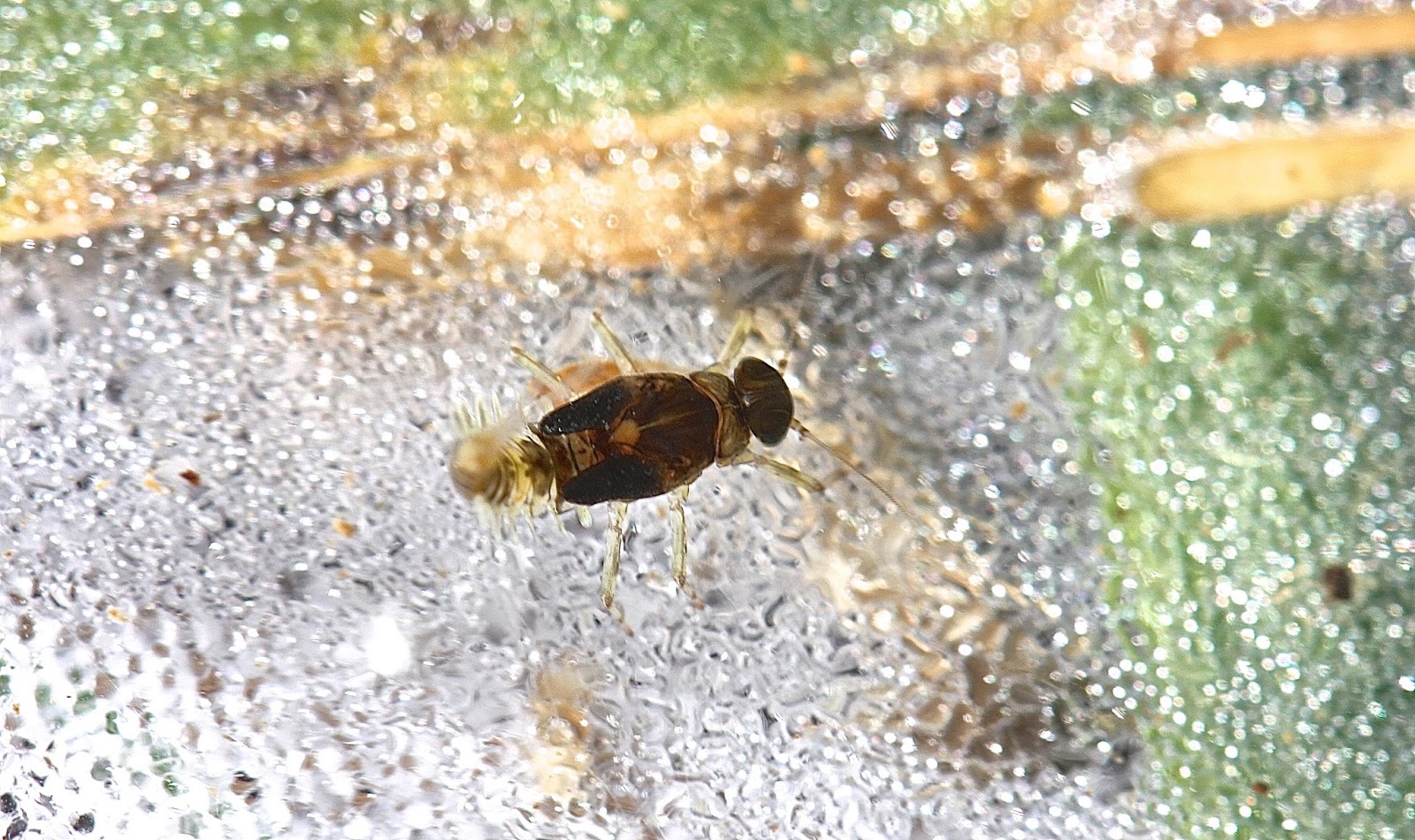
Still can't get in, but in the meantime...the Rivanna small minnow mayflies
Frustrating! The Rivanna at Crofton is still too high for me to reach the riffles that I want to explore. And I'm keen to look on those rocks since that's where I found this unusual small minnow mayfly last autumn -- on September 14th, to be exact. This is Heterocloeon petersi, and it's one of three small minnow mayflies (Baetidae) that, to date, I've only seen in the Rivanna. The others -- Iswaeon anoka and Labiobaetis propinquus.
From sampling this river in years past as a stream monitor, I know that the Rivanna has a good population of small minnow mayflies each summer. I don't recall seeing many at all in the spring and fall; I don't think I've ever looked in the winter (usually too high or too cold).
To date, these are the Rivanna small minnow mayflies that I've found: I hope to find more in the future.
1. Acentrella turbida. Tolerance value, 2.0. Rivanna at Darden Towe
2. Baetis intercalaris. Tolerance value, 5.0. Rivanna at Crofton and Darden Towe
3. Heterocloeon petersi. Tolerance value TBD. Rivanna at Crofton. Vulnerable to extirpation. (also pictured at the top of the page)
4. Heterocloeon curiosum. Tolerance value, 2.1. Rivanna at Crofton and Darden Towe.
5. Iswaeon anoka. Tolerance value, 4.4. Rivanna at Darden Towe. Uncommon.
6. Labiobaetis propinquus (formerly Pseudocloeon propinquum). Tolerance value, 5.8. Rivanna at Crofton.
________________
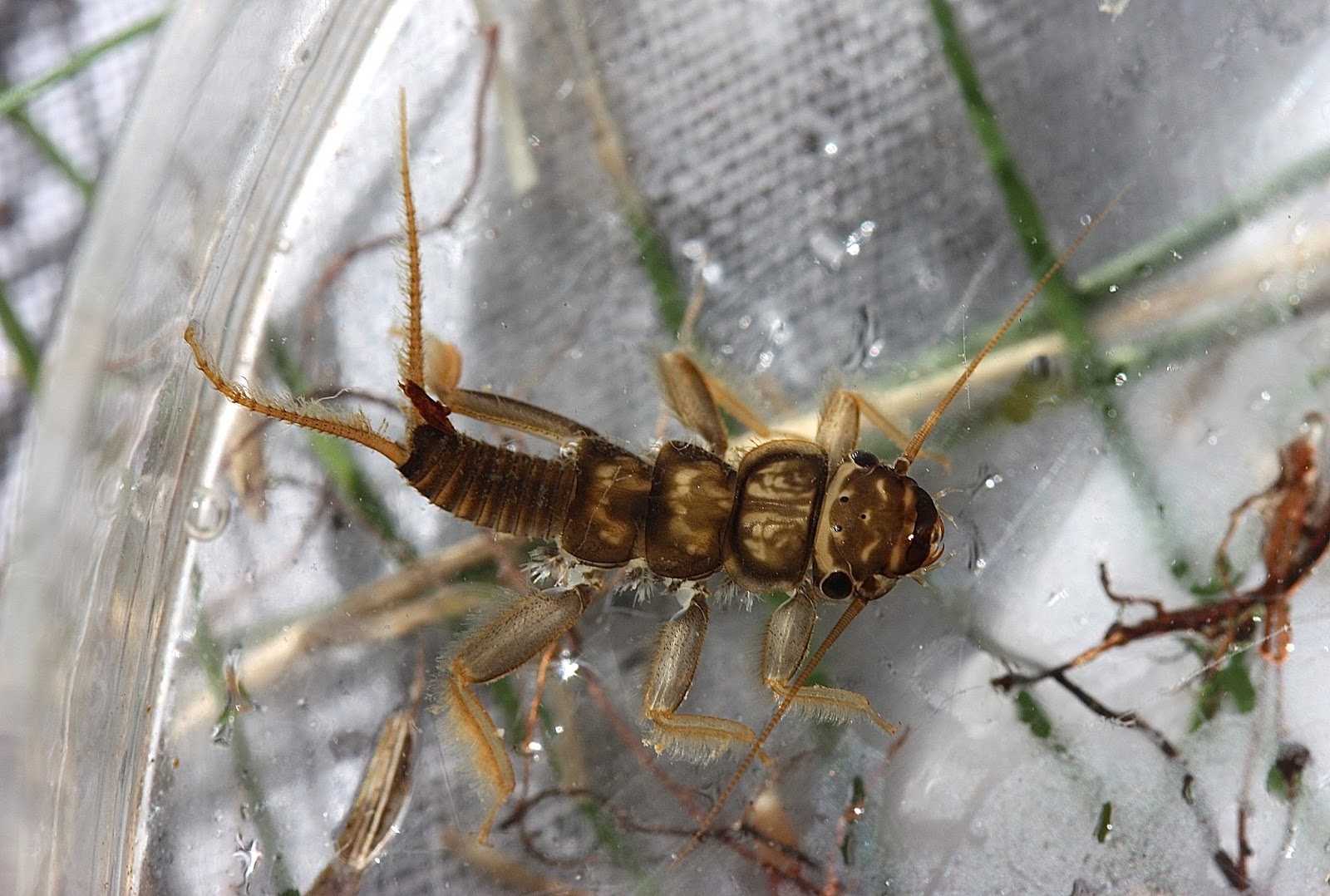
Hoping to report on the Rivanna at Crofton sometime next week. I'll also be looking for this unusual common stonefly which, to date, I've only found there. Agnetina annulipes.
Friday, September 13, 2013
And it's young stoneflies at the Moormans as well: Acroneuria abnormis
Still waiting for the Rivanna to drop -- though I may give it a try in the morning. So I thought I'd have a look at the Doyles and the Moormans out by White Hall today. As I expected, there's not a lot to see in these mountain streams at the moment. Common netspinners, some flatheaded mayflies (including Leucrocuta), lots of young hellgrammites, and the occasional small minnow mayfly (most/all seemed to be Baetis intercalaris). But again I saw quite a few young common stoneflies, nymphs that will most likely be hatching next year. They were all Acroneuria abnormis. I decided to photograph two -- one dark (in the photos above) and one light (pictured below).
Beaty describes A. abnormis -- which is the most common "common stonefly" that I see in our streams -- in the following way. "A. abnormis -- male nymphs 15-20 mm, female nymphs 25-30 mm; dorsum of head with a well defined M-shaped head pattern, sometimes with interruptions; posterior margins of abdminal tergies light, dark tergal bands irregular...anal gills always absent." ("The Plecoptera of North Carolina," p. 14)
Our nymphs are not yet nearly that long, still the defining features are easy to see. Note that on the darker nymph, the "M" pattern is interrupted while on the light one it isn't.
________________
We've reached the "slow" time of year when there's not a whole lot to see in a lot of our streams. Best to look in the Rivanna, which I ought to be able to do now that the summer rains have abated.
Tuesday, September 10, 2013
The Main Story Was Stoneflies -- Young and Old -- at the Rapidan River
Obviously one of the "old" ones with those very black wing pads: Paragnetina immarginata. This one was small, 15 mm. This one was large, 25 mm.
P. immarginata -- nymphs ?? mm; head M-pattern with medial pale line extended anteriorly, often connected to pale frontoclypeal margin; yellow femora distinctively patterned with dark brown longitudinal bar extending about 2/3 the length; abdominal terga banded, anterior half dark; anal gills absent. (Steven Beaty, "The Plecoptera of North Carolina," p. 18)
We can see those features on both of the nymphs, but let me use the big nymph for purposes of illustration.
Both of these stones have "missed the boat" when it comes to the peak hatch of the Golden Stones: that took place in July and August, and stonefly "shucks" were all over the place on the rocks in the river.
Note how the head and thorax splits open to allow the adult to emerge. Most of the mature nymphs have hatched, but the leaf packs were jammed with small and mid-sized Perlids, both P. immarginata and A. abnormis. Some of those will be hatching next summer; some have two years to go.
_______________
Other insects around? Some small minnow mayflies, mostly Acentrella nadineae, and still some E. vitreus flatheaded mayflies, lots of common netspinners and fingernet netspinners (Dolophilodes), and caddis casemakers -- Saddle-case makers (Glossosomatids), Humpless case-makers (Brachycentrus appalachia), and some Strong case-makers (Odontocerids), the case-maker we commonly see here in the fall.
Odontocerid, Psilotreta labida
Brachycentrus appalachia (quite a few of their "log cabin" cases attached to the rocks)
And then there was this Giant stonefly.
Do you recognize it? It's Pteronarcys proteus, the same species we see in the small streams in Sugar Hollow. This is the first time I've seen it up here. Actually, I've probably seen it before and mistakenly thought it was the species I'm used to finding in the Rapidan River, Pteronarcys biloba. This one.
Note how the lateral abdominal hooks point sharply away from the body on P. biloba while they're "appressed" -- i.e. tucked in close to the body -- on P. proteus. Also, while there are sharp hooks on segments 1-8 on P. biloba, on P. proteus, the hook on segment 7 is small and virtually non-existent on segment 8.
So last week we discovered two Giant species in Buck Mt. Creek (P. dorsata and P. biloba), and today we find the same thing at the Rapidan River (P. proteus and P. biloba).
Always a treat to make this trip to Madison County.
Saturday, September 7, 2013
And the answer is "yes": Pteronarcys biloba and Pteronarcys dorsata in the very same stream
Checked with Steven Beaty on this one, and "yes," it is possible for two different species of Giant stoneflies to live in the same stream -- more, in the very same set of riffles in the same stream, the riffles pictured in the photo above.
Buck Mt. Creek: Pteronarcys dorsata, June 20, 2013
Buck Mt. Creek: Pteronarcys biloba, September 5, 2013
That's the most tolerant Giant, -- P. dorsata, TV of 2.4 -- alongside the most intolerant Giant -- P. biloba, TV of 0.0.
Beaty added that this is most common in "good" streams. People should pay more attention to Buck Mt. Creek. I've said it before: I've found a greater variety of aquatic insects in this particular stream -- orders, families, genera, species -- than in any other stream I explore, ranging from very intolerant to very tolerant. (For the up-to-date taxa list for Buck Mt. Creek, see the entry posted on 6/20/13).
Thursday, September 5, 2013
Buck Mt. Creek Continues to Amaze
My destination this morning was the Rivanna River at Crofton where I found some very cool insects in September last year. I went to the river, and I looked for insects, but I found very little. The Rivanna is still abnormally high; the boulders that provide me with "tables" on which I can scrutinze rocks are all underwater.
But the morning sun was too good to waste, so I headed off to Buck Mt. Creek, my expectations low I might add. Surprise, surprise -- I found some very nice insects including this young Giant stonefly, Pteronarcys biloba, tolerance value, 0.0. If you look back to my posting of 6/20, you'll see another Giant that I found in this creek, one that appears to have been Pteronarcys dorsata (on which see the posting of 8/16). Two Giant species in the same stream? That's the way it looks at the moment. Note the long tails, the "hooks" forming on the anterior corners of the pronotum, and, critically, the sharp lateral projections on the abdominal segments.
Now I'm intrigued. Do P. biloba and P. dorsata co-exist? You can be sure that I'll be carefully checking every Giant I see in BMC from now on.
P. dorsata? on 6/20.
________________
But another pleasant surprise. I found three different species of flatheaded mayflies in the short while I was wading the stream: Maccaffertium ithaca (the "Light Cahill"), Heptagenia marginalis, and a very small Epeorus vitreus (so there are still some around).
1. M. ithaca. I didn't take diagnostic photos -- though I saw what I needed to see in my microscope study. "Sterna 5-6 or 7-8 with transverse sternal bands with anterolateral extensions" [and] "no denticles on tarsal claws." (Steven Beaty, "The Ephemeroptera of North Carolina," p. 19) Note that the thorax seems to be splitting in preparation for hatching.
2. Heptagenia marginalis. This is one that we normally see in late summer -- August and September -- though this is a small one that will probably hatch in October. Remember that this genus differs from Leucrocuta in having a fibrilliform portion on gill 7 (Leucrocuta does not), and that the species ID is determined by the oblique black lines on the sides of the abdominal segments. (Beaty, "The Ephemeroptera of North Carolina," p. 18)
3. And the very small Epeorus vitreus, tiny, tiny wing pads.
________________
One more surprise -- though I've seen a few of them in here before: common netspinner, Macrostemum. You'll recall that these larvae are common in the North Fork of the Rivanna below the bridge at Advance Mills. In some of my photos, the "carina," the rim that forms the edge of the head, is easy to see.
________________
It was a quick trip to Buck Mt. Creek, but one that I'm glad that I made.
Tuesday, September 3, 2013
The Best of Montana, 2013
Time to get back to my streams in Virginia -- which I'll be doing on Thursday -- but one last look at my favorite photos from my trip to Montana last week.
1. In the photo above, a Trico nymph (family, Leptohyphidae; genus Tricorythodes). I find them in the Rivanna all summer, but I never seem to find one that's "clean"! This was a beauty, and the large oval/triangular operculate gills couldn't be clearer.
2. The spiny crawler mayfly Drunella coloradensis: they're so photogenic with those different colors and patterns. (For the keys to species ID, by the way, look back to the posting of 8/31/12. This includes the distinction between D. coloradensis and D. flavilinea: they're closely related.)
3. Flatheaded mayfly, Epeorus deceptivus.
4. A lovely small minnow mayfly, Baetis tricaudatus Montana style.
5. Perlodid stonefly, genus Skwala. Finally found one.
6. Our free-living caddisfly larva, part of the R. brunnea/vemna group.
7. And a handsome common netspinner caddisfly larva, Arctopsyche grandis.
________________
I may make two trips to Montana next year, one in the spring where I'll do nothing but look for cool insects. (The Bitterroot range of the Rockies seen from the Bitterroot River.)
(And the "Box Canyon" in the Blackfoot.)
Subscribe to:
Posts (Atom)