Friday, January 17, 2014

Winter stoneflies on a cold winter's day at the Lynch River


(It was a balmy 32º when I bent over too far and got a boot full of water!  Long morning.)

I suppose we could call this the "dance of love" -- male and female small winter stoneflies, Allocapnia pygmaea -- but I think they just got tangled up in the tray.  Male on the left; female on the right.  As with so many mayflies and stoneflies (nymphs), the males seem to be richer in color while the females are bigger in size -- this female was 6.5 mm, the male was 5.5 mm -- but it's the males that are used for species ID.  For A. pygmaea two features that are used in ID are the dark, horizontal bands on the abdominal terga (male) and the length of the supra-anal lobe (twice as long as tergite 10).  This:


The females often seem to mature -- from what I've seen -- with light colored wing pads vs. the dark pads we see on the males.


Beautiful nymphs.  Almost worth getting a boot full of water!

But I also found some large winter stoneflies, both Taneiopteryx burksi/maura and Strophopteryx fasciata.  Tis the season.

T. burksi/maura -- real proud of these photos.


S. fasciata -- note that the wing pads are starting to darken.


________________

And then there were the Uenoids.  I'm not sure I've ever seen so many Uenoids in one place before.  I looked at three rocks in a 3' square section of river: on one were 8 cases, another with 10, and the third was covered with 12.  What a caddisfly hatch there must be here in the summer -- and no trout to eat them!

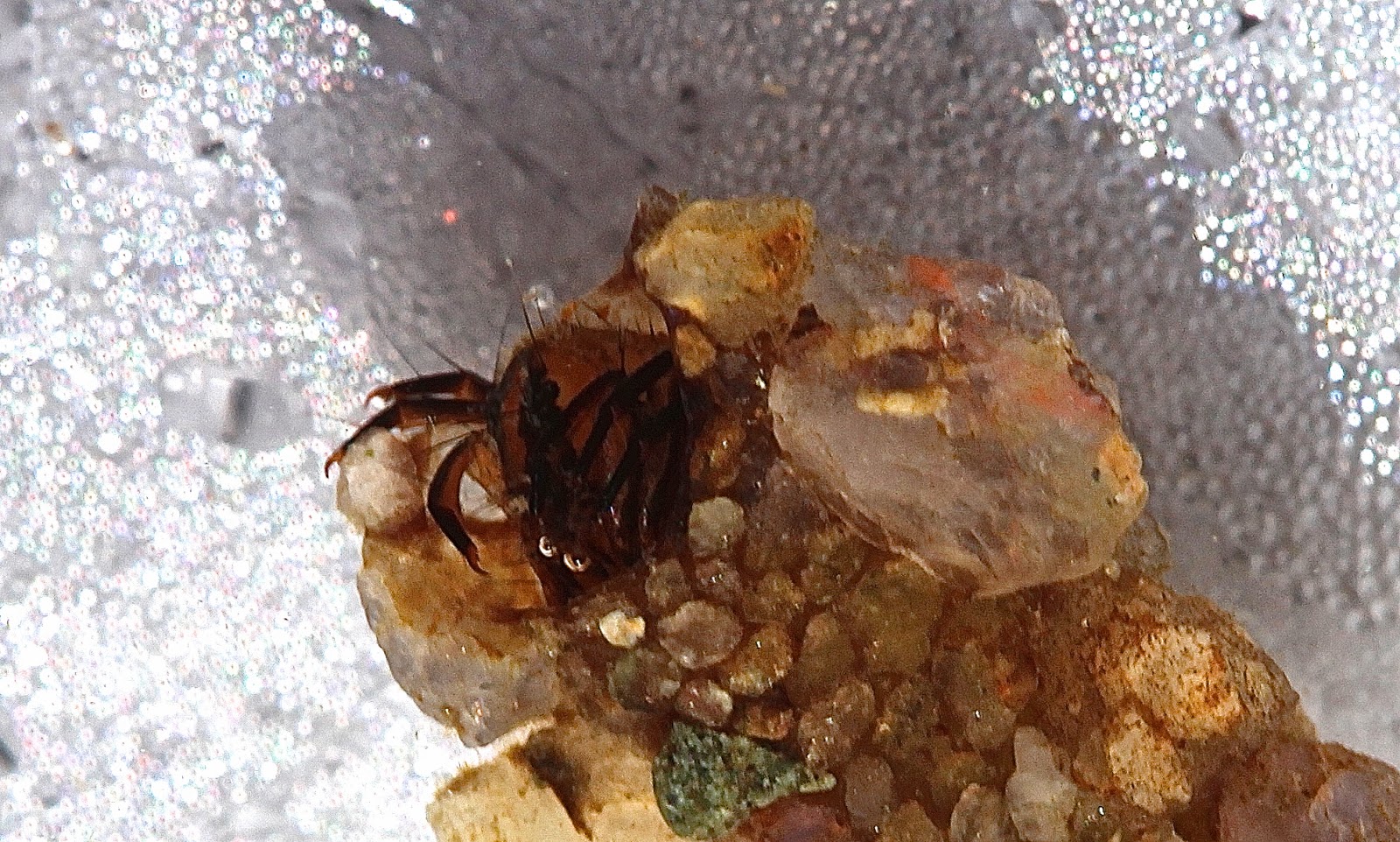
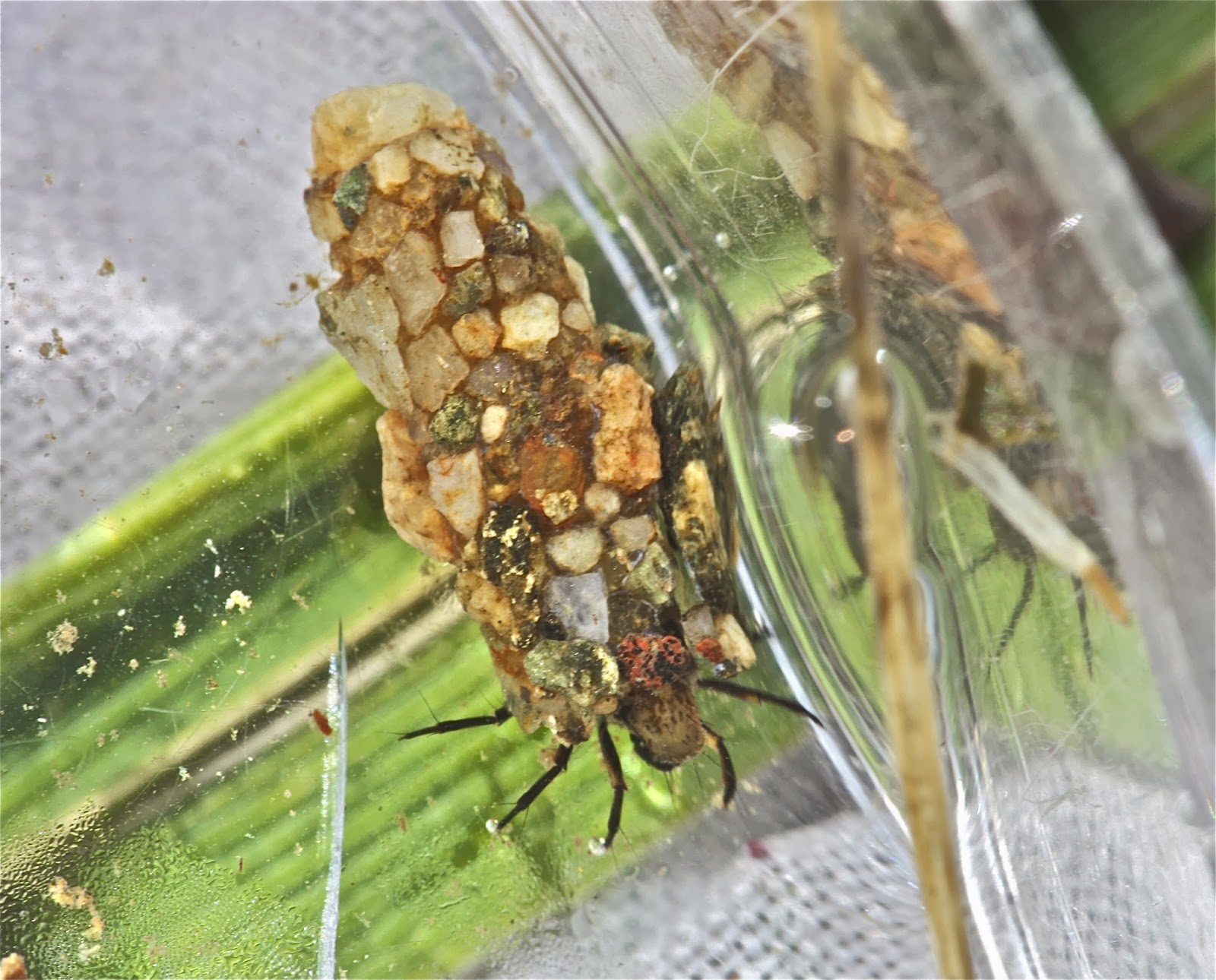
Species?  The same two I find at Buck Mt. Creek: Neophylax oligius and Neophylax fuscus.  I take it they like the same kind of water.   Their cases, by the way, were noticeably different: the N. oligius cases were bigger and made of much bigger pebbles.

N. oligius 1

N. oligius 2
N. fuscus 1
N. fuscus 2

No microscope needed to ID Neophylax oligius.  Note the long, orange stripe on the face (frontoclypeus) and the orangish underside of the head.


But the heads of the N. fuscus larvae didn't give me a clue.
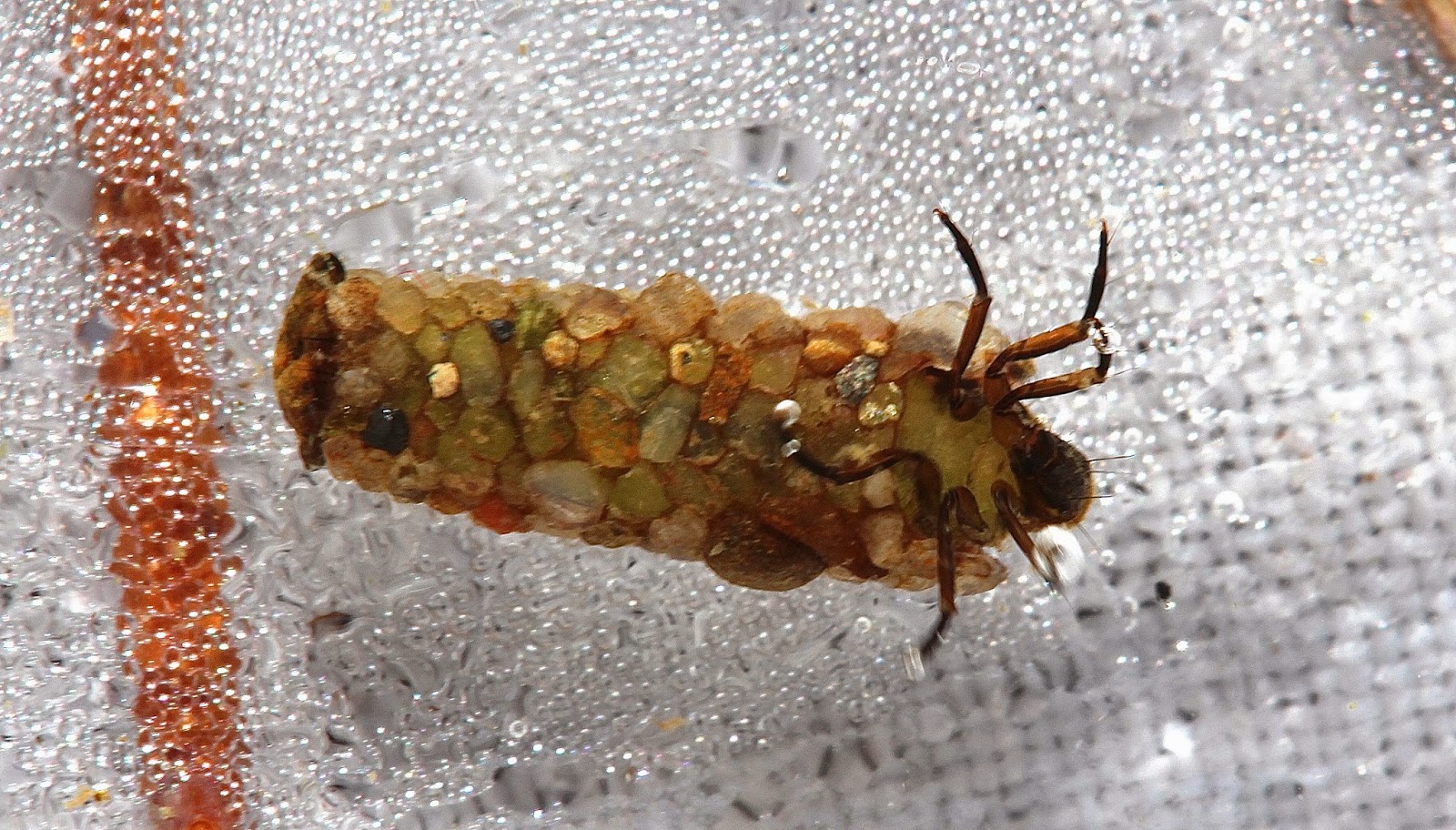


So, off to the microscope in my lab.  There I could see what I needed to see: 1) dark brown/black head with light muscle scars at the back; 2) no clavate ventral gills; 3) and 9-10 setae at the ventral sa3 position.  (See Steven Beaty, "The Trichoptera of North Carolina," p. 87 and R. N. Vineyard, et.al., The Caddisfly Genus Neophylax, pp. 23-24.)


You'll recall that we should also see "large blade-like spines" on the anterior of the pronotum (Beaty, p. 87) -- these


-- but the spines were jammed with crystals on the larvae I kept, so I can't give you a photo.
_______________

One other case-maker there -- Apatania incerta -- the one with the "hood" at the top of its case.

________________

But the dancers were the catch of the day.


Wednesday, January 15, 2014

Lepidostomatids and Uenoids: the new kids in town at the Upper Doyles River


The last time I went up to the upper Doyles River (6.4 miles north of White Hall, VA) I didn't find a whole lot: some flatheaded mayflies, lots of pronggilled mayflies, brushlegged mayflies, a few large winter stoneflies, and a few Chloroperlids (green stoneflies).  And that's about it -- er yi-yi 而已矣 as the Chinese would say.  But now that we're well into winter the caddisfly larvae have shown up in large numbers, both Lepidostomatids and the Uenoids.

In the picture above, a Lepidostomatid (genus Lepidostoma) in a "multi-media" case: part grains of sand and part a four-sided case made out of nicely trimmed sections of leaves.  We find these "mixed" cases, but the case that's made solely of the sections of leaves is surely more common.


There were a lot of them in the river today: look for their very small cases in packs of leaves.
_______________

Uenoids?  This is one of my sites that is densely populated by these "little northern case-makers."
It's also one of the spots where just about every Uenoid I see is N. consimilis.  Exactly what I found today.  And as I noted in my previous entry, many make a blocky, rectangular case, but not all of them.  Note the variety I found today, beginning with two of the large, blocky cases.

#1


#2


Both of these cases measured 10 mm x 4 mm.  But this next case was much smaller, tapered and curved -- but still N. consimilis.

#3


#4  And one more in a small, non-descript case.


While just about every Uenoid I've checked from this site has been N. consimilis there was one exception on 4/18 of last year, one I'm hoping that I'll see again.


It had a "mask-like" face, no clavate ventral gills, and a peg-like tubercle on its head.   It might have been N. toshioi which would be a real find.  I'll be checking those faces real closely!

________________

Other photos -- just a few.

1. Large winter stonefly, Taeniopteryx burksi/maura.


2. And for those fly fishermen who are reading -- get out those midge imitations.  Don't forget to tie some that are green (FYI, very few midges are red).


__________________

And this is my site.


Monday, January 13, 2014

Neophylax consimilis: Is it the most common Uenoid caddisfly that I see?


I think that it is -- but that's probably because of the streams that I frequent come winter.


Back to Sugar Hollow this morning: the small streams in Sugar Hollow are the "only show in town" at the moment with heavy rains making larger streams (2nd and 3rd order) too high and too fast.  Even the Moormans trib that I went to today was higher than normal.


I found two Uenoids on rocks near the shore, both were N. consimilis.   I find N. consimilis in all of the small streams I visit in Sugar Hollow; in the Rapidan River; the upper South River before Entry Run; and the upper Doyles River.  At a lot of my sites, it's the only Uenoid caddisfly species I see.   Last year, further up on the same stream I went to today, I found N. consimilis, N. aniqua and N. mitchelli  (see the posting of 2/21/13).   Consimilis in 1st order streams is normally found further downstream than aniqua and mitchelli, both slightly less tolerant species.  (Aniqua and mitchelli are 0.0; consimilis is 0.3.)

N. consimilis is one of the species with ventral clavate gills, and the head is either uniformly dark brown, or mostly brown with a pale spot/area/stripe on the head.


The reddish orange spot on the head of the consimilis that I found this morning was easy to see -- no microscope needed.


But there is something else that, for me at least, gives this species away.   The larvae tend to make a "blocky" looking case, a rectangular shape which tapers very little.  Look at the N. consimilis Uenoids in the entry I posted last week from South River and Entry Run.  And here are some more.

1/4/12: South River


1/18/12: from another small stream in Sugar Hollow


And 1/6/13: Rapidan River


Now be careful, not every N. consimilis makes this kind of case.  Note the other consimilis that I found this morning.


Still, when I see that fairly large, rectangular case, I have a good idea of the type of Uenoid I'll be finding inside.
________________

Other photos:

1. A small winter stonefly, Paracapnia angulata.  The stream where I normally find this unusual species is on the other side of the valley -- but not far away.


Note the rear wing pads: they're rounded at the bottom (and hairy!), not the truncate shape of Allocapnia nymphs.


2. And the Perlodid stonefly I've seen quite often in Sugar Hollow this season, Malirekus hastatus.

________________

Pretty spot.

I'll probably be back to Sugar Hollow later on in the week, and I'll probably see N. consimilis!