Monday, February 10, 2014

Exploring new water: the Patricia Byrom Park


A few years ago I catalogued insects in the small streams that flow through what would become the "Patricia Ann Byrom Forest Preserve Park," in northwestern Albemarle county.  My part in a "bio blitz" that preceded trail construction.  These are streams I would like to explore, so today I returned.  I had no intention of getting into the water -- it was 28ยบ and cloudy -- but once I was there I couldn't resist.

The stream in this photo is at the bottom part of the park -- it's as far as I went.  But, I know from the work I did before that there are smaller, even better streams, once you start climbing the trails.  Some other day.  Here are some of the insects I found today.  My photos are not the best: the sun never came out.

1. Ameletid mayfly, Ameletus cryptostimulus.


This species is fairly uncommon: I've only seen it in very small mountain streams.  North Carolina does not give it a tolerance value.

2. Large winter stonefly, Taenionema atlanticum.  Saw a lot of them: this is the habitat where they thrive.


3. Uenoids.  I picked up five or six cases which were all very small.  My bet was Neophylax aniqua -- and I was right in all but one case.  There was one that appears to be N. concinnus.

N. aniqua


Note the tubercle on its head.


Love the case.  As with so many aniquas I see, this one made a case that is tapered with fairly large pebbles placed at the top.  Also note that the pronotum is dark brown, just like the head.

N. concinnus (?)


The case differs from that of aniqua, and the pronotum is orangish brown.  If you look closely you can see the tubercle on this one as well.  I thought it would be N. mitchelli -- but no clavate ventral gills on abdominal segment 1.  The muscle scars on the head are very clear in this photo: I couldn't get a clear shot of the tubercle with my microscope.


3. A beautiful freeliving caddisfly larva (Rhyacophilid), Rhyacophila nigrita.  Tolerance value, 0.0.


Of the visible features that help us with species ID, we can see three in this photo.


1) The anterior of the pronotum is dark;  2) the fore femora are very broad; and 3) the second segment of the maxillary palpus is twice as long as the first.  (Actually, you can only verify that if you look at the base of the palpus -- microscope view.)

I saw other things -- Perlodid stoneflies, Diploperla duplicata, and common stoneflies, Eccoptura xanthenses.   But with numb fingers and toes, I decided to call it a day.  Next time, I'll be climbing up to those smaller streams.  Can't wait to see what is there!


Friday, February 7, 2014

Ephemerella dorothea spiny crawlers: the type that shows up in late winter


Back to Sugar Hollow today while I continue to wait for the water levels to drop in larger streams -- I hope to make it to the Rapidan River on Monday.   The stream for today -- a small one to which I've been only one time before.  Here it is as it empties into the Moormans.


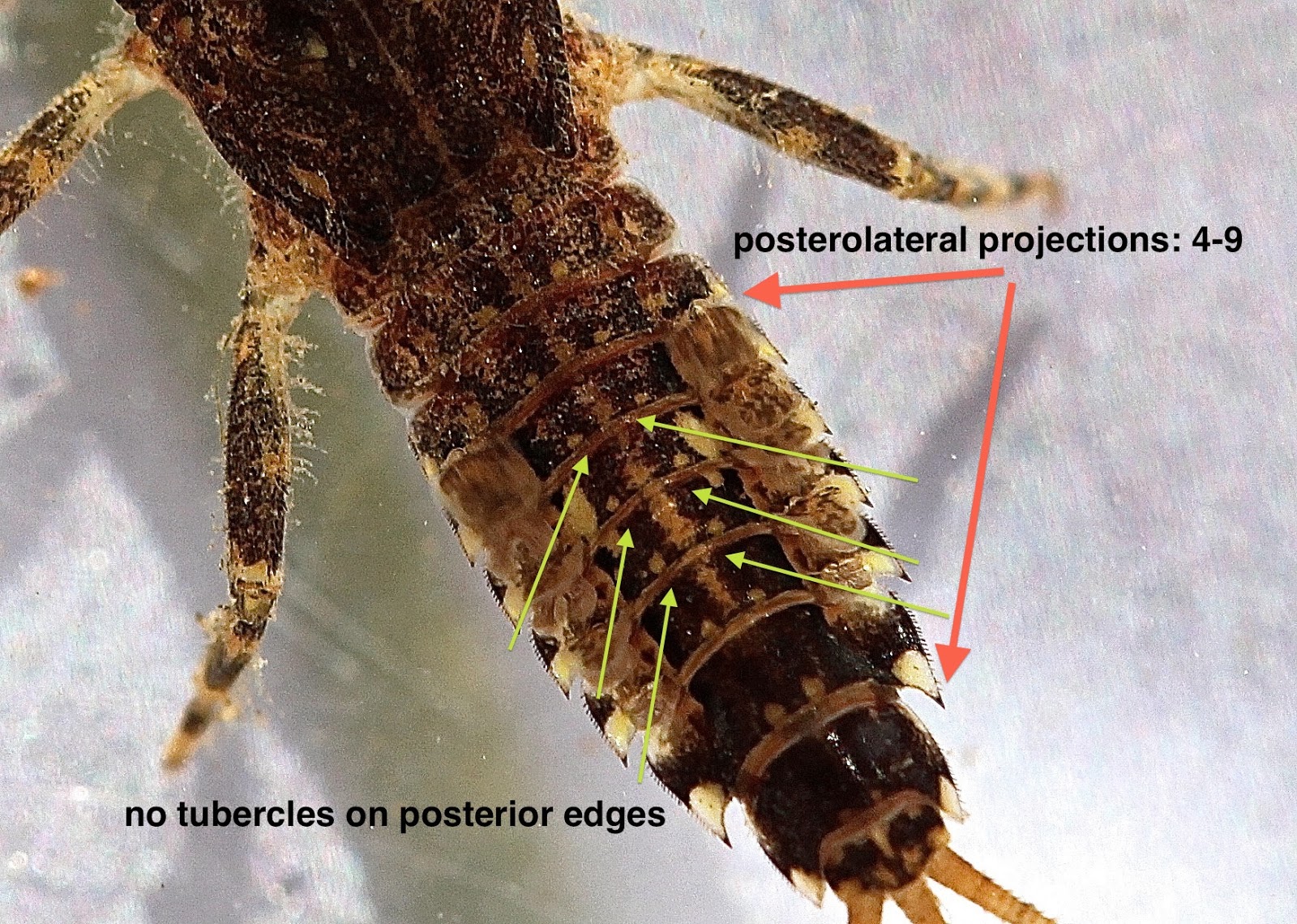
While I saw a lot of the insects I've been seeing in the other streams in this valley -- Uenoids, Giant stoneflies, Roach-like stoneflies, some Perlodids -- I was a little surprised to find a number of spiny crawlers, all of them dark brown with a pale dorsal stripe.  I assumed they were E. invaria nymphs -- but I was wrong.  They were E. dorothea, the species that we normally see in large numbers in April and May.  There were no paired tubercles on the posterior edges of terga 4-9. (E. invaria has them.)

Our nymph:


E. invaria:


Let me quote from Beaty's description of E. dorothea.  "E. dorothea -- nymphs 6-8 mm...terga without dorsal tubercles but may have slightly developed spiculate protuberances...lateral margins of terga 4-9 with posterolateral projections; lateral margins with slight, small serrations with numerous setae."  Those serrated posterolateral projections are very clear in the photo above.  He continues: "thorax and abdomen variable in pigmentation, light brown to dark brown, with or without pale speckles"  -- i.e., some are speckled like this --


typically with paired posteromedial pale spots and sometimes with segments 5 and 6 pale mediad of gills; tergites may have a thin, pale mediodorsal stripe in some nymphs; caudal filaments banded."
The paired pale spots on the terga are very clear on our nymph, as is the pale mediodorsal stripe.  While I'm not entirely sure what Beaty means by "mediad of the gills," terga 5 and 6 certainly differ from the rest and have pronounced pale spots close to the gills.


One final comment, "Darker, unspeckled nymphs -- ours fits that description -- may be a subspecies or possibly a color variant of E. dorothea but DNA analysis and/or adult associations are necessary to confirm."  ("The Ephemeroptera of North Carolina," p. 27)  So this "type" of E. dorothea that we find in the early part of the year could be a subspecies.

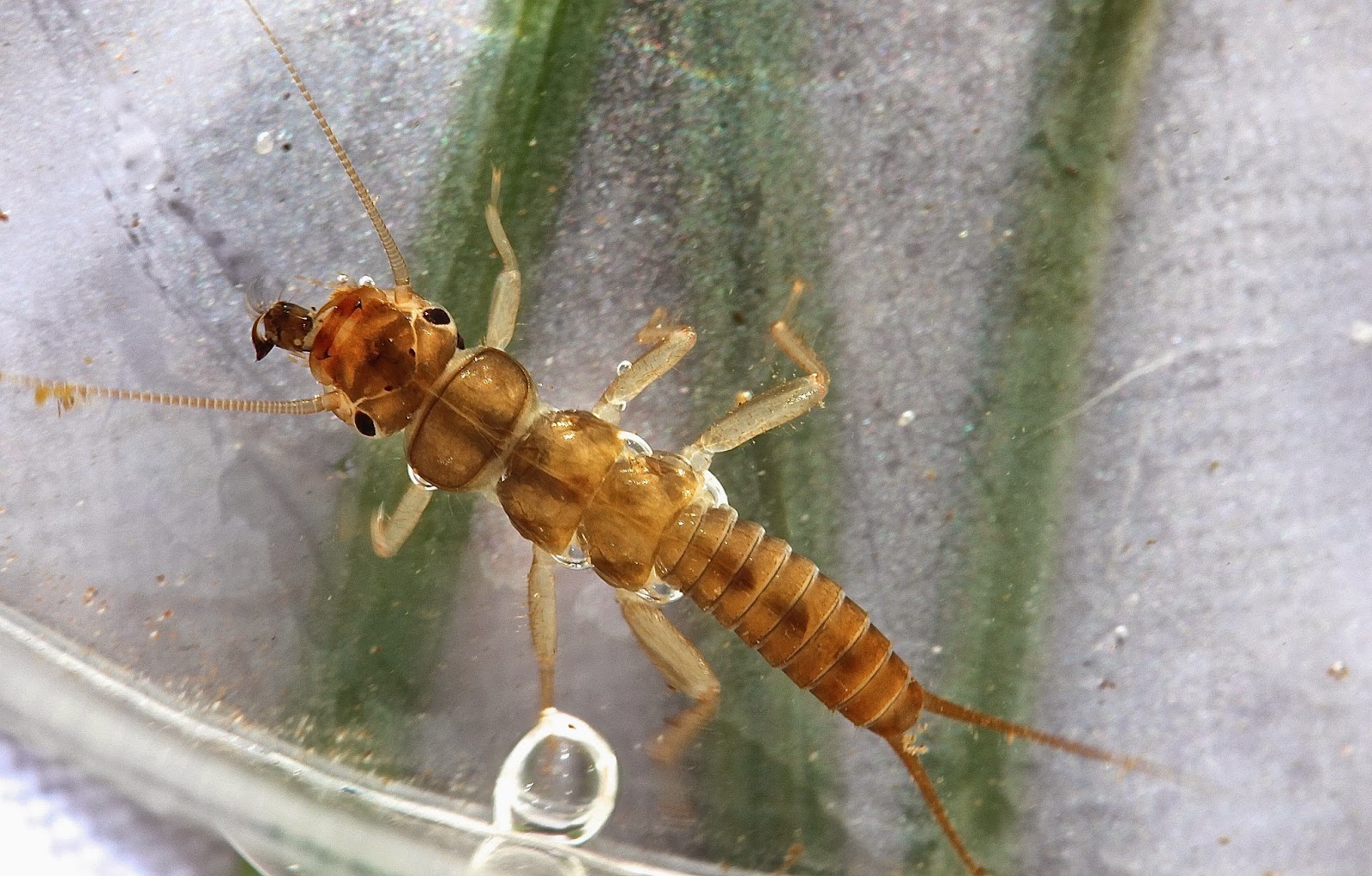
One of the other nymphs that I found this morning, this one clearly a male -- the eyes are turning red.

________________

And then there's the rest.

1. Giant stonefly, Pteronarcys proteus next to a young Perlodid stonefly, Clioperla clio.


2. A Roach-like stonefly -- Peltoperlid -- genus Tallaperla, probably the most common insect I see in these small mountain streams at this time of year.


3. Perlodid stonefly, Diploperla duplicata.  In the first photo, munching away on a hapless black fly.


4. Large winter stonefly, Taenionema atlanticum.  Lots of them around, and they're almost fully mature.


5. And a beautiful fingernet caddisfly larva, genus Dolophilodes.  Note that the leading edge of the head -- the frontoclypeal apotome -- is asymmetrical.


________________

Uenoids.  Their little stone cases were all over the place.  I picked up 5 or 6 and photographed 3 or 4.  When I got home and checked them for species ID, I was surprised to see that there were three different species represented in this small stretch of water: Neophylax oligius, Neophylax fuscus, and Neophylax concinnus.  No big surprise to find oligius and fuscus together: we've seen that before.  But most sources say that concinnus should be further upstream, in a different habitat altogether.  (See Vineyard, et.al., The Caddisfly Genus Neophylax, p. 48.)

1. N. oligius.  You can tell by the orange underside of the head.


2. N. fuscus.  Note the muscle scars at the back of the head and under the eye.  Also, the large, blade-like spines on the front of the pronotum were easy to see in a microscope view.


3. And N. concinnus.  Note the low tubercle on the head.  No clavate ventral gills, with 2-4 setae at ventral sa3 position.


_______________

Lots to see in this small mountain stream.


Saturday, February 1, 2014

The small winter stonefly Paracapnia angulata: Phase II


We're getting there -- but still not quite mature.  When they're mature, their wing pads will be easy to see, as in this nymph that I found two years ago in the same stream at much the same time (1/30/12).


While almost every small winter stonefly we see is Allocapnia in terms of the genus, these are Paracapnia, and it's the shape of the wing pads that gives them away: the posteriors of the front and back wing pads are round.   On Allocapnia nymphs the rear wing pads are truncate.  While you can make out the wing pads on the nymph in the photo at the top of the page, they're much sharper in this microscope view.


Beaty, however, prefers to use other traits for identification: 1) the body is very setose (hairy), and 2) there is a "purplish-brown reticulate color pattern on [the] head."  ("The Plecoptera of North Carolina", p.1)  Both are clear in this photo.


Paracapnia angulata -- the only species we find in the southeast -- "typically occurs in small headwater streams," which is where I was yesterday.   Accompanied by my friend who lives in Sugar Hollow, I returned to the stream where we found very small nymphs of this species on December the 3rd of last year.  I had no problem finding these uncommon nymphs in the leaf packs.  NC has not assigned a tolerance value to P. angulata, which usually means they've not found very many.  Size of these nymphs: 6 mm.


________________

2. Uenoids.  I had no trouble finding Uenoids, but the cases I saw were still very small.


But it was worthwhile to photograph some and then check the ID since I found the two "best" species we've seen so far in our streams: Neophylax mitchelli (below in this photo) and Neophylax aniqua (at the top).  N. mitchelli has a TV of 0.0; N. aniqua has not been assigned a TV in NC -- not enough found.  While I got some good photos of both caddisflies, I could not see what I needed to see for identification: the tubercles on their heads.  Well, I could almost see them.


The tubercle on N. mitchelli is long and pointed, "usually directed somewhat posteriorly" (Beaty, "The Trichoptera of North Carolina," p. 87) while that of N. aniqua is "often semi-blunt" (Beaty, p. 86).  Seen through the microscope they show quite well.

N. mitchelli:


N. aniqua:


More photos.

N. mitchelli:

N. aniqua


N. aniqua is said to occupy "the most upstream position in the longitudinal sequence of species in streams where it occurs" and "is restricted to springs and first-order streams."  (Vineyard, et.al., The Caddisfly Genus Neophylax, p. 43)  The same source notes that "N. mitchelli has been collected from the same habitats as N. ornatus ... N. atlanta, and ...  N. aniqua."  (Vineyard, et.al., p. 56)

By the way, I stopped further downstream and looked for Uenoids above the first bridge in Sugar Hollow -- here


-- they were all N. fuscus:  no tubercle, no clavate ventral gills, muscle scars at the back of the head.


A three species day!
_________________

Two other photos:

1. The flatheaded mayfly Maccaffertium pudicum, the one that is often found in headwater streams with M. merririvulanum.


2. And above the first bridge, the large winter stonefly Strophopteryx fasciata.


Oh.  While I was lifting rocks and sorting through leaf packs, my friend was digging in the substrate where she found a small Ephemera nymph, a "common burrower."  You can be sure we'll be back here in the spring in hopes of finding one that's mature.  In May, 2012, we found this mature Ephemera guttalata in a small headwater stream on the other side of the valley.  Very cool!