Thursday, October 9, 2014
Goera (Weighted-case maker) day in Sugar Hollow: in twos and threes and fours!
I knew that the water was low -- but I decided to have a look anyway -- so off to one of my favorite streams. I didn't see much -- too early for the stoneflies and mayflies to fill up the leafpacks -- though I did see quite a few small Giant stones. But there were Goeras all over the place. How did I miss them in previous years? Simple enough. Their cases look exactly like little pebbles that are scattered on rocks. But they no longer fool me.
I noted in the entry of 9/21 that Goeras are normally found in cases with two stones on each side. But on 9/21 I found that nice case with four stones on each side. Found another today (photo above), and I also found two that had three stones to a side. Photos. Two stones, three stones, and four stones.
Two
Three
and Four -- of which I got some very good photos.
Big case: 17 mm.
________________
What about species? They all seemed to be G. calcarata -- though I have reservations. I'd base the ID -- of G. calcarata -- on two things: 1) the larva has no sternal plates (see photos in the 9/21 entry), and 2) the central ridge of the pronotum is raised.
So why do I have reservations? I'm not sure about the metanotal sclerites. Do these larvae have 3 pairs of sclerites (G. calcarata) or 4 pairs of sclerites (G. fuscula)? (This is the larva from the four-stone case.)
Beaty has assured me that the larva from the Rapidan River (previous entry) was indeed G. calcarata.
And the larva from Entry Run -- on which the sternal plates were very distinct -- I am sure was G. fuscula.
But I have trouble deciding about the larvae that I found today. I'll let you know if I figure it out.
_________________
We had an inch of rain two nights ago -- but we need a lot more to fill up our streams. This is where I was looking today.
Here's a spot slightly lower last spring.
Monday, October 6, 2014
Just checking: Yes, it was Goera calcarata
I assumed yesterday that the Goera (weighted-case maker) I found was species G. calcarata since that's the species I've found before at the Rapidan River. But in this business, it's risky making assumptions about an ID -- so I thought I should check it, just to be sure. Down to the microscope.
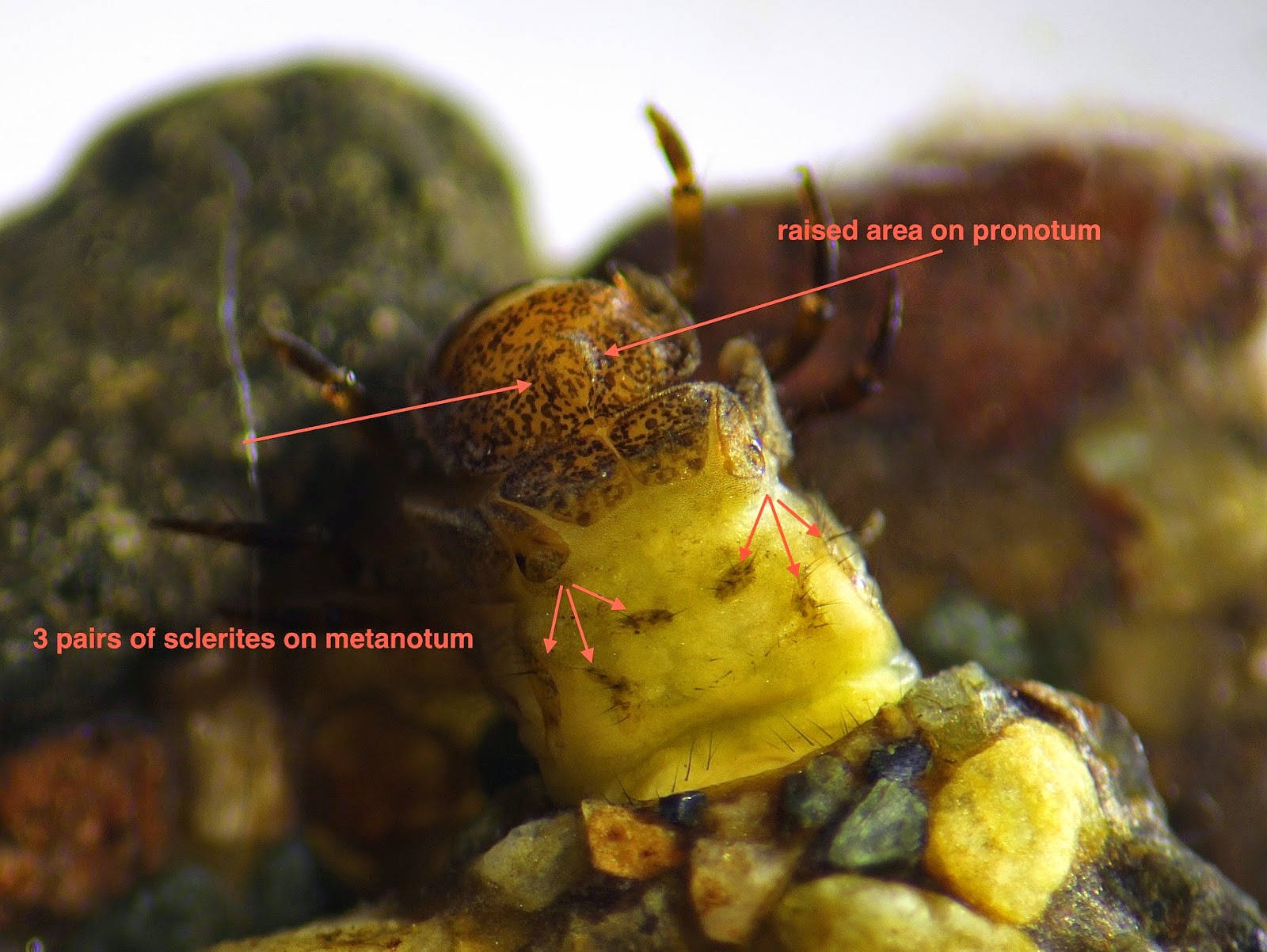
Steven Beaty, "The Trichoptera of North Carolina," p. 87: G. calcarata -- larvae 8-9 mm; 3 pairs of sclerites on metanotum; pronotum with central raised area and anterior margin with conspicuous spicules; sternal thoracic plates indistinct. Common in the Mountains and Sandhills.
1. This larva was almost exactly 8 mm.
2. The 3 pairs of sclerites on the metanotum and the central raised area on the pronotum both came out very well in one of my microscope photos.
3. On. G. fuscula larvae, the "sternal thoracic plates" -- you will recall -- are distinct and look like this.
Here's a look at our larva -- no plates to be seen.
It was indeed Goera calcarata.
I suspect that Goeras are "stream specific" in terms of the species, and G. fuscula larvae are apparently fairly uncommon (Beaty on G. fuscula "Rare with less than 15 BAU records.") (BAU = Biological Assessment Unit) In Entry Run, I see nothing but G. fuscula; in the Rapidan River, G. calcarata. But don't you wonder what determines which species is where? The Rapidan and Entry Run are both in the mountains, both flowing out of the Blue Ridge. Maybe it's size: Entry Run is a small, first order stream; the Rapidan is not.
But think this one over. My good friend who lives in Sugar Hollow on the banks of a "pristine" first order stream, finds nothing by G. fuscula: but on the other side of the valley -- less than 1/4 mile away -- in another "pristine" first order stream, I've found nothing but G. calcarata.
__________________
Sunday, October 5, 2014
The Rapidan River: a young Agnetina capitata and "hundreds" of caddis case-makers
It's a young one (11 mm) -- but it's already gorgeous: the common stonefly (Perlid), Agnetina capitata. Actually, since I so commonly see Paragnetina immarginata at the Rapidan River, I thought that's what it was. But the head pattern didn't look right -- and then I noticed the anal gills. Had to be Agnetina. (No anal gills on genus Paragnetina.)
Since I just wrote about Agnetinas, there's not much point in repeating the keys to identification (genus and species), but they all show up very well on this nymph.
This one has a long way to go before it's mature. It was 5/26 that I found this A. capitata that was ready to hatch.
__________________
1. Odontocerids (strong-case makers)
Most prolific -- the strong-case makers. There were hundreds of them lying on the tops of the rocks. I don't know how many times I looked down and saw 10-12 at a time. It was stunning. What a hatch of "Dark blue sedges" there must be up here in the spring. At this time of year, we often see them grazing on algae. But they'll soon seal up those cases to pupate, hatching in April and May (see Thomas Ames, Caddisflies, pp. 210-214).
The species? Quite sure they were all Psilotreta labida, just about the only species I see (though I have found Psilotreta frontalis, on which see the entries posted on 10/29 and 11/19 of last year). One of the key things to look for on P. labida is the long, acute, anterolateral projection on the pronotum. (Beaty, "The Trichoptera of North Carolina," p. 15)
I saw so many larvae this morning that I decided to only photograph those with the curved, tapered cases. But many cases are straight.
_________________
2. Brachycentrids (humpless case-makers)
Also prolific. I even found some in the leaf packs, though most were firmly attached to the rocks. Species? What we find is Brachycentrus appalachia, the one that makes these little 4-sided, tapered cases with thin ribbons of bark. Again, I saw hundreds of them. They too will soon seal up their cases, hatching as the "American grannom" in early spring (Ames, Caddisflies, pp. 175-181).
One very interesting photo. The short, stubby front legs, in this photo, were fully extended.
________________
3. Goerids (weighted-case makers)
And, yes, that's a Goera case on which the humpless case-maker is crawling. I had not noticed Goera at all until fall of last year: today, I saw their little cases all over the place. Species? Goera calcarata. Every larva I saw had the normal 2-stone case (see the entry of 9/21). Unfortunately every larva I saw played shy. This is the only time I saw one stick its head out of its case.
________________
Since it's a time of year when I don't expect to see a whole lot at the streams, I was pretty pleased with my findings this morning. And in future trips up to this river, I'll be watching out for the A. capitatas.
Friday, September 26, 2014
Focus, the "Agnetinas" (Common stoneflies, genus Agnetina): annulipes, flavescens, capitata
This morning I went out to the Doyles where, having gotten out of my car, I expected to find nothing at all: the water was just barely flowing. We need lots of rain. Nonetheless, I decided to turn over some rocks and sort through some leaf packs. I didn't see very much, but there were quite a few little Perlids (common stones). At first I dismissed them as baby Acroneuria abnormis nymphs, a common sight in a lot of our streams at this time of year. But, they were very small, and -- I thought -- too dark for abnormis.
As soon as I looked at them through my lens, it was clear that they were Agnetina annulipes. As you know, I commonly see this species in the Rivanna in late summer and fall (see the post from 9/11), but this is the first time I've seen them at the Doyles.
There are three Agnetinas: annulipes, flavescens, and capitata, and I've found all three in central Virginia. The common name is the "Southern Stone": they're found from PA down to FL, and across the south into Alabama, Mississippi, and Louisiana. Agnetina nymphs have two features in common, two features defining the genus: they have a complete setal row at the back of the head (occiput), and they all have anal gills. They are also, according to Beaty, uncommon ("The Plecoptera of North Carolina," p. 15). That may explain why, to date, I've found flavescens only one time, and the same for capitata. A. annulipes, on the other hand, while I don't see it in a lot of our streams, I do see a lot in the Rivanna at this time of year, and without looking real long, I picked up four nymphs today at the Doyles, all of them in the leaf packs.
Here's how we tell the species apart.
I. Agnetina annulipes
This is a nymph that I found in the Rivanna last year (9/18/13), on which we can see all of the critical features: the occipital setal row, the anal gills, and in addition -- following Beaty -- the arms of the "M" pattern on the head point to the rear, tergum 10 is mostly dark, and the terga are banded with the anterior edge of each tergite being dark. Not common enough to establish a tolerance value.
II. Agnetina flavescens
This is another nymph that I found last year (11/9) in the Rivanna. It is similar to annulipes -- with some exceptions. 1) Note that tergum 10 is this case is light, and 2) the pattern on the wing pads is totally different: it somewhat resembles the symbol for batman! Not common enough to establish a tolerance value. I hope to find more of these in the Rivanna this fall: it's one of things that keeps taking me back.
I've only found one: on 5/26 of this year at the Rapidan River. As I've noted before, this species is "listed by NC Natural Heritage Program as Significantly Rare (2010)." (Beaty, p. 15) Again, a quite distinct pattern on the wing pads. And in addition, the banding on the tergites is different than we see on the other two species: here the dark bands are on the posterior edges of the terga. One more thing noted by Beaty, the "posterior margins [of the terga are] dark and with a triangular mesal area anteriorly projecting forming an apparent mid-dorsal longitudinal stripe." That stripe is easy to see on this nymph that looks to be fully mature.(Beaty, p. 15) Not common enough to establish a tolerance value.
_____________________
I sure was surprised to see annulipes at the Doyles River this morning. I love surprises!
Thursday, September 25, 2014
Framing some photos: what to use?
I have a wall in my lab that's in need of a picture. So I thought -- "Why don't I pick out four of my favorite photos from those that I've taken over the years and frame them?" Seems fitting.
These were my choices.
1. In the photo at the top of the page -- the Perlodid stonefly, Isogenoides hansoni. Love the colors, love the composition.
2. A second Perlodid stone -- Helopicus subvarians.
3. Two case-makers lying side-by-side: the humpless case-maker, Brachycentrus appalachia, and a small, little mountain case-maker, Apatania incerta.
4. And the weighted case-maker that I just found on Sunday, Goera fuscula. Such an unusual case.
Should make a nice picture -- but I had to leave so many things out! For example...
I. Stoneflies
1. Giant stonefly, Pteronarcys biloba. Great colors, and this one is almost fully mature.
2. Another Perlodid stonefly, Malirekus hastatus. They're killers -- but they sure are pretty.
3. And a third Perlodid, Isoperla orata. This one is rare -- Rapidan River, of course.
5. Small winter stonefly, Allocapnia pygmaea
6. And one of the smallest stoneflies we see, a Leuctrid (needle fly), genus Leuctra.
________________
II. Mayflies
1. A rare one, the spiny crawler mayfly that I find at the Rapidan River, Ephemerella subvaria.
2. And a real beauty, the small minnow mayfly, Acentrella nadineae.
3. Another small minnow mayfly, Baetis tricaudatus.
4. And another small minnow mayfly, Heterocloeon amplum.
________________
III. Caddisflies
1. The free-living caddisfly larva, Rhyacophila nigrita.
2. And another case-maker, a Lepidostomatid, genus Lepidostoma. What an awesome case.
Hmm...maybe I need to make it a poster. With all of this beauty out there, be careful where you walk when you step into a stream!
Subscribe to:
Posts (Atom)


