Sunday, November 2, 2014

Small beginnings: winter/spring insects at the Rapidan River


A challenging day for photography.  It was cold -- 46ยบ -- and extremely windy (= watering eyes).  But the real challenge was the sun -- which kept popping in and out of fast moving clouds.  But I still did alright.

I continued to see strong-case makers (Odontoceridae) and humpless case-makers (Brachycentridae) -- but not nearly as many as I saw here last month (10/5).  Rather, the small mayflies and stoneflies that will mature in the spring are suddenly here in big numbers.  I left the pronggilled mayflies alone, choosing to focus instead on...

1.  The spiny crawler mayfly, Ephemerella subvaria (in the picture at the top of the page).  Dozens and dozens of them in the leaf packs, and you can see them at once because of their colors.  The tibial banding, by the way is a key for identification.


They'll be hatching in March and April, and when mature they look more like this.

_________________

2. Perlodid stonefly, Isoperla montana/kirchneri.  First of the season.


Very, very small: I'm pleased that this turned out as well as it did.  Given the size -- about 3 mm -- I should hesitate on the ID,  but I feel pretty confident.  Look at one that's fairly mature.


There are commonly two dark bars at the back of the head, and the abdomen's striped with the middle stripe formed by a series of crosses (or a line with dots on either side).  That middle stripe was already clear in a microscope view, and you can actually see the dark bars at the back of the head on this tiny nymph.

________________

3.  Another small Isoperla -- about 7 mm -- which turned out to be I. similis.


These mature rather quickly.  I found this one in February last year.


The head pattern is distinctive: "head brown with a pair of pale spots near labral suture, a pale M-shaped mark anterior to median ocellus and pale marks anterolateral to the lateral ocelli."  (Beaty, "The Plecoptera of North Carolina," p. 24)  Difficult to see the "pale spots near the labral suture" on this young nymph.  But you can see them if you look closely.

________________

3. Common stonefly, Paragnetina immarginata.


So much nicer when we find them in July.  Spectacular, really.


Still, we can already see a lot of key features.  "M-pattern with medial pale line extended anteriorly, often connected to pale frontoclypeal margin; yellow femora distinctively patterned with dark brown longitudinal bar extending about 2/3 the length; abdominal terga banded, anterior half dark; anal gills absent." (Beaty, p. 18) All Paragnetina nymphs have a complete setal row on the occipital ridge (back of the head).

________________

4. And I saw a number of, not so small, flatheaded mayflies, Maccaffertium pudicum.


When mature, this is one of the biggest Maccaffertiums that we see: 11-14 mm.
_________________

Such a pleasure to go to a stream where there are so many insects to see.

Tuesday, October 28, 2014

Small winter stones and the Perlodids: the new season begins at Buck Mt. Creek


I would have bet money that I'd find them today -- and I did: Clioperla clio Perlodids and Allocapnia small winter stones (Capniidae).    C. clio in the photo above, and here's one of 3-4 of the small winters that I found in the leaves.


The small winter stoneflies are very small at the moment: this one was 4 mm.  The C. clio Perlodid, at 7 mm, was a little bit bigger.

To me, the appearance of these particular stoneflies marks the start of the new season.  While we can see common stoneflies (Perlidae) -- especially Acroneurias -- just about anytime of the year (most Perlids have a 2 year life cycle), small winter stoneflies are univoltine (1 year life cycle) with rapid growth: they show up sometime in October (usually late), and they're pretty well gone by the beginning of March.  Here are some Allocapnia nymphs from previous years.

November 2012


December 2012


Perlodid stoneflies are also univoltine, but we can see them right into June, though the latest I've found C. clio was April.  Pretty spectacular when they're fully mature.


Pretty nice in February as well.  (Last year, Buck Mt. Creek)

_________________

Acroneuria carolinensis/Acroneuria lycorias

But I found another stonefly this morning in Buck Mt. Creek.  This.


Having just reviewed the ID of Acroneuria carolinensis (see the entry of 10/23), I knew right away what it was: A. carolinensis, right?  Still, given the problem of confusion with A. lycorias nymphs, I thought I'd best look for anal gills.  And look what I found!


I'll be damned: it could be A. lycorias.  You'll recall that Frison had argued that A. carolinensis and A. lycorias look much alike, but carolinensis lacks anal gills, lycorias has them.  But then, Beaty muddies the waters by saying that on carolinensis "anal gills usually absent," while on lycorias nymphs "anal gills [are] usually present, sometimes small."  ("The Plecoptera of North Carolina, p. 14 -- I've italicized the usually for emphasis).   So we can't be certain of the ID, but A. lycorias may be found in some of our streams.

(By the way, the nymphs that I found at the Doyles River last week did not have anal gills -- double checked.  I would not be surprised to find A. carolinensis (TV of 1.2) at the upper Doyles, and A. lycorias (TV of 2.1) in Buck Mt. Creek.)
_______________

Other pix from this morning.


Sunday, October 26, 2014

Giants and Goerids -- back to Sugar Hollow


It was a beautiful day to go into the mountains -- so back to Sugar Hollow even though I didn't expect to see very much.  And I didn't: I saw a lot of Giant stoneflies, various sizes, and some Goerids (weighted-case makers), and that's about it.  It's still early for much activity in these small mountain streams.

I wasn't going to file an entry today.  Still, when I downloaded my photos, two things commanded attention.  The first -- I got some very nice photos of two Giant stones, one little one large (though it won't mature until spring).


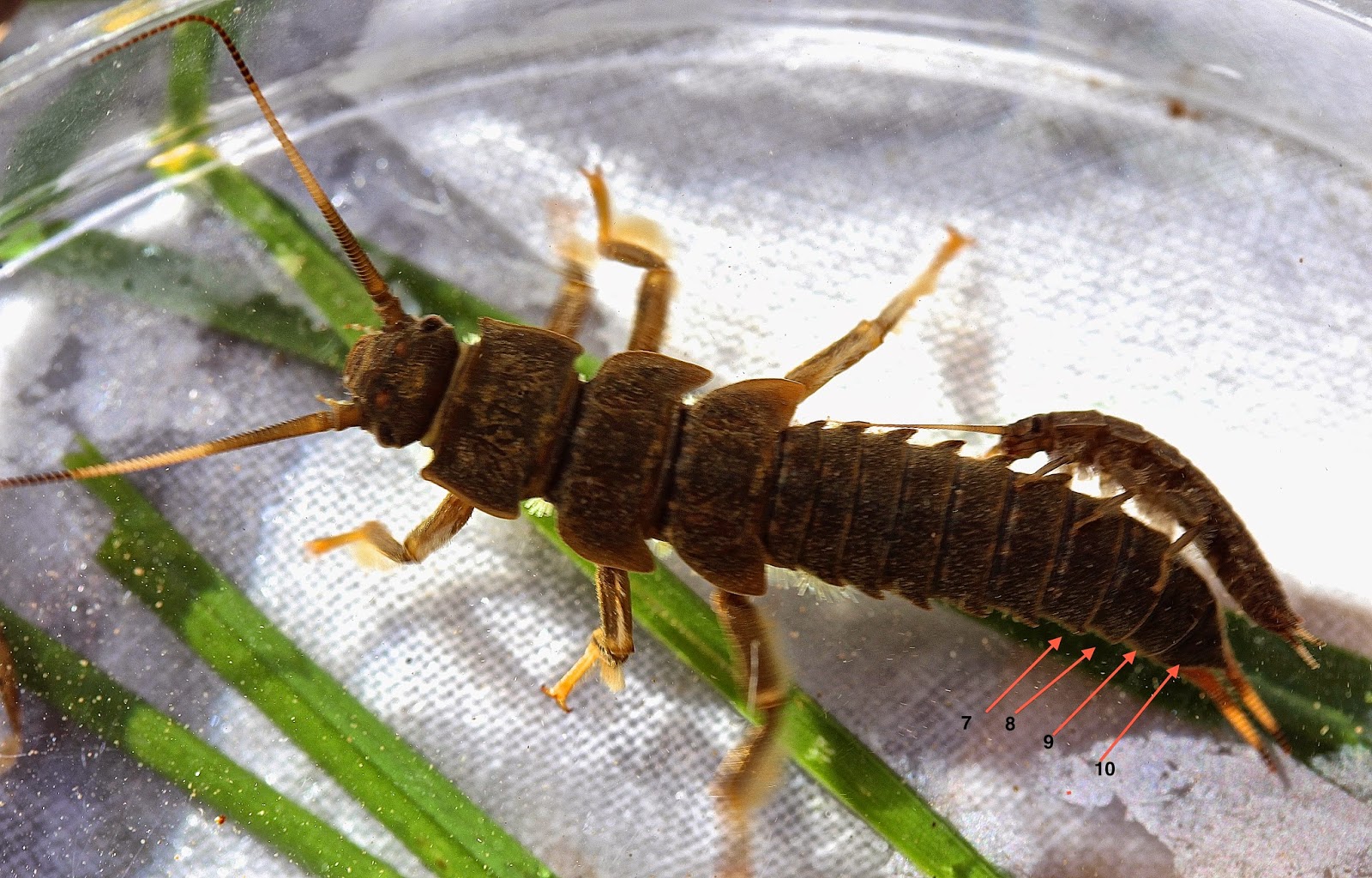
These are Pteronarcys proteus which, to date, is the only species I've found in this stream.   Note that the lateral abdominal hooks are "appressed" (i.e., they don't stick out to the sides as they do on P. biloba).  But while they are easy to see on abdominal segments 1-6, they are "not conspicuous on abdominal segments 7-8" (Beaty, "The Plecoptera of North Carolina," p. 28).

________________

The second thing that I noted had to do with one of the Goerids I kept for my photos.


If you look closely at the 1st abdominal segment, you'll see that the dorsal hump is very prominent -- the lateral humps are there, but they do not stick out from the sides as we'd expect on this type of larva.


This is interesting because in an article written a long time ago -- 1921 -- John Thomas Lloyd noted this feature as characteristic of Goera calcarata.  "On the first segment the dorsal hump is well developed; the lateral humps are present, but flattened."  ("The Biology of the North American Caddis Fly Larvae," Bulletin of the Lloyd Library of Botany, Pharmacy and Materia Medica: Entomological Series, No. 1, p. 81.)  And it was indeed G. calcarata -- 3 pairs of metanotal sclerites and no sternal plates (see Beaty, "The Trichoptera of North Carolina," p.87).   Pretty neat.
________________

Other pix from this morning.


Nice supply of colorful gravel and pebbles in this particular stream.

Thursday, October 23, 2014

The common stonefly Acroneuria carolinensis -- or is it?!


I've had several e-mail discussions this year with Steven Beaty about genus Acroneuria common stones (Perlidae) -- a genus, he feels, is badly in need of re-search and revision.  This came up in April when I "might" have discovered an A. internata (see the entries of 4/20 and 4/22), and it came up last month when I found A. arenosa in the Rivanna, a nymph I had previously thought was a "brown" A. abnormis (see the entries of 9/1 and 9/4).   In those discussions, Beaty mentioned in passing that if I thought distinguishing those species from one another was tough, just wait until I tried to distinguish A. carolinensis from A. lycorias.

Huh.  I've seen -- I thought -- A. carolinensis a lot in the past -- and posted a whole lot of photos -- I've never looked for A. lycorias: I didn't know this ID was in doubt.
________________

I commonly find what I thought were A. carolinensis nymphs in the Doyles River at what I call my upper site, which is where I went this morning.  (Actually, I started at Patricia Byrom Park.  But with the small streams there virtually dry, I backtracked to the Doyles.)  So I thought I would look into this problem.

No problem finding the nymphs: I found two in short order.  The one at the top of the page (another photo),


and this one.


So, which are they, Acroneuria carolinensis or Acroneuria lycorias?  Let's look at Beaty's descriptions.  ("The Plecoptera of North Carolina," p. 14)

A. carolinensis - male nymphs 17-19 mm, female nymphs 21-23 mm; dorsum of head with light M-shaped pattern; dorsum of abdomen banded, anterior half light and posterior margin of tergites dark; anal gills usually absent.  Relatively common in the northeastern Mountains and in the Sand hills year round but particularly in the early winter.

Perfect fit.  Light "M" pattern, tergites banded, dark in back, no anal gills.


A. lycorias -- male nymphs 15-18 mm, female nymphs 17-20 mm; dorsum of head with light well-developed M-shaped pattern; posterior margins of tergites dark; anal gills usually present, sometimes small.  ... Found in Mountains (mostly the Catawba River basin) and Sand Hills.  Though uncommon, nymphs can be collected year round.

As you can see, the species seem to differ only in one way:  the presence or absence of anal gills.  Of course the catch is that accoring to Beaty they are usually absent on carolinensis, and usually present on lycorias.  That sort of leaves the door open!

Since we can't clearly decide on the species using Beaty's descriptions, let's see if there's other information around.  As it turns out the confusion of the two species was noted as early as 1942 by Frison (T. H. Frison, Studies of North American Plecoptera: With Special Reference to the Fauna of Illinois:  Urbana, Illinois, Natural History Survey Division, pp. 281-284).    On A. carolinensis he says-- "particularly important features of the color pattern are the arrangement of the light and dark areas on the dorsum of the head and the banding of the abdominal tergites; in color pattern the nymph is very similar to lycorias, but it differs from the nymph of lycorias in the lack of anal abdominal gills." (p. 282)  It would seem that at that time, at least, the presence or absence of anal gills was taken as definitive.  Perhaps things have changed.

Frison does one other thing that might be useful in deciding this matter.  He provides full illustrations of both of the nymphs (A. carolinensis, on p. 282; A. lycorias on p. 283).   In those illustrations, the head patterns are not exactly the same.   The carolinesis head looks exactly like the heads of the nymphs that I found this morning.  Note two things: 1) the wide, light area at the back of the head forms an arc that reaches up to the sides of the eyes, and 2) that light area intrudes into the dark transverse band on the head on either side of the ocellar triangle.  I.e. this is what we see.

e

Neither of those things is true on the lycorias head.  That is to say, the light area at the back of the head essentially forms a closed rectangle at the back of the head --it isn't shaped like an arc, and it does not intrude into the transverse band.  Also, it's completely surrounded by a dark border.  So, fill in everything surrounding the rectangle with brown.


Hope your imagination is good: best I can do.
_________________

What that all comes down to is this: I feel pretty confident that the nymphs that I'm finding are Acroneuria carolinensis, and I'll continue to use that ID.  But I will be checking for any sign of anal gills.

________________

Oh.  Lots of Strong-case makers in this river as well.  Psilotreta labida from what I can tell.


And there was a freshly molted Acroneuria nymph -- probably A. carolinensis -- and this little crittered crawled onto its head while I was taking my photos!


Saturday, October 18, 2014

Finally rain! Which of course produces bad photos


We have water again in our streams.  Unfortunately, the rain was so heavy -- at our house, I measured 3.5" -- that it muddied up a lot of the water.  And, that can lead to photos like the one at the top of the page.  (Lots of silt on the head and pronotum: on the case as well.)

Back to Sugar Hollow this morning to a small stream just to the west of the stream that I went to last week (10/9), not at all far away.  And last week, you'll recall, I found these beautiful, "clean," Goeras (weighted-case makers).


The heads and pronota are easy to see.  Not so when the larva is covered with silt.


Ah well...at least I'm pretty sure now that Goeras inhabit most -- if not all -- of these small streams I explore.

Species?  Again G. calcarata.  No sign of sternal plates (see the post of the 10th); and three pairs of sclerites on the metanotum.

________________

I didn't see  many insects today -- other than two Goeras.  There was a fair number of common stoneflies in the leafpacks (leaves are building up and decomposing) -- Acroneuria abnormis and Eccoptura xanthenses.  I was hoping to see the first Perlodid stones of the season: maybe next time.