Monday, January 19, 2015

Rapidan River, Part I.: A significant find -- Perlodid stonefly, Isoperla lata


I'm disappointed that my specimen isn't perfect: one of my other stoneflies tried to eat this nymph before I could come to the rescue!  Still, I knew when I was taking my photos that this was an Isoperla Perlodid I had not seen before.  It keys out to Isoperla lata.

I. lata -- nymphs ~13 mm; lacinia distinct, broad, apex as wide as base and covered with a dense brush of setae; head with wide, enclosed pale area anterior to median ocellus; ocellar triangle open behind; pronotum with dark border except extreme lateral margins; abdomen with longitudinal stripes, lateral stripes wide with median stripe narrow and interrupted.  Nymphs are relatively rare and are collected from the Mountains only from September through May.  Listed by NC Natural Heritage Program as Significantly Rare (2010).    (Beaty, "The Plecoptera of North Carolina, p. 24)

1. This nymph, still immature, was about 9 mm.

2. The lacinia is indeed very distinct -- very broad and very dense setae.  My microscope photo is a clear match to Beaty's description.


3.  For the head and pronotum, let's again use a microscope view.


While we still have this photo, let me quote from Frison as well (T. H. Frison, Studies of North American Plecoptera, Urbana, Illinois, 1942, p. 334).  "Dorsum of head with a small yellowish spot anterior to median ocellus, another yellowish spot in ocellar triangle, and with a large yellowish area on posterior part of head running forward on each side between compound eyes and lateral ocelli.  Pronotum with a broad, median, longitudinal, yellowish stripe, much narrower at anterior end than posterior end; areas each side of stripe brown to black."  All very clear in that photo.

4.  As for the abdominal longitudinal stripes -- they're a bit messed up since someone took a bite out of the body (the culprit will soon be revealed!), but the lateral stripes are wide, and the median stripe is "interrupted."


So we have a new one: Isoperla lata.  The Rapidan River is rich in Isoperla Perlodids.  This species will be added to our EPT taxa list.
________________

I'll write up "Part II." of this entry tomorrow: I'll return to the issue of Paraleptophlebia species ID.  The river is loaded with pronggilled mayflies at this time of year.  But in this entry, let me include some additional photos from today's trip.  I found some beautiful insects -- as I always do when I go up to this river.

1. Giant stonefly, Pteronarcys biloba.  This was a bruiser -- close to 2 inches long.


2. One of my favorites, the Perlodid stonefly, Isogenoides hansoni.  "Relatively uncommon" according to Beaty and this is the only place that I've seen it.  (Ahem... they eat other stoneflies!)


3. Spiny crawler mayfly, Ephemerella subvaria.  Also rare/uncommon.  Two beauties today, a male and a female.

female


male


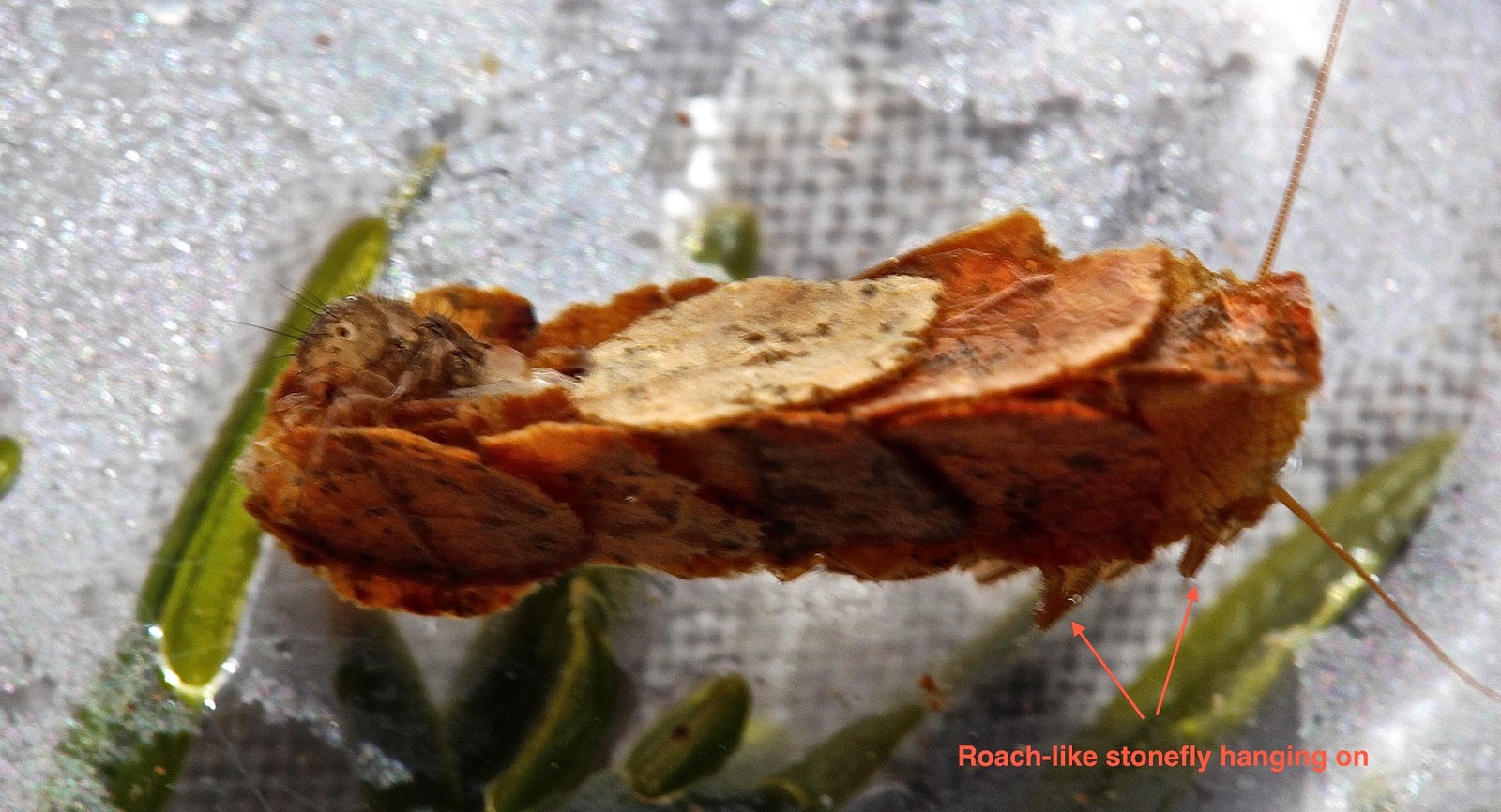
4. And of course, I saw lots and lots of Uenoids.  Just took a picture of one.  It was Neophylax consimilis, the only species I've seen in the Rapidan River at this location (entrance to Graves Mill path, SNP).

________________

On to the pronggills tomorrow.  Today it was all about I. lata.


Sunday, January 18, 2015

Something new to explore: distinguishing the species of Paraleptophlebia (pronggilled mayflies)


My good friend in Sugar Hollow -- who is often ahead of me in doing research -- has drawn my attention to some interesting work in Knopp and Cormier (Mayflies: An Angler's study of Trout Water Ephemeroptera, pp. 268-269) on the nymphs of Paraleptophlebia (pronggilled mayflies: "Blue Quills" to fly fishermen).   They note that some gills have tracheation, others do not, and there are differences from species to species in the ratio of the length of the gill filaments (remember that Paraleptophlebia gills are "forked").  Thus, in the gill pictured here


the gill has tracheation, and the ratio seems to be 1:1, while in the gill pictured here,


while it too is tracheated, has a ratio that is closer to 1:3.  On the other hand, with the nymph in the photo at the top of the page, the gills lack tracheation, and the ratio is more like 1:5.

________________

Super!  We have something to go on when we look at our nymphs -- and this is Paraleptophlebia season.

Of the 11 nymphs studied by Knopp and Cormier, only four are found in Virginia: P. adoptiva, P. debilis, P. mollis, and P. guttata.  As I looked at my photos this morning, I was pretty sure that I spotted 3 of these species: adoptiva, mollis, and guttata.  Have a look.

P. adoptiva?


P. mollis?


P. guttata


P. adoptiva gills have tracheation with a ratio of 1:1.  Looks good.  P. mollis gills have tracheation with a ratio of 1:3, and the gills of P. guttata lack tracheation with a ratio of 1:5.  Got them!  I was very excited.  But then I read more.  There is another distinction to make: some nymphs have "spines" or "posterolateral projections" on abdominal segment 9 -- or 8 and 9 -- while others do not.   On P. adoptiva, such spines are absent, but they seem to be present on the nymphs that I've found.


The same is true for P. mollis -- i.e., no spines on the abdominal segments.  Unfortunately my P. mollis seems to have them on 9.


But I did have one spot of success.  P. guttata does have a spine on segment 9.  And while I'm not sure you can pick out in this photo


I could see it in my microscope view, so I hope you'll trust that it's there.
_________________

So where does that leave us?  Using the Knopp and Cormier observations, I'd say I've found at least 3 different Paraleptophlebias, so far, in our streams.  One is P. guttata.  The others -- while resembling P. adoptiva and P. mollis -- appear to be unidentifed (by me) at this point.  But then Beaty notes that we should leave Paraleptophlebia ID at the level of genus, with at least 8 different species confirmed in NC: adoptiva, assimilis, debilis, guttata, moerens, mollis, swannanoa, and volitans.  (Beaty, "The Ephemeroptera of North Carolina, p. 40)  There is, I take it, a "key" to the ID of some of these nymphs, but it's in a book that's not easy to find: J.D. Unzicker and P.H. Carlson, Aquatic Insects and Oligochaetes of North and South Carolina, 1982.  A trip to the university library might be in order.  In any event, we certainly have features to look for in the nymphs that we find in our various streams.  Let's see what I run into tomorrow.


Saturday, January 17, 2015

At high elevation, some very small Uenoids -- Neophylax aniqua


Back to that pristine small stream in Sugar Hollow where we keep climbing higher, hoping to find two uncommon Uenoids: N. ornatus and N. atlanta.   And I picked up a bunch of tiny Uenoids -- all of which turned out to be N. aniqua.  This is a species that is sometimes found with N. ornatus, so we're looking in the right places.  "Neophylax aniqua usually occupies the most upstream position in the longitudinal sequence of species in streams where it occurs.  Larvae of N. aniqua occasionally occur together with larvae of N. concinnus or N. ornatus but are segregated from them by differences in periods of maximum larval growth and adult emergence."  ( R. N. Vineyard, et.al., The Caddisfly Genus Neophylax, p. 43.)


A key feature of N. aniqua -- the stout, semi-blunt frontoclypeal tubercle can be seen even on this very small larva (4 mm).


And a second larva.  Pretty cases.


And I continue to look for our "single gill" Peltoperlid species -- Viehoperla -- but I struck out there as well.  If you look closely you can see the two gills sticking out below the hind wing pad.  This was Tallaperla.


We saw a lot of the "headwater" stream flatheaded mayfly -- Maccaffertium meririvulanum.


And we continued to pick up a lot of small Pycnopsyche gentilis (Northern case-makers) in their 3-sided cases made out of pieces of leaves.  Very young.  The heads will turn orange as they mature.  (This one might have recently molted.)


But there was one surprise.  I picked up a small piece of bark on which I found two "strong case-makers" (Odontoceridae).  I was very excited.  My friend has found Psilotreta rufa up here, a species I've never seen.  But alas, these cases were already sealed for pupation.

________________

Next stop -- the Rapidan River.  Just need another sunny warm day.


Thursday, January 15, 2015

But I do get to see some beautiful streams


I went exploring this morning.  This is a small stream in Patricia Byrom Park, not too far from the parking lot.  It's always looked inviting to me.   It was cold -- 29ยบ -- but the sun was out and the wind was down, so it was time to give it a try.  I can't say I found anything unexpected for this kind of stream at this time of year -- Uenoids, Lepidostomatids, the occasional Eccoptura stonefly, and a few Ameletids -- but there are times when just being alone in this kind of place, with this kind of water, makes for a very nice day.

A few pictures.

1. An Ameletid mayfly, one of several I found on the bottoms of rocks.  You know it's winter, and you know you're in a high quality stream, when you find Ameletids, especially this species -- Ameletus cryptostimulus.


(Since it's been awhile since this has been noted, for a thorough description of mayflies in the southeast, see Beaty, Walters, and Holland, "The Ephemeroptera of North Carolina," [http://portal.ncdenr.org/c/document_library/get_file?uuid=5b6de50a-8f28-42b7-83a2-0e41c7019929&groupId=38364].  Ameletus species are described on p. 1.)
________________

2. A "weighted-case maker" -- and the one that's felt to be "rare" -- Goera fuscula.  This is the one that I see at Entry Run in Greene County.


________________

3. And of all the Lepidostomatids I saw -- and there were a lot of small ones still in sand cases -- the one with the nicest case wasn't home!  I wasn't sure of that when I was taking these pictures.  But what a beautiful case.


________________

4. Oh yes, there was a Uenoid, but my photos didn't turn out all that well.  It appeared to be Neophylax aniqua.


Note the semi-blunt frontoclypeal tubercle.

________________

The very best stream in this park requires a 1.5 mile hike, pretty steeply uphill.  I'll be heading up there in the spring when the insects will be more mature -- and the temperatures a little bit warmer!