Thursday, August 13, 2015

But a few nice photos -- up to the Rapidan River


It's not the best time of year for finding nice insects in Virginia.  Still, I could not not go some place this morning: low humidity and bright blue skies.  So I drove up to the Rapidan River.


In the photos above, a mature small minnow mayfly -- Baetis intercalaris.  Note the pale parentheses marks ( ) on the tergites, one of the keys to identification.  It's one of several small minnows we see in the summer.  All of them hatch in the fall as Blue-winged Olives (BWO's), a hatch that makes for very good fishing.

And here,


that beautiful stonefly, Paragnetina immarginata.  This nymph was around an inch long, and it's still immature.  It will hatch out next summer -- the Golden Stone.


The most prolific insect today?  The "humpless case-maker" Brachycentrus appalachia.   There were literally hundreds of cases attached to the rocks.  One rock alone must have had 100 cases.

But it was one of those days when "the good one got away."  I picked up a nymph that I know was a Perlodid stonefly, but it got out of my bowl on my way back to the car.   Perlodid stoneflies are not at all common in summer months, so I'd sure like to know what it was.  Bummer!

Monday, August 10, 2015

And the spiny crawler nymph was Ephemerella aurivillii, the "Pale Morning Dun"


They covered the rocks in Rock Creek, and for very good reason.  The "Pale Morning Dun" hatch is the mayfly hatch at this time of year in Montana.

I'm hesitant on the species ID for two reasons: the other photos of E. aurivillii I find online don't look exactly the same as those of my nymph; and the nymphs commonly associated with the Pale Morning Dun (PMD) are E. excrucians and E. dorothea infrequens.  Still, the description of E. aurivillii seems to be the best match for our nymph.

Top hind edge of (at least) abdominal segments 3-7 w/small to medium tubercles; hind corners of abdominal segment 3 w/points similar to following segments; front of head smooth no tubercles.  (http://www.flyfishingentomology.com/PNW%20Mayflies.htm)

You can see the smooth head in the photo above.  Here's a look at the abdominal segments.  The "hind edge" in our description refers -- I assume -- to the posterolateral projections.


Try to get a picture of this one on a dark cloudy day!  Have to settle for microscope views.

B. appalachia's Western cousin: B. occidentalis


The Brachentrid (humpless case-maker) that I commonly find at the Rapidan River is the one in the photo above -- Brachycentrus appalachia.  The case is important: 4-sided and tapered, made of neatly wound strips of vegetative matter.   The case-maker I found at Rock Creek last week makes a case that looks much the same, though somewhat distinct given the small pieces of leaves in the middle of the case.


Using our descriptions for caddisflies of the Pacific Northwest, this larva keys out at Brachycentrus occidentalis.  (http://www.flyfishingentomology.com/PNW%20Caddisflies.htm) The shape of the case and the materials used in its construction were a pretty good indication of family and genus, and the deal was sealed when I saw the crease/divot in the pronotum.


Going by the looks of the case, I thought the species was americanus -- "cases typically 4-sided and made of plant pieces, but may incorporate sand other kinds of debris" -- but that didn't work out. B. americanus and B. occidentalis are distinguished by the number of setae on the venter of the first abdominal segment.

americanus -- "1st abdominal segment w/2 (not 4) long, dark hairs in the middle."

occidentalis -- "Underside of first abdominal segment w/4 long, dark hairs in the middle."

Our larva has four.


But there is more.  Two other features of B. occidentalis: 1) "only 1 mesonotal sa1 seta," and 2) "posterior opening of case circular."  Both are clear in these photos.


Brachycentrus occidentalis -- American Grannom.

I was so disappointed that I couldn't get any live photos.  Not much we can do with heavy, overcast skies.

Sunday, August 9, 2015

Montana, 2015: some old some new


Another wonderful trip to Montana.  We fish out of Missoula, floating -- this year -- the Blackfoot River, the Upper and Lower Clark River,  and Georgetown Lake, one of my favorite places.  We also waded Rock Creek.  In the insect department I found a number of new things, but I also found a number of Tricos (Leptohyphidae, genus Tricorythodes).  They were hatching on all of the rivers.


The long middle tail is one of the keys to identification.  So too are the triangular, operculate gills.   (For the nymphs and larvae I find in the Northwest, I use the keys provided by Flyfishing Entomology.  For the descriptions of mayflies, go to http://www.flyfishingentomology.com/PNW%20Mayflies.htm.)


We found prolific hatches of Tricos, especially on the lower Clark Fork.  My friends took some really nice fish (19", 20"), using dry fly imitations.  While we have Tricos in our Virginia rivers as well, it's unlikely that we have the same species.  These apparently are Tricorythodes minutus.
__________________

But I was delighted to find something new.  Number one -- the flatheaded mayfly, Heptagenia solitaria (Gray Fox, Ginger Quill Spinner).


For the description, see the Flyfishing entomology website at the same site noted above.  Quoting that source: "Heptagenia -- Similar size and shaped gills on all segments; additionally, fibrilliform gills on segment 7 as well as on other;  tarsal claws with single basal tooth, no denticles.  3 tails.  solitaria -- Paired white spots on tergites; tufts on 7th gill."   My photos of the tarsal claws just didn't turn out.  But the other features are clear in the photos above.  For a closer look at the fibrilliform on segment 7 and the paired light spots on the terga, here's a microscope photo to use.

________________

Number two was a new common stonefly (Perlidae), Hesperoperla pacifica.   Found this one at Rock Creek on a rainy, dark, cloudy day.  For photos this is the best I could do.


As you can tell from the short wingpads, this was a young one.  It will probably hatch sometime next summer (Golden Stone).  For the genus and species descriptions we turn to the following page: http://www.flyfishingentomology.com/PNW%20Stoneflies.htm.  "Hesperoperla --Paraprocts are small and triangular and 9th seg bears a large quadrangular hammer, females have moderately produced subgential plate.  pacifica -- Nymphs w/wide longitudinal (hourglass-shaped) yellow band extending from middle ocellus to labrum; fluffy white gills between its tails.  Habitat preference: fast rocky runs & riffles."   Rock Creek is a "fast rocky run."

Not sure of the gender ID, but to me this looks like a male.


For other features --


I found two other things at Rock Creek that I need to ID -- a mayfly nymph and a cased caddis.   I'll post photos of those when I know what they are.   But, my live photos were too dark and too blurred (even at ISO 400 and using the flash!), so microscope photos will just have to do.  More to come.
__________________

And this is the kind of Trout we find up at Georgetown.


Georgetown Lake


Thursday, July 16, 2015

Photos from the Moormans


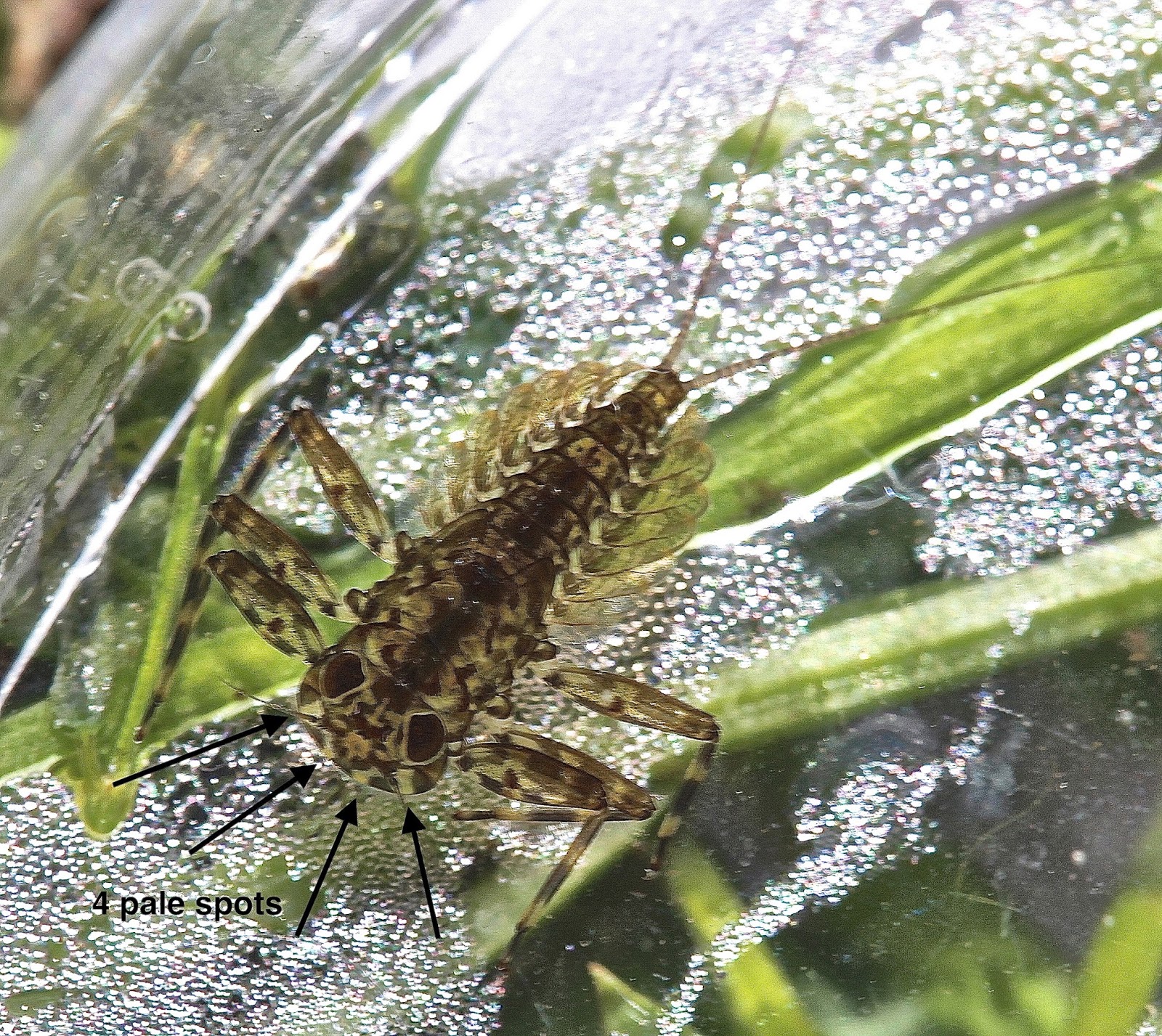
Just a few photos from a trip to the Moormans this morning.  In this photo, a flatheaded mayfly that we see quite a lot in the summer: Epeorus vitreus.  That's a pretty nice photo.  One of the key traits of this species is easy to see -- the four pale spots on the leading edge of the head.


And the flatheaded nymph that I commonly see this time of the year in our mountain streams, Maccaffertium ithaca.

_________________

Still hoping the Rivanna will clear before all of the small minnow mayflies are gone.  Yesterday, it was very high and very muddy.    I'm normally complaining about the lack of water by now, but this year we have just the opposite problem.

Tuesday, July 7, 2015

Maccaffertium ithaca: the flatheaded nymph of the moment


While I've made my way out to some streams, I haven't posted an entry since the photos I've taken just aren't that good.  Cloudy skies.  Nonetheless, what I've been finding does warrant comment.

The flatheaded mayfly at the moment in a lot of our streams -- mid-sized streams -- is Maccaffertium ithaca.   That's one at the top of the page, photo taken on 9/4/13, and here's one of several I found at the Rapidan River on Sunday.


M. ithaca, as Beaty points out ("The Ephemeroptera of North Carolina," p. 19), is a "mountain taxon": we're finding them in the Moormans River, the Doyles River, and the Rapidan River.  I.e. they're in moutain streams, but not the small headwater streams that I visit in the winter and spring.  This is an important mayfly to fly fishermen to whom it's known at the "Light Cahill."  There are evening hatches throughout the summer (June through August).  I remember them well from my years in Vermont.

For a detailed description of the species ID, we use the well-known work of A. F. Bednarik and W. P. McCafferty, "Biosystematic Revision of the Genus Stenonema" (Bulletin 201 of the Canadian Bulletin of Fisheries and Aquatic Sciences).  See page 22.  Here's what they say.

Head -- Brown with pale markings; freckled, pale dots present; large pale areas laterad of compound eyes each divided by brown band extending from eye to lateral margin.  We can see those features in the photo at the top of the page.


They continue by noting the setal patterns on the mandibles and maxillae.  I can see those patterns, but I can't get really good photos.

Thorax -- Brown to grey-brown ... Fore femora with armature in apical 1/2--2/3 dorsal surfaces; posterior margins of fore femora with spinelike setae and hair setae; anterior margins with variable armature; hair setae, if present, shorter than hair setae on posterior margins.

In our picture, the spinelike setae and the long setae on the posterior margin of the fore femora is very clear: hard to see any setae on the anterior margin.


Fore tarsal claws usually not denticulate.

No "teeth" on the claws of this nymph though there are basoventral hooks.


Abdomen -- Dorsally light brown to greyish brown, ventrally pale yellow with dark maculations.  Terga with variable pale areas; at least some with lateral pale areas.

The lateral pale areas are easy to see on this nymph from the Rapidan River.


Sterna 2-8, 3-8, 4-8, or 5-8 with median, sinuate posterolaterally directed, transverse maculations with vertices reaching anterior margins of segments only on posterior sterna; transverse maculations often reduced on anterior sterna; 9 with pair of sublateral to lateral, oblique, dark brown bands, often connected anteriorly on 9, forming an inverted-U.  Lateral projections on segments 7-9 (rarely 6); those on segment 9 shorter than on 8 and shorter than ventral lateral margins posterior to projection bases   That's a lot to look for, but you can see all of those features in the following photo.


Caudal filaments yellow basally, apically often with alternating light and dark segments.  Yes.

__________________

I plan to focus on Maccaffertium nymphs this summer, and I hope to see a number of species.  But I need to get to some streams that aren't in the mountains.  Need a break from the rain.


Saturday, June 20, 2015

Revised EPT List, and yes, those nymphs were Acroneuria evoluta


Still sweating it out -- literally! -- in central Virginia, and it's supposed to be hotter next week.

Steven Beaty has confirmed that, using current species descriptions, the nymph in the photo at the top of the page appears to be Acroneuria evoluta.  (See the entry of 6/12.)  So, it is a species we find in the Rivanna, usually in the fall, and I've found it at Darden Towe Park in C'ville, and in Fluvanna County at the Crofton bridge.  Apparently, this is the first time this species has been recorded in the state of Virginia.
________________

On 9/8/12, I posted an EPT List for central Virginia.  While I've tried to update that as things have proceeded, I think it's worthwhile to post a "revised" list based that shows where things stand at the moment.  Here it is.


              EPT Species List for Central Virginia
              (Albemarle, Greene, Madison, Fluvanna)
                 
I. Ephemeroptera (Mayflies)

1. Ameletidae

1. Ameletus lineatus
2. Ameletus cryptostimulus

2. Baetidae (Small minnow mayflies)

1. Acentrella nadineae
2. Acentrella turbida
3. Baetis flavistriga
4. Baetis intercalaris
5. Baetis pluto
6. Baetis tricaudatus
7. Heterocloeon curiosum
8. Heterocloeon amplum
9. Heterocloeon petersi
10. Iswaeon anoka
11. Labiobaetis propinquus
12. Plauditus dubius

3. Isonychiidae (Brushlegged mayflies)

1. Isonychia sp.

4. Heptageniidae (Flatheaded mayflies)

1. Cinygmula subaequalis
2. Epeorus pleuralis
3. Epeorus vitreus
4. Epeorus fragilis
5. Heptagenia marginalis
6. Leucrocuta hebe
7. Leucrocuta juno
8. Leucrocuta aphrodite
9. Leucrocuta thetis
10. Maccaffertium ithaca
11. Maccaffertium meririvulanum
12. Maccaffertium pudicum
13. Maccaffertium vicarium
14. Maccaffertium modestum
15. Rhithrogena sp. (exilis?)
16. Rhithrogena sp.
17. Stenacron carolina
18. Stenacron interpunctatum

5.  Ephemerellidae (Spiny crawler mayflies)

1. Drunella cornutella
2. Drunella tuberculata
3. Drunella walkeri
4. Ephemerella dorothea
5. Ephemerella invaria
6. Ephemerella subvaria
7. Eurylophella verisimilis
8. Eurylophella funeralis
9. Eurylophella sp. (minimella?)
9. Serratella serratoides
10. Serratella serrata
11. Teloganopsis deficiens

6. Leptohyphidae (Little stout crawler mayflies)

1. Tricorythodes

 *7. Caenidae (Small square-gill mayflies)

1. Caenis sp.

*8. Baetiscidae (Armored mayflies)

1. Baetisca sp.

9. Leptophlebiidae (Pronggilled mayflies)

1. Paraleptophlebia mollis
2. Paraleptophlebia guttata
3. Habrophlebia vibrans
4. Leptophlebia

10. Ephemeridae (Common burrower mayflies)

1. Ephemera guttalata


 II. Plecoptera (Stoneflies)

1. Capniidae (Small winter stoneflies)

1. Allocapnia sp.
2. Paracapnia angulata

2. Leuctridae (Needleflies)

1. Leuctra sp.

3. Nemouridae (Forestflies)

1. Amphinemura sp.
2. Ostrocerca truncata
3. Prostoia completa
4. Soyedina sp.

4. Taeniopterygidae (Large winter stoneflies)

1. Strophopteryx fasciata
2. Taenionema atlanticum
3. Taeniopteryx burksi/maura

5.  Chloroperlidae (Green stoneflies)

1. Alloperla sp.
2. Haploperla brevis
3. Sweltsa sp.

6. Peltoperlidae (Roach-like stoneflies)

1. Peltoperla sp.
2. Tallaperla sp.
3. Viehoperla sp.

7. Perlidae (Common stoneflies)

1. Acroneuria abnormis
2. Acroneuria carolinensis
3. Acroneuria sp. (possibly internata, possibly a variety of abnormis)
4. Acroneuria evoluta
5. Acroneuria lycorias
5. Agnetina annulipes
6. Agnetina capitata
7. Agnetina flavescens
8. Eccoptura xanthenses
9. Neoperla sp.
10. Paragnetina immarginata
11. Paragnetina fumosa
12. Perlesta sp.

8. Perlodidae (Springflies and Stripetails)

1. Clioperla clio
2. Diploperla duplicata
3. Helopicus subvarians
4. Isogenoides hansoni
5. Isoperla dicala
6. Isoperla holochlora
7. Isoperla holochlora "A"
8. Isoperla latta
9. Isoperla montana (group)
10. Isoperla similis
11. Isoperla davisi
12. Isoperla orata
13. Isoperla orata (variant form)
14. Isoperla sp.VA
15. Malirekus hastatus
16. Rememus bilobatus

9. Pteronarcys (Giant stoneflies)

1. Pteronarcys biloba
2. Pteronarcys dorsata
3. Pteronarcys proteus


III. Trichoptera (Caddisflies)

1. Rhyacophilidae (Free-living caddisflies)

1. Rhyacophila carolina
2. Rhyacophlia fuscula
3. Rhyacophila nigrita
4. Rhyacophila glaberrima
5. Rhyacophila ledra/fenestra
6. Rhyacophila sp. (banksi?)

*2. Hydroptilidae (Micro caddisflies)

1. Hydroptila sp.

3. Glossosomatidae (Saddle-case makers)

1. Glossosoma nigrior

4. Philopotamidae (Fingernet caddisflies)

1. Chimarra sp.
2. Dolophilodes distincta
3. Wormaldia sp.

5. Polycentropodidae

1. Polycentropus sp.

6. Hydropsychidae (Common Netspinners)

1. Ceratopsyche alhedra
2. Ceratopsyche bronta
3. Ceratopsyche morosa
4. Ceratopsyche slossonae
5. Ceratopsyche sparna
6. Cheumatopsyche sp.
7. Diplectrona modesta
8. Diplectrona metaqui
9. Hydropsyche betteni
10. Hydropsyche rossi
11. Hydropsyche venularis
12. Macrostemum sp.

 *7. Phryganeidae (Giant case-makers)

1. Phryganea sp. (sayi?)

8. Brachycentridae (Humpless case-makers)

1. Adicrophleps hitchcocki
2. Brachycentrus appalachia
3. Micrasema wataga
4. Micrasema charonis
5. Micrasema bennetti
6. Micrasema sp. (scotti?)

9. Lepidostomatidae

1. Lepidostoma sp. (at least 2 different species, possibly more)
2. Theliopsyche sp.

10. Limnephilidae (Northern case-makers)

1. Ironoquia punctatissima
2. Pycnopsyche gentilis
3. Pycnopsyche scabripennis
4. Pseudostenophalyx sparsus

11. Apataniidae

1. Apatania incerta

12. Goeridae

1. Goera calcarata
2. Goera fuscula

 13. Uenoidae

1. Neophylax oligius
2. Neophylax consimillis
3. Neophylax aniqua
4. Neophylax mitchelli
5. Neophylax fuscus
6. Neophylax concinnus

14. Leptoceridae (Long-horned case-makers)

1. Nectopsyche equisita
2. Oecetis sp.
3. Ceraclea maculata

15. Odontoceridae (Strong case-makers)

1. Psilotreta labida
2. Psilotreta frontalis
3. Psilotreta rufa

16. Molannidae (Hooded-case maker)

1. Molanna blenda

As I've done in the past, I will make changes to this as needed.