Tuesday, September 5, 2017

Another brushlegged nymph from Buck Mt. Creek: see no reason to doubt the ID -- Isonychia georgiae


I took photos of two of these nymphs yesterday: this is the second.  The morphology this time really confirms, I think, the ID of Isonychia georgiae.

"Filamentous forecoxal gills each with single filament."


Yes.  "Abdominal sterna with markings similar to any of Figs. 2.386-2.389."  Figure 2.388 looks something like this.  (.°.)  In the middle of the sterna there are what look like parentheses marks.  Above and between those marks there is a small pale circle, while in-between those marks at the bottom there are two smaller pale dots.  Have a look at sterna 6-8 on our nymph.


Bingo!  That pattern's as clear as can be, especially on sterna 6.


Finally, "Abdominal sterna 6-8 with markings similar to any of Figs. 2.386-2.388; abdominal terga yellowish brown to dark reddish brown (with or without lighter mid-longitudinal stripe)...... Isonychia georgiae."  As we've seen, we have an exact match for pattern 2.388.  I'd say the terga are dark reddish brown.


One other thing I might mention, that the gills are rosy/purplish in color is apparently also used in diagnostics.  (See the comment by Roger Rohrbeck at http://bugguide.net/node/view/1387557.)

Monday, September 4, 2017

Exploring species ID for Brushleggged mayflies (Isonychiidae)


Brushlegged mayfly nymphs are fairly easy to find -- if not prolific -- in many of the streams that I visit: the Rivanna River, Buck Mt. Creek, the Rapidan River, and so on.  I've taken photos of many of them over the years but no longer bother since they all look the same and species ID isn't encouraged.  Leave them at genus: Isonychia.

But emboldened by the species descriptions in our new key (Larvae of the Southeastern USA: Mayfly, Stonefly, and Caddisfly Species, pp. 126-129), I've decided to look more closely at what I'm finding this year.  All the same species?  Species that vary by stream?  Can I decide on the species with any exactness?  That's why I was excited this morning to find this nymph at Buck Mt. Creek.  It looks nothing like the brushlegged nymphs that I commonly see, which look like this.


Clearly visible here is a wide, pale stripe that runs from the head to the tails.  Nothing like that on the nymph that I found today.


Intriguing.  Let's see what we can find out from our key.  Couplet one.

239  Filamentous forecoxal gills each with single filament..........240
239' Filamentous forecoxal gills each with cluster of filaments.........244

Ours are single.


(Before I proceed, let me note that if I find any nymphs with a cluster of filaments on each of the gills -- and I hope that I do -- it may be difficult for me to make any headway.  Identifications in that case require seeing setae on the median ridges of gills -- I don't have the magnification required to carry that out.)

240  Abdominal sterna 6-8 with marking similar to any of Figs 2.386-2.389 ............  241
240' Abdominal sterna 6-8 not exactly matching any of the above variations...........242

Let's look at the sterna.


There clearly are markings on 6-8 (on 5 and 9 as well for that matter), and it looks something like this: (. .) -- a parentheses with two small dots in-between.  That pattern is a very good match for variation 2.388 (p. 127).   On to 241.

241 Abdominal sterna 6-8 with markings similar to any of Figs. 2.386-2.389; abdominal terga yellowish brown to dark reddish brown (with or without lighter mid-longitudinal stripe) .....Isonychia georgiae
241' Abdominal sterna 6-8 with markings similar to Fig. 2.389; abdominal terga light orange-brown with indistinct mid-longitudinal stripe (stripe interrupted by reddish-brown posterior margins of terga 2-9)........ Isonychia obscura


Tough call on the color of the terga since they're really a mix of yellow and brown.  Still, given the match with illustration 2.388,  I'm tempted to propose an ID of Isonychia georgiae.
_________________

Well, it's a start.  Don't expect any dogmatic assertions on species ID for the brushlegged nymphs that I see.  Still fun to see what we come up with.  If the other nymph that I showed you --


had the single filament forecoxal gills, by the way, it would key out to Isonychia serrata ("Abdominal terga with wide mid-longitudinal stripe on terga 1-9").  Pretty much a slam dunk on that one.

Thursday, August 31, 2017

Stenacron, Acroneuria arenosa -- and other things at the Rivanna


On the first rock I turned over this morning -- at the Rivanna at Crofton -- there were 3-4 Stenacron nymphs; took me by surprise.  As you can tell by the wing pads on this one, it was fairly mature which made for some very nice photos.


The genus call on these nymphs -- Stenacron -- is fairly easy to make:  they're long and slender, and the gills on terga 1-6 are sharply pointed with the gill on segment 7 being no more than a string.  (See Steven Beaty, "The Ephemeroptera of North Carolina," p. 42)  Here's a photo of one that I found some years ago.


For that matter, the species ID isn't too difficult either.  This is Stenacron interpunctatum.  Two things give it away.  1) The "mid-dorsal streaks" on the abdomen are very distinctive, and 2) the "pale spot anterior to [the] median ocellus [is] approximately as long as wide [and] may be triangular to irregularly shaped."  (Beaty, p. 42)  Bingo.


Beaty notes that S. interpunctatum is "the most common and tolerant Stenacron species in NC": probably the same here in VA.  Still, I think it's one of the more attractive flatheaded mayflies.
________________

I also picked a couple of common stoneflies (Perlidae) both of which turned out to be Acroneuria arenosa.


I've gone back and forth on the species ID for these nymphs:  A. arenosa or A. evoluta?  The difference is slight.  While both have anal gills -- clearly visible in both of those photos -- the terga on A. evoluta are "uniformly brown" (Beaty, "The Plecoptera of North Carolina," p. 37), but on A. arenosa there's  a "narrow, pale anterior band" on each of the segments.  In the past, I've never seen that "pale, narrow band" so I've been tempted to go with A. evoluta.  But I could easily see it on both of these nymphs.


Acroneuria arenosa, I'm a believer.
__________________

I made one other find, not something I've seen before in the Rivanna.


The dragonfly nymph -- Macromiidae.  Might have to key this one out to the level of genus.  This was a BIG, BIG nymph.
_________________


Need rain!

Wednesday, August 23, 2017

Somehow I missed this: Clubtail dragonfly, genus Ophiogomphus


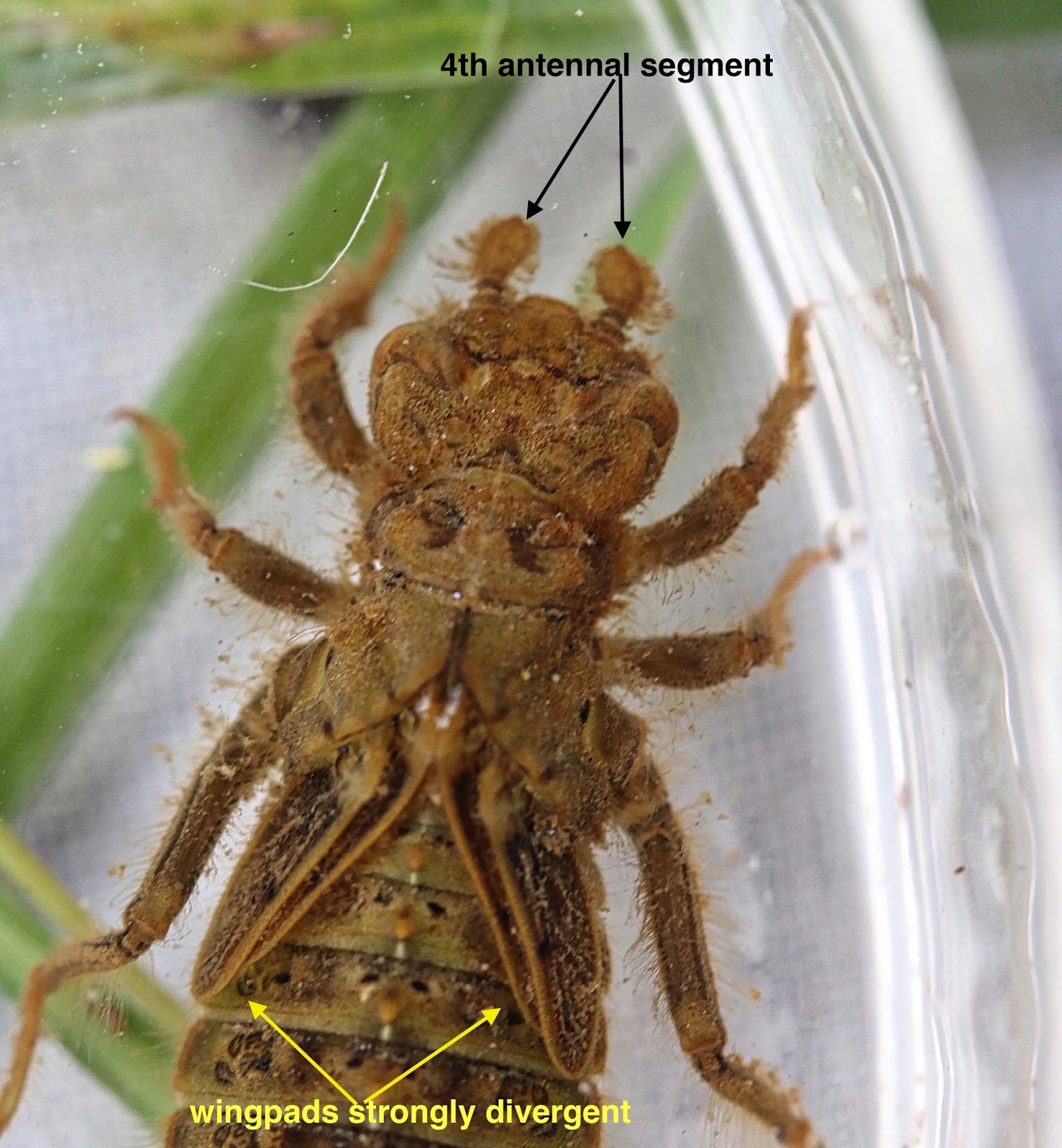
I was looking through my dragonfly photos this morning when it suddenly dawned on me that this nymph -- which I found in the Doyles on 9/2 of last year -- was not the clubtail dragonfly that I normally see.  The nymphs that I normally see have wingpads that are parallel to the body: they look like this.


Perplexed, I decided to key out both types and here's what I found.

17a  Naked antennal segment 4 generally about 1/2 as long as hairy segment 3..........Progomphus
17b  Segment 4 of antennae vestigal or nearly so.......18

We've got the latter as I'll show in a moment.  So on to 18.

18a Wingpads strongly divergent........... Ophiogomphus
18b Wingpads laid parallel along back........19

Here you go.


Ophiogomphus for sure.  Hmm...  But I'm quite sure that I thought the other nymph was Ophiogomphus.  Time to explore.  On to 19.

19a Body very flat: abdomen nearly circular in dorsal view; paired tubercles on top of head....... Hagenius
19b Abdomen more nearly cylindrical; no tubercles on head....... 20

19a describes genus Hagenius, and I've found quite a few of those over the years.


We move on to 20.

20a Antennal segment 3 flattened and oval, nearly as wide as long.... 21
20b Long antennal segment 3 more or less cylindrical....... 22


Definitely "nearly as wide as long."  On to 21.

21a Antennal segment 3 widest proximally..... Stylogomphus
21b Antennal segment 3 widest near middle, about 2 times as long as wide and rounded apically....Lanthus

Lanthus.  Got it.  And I find that one a lot.  But for me, Ophiogomphus is a new one.  Have to add that one to my list of taxa.


Thursday, August 17, 2017

Macrostemum carolina: no doubt about it


It's the weirdest common netspinner (Hydropsychidae) we see in our streams and I've long wondered about the species ID.

Macrostemum is a netspinner that I've found a number of times in the North Fork of the Rivanna and just last year, I found one in the Rivanna at crofton.  I've posted entries on this one in July, 2011 and August 2012, where I've discussed the genus ID, but to review, there are two features that are fairly dramatic:  1) "the flattened head with a sharp U-shaped carina," and 2) the "dense fringe of setae on the fore tibia and tarsus."  (Glenn B. Wiggins, Larvae of the North American Caddisfly Genera, p. 110 in the 1977 edition)   These.


In the past, using Beaty's "The Trichoptera of North Carolina" (p. 77) I've resisted speculating on species ID, divided between M. carolina and M. zebratum.  The distinction is small: on carolina the tubercles near the eyes are large; on zebratum they're little.   But, our new key -- Larvae of the Southeastern USA: Mayfly, Stonefly, and Caddisfly Species -- seems to resolve the issue in a definitive way.

115  Anterior tubercles above each eye conspicuous ........ Macrostemum carolina
115' Tubercles above each eye inconspicuous .......... Macrostemum zebratum

On the larvae I've found, those tubercles are very, very conspicuous.


Actually, no microscope photo is needed.


__________________

I'd say that mystery's solved.  Macrostemum carolina for sure.


Saturday, August 12, 2017

Working on species ID for our Leuctrids: they appear to be Leuctra sibleyi


Our new key -- Larvae of the Southeastern USA: Mayfly, Stonefly, and Caddisfly Species -- keys out 8 different species of Leuctra (family Leuctridae: genus Leuctra), so I thought I'd see if I could ID the specimens I have in my vial, including the nymph at the top of the page, one that I collected this spring.  As with a number of taxa that we find in our streams, not all species are covered in this key, so any conclusions we reach are bound to be tentative.  But let's see what we have.

I'd best begin by verifying that our nymph is indeed genus Leuctra.  It's fairly easy to do using this key (pp. 184-186).  We can eliminate Megaleuctra which has "body form robust": all of the Leuctrids I find have "body form slender."  We can also take Zealeuctra out of the mix: Zealeuctra is "without long setae on [the] corners [of the pronotum]"; those setae are present here.


That leaves Paraleuctra or Leuctra.  On Paraleuctra nymphs "abdominal segments 1-6 [are] divided by a ventrolateral membrane" and the "mesosternal Y-arms [have a] double stem and [a] median dark band"; on Leuctra, the ventrolateral membrane only divides segments 1-4, the Y-arms have a single stem and they lack the dark median band. (p. 186)

We have a Leuctra.


Good.  We can proceed.  Our first couplet reads:

79  Cercal segments bearing prominent, long, bushy whorls consisting of 8 or more lateral setae on most segments.....Leuctra sibleyi
79' Cercal segments with less prominent whorls usually consisting of 5 or fewer lateral setae on most segments..........80

Since I have a number of nymphs preserved in a vial, I just grabbed one and looked, assuming all of my nymphs would key out to the same species.  Here's what I saw.


And another.


And a third.


Just no doubt about it.  Those are "long bushy whorls" with more than 8 lateral setae.  End of story: our Leuctrids are Leuctra sibleyi.

But to be sure of our nymph at the top of the page, I looked at those cerci as well.


Certainly not "prominent, long, bushy whorls of setae."  I'll proceed on that assumption to see where it leads, but not without noting before I begin that on closer inspection, I do think there are more than 5 setae in each of those whorls: I think I can see 8-10.  So in the end, this one is probably L. sibleyi as well.  But let's explore option one.

If there are "5 or fewer lateral setae" in the cercal whorls of our nymph, we proceed to couplet 80.

80 Abdominal terga 7 to 10 or 8 to 10 covered with short, stout hairs, more anterior terga with hairs reduced.......... 81
80' All abdominal terga covered with short, stout hairs......82

I see the former, but I admit I'm largely going by what I can see at the sides of the terga: this.


There are clearly short, stout setae on terga 7-10; none on 6 or 5.  So I went on to couplet 81.

81  Mesonotum with numerous short, stout setae on anterolateral angles......Leuctra tenella
81' Mesonotum with few short, stout setae on anterolateral angles.......Leuctra truncata

Judging by that, I'd call this Leuctra truncata.


Worth noting as well that L. tenella has not been found in VA; L. truncata is here.
___________________

At the moment, the safe thing to say is that many of the Leuctrids I find are -- using this key -- Leuctra sibleyi in terms of the species.   Some could be Leuctra truncata.  But there is a third possibility as well,  one that I find very appealing.  The nymph that could be L. truncata could also be a species for which the nymph has not yet been described, one not associated with any adults.  For that species, the setae on the cercal whorls number more than 5 in lateral aspect, but they're on the short side, not long, and they're also far from bushy.  

______________________

A final note for those who monitor streams.  I'm sure that all of you have struggled with distinguishing Leuctrids (rolled-winged stoneflies) from Capniids (small winter stoneflies) in your samples, especially when dealing with very small nymphs.  The usual feature we use -- the ventrolateral folds.  On Capniids, those folds are present on segments 1-9: on Leuctrids, at the most, on segments 1-7.  E.g. here's a Capniid:


And those on our Leuctrids only present on 1-4.


But as you know, those folds are not always clear.  Our new key might be a help in this regard, providing another distinction.

8  Mentum [sic. should be submentum] small, not extending over base of maxilla....Capniidae
8' Mentum [= submentum] extends forward partially covering inner margins of maxillary base......Lecutridae

A nice view of this feature is also provided -- Fig. 3.29 on p. 183.  But here are two photos I took.


That's pretty clear.  We might actually use the shape of the submentum to distinguish the two.