Friday, January 3, 2020

Leptophlebia: Working on the species ID of a nymph I found on New Years Day


I celebrated New Years Day by going to a tiny, slow water stream in Sugar Hollow and was rewarded by finding a pronggilled mayfly nymph, genus Leptophlebia.  This is only the second time I've found a nymph of this genus,  the first was in December of 2012.  This one.


We can ID these nymphs to the level of genus by looking closely at the gills. 


Gills on segments 2-7 on Leptophlebia nymphs are bilaminate, meaning they have two leaves on each gill, each one ending in a thin, string-like filament.  Here's a microscope view.


Having not saved the nymph I found in 2012, I was excited to find this nymph so I could work out the species ID, though admittedly, the one I found on Wednesday might not be the same species as the one I found 2012.
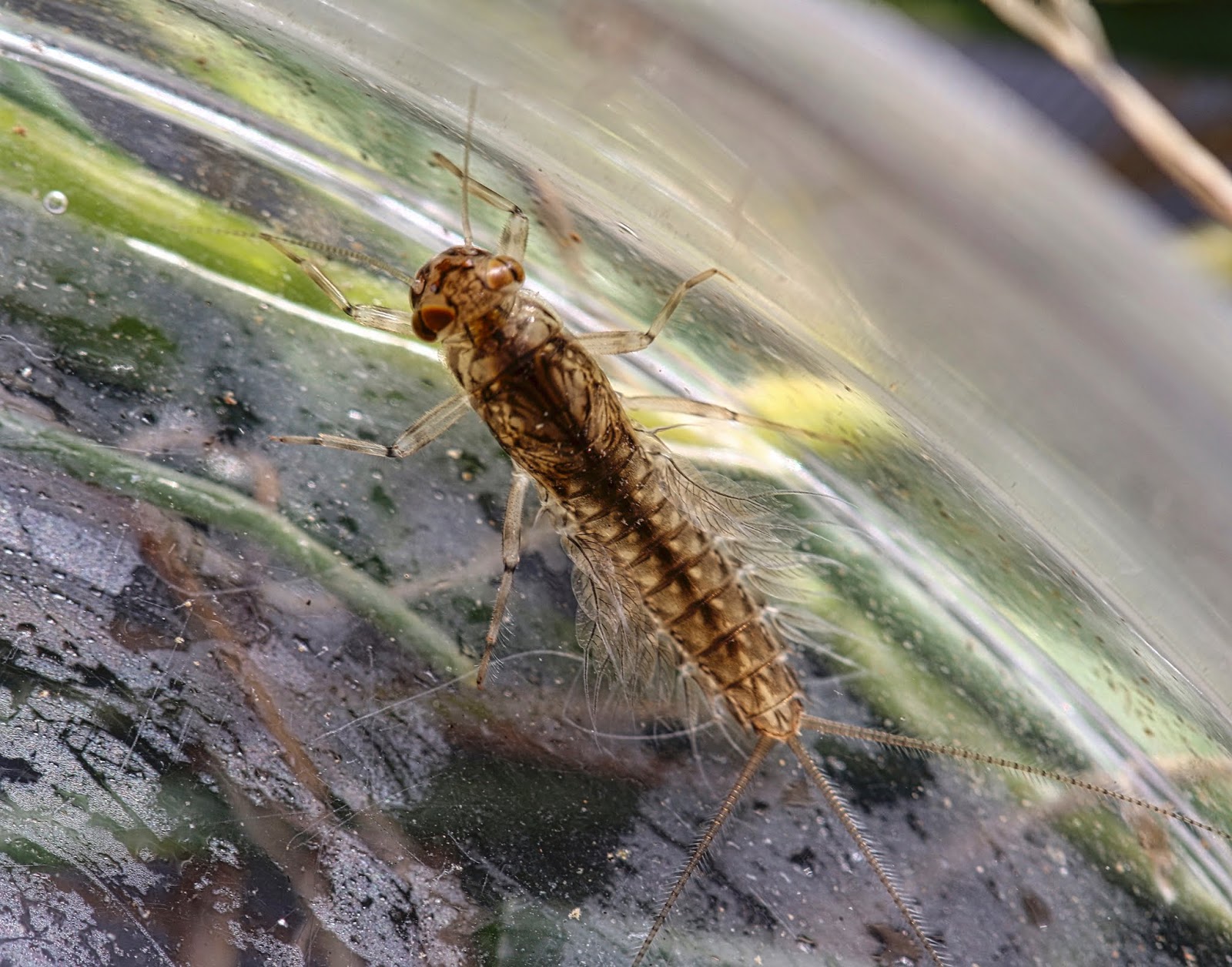

So what did I find?  My findings suggest that this is either L. cupida or L. nebulosa (the two species  cannot be safely distinguished as nymphs).  However, the two keys that I use both describe features for this ID that I can't be sure that I see: my microscope doesn't provide the magnification that I need.  More on that as we proceed.  Here are the information I've found. 

1. Larvae of the Southeastern USA: Mayfly, Stonefly, and Caddisfly Species (Clemson University, 2017), pp. 138-139).  The couplets are these.

259  Abdominal terga with numerous spinelike setae on lateral margins ........260
259' Abdominal terga with very few or no spinelike setae on lateral margins..........262

Let's look at our nymph.


There are indeed, numerous spinelike setae present.  On to couplets 260 and 260'.

260  Forelegs with broad tibial and tarsal banding as in Fig. 2.423; inner margin of forefemur with considerable palmate setae (Fig. 2.424) ....Leptophlebia intermedia
260' Forelegs without broad tibial and tarsal banding (if banding present, then much narrower or much fainter); inner margin of forefemur with numerous serrate setae with small serrations on one or both sides of setae (Fig. 2.425) .......... 261

Look at the tibia and tarsus.


There is a dark area medially on the tibia, but it is clearly not a band, and there is banding at both ends of the tarsus, but it's clearly narrow and faint.  On the setae on the forefemora, the magnification of my microscope is not strong enough to let me determine the shape of that setae (though I can see it).  But since there is at the most faint banding of the tibia and tarsus, I'd conclude that we should move on to couplet 261/261'.

261  Labrum typically with dorsal surface setae as in Fig. 2.426 .............Leptophlebia cupida
261' Labrum typically with dorsal surface setae as in Fig. 2.427 ............. Leptophelbia nebulosa

The figures in question (on p. 139) both show setae covering the labrum, but the illustration for L. nebulosa has a dense area of setae in the upper half of the labrum, an area that is missing on the  L. cupida nymph.  While I am able to see the setae covering the labrum, I cannot determine if that dense area of setae is present or absent.  Moreover, our key adds the following note: "It may not always be possible to differentiate the larvae of L. cupida and L. nebulosa.  Rearing to obtain  the more easily differentiated adults is advisable." 

If my logic is correct, our nymph appears to be either L. cupida or L. nebulosa, but that's as far as we can go.   Having reached that conclusion, I decided to see what Steven Beaty had to say.

2. Steven Beaty, "The Ephemeroptera of North Carolina," p. 78.  Here are his descriptions.

cupida -- nymphs 8.9-13.2 mm; peg-like setae on palpifer (small basal segment of maxillary palp) usually in regular rows; many large spine-like setae along lateral margins of abdominal segments along with scattered long hair-like setae; legs not usually banded or with faint bands on tibiae and tarsi only.  Note: need to slide mount mouthparts and legs to separate from L. nebulosa which still may not guarantee correct species identification.

nebulosa -- nymphs 7.1-12.5 mm; peg-like setae on palpifer (small basal segment of maxillary palp) usually in regular rows; many large spine-like setae along lateral margins of abdominal segments along with scattered long hair-like setae; legs usually faintly banded or with faint bands only on femora with more distinct bands on tibiae and tarsi.  Note: need to slide mount mouthparts and legs to separate from L. cupida which still may not guarantee correct species identification.  

This is tough.  We've already seen that there are "large spine-like setae along [the] lateral margins of the abdominal segments along with scattered long hair-like setae".  All well and good.  On the legs, there does appear to be faint banding on the femur, though it isn't complete, and I can't say that the banding on the tarsus and tibia is any more distinct.  For the "peg-like setae on the palpifer," I think I can see it, but once again my microscope magnification won't allow me to confirm that let alone try to take a clear photo (I tried!). 

Kind of stuck.  I do think it's safe to conclude that our nymph is either cupida or nebulosa, but there's no way to go beyond that without a microscope with greater magnification.  And even with that, we probably need an adult to be certain of our ID. 
_____________

One other thing about this nymph. 


Check out those eyes.


This "double eye" feature is something we also see on occasion on Baetidae nymphs, and it indicates that this is a male.  The brown eyes on the sides are "compound eyes" that allow the nymph to see in various angles, the red eyes in the middle are "tubinate eyes" and are used by the adult mayfly to see directly above itself.  They allow the male to pick out the females during mating.  Very useful!
________________________

My photos can now be found on Instagram.  My IG name is "buddhabob2hanlubo".  I'll only be using this blog to post info on the new species I find, working out the species ID.


Thursday, June 20, 2019

Updated Species List for Central Virginia


Since I've been finding a number of new species this year, I thought it best that I update the EPT (Mayflies, Stoneflies, and Caddisflies) List of the taxa I've found so far in this part of Virginia.  Hope to add even more species real soon!


EPT Species List for Central Virginia
         (Albemarle, Greene, Madison, Fluvanna)
                 
I. Ephemeroptera (Mayflies)

1. Ameletidae

1. Ameletus lineatus
2. Ameletus cryptostimulus
3. Ameletus tertius

2. Baetidae (Small minnow mayflies)

1. Acentrella nadineae
2. Acentrella turbida
3. Baetis flavistriga
4. Baetis intercalaris
5. Baetis pluto
6. Baetis tricaudatus
7. Heterocloeon curiosum
8. Heterocloeon amplum
9. Heterocloeon petersi
10. Iswaeon anoka
11. Labiobaetis propinquus
12. Plauditus dubius

3. Isonychiidae (Brushlegged mayflies)

1. Isonychia sp. (bicolor?)

4. Heptageniidae (Flatheaded mayflies)

1. Cinygmula subaequalis
2. Epeorus pleuralis
3. Epeorus vitreus
4. Epeorus fragilis
5. Heptagenia marginalis
6. Leucrocuta hebe
7. Leucrocuta sp.
8. Leucrocuta aphrodite
9. Leucrocuta thetis
10. Maccaffertium ithaca
11. Maccaffertium merririvulanum
12. Maccaffertium pudicum
13. Maccaffertium vicarium
14. Maccaffertium modestum
15. Rhithrogena exilis
16. Rhithrogena manifesta
17 Rhithrogena sp. (uhari?)
18. Rhithrogena sp. (fasciata?)
19. Stenacron carolina
20. Stenacron interpunctatum

5.  Ephemerellidae (Spiny crawler mayflies)

1. Drunella cornutella
2. Drunella tubercula
3. Drunella walkeri
4. Ephemerella dorothea
5. Ephemerella invaria
6. Ephemerella subvaria
7. Eurylophella verisimilis
8. Eurylophella funeralis (found by DB)
9. Eurylophella sp. (minimella?) (found by DB)
9. Serratella serratoides
10. Serratella serrata
11. Teloganopsis deficiens

6. Baetiscidae (Armored mayflies)

1. Baetisca berneri

7. Caenidae

(I saw a lot of Caenidae when I was with StreamWatch: not a one since then.  I hope to correct this so I can determine genus and species.)

8. Leptohyphidae (Little stout crawler mayflies)

1. Tricorythodes

9. Leptophlebiidae (Pronggilled mayflies)

1. Neoleptophlebia assimilis
2. Paraleptophlebia guttata
3. Paraleptophlebia jeanae
4. Paraleptophlebia strigula
5. Habrophlebia vibrans
6. Leptophlebia sp.

10. Ephemeridae (Common burrower mayflies)

1. Ephemera guttalata


II. Plecoptera (Stoneflies)

1. Capniidae (Small winter stoneflies)

1. Allocapnia pygmaea
2. Paracapnia angulata

2. Leuctridae (Needleflies)

1. Leuctra sp.

3. Nemouridae (Forestflies)

1. Amphinemura delosa
2. Prostoia completa
3. Soyedina sp.(carolinensis?)

4. Taeniopterygidae (Large winter stoneflies)

1. Strophopteryx fasciata
2. Taenionema atlanticum
3. Taeniopteryx burksi/maura

5.  Chloroperlidae (Green stoneflies)

1. Alloperla sp.
2. Haploperla brevis
3. Sweltsa sp.

6. Peltoperlidae (Roach-like stoneflies)

1. Peltoperla sp.
2. Tallaperla sp.
3. Viehoperla sp. (found by DB)

7. Perlidae (Common stoneflies)

1. Acroneuria abnormis (brown)
2. Acroneuria abnormis (patterned)
3. Acroneuria carolinensis
4. Acroneuria sp. (possibly internata, possibly a variety of abnormis)
5. Acroneuria arenosa
6. Acroneuria lycorias
7. Agnetina annulipes
8. Agnetina capitata
9. Agnetina flavescens
10. Eccoptura xanthenses
11. Neoperla sp. (clymene?)
12. Paragnetina immarginata
13. Paragnetina fumosa
14. Perlesta spp. (various species)

8. Perlodidae (Springflies and Stripetails)

1. Clioperla clio
2. Diploperla duplicata
3. Helopicus subvarians
4. Isogenoides hansoni
5. Isoperla dicala
6. Isoperla holochlora (light form)
7. Isoperla holochlora (dark form)
8. Isoperla latta/pseudolatta
9. Isoperla kirchneri group
   (probably both I. kirchneri and I. montana)
10. Isoperla similis/prosimilis group
11. Isoperla davisi
12. Isoperla orata
13. Isoperla orata (variant form)
14. Isoperla nelsoni
15. Malirekus hastatus
16. Rememus bilobatus

9. Pteronarcys (Giant stoneflies)

1. Pteronarcys biloba
2. Pteronarcys dorsata
3. Pteronarcys proteus


III. Trichoptera (Caddisflies)

1. Rhyacophilidae (Free-living caddisflies)

1. Rhyacophila carolina
2. Rhyacophlia fuscula
3. Rhyacophila nigrita
4. Rhyacophila glaberrima
5. Rhyacophila fenestra
6. Rhyacophila sp. (banksi?)
7. Rhyacophila torva

2. Glossosomatidae (Saddle-case makers)

1. Glossosoma nigrior

3. Philopotamidae (Fingernet caddisflies)

1. Chimarra obscura
2. Dolophilodes distinctus
3. Wormaldia sp.

4. Polycentropodidae

1. Polycentropus sp.

5. Hydropsychidae (Common Netspinners)

1. Ceratopsyche alhedra
2. Ceratopsyche bronta
3. Ceratopsyche morosa
4. Ceratopsyche slossonae
5. Ceratopsyche sparna
6. Cheumatopsyche sp.
7. Ceratopsyche etnieri
8. Diplectrona modesta
9. Diplectrona metaqui (found by DB)
10. Hydropsyche betteni
11. Hydropsyche rossi
12. Hydropsyche venularis
13. Hydropsyche potomacensis
14. Macrostemum carolinensis

6. Brachycentridae (Humpless case-makers)

1. Adicrophleps hitchcocki
2. Brachycentrus appalachia
3. Micrasema wataga
4. Micrasema charonis
5. Micrasema bennetti

9. Lepidostomatidae

1. Lepidostoma spp. (at least 2 species, possibly more)
2. Theliopsyche sp.

10. Limnephilidae (Northern case-makers)

1. Pycnopsyche gentilis
2. Pycnopsyche scabripennis
3. Pycnopsyche luculenta
4. Pseudostenophalyx sparsus
5. Ironoquia punctatissima

11. Apataniidae

1. Apatania incerta

12. Goeridae

1. Goera calcarata
2. Goera fuscula

 13. Uenoidae

1. Neophylax oligius
2. Neophylax consimillis
3. Neophylax aniqua
4. Neophylax mitchelli
5. Neophylax fuscus
6. Neophylax concinnus

14. Leptoceridae (Long-horned case-makers)

1. Nectopsyche equisita
2. Ceraclea maculata

15. Odontoceridae (Strong case-makers)

1. Psilotreta labida
2. Psilotreta frontalis
3. Psilotreta rufa (found by DB)

16. Molannidae (Hooded-case maker)

1. Molanna blenda (found by DB)

17. Calamoceratidae (found by StreamWatch monitors)

1. Anisocentropus pyraloides

New taxa -- so far -- in 2019


It's been a good year so far in terms of finding new species of EPT, so I thought I'd sum up our findings so far.

1. In the photo above, a free living caddisfly larva, Rhyacophila torva.  (Small mountain stream in Sugar Hollow.)

2. A new caddis casemaker, Ironoquia punctatissima. (Small intermittent stream in Sugar Hollow.)


3. An Ameletidae, Ameletus tertius. Rapidan River.


4.  A new Hydropsychidae species, Ceratopsyche etnieri.  (Buck Mt. Creek.  Not the best photo.  I hope to find another one soon.)


5. And another Hydropsychidae, Hydropsyche potomacensis.  (Whippoorwill Branch of the Mechums.)  (Again, I need to get a better photo.)


Also worth noting, I found a pronggilled mayfly that I've only seen once before.  It's very uncommon.

6. Habrophlebia vibrans.  (Small mountain stream in Sugar Hollow.)


Kind of a bumper crop this year.  My summer focus will be working on Hydropsychidae, and I won't be surprised if I identify even more species. 

Monday, April 15, 2019

A fresh look at the problem of Rhithrogena species ID


I found this little nymph at Buck Mt. Creek last Thursday (4/11/19),  and since we have a new key to use for species ID -- Morse, McCafferty, Stark, and Jacobus, Editors, Larvae of the Southeastern USA: Mayfly, Stonefly, and Caddisfly Species, 2017 -- I thought I might see if I could work out the species ID.  My conclusions should be seen as tentative since I know from Beaty that work still needs to be done on this genus, and the descriptions in our new book are indeed rather tentative.  Nonetheless, using this key, I'd conclude that, to date, I've found three different species.

1. Rhithrogena uhari (the nymph above)

The description of R. uhari reads as follows: "Abdominal terga light yellow brown to light chestnut brown to cinnamon brown; conspicuous dorsal abdominal marking not present in darker forms but some diffuse pairs of markings sometimes evident in lighter-colored forms, including pairs of cloudy patches laterally." (p. 122)

The color sure seems right, and I do see pale paired dots on the terga as well as interesting lateral markings on all of the terga.  Can't say if they're "cloudy," since I'm not sure what that the editors have in mind.


So, possibly R. uhari.

2. Rhithrogena exilis


Beaty told me sometime ago that this one would key out to exilis, even though he cautioned to take that ID with a grain of salt.  Here's the description of exilis in our new key.  "Abdominal terga 1 and 2 pale yellow; terga 3-6 dark reddish brown and unmarked except for yellow or yellow-hyaline lateral margins; terga 7-9 yellowish, unmarked."  (p. 122) This one works out pretty well: terga 1 and 2 are indeed pale, as are 8 and 9 -- can't say that's true for tergite 7.  But, I do see pale markings on the terga.


3. Rhithrogena fasciata


This nymph is clearly darker than the two we've looked at above.  Here's the description of R. fasciata"Abdominal terga medium to dark brown or orange brown; terga 1 and 2 sometimes pale; terga 4-8 sometimes darker anteriorly and paler posteriorly; terga 7-9 often shade lighter than preceding terga." (p. 122)


Certainly true that terga 1 and 2 are pale, and terga 8 and 9 are clearly a "shade lighter than the preceding terga" -- not sure I could say that of segment 7.  It is not the case that terga 4-8 are "darker anteriorly and paler posteriorly," rather, it seems that the posterior edge is darker.  That character doesn't apply to any of the species that our key describes, so maybe it's a variant with this species.  But that exception should be noted.
___________________

Results and conclusions are tentative for sure.  Still, I'd argue that we've clearly found three different species, and they key out pretty closely to uhari, exilis, and fasciata.  Be in touch if anything new shows up on this one.


Sunday, March 31, 2019

Another new insect: an Ameletidae, Ameletus tertius


I found this little mayfly at the Rapidan River on Tuesday, and when I looked at it in the bowl, my first guess was that it was nothing but the small minnow mayfly, Baetis intercalaris.  Still, something wasn't quite right.  It was only when I focussed in to get some photos that I realized this was something I'd not seen before.  By the shape of the head, the short antennae, and the fact that the gills pointed straight up and down -- sort of like the oar blades on a crew boat -- I knew that it was Ameletidae,  but what species?

When I got home I looked at Steve Beaty's descriptions ("The Ephemeroptera of North Carolina," p. 1) in which five different species are keyed out for this part of the country -- cryptostimulus, lineatus, ludens, tarteri, and tertius.    The A. tertius description caught my eye for one prominent reason: "distinctly marked small species with dorsal terga 3-6 with two large, ovalized submedian segments" (Beaty, p. 1)  Bingo!


And another feature shows up in this photo as well -- "tarsi with both dark basal and apical bands." (Beaty)

But there were two other features that required some microscope work: 1) "ventrally pale except sterna 9 and 10 darkened (also sometimes a portion of 8)," and 2) "posterior spinules on abdominal terga 1 or 2-10."

Yes in both cases (though I realize it may be difficult in my photo to see the spinules except for those on segments 5 and 6, they were present on all of 2-10.)


Score again for the Rapidan River -- Ameletus tertius!  Here's some more photos.


Sometimes I wonder why I go to other streams.


A. tertius is the fourth Ameletidae species I've found.  The others,

Ameletus cryptostimulus,


Ameletus lineatus,


and in Montana, Ameletus subnotatus.