This is my list of what the Chinese would call 非有不可的書 (fei you bu ke de shu) -- "not have, not o.k." books: i.e. these are books you simply have to have! (if you want to do this kind of work --- at least at the amateur level).
These are not listed in any particular order:
1. Glenn B. Wiggins, Caddisflies: The Underwater Architects (Toronto: University of Toronto Press, 2004).
2. Glenn B. Wiggins, Larvae of the North American Caddisfly Genera (Trichoptera) (Toronto: University of Toronto Press, 1977). 1st edition. 2nd edition, 1996.
3. Barbara L. Peckarsky, Pierre R. Fraissinet, Marjory A. Penton, and Don J. Conklin, Jr., Freshwater Macroinvertebrates of Northeastern North America (Ithaca: Cornell University Press, 1990).
4. W. Patrick McCafferty, Aquatic Entomology: The Fishermen's and Ecologists' Illustrated Guide to Insects and Their Relatives (Boston: Jones and Bartlett Publishers, 1998). Originally published in 1981 by Science Books International, Inc.
5. Malcolm Knopp and Robert Cormier, Mayflies: An Angler's Study of Trout Water Ephemeroptera (Helena: Greycliff Publishing, 1997).
6. R.W. Merritt, K.W. Cummins, M.B. Berg, An Introduction to the Aquatic Insects of North America, Fourth Edition (Dubuque: Kendall/Hunt Publishing Company, 2008). Previous editions: 1978, 1984, 1996.
_______________
To this I would add as "strongly recommended":
1. Kenneth W. Stewart & Bill P. Stark, Nymphs of North American Stonefly Genera (Plecoptera) (Columbus, Ohio: The Caddis Press, 2002).
2. Thomas Ames Jr., Caddisflies: A Guide to Eastern Species for Anglers and Other Naturalists (Mechanicsburg, PA: Stackpole Books, 2009).
Friday, February 11, 2011


The Pupae of Diptera (true flies) and Trichoptera (caddisflies)

One of the things monitors sometimes find in their samples -- often to their consternation -- is a pupa of a true fly or a caddis. When I was working with StreamWatch, we counted these right along with the larvae: some of us could identify the pupae of crane flies (pictured above), black flies, and midges in the field, caddis pupae -- especially when they were still in their cocoons -- had to be preserved and identified in the lab. Lab ID of caddis pupae was something we dreaded -- it's not easy to do. But to our delight, DEQ informed us last year that pupae of any sort could be ignored; they should not be counted as part of a sample.
Still, these are things you might see in a stream, so let's have a close look at some examples. The odd looking creature at the top of the page is a crane fly pupa -- something we saw only rarely. More commonly found in our samples were midge pupae, which could be found at almost any time of the year (there are a lot of midges hatching right now). Here is a picture of what they look like (though they can be various colors, and they're often black).

The other true fly (Diptera) pupa we commonly saw was the black fly pupa -- a strange looking critter indeed. You could hardly mistake it for anything else, though it's strangely attractive!

Caddisflies:
Caddisflies, like true flies, are "holometabolous," that is to say, they live a full life cycle of egg, larva, pupa, and adult (terrestrial). (By contrast, mayflies, stoneflies, dragonflies, and damselflies are "hemimetabolous": they omit the pupal stage, going from egg to nymph to adult.) So, on occasion we find caddis pupae as well. But these we can find in various stages of development. And this often depends on the "type" of caddis we find: remember that there are "case-makers" (Integripalpia -- Wiggins), 2) "net spinners" (Annulipalpia -- Wiggins), and 3) "cocoon makers" (Spicipalpia -- Wiggins). Odontocerids, Uenoids, Brachycentrids...are all "case-makers": "Common netspinners, Fingernets, and Trumpetnets are all "netspinners (or retreat makers): and the free living caddis and the saddle case-maker are both "cocoon makers". (For these distinctions, see Glenn B. Wiggins, Caddisflies: The Underwater Architects, pp. 11-28 and 59-71).
Case-makers:
With the "case-makers" we often find the pupae snugly sealed in their cases. When case-makers pupate, they simply seal up both ends of the case they've been in all along, weave a cocoon on the inside (which is "glued" securely to the case) and transform from a larva into a pupa. (By the way, caddisflies [Trichoptera] and butterflies and moths [Lepidoptera] are descended from a common ancestor -- hence the use of cocoons in transformation [following Wiggins]. The cocoon is permeable, and water flows through openings in both ends of the case providing oxygen to the larva/pupa. Below is a remarkable picture showing a "grill" or "grate" at one end of a case that provides water access.

And here is a picture of the whole case, clearly showing how both ends of the case have been sealed.

Since the cocoon is firmly sealed to the case, it is impossible to remove the pupa from a sealed case of this sort without making a mess of it: we never tried to ID the pupae in these situations.
I did once find a case from which the pupa could be removed -- though I don't recall how I did it. There was no doubt in my mind that this was a Strong case-maker (family: Odontoceridae), mostly because of the manner of case construction. Here is a look. The head of the pupa is visible on the left.

Netspinners:
What about the "net spinners"? Netspinners also weave cocoons after building domes made of pebbles for protection, the domes then secured to rocks. If you peel that dome off of the rock, the cocoon is clearly visible since no bottom is put on the dome. However, the cocoon cannot be removed from the dome. We do find these domes from time to time with the cocoons still inside, and inside the cocoon we normally find a Common netspinner pupa. One is pictured below, having been removed from its cocoon.

Pretty freaky, but that's what they look like.
Cocoon makers:
Finally, we have the group called the "cocoon makers" by Wiggins -- the free living caddisflies, saddle case-makers, and micro caddisflies. While all caddis larvae weave cocoons, this group makes a special type of cocoon. This cocoon is rigid to the degree that water cannot flow through it, but it is "semi-permeable" so that the dissolved oxygen in the water that enters the case reaches the pupa by osmosis.
Also, this cocoon is not "glued" to its domed case of pebbles. So it can be removed from its protective shell without causing harm. In fact, in samples, we often find the cocoons all by themselves. Such cocoons are easily recognized because they have the look and texture of "parchment paper" (Wiggins).
The pupa inside is either that of a free living caddis or a saddle-case maker.
I have three photos to show you: in all three the pupa inside the cocoon is -- I'm pretty sure -- a free living caddis. The first two photos are of the dorsal and ventral view of a cocoon in which there is a free living larva which has, as yet, transformed very little.


Note that in the dorsal view, the "curvy" black line forming the back edge of the pronotum -- characteristic of the free living caddis larva -- is clearly visible. While in the ventral view, the full legs of the larva are still intact.
In the other cocoon in my collection, the pupa is much more advanced in its transformation. This is the dorsal view. The "junk" at the rear end of the case is the larval exuviae (i.e. parts of the larva that have been shed in its metamorphosis into a pupa).

By the way, to determine for sure if this is a free living pupa or a saddle case-maker pupa, the pupa would have to be removed from the cocoon, and the tops of the abdominal segments (which are clearly visible in the picture) would have to be studied to count up the "pairs of hooked plates" on each of those segments: it's a pain!
Mayflies and stoneflies:
It's very considerate of the mayflies and stoneflies not to put us through all of this work. When they're ready to hatch, they simply swim to the surface, or crawl to a rock on the side of the stream, break open their skins (exoskeletons), push up and dry off their wings, and off they go! Stoneflies often leave "shucks" behind which you can find as you walk by the edge of a stream. The one below is that of a Common stonefly (genus Agnetina), and you can clearly see where it has cracked open its thorax to gain its freedom.

Wednesday, February 9, 2011
Freshwater Crustaceans: Scuds and Sowbugs

I know, I know -- they're not "insects"! But I had so many co-volunteers when I was in StreamWatch who had never seen either of these, that I thought I'd do a short entry on them -- just in case any of those colleagues from StreamWatch are reading this blog.
Scuds (order: Amphipoda) and Sowbugs (order: Isopoda), along with Crayfish (order: Decapoda) are "Freshwater Arthropods," more specifically "Freshwater Crustraceans." I will not comment on crayfish:
if you haven't seen crayfish, I'm not sure why you're reading this blog!
Scuds and sowbugs (that's a sowbug at the top of the page) both have two pairs of antennae at the front of the head, and the head and first thoracic segment, in both cases, are fused to form a "cephalothorax." The following seven thoracic segments each has a pair of legs, with the abdomen being -- in the photo above -- the single, squarish segment at the tail end. Sowbugs are "dorsoventrally" flattened, meaning they are wider than they are "tall": the photo at the top of the page shows us a view from above; the photo below is a side view.

They're not very pretty -- and they're sort of slow as they move on the net: average size is, I'd say, 1/4" - 1/2".

Scuds, by contrast, are "laterally" flattened, meaning they're taller than they are wide. The legs show up very well on this example, as do the two pairs of antennae. Scuds, unlike sowbugs, are pretty fast on the net, and once you've put them into the tray, they're almost impossible to pick up again with the tweezers. Also, they're "sideswimmers," squirming about on their sides.
In StreamWatch we were not required to ID sowbugs to the level of family, but I think we always assumed they were Asselidae, the family most commonly found in North America. With scuds, we did ID them to family, but that had to be done in the lab -- so all of our samples were preserved. Most of our scuds were found to belong to two different families: Gammaridae and Crangonyctidae.
Sowbugs and scuds both live in slow-moving, shallow water -- and not the best water at that. Their tolerance values range from 6 to 8 depending on family ID. In which streams did we normally find them? Number one: Carroll Creek in Glenmore. I always told volunteers, if you want to see them, that's where you want to sample. Of course, we'd find the occasional scud here or there and the same for the sowbugs. But if you want to see them in significant numbers, Carroll Creek is the place to go.
When I go out to streams on my own, I often find lots of scuds in leaf packs in small, feeder streams in the fall. But if you want to catch one, you've got to be quick with the tweezers.

Tuesday, February 8, 2011
"Looking under the hood": labium composition and stonefly identification

In terms of "Functional Feeding Groups" (FFG's), stoneflies fall into two different groups: predators = common stoneflies (Perlids), Perlodids, and green stoneflies (Chloroperlids); and herbivores/detritivores = giants, roach-likes, large winters, small winters, rolled-wingeds, and Nemourids. Directly related to this, predators have one kind of labium (lower lip), herbivores have another.
Is this important information? Well, I doubt that this would be a Jeopardy question (!), but it is something you do have to know if you work in a macroinvertebrate lab. When this came up for me when I worked with StreamWatch was normally in the fall when we would often have very small stoneflies that needed identification. Wingpads are not yet developed on immature stoneflies, and almost all tiny stoneflies are tan or yellow -- sometimes almost transparent in color. The most common decision that we had to make was: is this a green stonefly? a large winter stonefly? a small winter stonefly? or a Perlodid stonefly? These four families can be confused when they're small. Sometimes, "common" stoneflies could also cause problems -- but they usually couldn't hide their "hairy armpits".
What did we do? We looked at their lower lips (labia). So let's do that, first for the "predator" group (Perlids, Perlodids, Chloroperlids), and then for the "herbivore" lot (here, just the large and small winters). The head at the top of this page is that of a Perlid (common) stonefly, genus Acroneuria. Let's flip that head over.
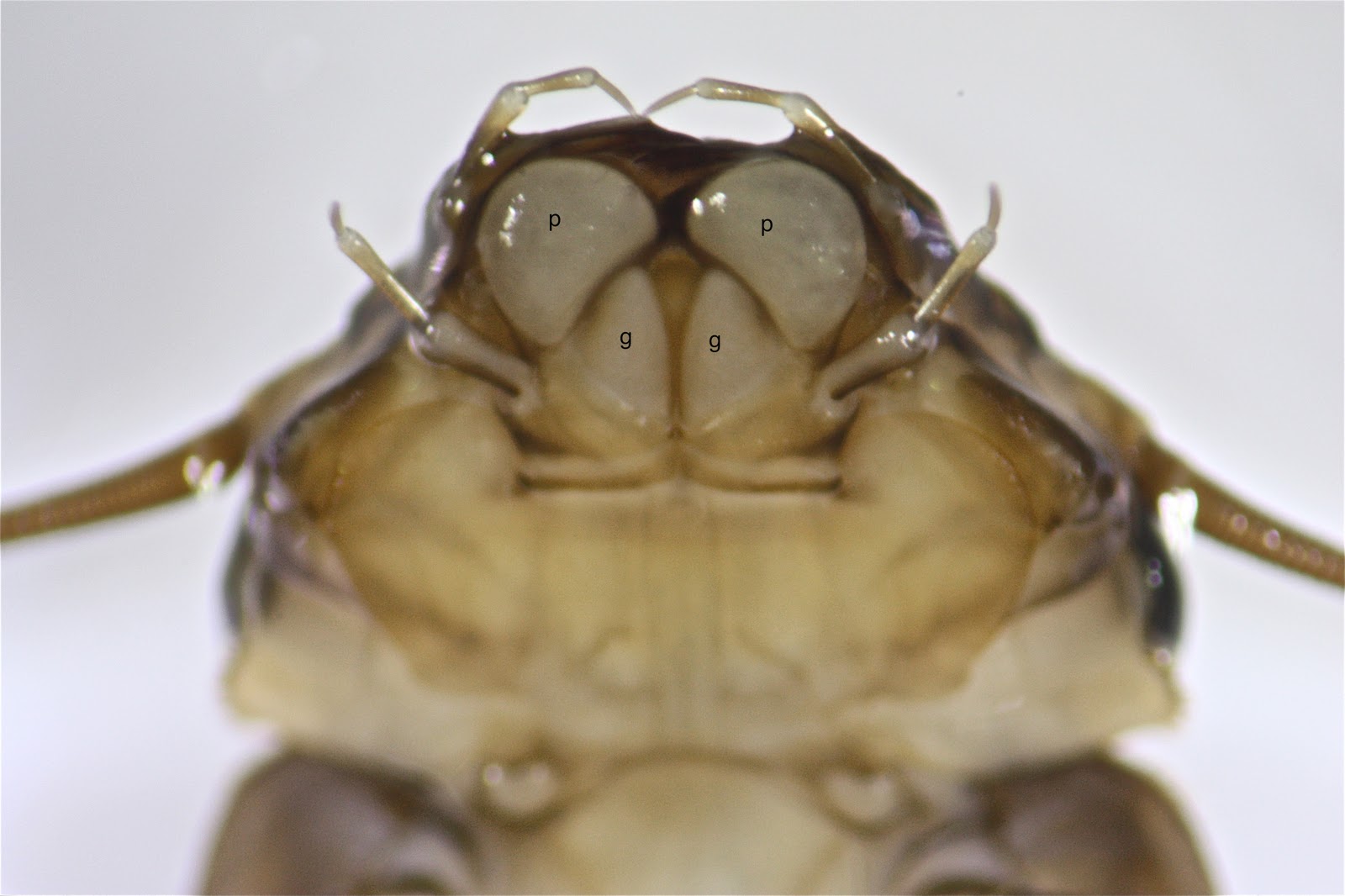
The four elements at the top of the labium are the paraglossae (p,p -- upper distal margins of the labium) and the glossae (g,g -- lower distal margins of the labium). With all predators, the paraglossa is on top of the glossa, and inbetween the glossae, there is a notch, a "V". The stems branching out from the base of the glossae are the "labial palps".
Perlodid. The labial "notch" in the Perlodid stonefly is even more pronounced. Let's have a look.

Again the paraglossae (p,p) rise over the glossae (g,g), but here the glossae lean back, forming a very clear "V" -- i.e. a "notch".
Chloroperlid (Green).

Mature Perlodid stoneflies and mature Green stoneflies look quite a bit different: the wingpad shapes in both cases are distinct, and you may recall that the tails of the Green stonefly are abnormally short. But,
if we have to decide between Perlodid and Green based on this look at their labia -- their paraglossae and glossae -- we're in big trouble! So what do we do? At this point we crank up the microscope magnification and draw down on the last two segments of the maxillary palp. Here you go:

I've written "mp" on the next to last segment of the maxillary palp of this Green stonefly. The final segment is visible -- but just barely (that's an arrow that points to it). On the Perlodid stonefly, the final segment would not be this thin. I.e. on a Perlodid stonefly the final segment is almost as thick as the preceding segment; on a Green stonefly it's dramatically thinner.
The critical thing for us to note is the shape and location of the glossae and paraglossae in the labium of a predaceous stonefly, and how a "notch" is formed between them. On to the large and small winters.
Large Winter (Taeniopterygidae).

Notice how this labium differs from the labia of the predator group. First, the paraglossae and glossae are lined up together -- side-by side -- and roughly equal is size and shape: and second, there is no "V" formed between the glossae, no "notch".
Small Winter (Capniidae).

A little more difficult to see -- but the configuration on the small winter is the same as we find on the large winter. No "V"; no "notch". To move on and distinguish the small winter from the large winter, you have to look at the abdomen: the small winter abdomen has "venterolateral folds" (see the entry for 12/19/10 ).
I realize that most volunteers monitors will not be in situations where they have to make these kinds of decisions. Still, it's always of interest to see what goes on in the lab with tricky cases of identification.
(Below, "dorsal" views of the stoneflies we have just looked at.)
Perlid (common):

Perlodid:

Chloroperlid (green):

Large Winter (Taeniopterygidae) -- mature and "tiny":

Small Winter (Capniidae):

Monday, February 7, 2011
Stream Report: Buck Mt. Creek

(A large winter stonefly -- genus Strophopteryx -- crawls over a rock. There were about 30 large winter nymphs on this rock when I lifted it out of the water.)
At the moment, Buck Mt. Creek is "chock-a-block" full of Strophopteryx large winter stoneflies. It's also got a lot of black flies all of a sudden: you can look down at the rocks in the stream and see the black patches. They showed up real well on this white rock -- so I pulled it out of the stream for a close shot.

I saw no Taeniopteryx large winter stoneflies: I think they've all hatched (at least in this stream). And I only saw 1-2 small winter stoneflies -- and that was with 1-2 hours of looking intently. They too are pretty well gone for the season.
I did continue to find Clioperla Perlodid stoneflies -- and by now they're really big. The one in the picture below was about 1 inch long, not counting the tails. (Note that he's joined in this group photo by a Uenoid caddis, a Saddle case-maker caddis and a midge!)

While the large winters I found were crawling around on the bottoms and tops of the rocks, this Perlodid -- and about 4 others of similar size -- was rooting around in a leaf pack. No surprise there.
Perlodid stoneflies, Common stoneflies (Perlids), and Green stoneflies (Chloroperlids) are all "predators"
in their eating habits, all other stoneflies are herbivores/detritivores. So the Perlodids were looking for lunch -- in the form of large and small winter stones, crane fly larvae, midge larvae, and black fly larvae. I found a large number of black flies today in the leaves -- a fact that delighted, I'm sure, the Perlodids!
One more group shot. Here a large winter stonefly sits in the tray while a midge floats by doing the backstroke!

Thursday, February 3, 2011
The "Ameletid Minnow" Mayfly: family: Ameletidae

This is a mayfly I was not sure I'd find before I finished this blog -- but I lucked out and found two this morning. With a tolerance value of "1," it finds the clean, cold water that it desires in a limited number of streams that we sample. StreamWatch data reports Ameletids in its Albemarle county reference stream (it's a tiny stream that comes out of the mountains), in the Doyles River where it flows out of the National Park, and -- perhaps surpisingly -- in the Whippoorwill Branch of the Mechums River. That's it.
The Ameletid mayfly is easily confused with the brushlegged mayfly (family: Isonychiidae) when we see it on rocks and on nets. They have a similar shape, and they both flop around like fish pulled out of the water when they're exposed to the air. They're also both very fast swimmers. The Ameletid, like the brushlegged, has brushy tails that it can pull together and use like a paddle, and it's common to see a dark band across the tails in both of the nymphs.
But up close, they look quite a bit different. Let's look closely again at the brushlegged mayfly.

Let's focus on three distinct features. 1) On the brushlegged mayfly, the abdominal gills set up horizontally when the nymph is at rest, on the Ameletid mayfly, they point vertically up and down. 2)
The antennae on the brushlegged mayfly are about twice as long as the head is wide; on the Ameletid mayfly, the antennae are less than 1/2 the width of the head (this may show up better in the photo below. And 3) -- and most importantly -- the Ameletid nymph has no hair on its forelegs: the legs are not "brushy".

This is a nymph that we find in the streams in the winter: January, February, and March: it hatches in early spring. When it's fully mature (this one isn't), it is a beautiful, beautiful creature. Mature colors are a mix of oranges and tans and browns. If you have a copy of J. Reese Voshell's A Guide to Common Freshwater Invertebrates of North America, take a look at p. 145. This illustration is right on the mark.
Tuesday, February 1, 2011
How do we determine "genus" identification? A case study

Pictured above is a Perlodid stonefly, genus Clioperla. But we're going to pretend that we don't know that. We know for sure it's a stonefly: two tails, and no gills on top of, or sticking out from the sides of the abdominal segments. We've also eliminated a lot of the stoneflies, for making family identification, since it's just too big to be some of those critters, and it looks nothing at all like a Roach-like stonefly or a Giant stonefly, etc. So, we've narrowed it down to a "Common stonefly" (family: Perlidae) or a "Perlodid" stonefly (family: Perlodidae).
The question becomes -- does it, or does it not, have what Rose Brown so cleverly calls "hairy armpits"?
I.e. are there tufts of frilly gills behind each set of legs? If there are then it looks like this and it's a Perlid (Common stonefly).

Let's flip our critter over and look.

Nothing. Shaved clean (as it were!). Our nymph is a Perlodid stonefly.
But we want to know more. Can we determine the "genus" -- not just the "family" -- of this particular insect? Genus identification requires the use of a dichotomous key, and the standard text most of us use -- those of us working in this part of the country -- is Barbara L. Peckarsky, et.al., Freshwater Macroinvertebrates of Northeastern North America, Cornell University Press, 1990. Perlodidae genera are keyed out in this book on pp. 69-73.
Where does the key have us begin? It tells us to look at the "Y ridge of the mesosternum" (the "chest" between the first two pairs of legs). Let's take a look.

(Trust me -- that "Y" isn't always this clear!) The question is: do the end tips of the up-facing arms point up? Or do they re-curve and point down? Clearly, they're pointing up. That eliminates one of the genera.
The next thing we're told to do is to look at the "submental" gills. (Submental gills would stick out on either side of the neck.) Does it have them or not? And if it has them are they "at least twice as long as the greatest width"? Well, let's get a better idea of what these gills look like by looking at a different sample from my collection.

That little "finger" sticking out from the neck on the left -- from our point of view -- is a submental gill.
Now let's look at the neck of our nymph.

It looks like it's wearing a "choker" (!), but it does not have submental gills. That eliminates three more genera.
Now the focus becomes the nature of the lacinia (part of the maxilla -- supplementary jaws). In the picture above, the lacinia -- there's one on each side of the head and we're looking at the underside of the head -- is the dark orange point about 2/3's of the way up the head. Let's tear that away so we can see it much better.

We now have two questions that have to be answered: 1) are there any hairs along the top ridge that follow the two large spikes at the top, moving from right to left? (The answer is "Yes.") And 2) is the lacinia tapered and rounded from the second tooth/spike to the base? (Again the answer is "Yes.")
At this point, I will skip over some other details brought up by the key -- but we've already hit on everything that's important. Our answers have taken us to two possibilities: our nymph is either "Isoperla" or "Clioperla". The key sets out the following options:
1) Dorsal abdominal segments with alternating transverse or longitudinal light and dark stripes or bands..... Isoperla
2) Dorsal abdominal segments uniformly brownish except for a few small light spots (which may be in longitudinal rows)..... Clioperla
So, do we have this? ("alternating dark stripes or bands")

Or do we have this? ("uniformly brownish")
We have this. It's a Perlodid nymph, genus Clioperla. One other thing will confirm this. In their detailed study of stonefly genera -- Nymphs of North American Stonefly Genera (Plecoptera) -- Stewart and Stark say of the head of Clioperla "(it is)...mostly yellow with dark bands extending through or behind lateral ocelli to compound eyes and across anterior margin of frons [front of the head], enclosing a large yellow quadrangular area." (p. 381) Here is a close-up view of a Clioperla head.

Could anything be more fun than this? It's hard to imagine! But I should warn you that genus identification is rarely easy, especially when the subject is a Perlodid stonefly. I've worked with Rose Brown of StreamWatch on genus ID when, on occasion, we've read and re-read the options presented to us by the "keys," and still ended up despairing of reaching a final solution. Still, when you can determine genus identification for certain, it is very, very rewarding.
Subscribe to:
Posts (Atom)