Tuesday, March 22, 2011

The "Hidden Stream": Second Visit


I first looked at this stream on March 4th (see the entry on "Hidden Streams"), so this was my second trip.   For beauty, this stream has no match: crystal clear water, waterfalls, glides and pools, and moss covered boulders and rocks.  I could easily spend many a day exploring this wonderful branch of the Moormans.   And the insects?  Diverse and abundant, and only the best.  Can you blame them for wanting to live in this place?!

Today I moved downstream from the water I explored the first time.  And I found different insects -- though I think that has more to do with the changing seasons than the change in location.  Thus, last time I found stoneflies from 8 different families; today I only had 5.  I still didn't find any Leuctrids (Rolledwinged Stoneflies) -- even though I'm finding them on the other side of the valley.  Also missing this time -- large and small winter stoneflies and Nemourids (genus Nemoura).   There's a good chance that these three families are gone, hatched;  I certainly did see large winter adults alongside the stream and in the air.

So what did I find?  Giant stoneflies -- lots of them!  There were 6 in one leaf pack alone.  I started brushing them back into the water as soon as I saw them.  And I saw "large" Giants and "little" Giants.
In this photo, two of them actually snuggled together inside my tray.  (Note the Green stonefly to the left of the "small" Giant -- and the contrast in wingpad development on the two Giants.)


I also found a fair number of common stones, and like last time, they were mostly Eccoptura stones; only one was genus Acroneuria.  I did get a nice photo of one of the Eccoptura nymphs.


Again, there were "Roach-like" stoneflies running around -- but I gave them a break from my lens.  And again, there were quite a few Chloroperlids (Green Stoneflies), genus Sweltsa.  They were considerably bigger than those I saw on my first visit.


I also saw a few Perlodid stoneflies, all genus Isoperla, and they were larger here than those I've been finding on other streams in the last couple of weeks.  The characteristic "brown stripes on yellow background" that we find on the abdomens of these insects were actually starting to show -- though I'm not sure you can see that in this live shot.


Mayflies?  I found a number of Pronggilleds and a few Ameletids and two genera of flatheaded mayflies: Leucrocuta and Epeorus.  Leucrocutas have a small body with a very large head, which is pretty clear in this photo.


I took a number of photos of one of the Epeorus mayfies -- they were abundant -- but my favorite is one in which it's side-by-side with a young spiny crawler.


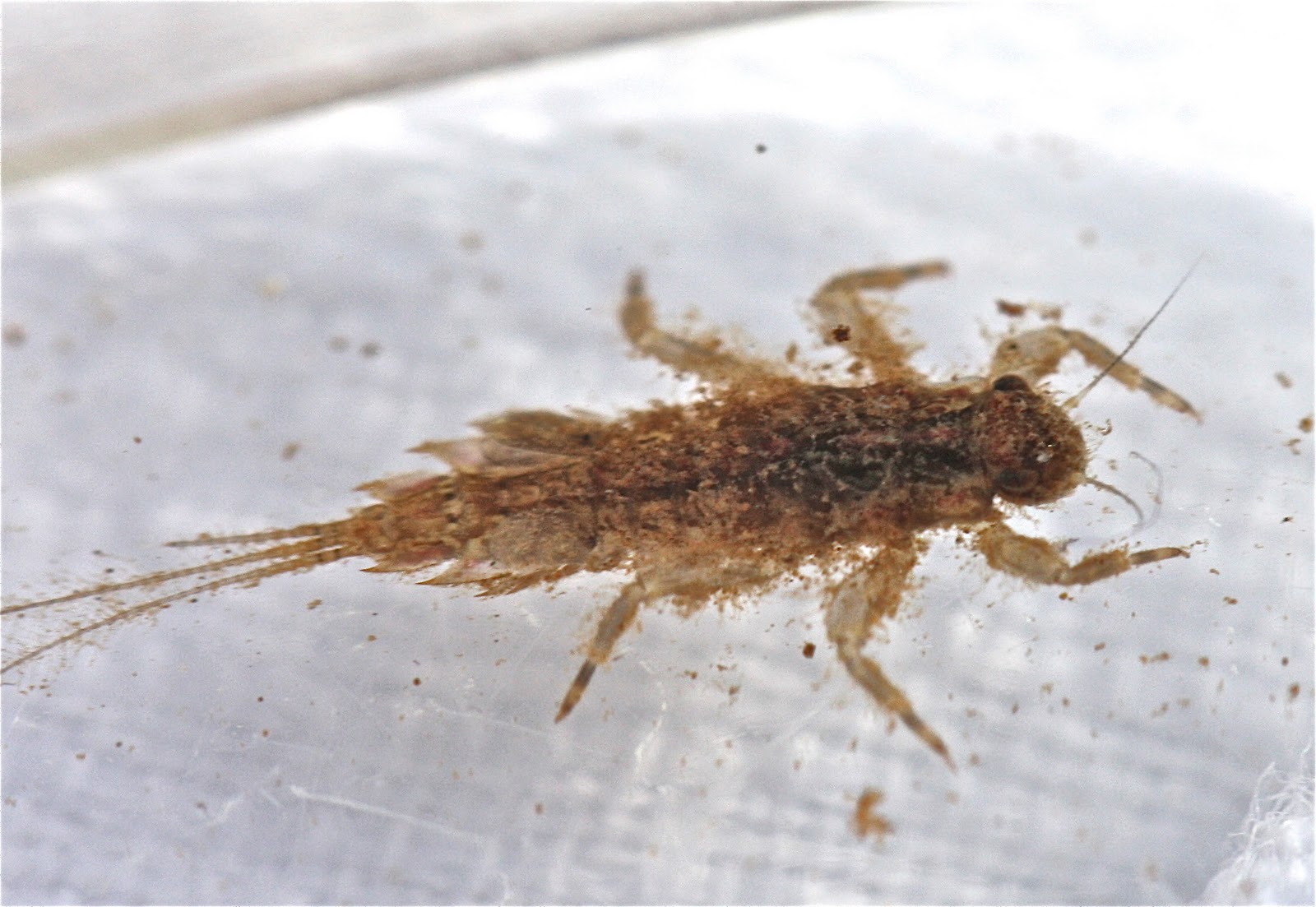
Speaking of "spiny crawlers" -- I don't think I found them last time; this time there were a lot of them here.  Most were genus Ephemerella (including the one in the photo above), but I did find my very first spiny crawler, genus Eurylophella!  Exciting!  Unfortunately, he was crawling around in a mud filled leaf pack and refused to bathe for his guest.  So, it's not the prettiest nymph that you're going to see.

Remember from the entry on 2/17 that this genus is special: it has gills on abdominal segments 4-7, but the gill on segment 4 is large and operculate and covers the rest.  We can see that best in this microscope photo I took when I got home.


The other "first" that I had today was finding a beautiful "Northern Case-maker" caddis (Limnephilidae), genus Pycnopsyche, which makes the prettiest case of which I know.  It's a three-sided case made out of nicely clipped pieces of leaves.


Quite a feat of engineering!  I waited and waited for the larva to stick its head out -- and it finally did.


On caddisflies -- I found a lot of common netspinners, genus Diplectrona (TV of "2"), and I found several Freeliving caddisflies: this time, they were all "green," just like they're pictured in Voshell (Freshwater Invertebrates, p. 164, plate 77).   Let me finish this entry with two nice pictures of one of those.


Saturday, March 19, 2011

Whippoorwill Riches: Spring Insects Galore


I went to the Whippoorwill Branch of the Mechum this morning with a specific purpose in mind:
I wanted photos of common netspinners and fingernet caddis in their homes on the rocks.  I was partly successful -- but let me turn to that later on.

The photo above is a nice shot of two flatheaded mayflies (family: Heptageniidae), but two different genera.  The nymph on the left is the most common genus we see -- Maccaffertium (formerly Stenonema) -- while the one on the right is genus Stenacron, a genus that I've seen only rarely.


The Stenacron nymphs that I've seen all look like this -- they look slim and trim, especially when seen alongside their Stenonema (Maccaffertium) kin.   These two genera are closely related in that they share a common gill structure: gills 1-6 are the same, while gill 7 is thin and fingerlike.  But Maccaffertium gills are "truncated," i.e. squared off on the bottom, while the Stenacron gills come to a point.  That shows up very clearly in this microscope shot of the Stenacron gills.


I also found a number of Ameletids, which I'd have to call fairly mature.  One photo gives a good idea of just how big they've become.


But the "mayfly of the day" -- so to speak -- was the spiny crawler (family: Ephemerellidae).  The stream was loaded with them.  Most were small; but some were already mature.  This is the main mayfly we find in the spring in our streams, so I've been waiting for them to arrive on the scene.  Here's a shot of one of the larger ones that I found.  This -- well, all of the spinys I found this morning -- is genus Ephemerella.


While this large (actual size, about 1/2") nymph was brown; the small nymphs that I found, by contrast, were more olive in color.  I brought a couple home with me to confirm the genus, and I shot this picture of one:


I suspect that the two different colors -- the two photos above -- are actually two different species,  but I have no way of knowing for sure.

Stoneflies?  Quite a few actually.  I found one common stonefly, genus Acroneuria, and 3-4 Perlodids (Diploperlas and small Isoperlas), and I again found two large winter stoneflies that I think are genus Taenionema.

Now -- to the main plan for the day.  When you turn over rocks in a stream, it's fairly easy to pick out the homes of netspinners and fingernet caddis if you know what you're going to see.  The "common netspinner" (family: Hydropsychidae) makes a "fixed retreat" out of small pieces of rock in which it stays hidden away for protection.  Outside its retreat, it spins a net which it props up between some pebbles, in which it catches its food.  Then, every so often, the larva emerges from its retreat to clean off the net.   Here's a fixed retreat on a rock:


Just looks like a collection of pebbles and grains of sand.  Note that in this case the larva is partly exposed (the green); it looks to me like part of his "tunnel" (and these retreats are often built in the shape of a tunnel) has collapsed to the left.  When I pulled away even more of its cover -- don't worry, it will build a new home! -- the larva was more fully exposed and started crawling away.


And here's the larva as it looked in my tray, both dorsal and ventral views.


This is genus Cheumatopsyche -- the most common genus we see in our streams -- and it has a tolerance value of "6".  But I should note that I also found 3-4 netspinners that were genus Diplectrona, with a tolerance value of "2", in this stream as well: sometimes their pebbly "fixed retreats" were on the same rocks!

Fingernet and Trumpetnet caddisflies do not make retreats out of stones.  Rather, they spin nets out of silk in the shapes of fingers and trumpets respectively.   These "homes" are not so easily recognized when you pick up a rock, because when you pick up the rock, their nets collapse into slime.  The slime looks like its make out of fine grains of sand; it's not, it's made out of silk which the caddis produces.
Here's what you will see -- but this is a "trumpetnet" caddis in its collapsed home: I couldn't find any fingernets.


If you look closely, you can see the larva struggling inside of its goo; it was a small one, cream colored, almost transparent.  This spot is, at the most, an inch square.

I tried to get a photo of this larva out at the stream -- but I couldn't get anything good.  You'll have to settle for this microscope shot from my lab (which still isn't great).


That's what was crawling around inside of that mess.  The defining traits of the trumpetnet caddis (family: Polycentropodidae), by the way, are the gray spots ("muscle scars") on the top of its head, and the sharply pointed fore trochantin.


One final picture to share.  There were still a fair number of Uenoid case-makers stuck to the rocks in this stream, but I also saw "groups" lined up in pupation.  Here's a good shot of the formation they take (the rock was carefully returned to the water after the photo was taken).

Thursday, March 17, 2011

Another "Secret Stream": Discovering "Mystery" Bugs


Today I explored a very small stream -- a tributary to the Moormans River.  This is on private land, so the stream goes unnamed.  It is a rocky, boulder-strewn gem that drops down a steep ravine in a place where you keep an eye out for bears!

I didn't find a whole lot -- but this stream was virtually dry until the rains poured down last week.   I did return with some "mystery" nymphs that required identification work in the lab.   What I did find, of course, was very good.  There were:

1) A lot of young Chloroperlids (Green Stoneflies), genus Sweltsa,


2) A handful of Roach-like stoneflies (Peltoperlids),


And 3) quite a few Ameletid mayflies.


And now for the problems.  I had two insects that I couldn't ID with certainty at the stream.  Number one:


When I first saw this in the tray -- because the tails were so short (they're broken off, as it turns out) -- I thought it was another Green Stonefly, one that was more colorful, more mature than the rest.  But the wingpads weren't right.  In this photo, you can barely make out the rear set of wingpads (but you might have success by enlarging the photo), but it's clear that the front pads are long and finger-like.  My guess became --  a "Small Winter".

Having looked at this now with the scope, I'm pretty sure it's a Leuctrid -- a Rolled-winged Stonefly.  If it is, it would be the first one that I've seen this year.  The rear wingpads are crucial in making  this identification.  If they're short and stubby -- it's a Small Winter; if they're "finger-like" like the front wingpads, then it's a Leuctrid.  Here's the best photo I could get in the lab.


The rear wingpads on a Small Winter stonefly are also "truncated" -- i.e. squared off on the bottom; these clearly are not.  Hence the identification.  The other determining factor -- and I failed to get a good photo of this -- is that the "ventrolateral folds" on the abdomen are only on segments 1-4 on this insect; on a Small Winter stonefly, they run the length of the abdomen, from segments 1-9 (see the entry on "Small Winter Stoneflies," 12/19/10, for more on these "folds").

Number two:


With these wingpads, this is either a Large Winter stonefly (Taeniopterygidae) or a Nemourid (Nemouridae).  But it's not the right color for a Taeniopteryx Large Winter Stone (plus it has no "coxal" gills), and it does not have the abdominal stripes we expect on a Strophopteryx Large Winter Stone.  On the other hand, if it's Nemourid, clearly it isn't genus Amphinemura since it does not have frilly gills sticking out from it's neck.  That left me with Nemourid, genus Nemoura -- but it doesn't look like any other Nemoura that I've ever seen!

Well, microscope work showed me that this is, indeed, a Large Winter stonefly, it's not a Nemourid:  tarsal segments 1 and 2 on the leg are equal in length (see the previous entry on the genus Nemoura, 3/10/11):

 and it also has the "triangular, ventroapical plate" characteristic of the Large Winter family.


But that still left me with the problem of genus identification.  It's not Taeniopteryx (for the reasons mentioned above), and I could not convince myself that it was Strophopteryx -- no abdominal stripes (take a look at the Strophopteryx pictures in the entry for 3/2/11) -- yet those are the two genera we see in our streams.  So, off I went to the "keys".  My conclusion is -- and it's a tentative one, I am open to other suggestions -- that this is a Large Winter stonefly, genus Taenionema.  I hope I'm right; it's exciting to find something new!  My evidence is drawn from two different sources.  In Peckarsky, et.al., Freshwater Macroinvertebrates of Northeastern North America, p. 67, there are two keys that lead to the Taenionema label: 1) "[The] proximal cercal segments [are] without long dorsal hairs," (i.e. there are no long hairs on the cercal segments [that is, the "tails"] closest to the body -- see the photo above), and 2) "[The] body [is] dark brown, pattern indistinct: legs uniformly dark brown.)  I think the nymph in our picture above fits that description.  But I also looked for confirmation at the definitive work on stonefly genera by Stewart and Stark -- Nymphs of North American Stonefly Genera (Plecoptera).   On p. 240, the authors provide a drawing of the "male terminalia, ventral" -- it looks exactly like the "terminalia" in the photo directly above: Stewart and Stark also confirm that Taenionema nymphs (specifically, Taenionema atlanticum ) are present in Virginia (p. 241).

Counter proposals are invited.


Wednesday, March 16, 2011

Stream Report: The Lynch River


The Lynch River flows through the northern part of our county (Albemarle), and I've been told that it used to be one of the best trout streams in the state -- not the case anymore.    It does have good populations of mayflies and stoneflies,  and like some of our other "good" streams, in the winter it is overrun with black flies.  As I looked down today at the rocks in the water, there were very few without strings and patches of black on them -- colonies of black fly larvae.

As I went about lifting rocks -- with my gloves and boots soon covered with the squirmy black things! -- I saw lots and lots of small minnow mayflies, and a fair number of Epeorus flatheaded mayflies.  The Lynch, like the Doyles River, is a stream where I expect to see this genus of flathead -- and only this genus of flathead -- this time of year.   I left them alone, though I did put on in the tray for a photo.


On the small minnow mayflies -- they were all genus Baetis, but as I did yesterday at the Doyles, I found two different colors: some were the normal olive green that we've come to expect, others were totally black.  Both types were mature (large wingpads), both had two tails, both had metathoracic wingpads -- i.e. both were Baetis in genus.   But look at the difference in color:

The black one (with a brown head):


And the green one (with black = mature wingpads):


I don't recall seeing these "totally" black small minnow mayflies before.  I assume this different color is a matter of "species" -- but I don't know for sure.

So the rocks were covered with black flies, lots of small minnow mayflies, a fair number of flatheads (all Epeorus), and I also saw a couple of Strophopteryx large winter stoneflies crawling around.  All of the stoneflies I found were in leaf packs.

Because the heavy rains of last week really flushed out the streams, the leaf packs were not that many.  Still, there were some close to shore, so I took a look.   I looked in two leaf packs -- one had 6 Clioperla Perlodids in it, the other had 8!  I've never seen so many Clioperlas in one place together.  And they were all large, all mature.  I picked up a couple for pictures, then scrambled to grab the others and get them back into the water before they got confused and ran off into the woods!  Have a look at one of these beautiful insects:


What a magnificent creature!  Hard to beat colors like that (Don't forget to click on the photo to enlarge it.)   And take note of the light colored dots on the abdomen while I read from Peckarsky, et.al. (Freshwater Macroinvertebrates, p. 73) on the final key to Clioperla identification: "Dorsal abdominal segments uniform, brownish, except for a few small light spots (which may be in longitudinal rows)."  Here we've got a "textbook" example!  (Also notice how the outer edges of the first pair of wingpads -- those closest to the head -- run parallel to core length of the body, while the outer edges of the second pair of wingpads angle away from it.  This is one of the ways we identify Perlodid stoneflies.)

I also found Diploperla Perlodids and Isoperla Perlodids, and just as I found yesterday, the Clioperlas were fully mature, the Diploperlas were mid-size (shall we say "juveniles"), and the Isoperlas were babies.   Sort of like "papa bear" "mama bear" and "baby bear" -- if you will.

Finally, I found one Giant stonefly in one of the leaf packs -- and it was a "giant" (approaching 2" in length).  Below are the dorsal and ventral views: note the "thoracic gills".


Oh.  I did not find any spiny crawler mayflies or any brushlegged mayflies.  I'm sure they're here since the spring samples I've done here in the past with StreamWatch have been loaded with them.  I suspect it's simply a matter of where I looked in the riffles.  (If you're someone from StreamWatch who's reading this blog, by the way, I never go into the riffles in which StreamWatch samples when I'm out on these excursions.  I always find my own riffles.  Not to worry.)

Tuesday, March 15, 2011

The Doyles River: Watching Things Grow and Mature


First of all, it was not a good day for photos, so I'm not thrilled with the shots I'm including today.  It was cloudy and dark -- not good conditions for macro photography.  That being said, it was a good day to take note of how the mayflies are maturing, and for noting the changes in color and shape that occur as they do.

The photo above is of a fairly mature spiny crawler (family: Ephemerellidae; genus Ephemerella).  This is the common genus we see in our streams in the spring, and the colors and patterns are what I'd call "normal" -- olive green/brown, and highly patterned.  This is a live shot.  When I got home and looked in my vial to see what I had preserved, I discovered that I had two other, much smaller, spiny crawlers  -- and note how they differ in color.


The smallest (bottom left) is quite light in color and not highly patterned: to its right is one that's a bit bigger; it's colors are darker and it's quite richly patterned.  And finally, the large nymph at the top is the same nymph that is in the live shot at the top of the page.  And if we want even greater contrast, let's look again at the tiny, tiny spiny (here highly magnified -- 45X) that I found in this very same spot almost one month ago (2/14).


Very pale, with just the barest amount of "mottling" on the thorax and head.

Another example of how things change in color in shape as they mature -- a couple of small minnow mayflies.  Here's a photo of a small minnow (genus Baetis) I found at this spot in the Doyles (near White Hall, VA) on February 14.


Light green/yellow/brown, and you can see the primary wingpads -- but they're not very long.  Today I was finding VERY big small minnow mayflies that looked almost black.  For example:


(If you can't see the tips of the wingpads, click on the photo to enlarge it.)  At first I thought I had found some other genus -- but no, they're genus Baetis, it's just that they're fully mature, with black wingpads, and they're ready to hatch any day.  Here's a microscope photo of that same insect next to a younger Baetis that I also brought home today.  On this shot, the large wingpads stand out very clearly.


The other interesting find I made today was examples of three different Perlodid stonefly genera (Clioperla, Diploperla, and Isoperla) -- all in the stream at the same time, and all in different stages of growth.  The Clioperla Perlodids were very large, and I didn't keep any or photograph them since I've done so often before.  If the reader forgets what they look like -- here's a picture I took of Clioperla at Buck Mt. Creek almost one month ago.


The Clioperlas I saw today were about the same size.  The Diploperla Perlodids I found were approaching maturity, but the wingpads were not yet fully developed (they don't flare out to the sides at the bottom).  Here is a live shot I took.


Compare this in size -- and color -- to the much larger nymph that I found at a branch of the Moormans on 3/3:


The Isoperla Perlodids I found were not identified at the stream -- they were too small.  For that I needed my microscope.  In the photo below, the two nymphs on the right are Isoperla; the larger nymph on the left is Diploperla.  Not a great picture -- but it makes the point of how small they were.  We find a lot of Isoperla Perlodids in May: then they'll be fully mature.