Thursday, August 11, 2011

Waiting for Rain


When I start taking pictures of snails, you know things are getting desperate.  We need rain -- lots of it.  Our streams are drying up.

I went up to Sugar Hollow today to check on the tributaries to the Moormans River where I found so many wonderful stoneflies, mayflies, and caddisflies in the winter and spring.  They've all been reduced to a trickle: smart bugs have moved under ground.  I did find a few young Peltoperlids (Roach-like stoneflies), and the rocks in the still-water pools were covered with water penny larvae -- but that was it.  Discouraging.

So I decided to look at the Moormans itself where it flows through Sugar Hollow, before it joins up with the Doyles in the town of White Hall.  At least here there were a few riffles and some signs of aquatic life.  I saw quite a few flatheaded mayflies -- they all looked like Maccaffertiums to me -- and I also found quite a few small minnow mayflies.  Some of the small minnows were Baetis intercalaris, and this one, I "thought" was Acentrella nadineae.


But when I looked at this nymph through the microscope I didn't see any pigmentation in the gills, so at the moment I'm not really sure what it is (genus and species).  Have to do more research on this one over the weekend.

Lots of fingernet caddisfly larvae and lots of netspinners too, both Hydropsyche and Cheumatopsyche.
The Hydropsyche larvae were both grey and olive green, as you can see in the pictures below.

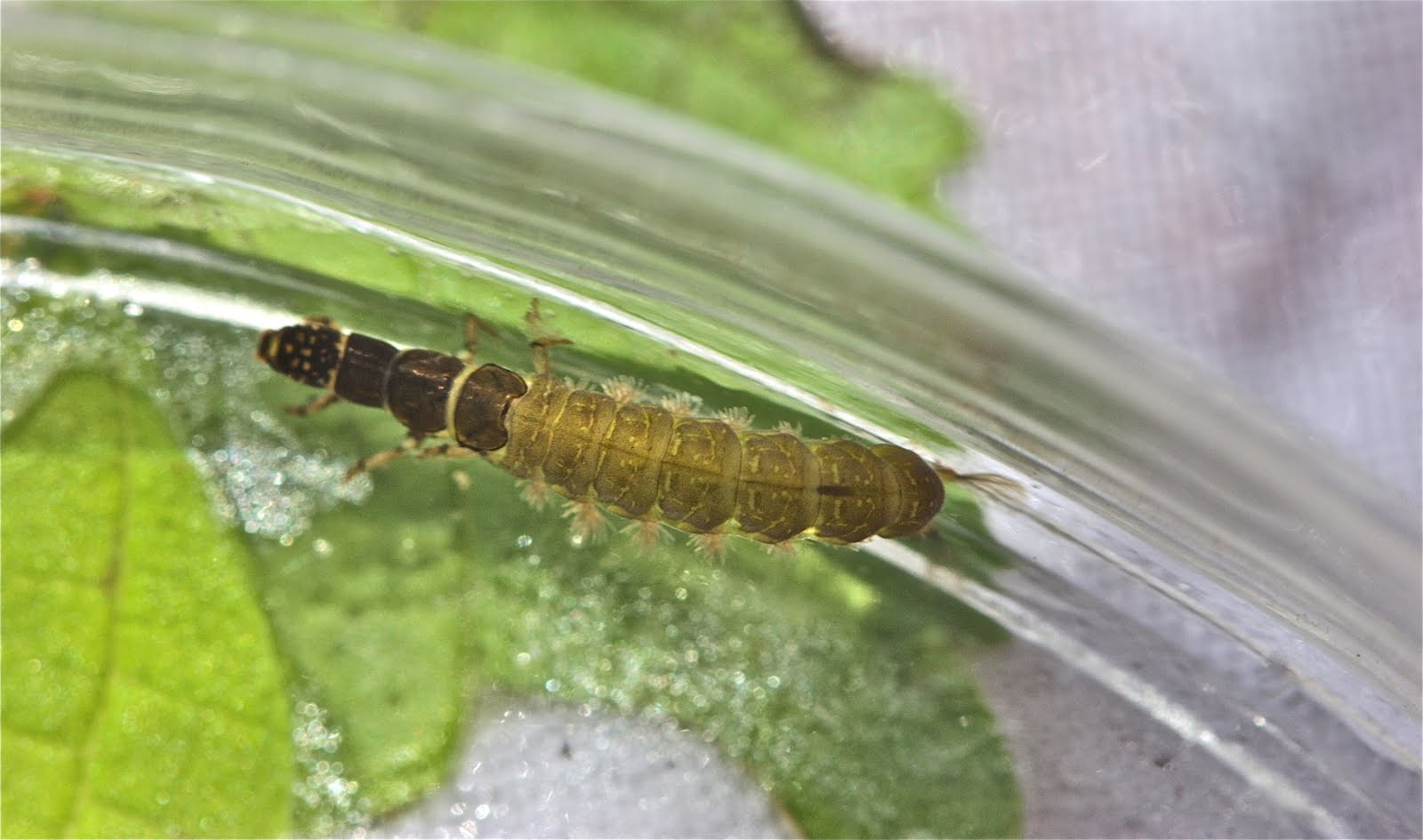

The grey/brown larva spent a lot of time on its back in my tray -- which gave me a chance to see the frilly gills that covered its belly.


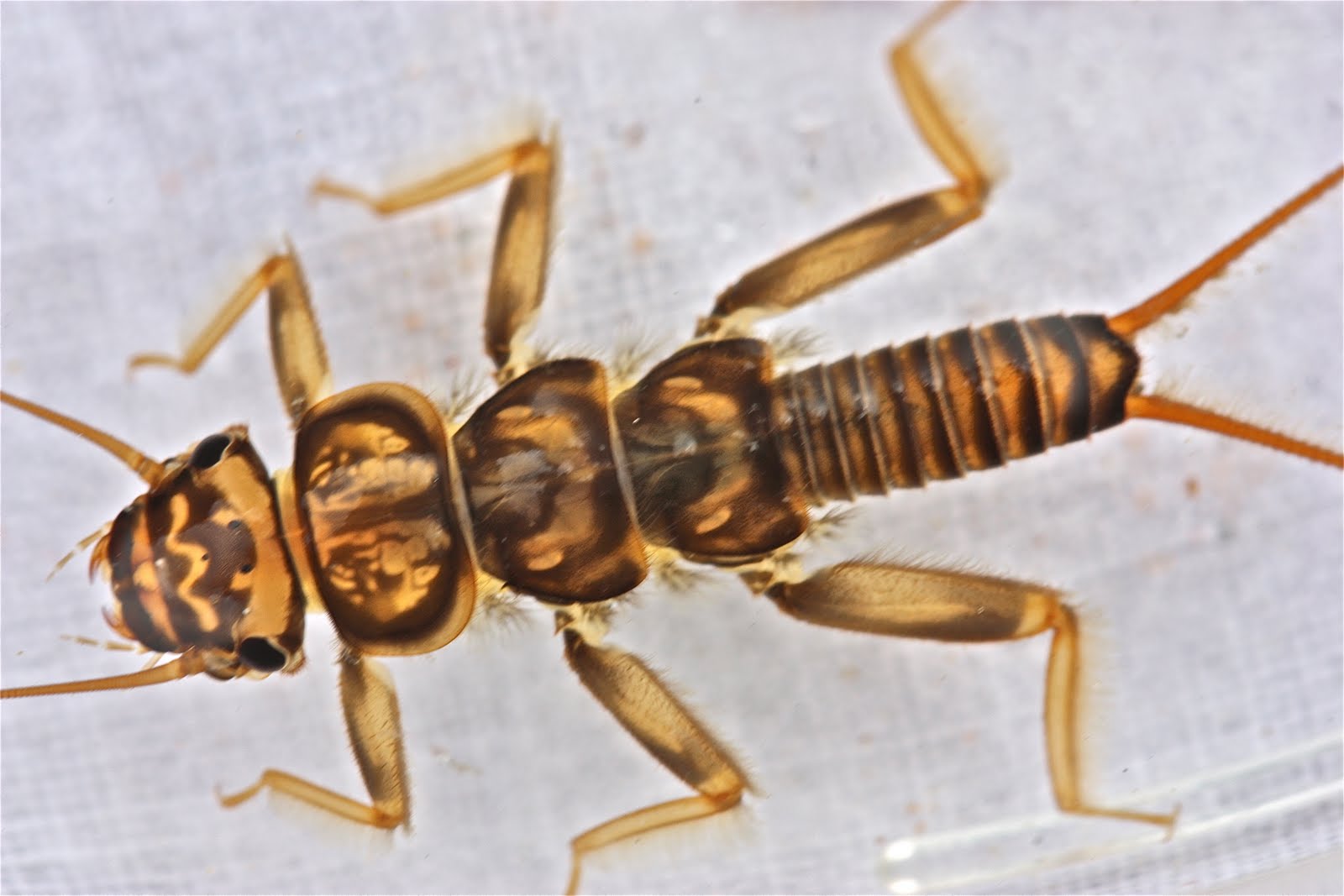
Finally, again, there were quite a few young common stoneflies, genus Acroneuria.  As they did in the winter and spring, they were mostly crawling around in the leaf packs -- but they're also roaming around on the bottoms of rocks in the summer.  Here's a real beauty.


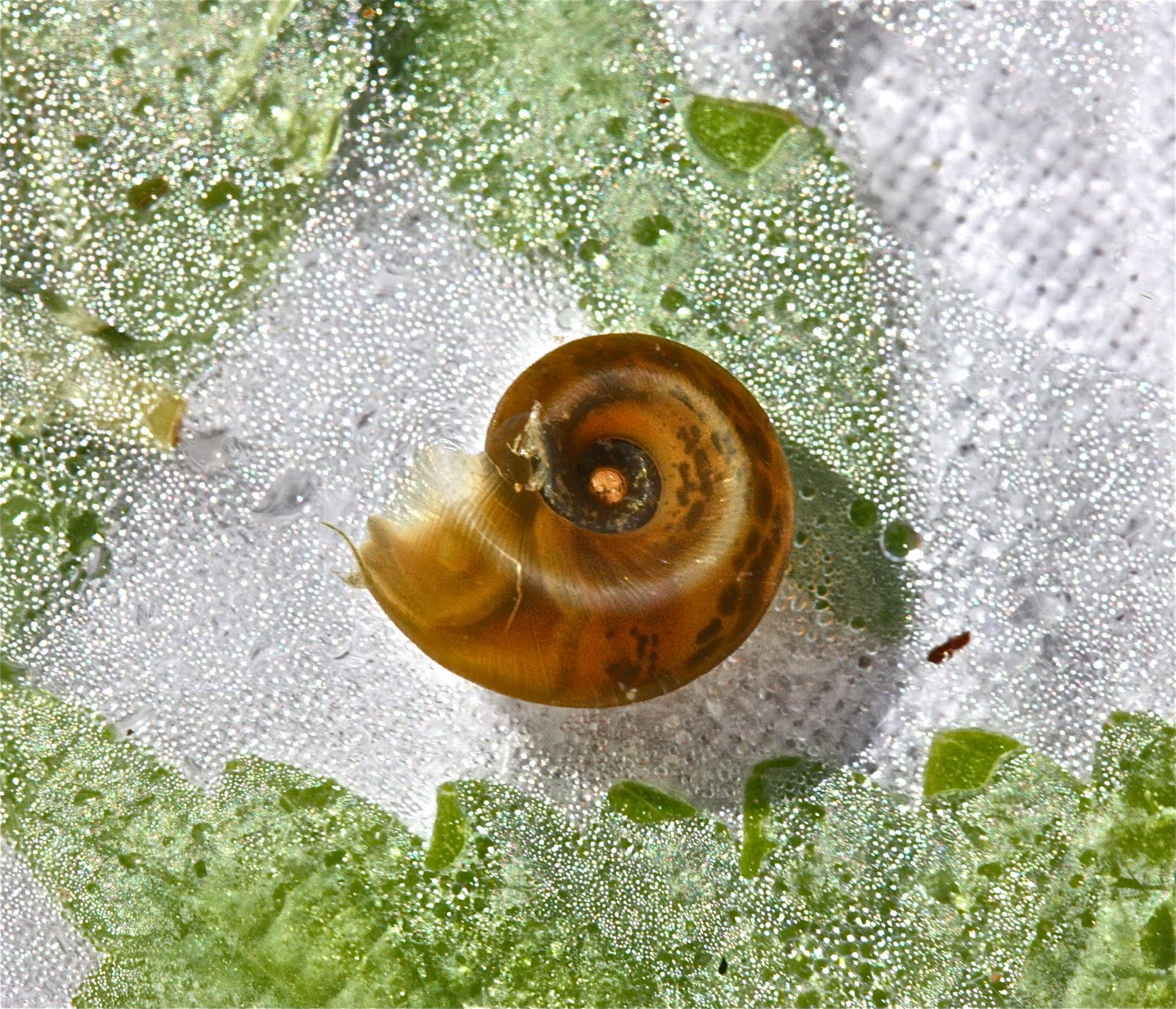
Oh!  Our snail!  It's a Planorbid -- or, in Bob's terms, a "cinnamon bun" (!)   But not a cinnamon bun that I'd like to eat.  This is a "lunged" -- i.e. "tolerant" -- snail, and like most (not all) lunged snails, when looked at correctly, it opens on the left.  Actual size?  About the size of a button on a man's shirt.    By the way, when the snail comes out and crawls around, the shell stands on end; it doesn't lie on its side.  Pretty clear from the photo below.


This one kept oozing its way around my tray, and I had to push it over to get a good look at that case.
Here the case is turned the "wrong" way, so it appears to open on the right, but note the tentacles coming out.


Tuesday, August 9, 2011

Netspinners and Small Minnow Mayflies: Back to the Rivanna


I was busy all morning running some errands.  But I was close to Darden Towe Park in C'ville and stopped by to see what I could find in the Rivanna River.  The entry title is right -- "netspinners" and small minnow mayflies, all of the small minnows Heterocloeon curiosum like the one in the photo above.  There were a lot of them crawling around on the rocks and algae today.  Quite a few were "mature," like the one in this picture, but some were still young with very small wing pads.  The color difference between young and mature is quite striking.  Have a look.

mature


immature


But through the microscope, both immature and mature reveal the defining characteristics of this particular species: grey pigment in the center of each gill, and "procoxal gills."


and


I picked up over a dozen of these H. curiosums, but that doesn't compare to the hundreds of netspinners I saw.  There are so many of them crawling around in the algae at the moment that it really gives me the creeps!  And in the Rivanna, they're to a one, a drab olive in color -- just not very appealing.

Still, there were other things to be found.  I picked up another "Trico," a "Little Stout Crawler" mayfly.  It was not the prettiest Trico that I've ever seen -- it was filthy!  They seem to like to root around in the silt on the rocks.


Still, it was easy to pick out its "triangular operculate gills," the large "gill plate" that covers the actual functioning gills.

I also found, to my surprise, several Heptagenia flatheaded mayflies in addition to the expected lot of Maccaffertiums.   So I've now found this genus in the Moormans, Buck Mt. Creek, and now the Rivanna itself.   The photo is of a small one, but it's fully intact: it has all of its legs and its tails!  (If you've never picked up a flatheaded mayfly with tweezers, you won't know how hard it is to keep all of their body parts on!)   Two photos: in the second one, the Heptagenia nymph is joined by an adult Riffle beetle.


Finally, I got a good shot of a young common stonefly today, genus Acroneuria.  I'm seeing a lot of them now, just about everywhere that I go.  This is the genus that will have the yellow "M" on its head when it's mature.  If you look closely (enlarge the photo), you can start to see it already.


Next spring this stonefly will look more like this.


Monday, August 8, 2011

The "Other" Small Minnow Mayflies (Baetidae) of Summer


I have found four species of small minnow mayflies (Baetidae) in our streams over the summer.  Though it's a bit premature to do a "wrap-up" of these summer findings, that's what this is intended to be.  Clearly, new species will be noted if they are found.

The four small minnow species I've found are Acentrella nadineae, Baetis pluto, Baetis intercalaris, and Heterocloeon curiosum.   Since I focussed on A. nadineae in my last entry, this entry will look at the other three species describing key characteristic,  then noting where and when samples of each have been found.

I. Baetis pluto


The photo at the top of the page is a young Baetis pluto; in the picture below we find one that's a bit more mature.


Baetis pluto is an elegant mayfly with sleek lines and rich colors.  Key features include: 1) the head colors look like longitudinal stripes; 2) tergum (the dorsal side of an abdominal segment) 5 is always pale -- 6 and 7 are completely dark; and 3) the middle tail (caudal filament) is about 3/4 the length of those one either side.  The tolerance value is 3.4.

II. Baetis intercalaris


immature specimen


mature specimen


I've seen a lot of these in our streams.  My first sighting was on May 11th at Powells Creek; my most recent sighting was on August 4th at Buck Mt. Creek.  Again, there are three key features that lead to this identification: 1) the tracheation in the gills is well developed; 2) there are "parentheses" marks, ( ) on the leading edges of the abdominal segments; and 3) the tails (caudal filaments) have dark banding, at the base, the middle, and the tips.  The tolerance value is 5.0.

III. Heterocloeon curiosum


immature specimen


mature specimen


Like A. nadineae, this is a "two-tailer," but only one of the key features for identification is visible in the photos -- the spot of grey pigmentation in the center of each of the gills.  The other feature that we have to see is the "procoxal gills," small finger-like gills that stick out from the base of the front legs; this requires microscope work (see the photo below).  The tolerance value is 2.1.


Now let me give you a run down, stream by stream, of what I've seen and when I've seen it.

A. Buck Mt. Creek

1. A. nadineae: 5/30, 6/30, 7/2, 8/5
2. B. pluto: 6/10
3. B. intercalaris: 6/30, 7/2, 8/5

B. Powells Creek

1. A. nadineae: 8/4
2. B. pluto: 5/11
3. B. intercalaris: 5/11, 8/4

C. Doyles River

1. A. nadineae: 6/23, 7/14
2. B. intercalaris: 7/14

D. Moormans River

1. A. nadineae: 6/24, 7/19
2. B. intercalaris: 6/24
3. H. curiosum: 6/24

E. Rapidan River

1. A. nadineae: 6/6, 8/4

F. Lynch River

1. A. nadineae: 7/2
2. B. intercalaris: 7/2

F. Rivanna River


1. H. curiosum: 7/11, 7/25
2. Oh, yes -- and an unidentified, tiny, tiny, Baetis nymph (three tails) inadvertently found (didn't see it until I looked closely at the photo) when taking a picture of an Emerald dragonfly!


Now that is one "tiny" insect!  (Click on the photo to enlarge it.)


Saturday, August 6, 2011

Acentrella nadineae: One of the Small Minnow Mayflies We Find in Our Streams in the Summer


In 2009 -- just two years ago -- W.P. McCafferty, R.D. Waltz, and J.M. Webb, published an article in the Proceedings of the Entomological Society of Washington entitled "Acentrella nadineae, A New Species of Small Minnow Mayflies (Ephemeroptera: Baetidae)" (issue 111 (1), pp. 12-17).  An abstract of the article's contents can be found at http://www.bioone.org/doi/abs/10.4289/0013-8797-111.1.12.
They noted that this species had been found in southern and eastern Ohio as well as parts of North Carolina.  I've now realized -- using a key to Ephemeroptera species -- that one of the small minnow mayflies that I've been finding all summer in a number of area streams is in fact Acentrella nadineae.    I don't know if this is the first sighting of this species in the state of Virginia -- probably not -- but this might add to the data collected so far.

 The nymph in the photo above was found in the Doyles River at Doylesville on June 23rd, and it nicely reveals two -- possibly three -- of the key features entomologists use in identifying this species: 1) the gills are large, asymmetrical, and have a line of "baso-medial" (running from the body to the middle part of the gill) grey pigmentation; 2) there are splotches of red or orange on the thorax and abdominal tergites; and 3) -- if you can see it -- the tarsi and tibiae of the first pair of legs when combined are not as long as the femora.

I have now found this Baetid species in five of our streams: Buck Mt. Creek, the Doyles River, the Lynch River, the Moormans River, and Powells Creek.   These are all pretty good streams, and all of them are close to the Blue Ridge mountains.   The tolerance value of this small minnow species is a mere 1.9, but I'm not surprised to find a low tolerance mayfly in these particular streams.

For the rest of this entry, I will simply post some of the photos I've taken of this species of Baetidae over the summer.  Some of these nymphs are young; others are clearly mature.  The photos reveal that, as with so many other mayflies and stoneflies, Acentrella nadineae nymphs get darker as they get close to hatching.  Dates and locations are noted for each of the photos, and I've listed the photos in chronological order.

May 30th, Buck Mt. Creek.  First sighting.


June 6th, Rapidan River (Madison County).


June 23rd, Doyles River (another photo of the nymph at the top of the page).


June 24th, Moormans River.


June 30th, Buck Mt. Creek -- young.


June 30th, Buck Mt. Creek -- mature (note the dark wing pads).


July 2nd, Lynch River -- young.


July 2nd, Lynch River -- mature.


August 2nd, Powells Creek.


August 5th, Buck Mt. Creek -- very young.


I will look at the "other" small minnow mayflies of summer that I've found in our streams in a subsequent entry.  This one deserves an entry all of its own.

Thursday, August 4, 2011

The "Golden Stone" Hatch in the Rapidan River


The Rapidan River in Madison County is rich in stoneflies -- lots of "Common Stoneflies," Perlids, which hatch out as "Golden Stones" in fly fishing terms.  As I walked through the river this morning looking for insects, I saw Perlid "shucks" all over the rocks.  A couple of photos, beginning with a double.


And then this one, in which we can see how the "shuck" was cracked open to allow the flying adult emerge.


There are two Perlid genera that inhabit this stream: Acroneuria and Paragnetina.  The one in the photo above is a Paragnetina imarginata that I found this morning, and here is a beautiful Acroneuria (carolinensis) that will surely crack its shell and fly off before very long (or will it be part of next year's class?)


But I also found a member of the "new generation".  Take a look at this photo, another of this Acroneuria nymph, but note what's crawling around in the bottom left of the picture.


Now, that is what you call a small stonefly, especially when we know that the mature nymph was about 1 inch in length!   Let's let him take the stage on his (or her) own.  It's in a petri dish which is 3 1/2" in diameter.


This turned out to be a small Paragnetina common stonefly, but it took microscope work to make that identification.  The crucial factors?  There is a row of spinules along the back side of the head (the "occipital ridge"), and "subanal gills" are not present.  Here's a look at that ridge.


The Rapidan -- like all of the streams I'm visiting at the moment -- was full of netspinning caddisfly larvae, flatheaded mayflies (Maccaffertium and Epeorus vitreus), and small minnow mayflies (genus Acentrella).  There were also some small Giant stoneflies and lots of small Peltoperlids (Roach-like stoneflies).   But the other thing I found here was lots of BIG brushlegged mayflies, some that were clearly ready to hatch.  For example...


And I'm quite sure that many brushlegged mayflies have already emerged -- as "Slate Drakes" or "Leadwings," to use the fly fishing terms.  In fact, I found evidence of this as I was snapping photos of stonefly shucks.  Have a look.


Now, it's not a very good photo -- it was in an awkward place on the rock -- but it's clearly a brushlegged "shuck".  The brushlegged mayfly (Isonychiidae), in contrast to most other mayflies, crawls out of the stream onto rocks to emerge (see Knopp and Cormier, Mayflies, p. 84).   The species of brushlegged mayfly that we have in the East is Isonychia bicolor, and Knopp and Cormier (p. 85) note that it emerges here from late spring into fall.

My photography today was limited by heavy cloud cover.  Still, I got photos of a couple of cased caddisflies that I can use to close out this entry.  The first is of a Glossosomatid (Saddlecase Maker), crawling out of his stony "tortoise shell" case.  The second is of one of many Brachycentrids (Humpless case makers) that are starting to show up in our streams.  This one appears to be staring down that tiny common stonefly.  (Final photo -- another pic of the Acroneuria Perlid.)


Tuesday, August 2, 2011

Rich in Small Minnow Mayflies: A Look at Powells Creek


I've become interested in attempting to identify small minnow mayflies to the level of species, so I've been intently looking for nymphs.  I thought Powells Creek in Crozet might be a good place to find some -- and I was right.   In the photo above, we have a Baetis intercalaris small minnow mayfly swimming next to a lovely common stonefly, genus Neoperla.

I found both mature and immature B. intercalaris nymphs.  Here's a look at one of each.

mature:


immature (note that the center tail/cerci is broken off):


How have I arrived at the B. intercalaris identification?   I've been given the use of a key that is a "work in progress," not yet published, and therefore one I cannot fairly cite from it.  But I think I can note the key features of this particular species without using quotations.  First (and you might want to click on the photo of the mature sample to enlarge it to follow along), the "tracheation" (veins) in the gills is well developed.  Second, the color is one of the keys: mature nymphs are often gray /brown.  Third,
the abdominal gills have a distinct pattern, with what look like "parentheses" marks at the top of each segment, and there are often three pale dots at the back of the abdominal segment.  All of these features show up very well in the mature sample pictured above.  For a close-up of the abdominal pattern, here is a microscope view.


I found 4-5 nymphs of this species today in a short period of time.  But, I also found several Acentrella small minnow mayflies.  They looked like this.


Two tails, gills well tracheated with a gray pigmented area on the front part (distal) of each gill.  And, like all of the Acentrellas I've found this summer, these seem to have red/orange spots on various parts of the body.  Just look at how one of these looks in a microscope view.


Pretty spectacular!  Needless to say, I'm trying to figure out the species on this one.  I think it's Acentrella parvula -- but I'm trying to get confirmation of that from an expert.  More on that later.

As always, I found a variety of insects today.   A fair number of flatheaded mayflies, genus Maccaffertium and Epeorus vitreus.  There were also lot of common netspinners and a few fingernet caddisflies.  I also found quite a few adult Riffle Beetles (Elmidae): meant to take a few photos, but I simply forgot.

And I did find quite a few common stoneflies, the one Neoperla -- you might recall that this is the only stream in which I've found this particular species -- and quite a few young Acroneurias.  I need to start taking photos soon of the latter to document how they change as they grow.  At the moment, the yellow "M" pattern on the head is still indistinct.  Another shot of the Neoperla.