Thursday, February 23, 2012

The Leuctrids (Rolledwinged Stoneflies) Start to Show up in Our Streams


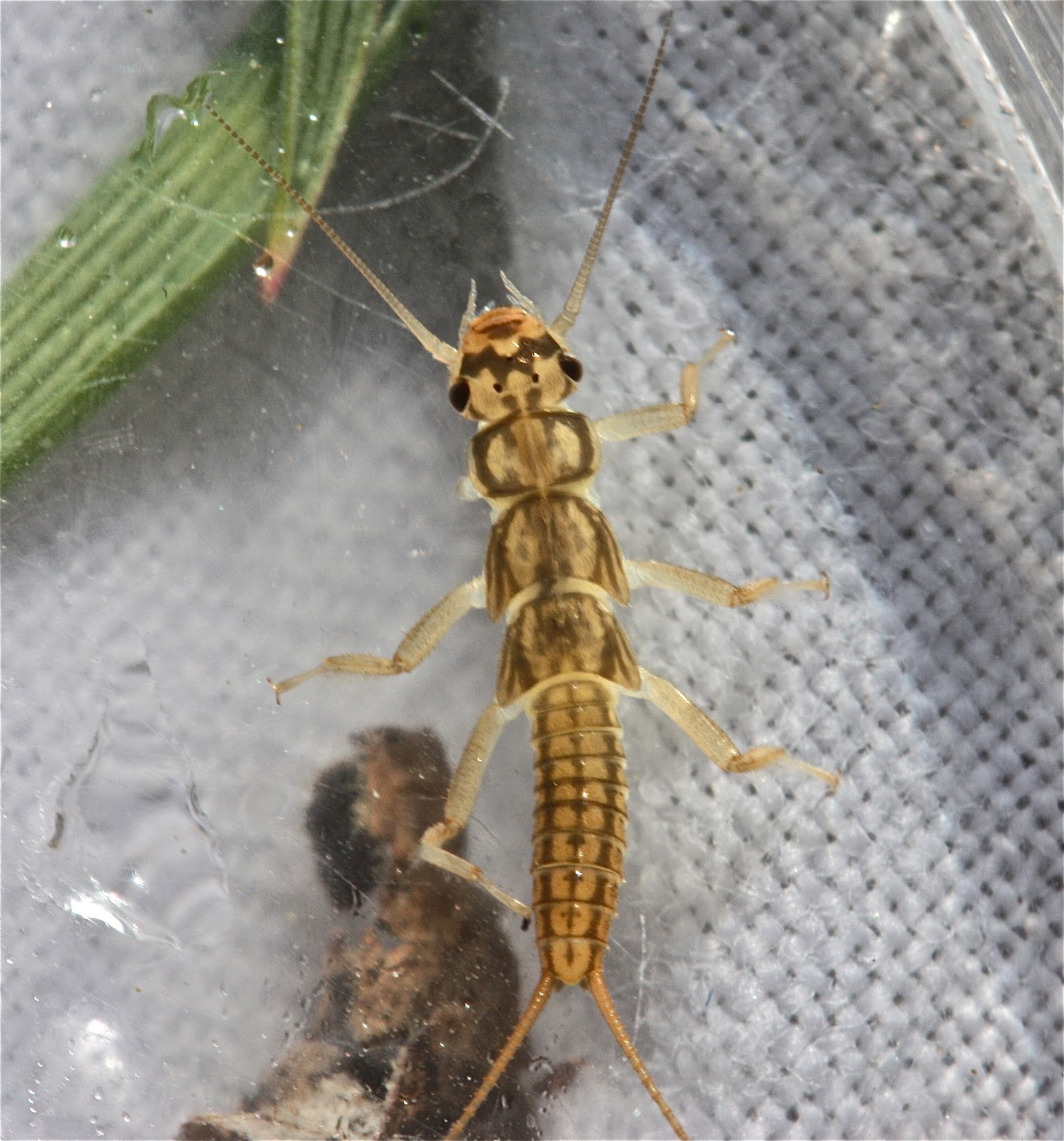
They're small, and I've only seen them in very small (narrow) streams, mostly very clean streams that flow through the mountains.  The tolerance value is only 1.5 for the genus "Leuctra," which is the only one that I've seen in this region.

Monitors sometimes confuse Leuctrids with small winter stoneflies.   But if they look closely they should be able to tell them apart, and, they don't overlap that much in our streams: by now, most small winter stoneflies are gone, and the Leuctrids are just coming on (they normally hatch in August -- November).  In any event, Leuctrids have a long, thin abdomen -- small winter abdomens usually have a slight bulge in the middle -- and the rear wing pads on Leuctrids are always longer than they are wide (see the photo below), not the case with most small winter stoneflies.


The genus Leuctra is descibed by Beaty ("The Plecoptera of North Carolina," p.2) in the following way:
"Nymphs 6-9 mm; labial palpi extend past rest of labium; hind wing pad longer than its greatest width; first four abdominal sternites with pleural folds; abdomen parallel sided; pair of terminal setae on lobe of last abdominal segment."

That the labial palpi extend beyond the glossae and paraglossae is easy to see.


And, I think you can distinguish the pleural fold in this photo.  The fold occurs right where there's a color change at the edge of the segments 1-4.


As for the pair of terminal setae -- well, tough to see on our nymph since they were covered with silt.


I should find some better Leuctrid examples as we advance through the spring.  Another look at our nymph.


And, here's a microscope photo of a mature nymph, taken two years ago.  When they mature, their wing pads and abdomen often contrast in color.


___________

I was back in Sugar Hollow this morning since a lot of our streams are, once again, a little bit high following the melting of 6 inches of snow and a quick shot of rain.  But, I always find beautiful insects when I go to these streams.

1. Flatheaded mayfly, Epeorus pleuralis.  You can pick up just about any rock, and you'll see them scamper for cover.  The stream is loaded with them.  This is the mayfly of the moment.  Oh, but I also saw a lot of Leucrocutas which, at the moment, are just too small to pick up for pictures.


2. And the "stonefly" of the moment -- what else? -- Isoperla nr. namata.  The rocks are covered with flatheads; and the leaf packs are loaded with the Perlodid stonefly I. nr. namata.  Sure with quite a hatch of "Yellow Sallies" from late March through April.


3.  But I also found more of the big Perlodid, Malirekus hastatus.  You really have to be careful with these -- they'll eat anything they can get hold of.  I lost a number of flatheaded mayflies to their hungry jaws and an I. nr. namata as well.  But, they are beautiful insects.


4. I saw quite a few Uenoid case-maker caddisfly larvae: some were crawling around on the top of the rocks (rocks that were underwater, that is), others have already sealed up their cases and entered pupation.  Beautiful Uenoid cases in this particular stream.


5. And in this photo, a free-living caddisfly larva (R. fuscula) decided to perch on one of the cases in which a Uenoid has gone into pupation!  (Notice how the Uenoid has sealed its case at one end with an orange pebble.)


6. Another free-living caddisfly larva, Rhyacophila nigrita, a species that's common, it seems, in this stream.


7. And finally, a Chloroperlid (Green stonefly, genus Sweltsa) that has started to move toward maturity, getting darker in color and with wing pads that are "rounding" into shape.

Sunday, February 19, 2012

Was There Something New at the Rapidan Yesterday? Baetis tricaudatus?


It seems like I always find something new when I go to the Rapidan River.  So I was a bit disappointed with the report that I had to post yesterday.  But I had preserved a few insects for closer inspection, including the tiny small minnow mayfly in the picture above, one that I found towards the end of the day.
I knew that the genus was Baetis: I could see that it had three tails.  But it took the microscope to show me that this was a species I had not seen before: Baetis tricaudatus.

Baetis tricaudatus nymphs can be confused with Baetis pluto nymphs, but the "caudal filaments," or "cerci," or "tails" help us to distinguish the two from one another.  Here's a Baetis pluto that I found last summer, and focus on the tails.


Let me read you what Steven Beaty says about the tails (caudal filaments) of Baetis pluto.  "[the] middle caudal filament [is] 3/4 to subequal to [the] lateral filaments, usually with [a] distinct dark band on [the] caudal filaments medially." (The Ephemeroptera of North Carolina," p.6).    A perfect description of the tails of the nymph in our photo.

Now, here is a microscope view of tails of the tiny nymph I found yesterday, the one in the picture at the top of the page.


There is no dark medial band, and that middle caudal filament is certainly not 3/4 the length of the lateral filaments -- i.e. the tails on the side.  Back to Beaty:

B. tricaudatus -- nymphs 5-8mm; distinct palpal "thumb"; antennal scape and pedicel with robust setae; gill margins without large robust setae and serrate; caudal filament shading gradual, less dark than in B. intercalaris; middle caudal filament less than half as long as lateral filaments.  Primarily a Mountain species.  Typically collected spring through fall.  Relatively common and intolerant.  ("The Ephemeroptera of North Carolina," p.6).    (North Carolina assigns a TV of 1.5 to Baetis tricaudatus.)

The nymph in our photo was not quite 5mm -- but it's a young one.  On the "distinct palpal 'thumb," have a look.


Not my best photo, but the "palpal" thumbs are quite well defined: the palpal lobes look like "mittens"!
I could see the setae on the pedicels of the antennae -- but I could not get a good microscope photo.  The same is true for the edges of the gills.  But, the shading of the caudal filaments is indeed gradual, turning darker as we move toward the tips, and, the middle filament/tail is, indeed, "less than half as long as [the] lateral filaments."  I have no trouble calling this Baetis tricaudatus.  Always fun to find something new!

Another look.


________

Postscript:  Yikes!  I just had another look at the nymph I found at South River on 1/12.  That, too, could well be B. tricaudatus.  Very short middle tail and no medial banding.  I'll have to check these three-tailers with greater care.


Saturday, February 18, 2012

Pteronarcys biloba: The "Giant" of the Rapidan River


Time to take a close look at the spectacular Giant stonefly that haunts the leaf packs of the Rapidan River.
This is the only species of Giant that I've seen in this stream -- and it's quite a beast!  This was close to 2" long, and look at those abdominal "spikes".  I always wonder if the Brook trout that inhabit this river lick their chops when they see one of these coming -- or do they dive for cover?!

Let's take a look at Beaty's description of Pteronarcys biloba ("The Plecoptera of North Carolina, p. 28).

P. biloba -- lateral margin of frontoclypeus with small triangular tubercles adjacent to, and partially obscuring, antennal pedicels; anterolateral angles of pronotum conspicuously produced into hook-like processes, although North Carolina specimens less so; abdominal hooks divergent, often with low knob on the posterior margin of one or more of the pairs, and conspicuous on abdominal segments 7-8; antennae and cerci with a pale yellow medial band; cerci greater than half the length of the abdomen.  Nymphs occur year-round in the Mountains from June through February.  Semivoltine.


I did not preserve this nymph, so I can't verify the size and shape of the tubercles at the front of the head next to the antennae.  But the other features we can see clearly without special magnification.

1. Are the front corners of the pronotum "hook-like"?  Yes.


2. Are there low knobs on the rear margins of the "spikes" that stick out from the abdominal segments?
Yes.  In fact I can see them on every pair of projections.


3. And, is there a medial, yellow band on the cerci, and are the cerci more than half the length of the abdomen?  I did not measure the cerci -- but they are indeed very long, and they probably matched Beaty's description.  (Compare these to the short cerci of P. scotti, the Giant featured the entry posted 2/2).


Finally, a close look at the antennae.


Quite a magnificent creature, and with a TV of 0.0, it's absolutely intolerant of impairment.
______________

The insects I found at the Rapidan River this morning were pretty much what I expected to see, but, as always, there were a couple of surprises.  The first was the sheer number of Isoperla nr. namata Perlodid stoneflies I found in the leaf packs.  There were hundreds.  This was clearly the dominant taxon in the exploring that I did today.  And, a lot of these nymphs are showing signs of maturing: the rear wing pads are starting to flare out from the body.


The other surprise?  I found three small minnow mayflies.  And though I was expecting them to be Heterocloeon amplum -- they were not:  they were Baetis pluto.  Notice the three tails, with the middle one much shorter than the two on the outside, and, note that tergite 5 is pale while 6 and 7 are dark (= B. pluto).


So, there are at least two species of small minnow mayflies in our streams in the winter.   (You may recall that I previously found a Baetis pluto in the South River on 1/12.)
_______________

Here are a few other nice photos from today's journey up to Madison County.

1. A pretty spectacular free-living caddisfly larva: Rhyacophila fuscula.


2. A lovely fingernet caddis: genus Dolophilodes.  (I've never seen the common Chimarra in here.)


3. Another Malirekus hastatus Perlodid stonefly.


4. The Common stonefly (Perlid), Paragnetina immarginata.


5. And, the spiny crawler that I only see when I come to this stream -- Ephemerella subvaria.  I saw a lot of them on this trip, and they're getting ready to hatch as the "Hendrickson" in April and May.


Friday, February 17, 2012

More Thoughts on Stream Protocol and the "Scores" That We Use


No, I swear that's the actual color.  It may be a killer -- but it sure is a beautiful stonefly.  The Perlodid stonefly, Clioperla clio.  If you're collecting mayflies and stoneflies and you get one of these, put it in a bowl by itself; otherwise, you'll soon find that some of your other insects are missing!


I went up the Doyles River today to a spot that I like to visit -- where Rt. 810 takes a sharp right and crosses over the stream.  This is roughly 8 miles north of White Hall, VA.   The leaf packs were "packed" with the little Perlodids, Isoperla nr. namata -- I saw dozens of them -- while the bottoms of rocks were literally crawling with the flatheaded mayflies, Epeorus pleuralis.   The Isoperlas will hatch out in April and May as "Yellow Sallies" (in fly fishing terms), while the Epeorus mayfly emerges in March and April as the "Quill Gordon."  Ought to be great trout fishing here in the spring -- if only there were some trout!

On my way back into town, I decided to look for some small minnow mayflies at a spot lower down on the Doyles, roughly 1 mile outside of White Hall.   I had a theory to explore, that being that the orange/brown H. amplum nymphs are males while the olive ones are females.   I sorted through some leaves and had 6-8 nymphs in 5-10 minutes.  I found only one Isoperla nr. namata: at the upper site, I had found no small minnow nymphs.  I also found, at the upper location, a bunch of free-living caddisfly larvae, and some Maccaffertium pudicum flatheaded nymphs, along with the Epeorus pleuralis and the I. nr. namata, all good indicators of a real healthy stream.

There's a point to make here before I get to some photos.  The "score" we assign to a stream as an indication of the health of that stream all depends on the part of that stream that's being examined.  The upper Doyles river is very clean water, being close to the boundary of the Shenandoah National Park.  The insects here are quality insects with very low tolerance values.  The lower site I explore isn't bad, but I've never seen a free-living caddis here, and I've never seen Giant stoneflies (I've seen them up above), and it's a superb location to look for small minnow mayflies (which are, relatively speaking, pretty tolerant critters).   If we "score" the Doyles at the upper location it will come out as a very good stream; if we score it at the lower location -- well, it's fair to good, but the score will be quite a bit lower.   How do you decide where to sample?

More photos taken today.

1. A beautiful brown/orange Strophopteryx fasciata large winter stonefly.


2. One of several Lepidostomatids in its little square case made out of leaves.


3. A flatheaded mayfly, Maccaffertium pudicum.


4. One of the many Epeorus pleuralis nymphs that I saw -- and note that the wing pads are now getting long.


5. A "group" shot of an M. pudicum nymph with a E. pleuralis nymph -- so you have a sense of the relative size.  M. pudicums are BIG.  This one measured 14mm.


6.  A couple of the Isoperla nr. namatas.


7. One of the free-living caddisfly larvae: Rhyacophila fuscula, I think.  But I need to check; there's something a bit odd with the topless "H" on the head.


8. From the lower site -- another Helopicus subvarians Perlodid stonefly.  They're pretty common in here.


9. And finally, two of the six small minnow mayflies I found in the stream down by White Hall.  They're Heterocloeon amplums, and yes, the males (big, red eyes) are the ones that look a orange/brown; the females (small, dark eyes) are olive.


Thursday, February 16, 2012

A Further Note on the I. namata Issue


I've been in touch with Steven Beaty (NC DWQ), and he thinks that the Isoperla namata nymphs that I'm finding in Central Virginia should still, at the moment, be called Isoperla nr. namata.   According to Beaty, the leading authority on Isoperla argues that true Isoperla namata is only found in the Ozarks and the Midwest.  Also, Isoperla "patterns" can vary.  So the three head patterns we saw yesterday still qualify as Isoperla nr. namata.

Those patterns were:

1. The most common, where the dark lines/bands from the transverse band crossing the head extend back to the lateral ocelii and beyond, to dark spots at the back of the head.


2. Nymphs where there are no lines extending from the transverse band back to the ocelli.


3. And the nymphs that I'm finding in Sugar Hollow where there are no dark bands/lines/spots behind the lateral ocelli -- as with the nymph pictured at the top of the page.

So, Isoperla nr. namata it will be.  However, I think it's still worth our while to keep track of the streams in which we find each of these patterns.  There may be habitat differences that account for these variations.

Wednesday, February 15, 2012

Isoperla namata: Comments on a Number of Issues


This picture was taken on 3/24/11 at the Rapidan River in Madison County.  It's the Perlodid stonefly, Isoperla namata, which is the most common Isoperla species we see in our streams -- more, it's the most common Perlodid stonefly we see in our streams.  But there are a number of issues surrounding the ID call of "Isoperla namata" that I think we need to discuss.

1. Let me begin by noting that Isoperla namata is a species that is primarily found in the Ozarks -- Missouri and Arkansas (for the distribution of I. namata, look at: http://www.npwrc.usgs.gov/resource/distr/insects/sfly/usa/468.htm.  (Note that "npwrc" stands for the National Prairie Wildlife Research Center).   In fact, the common name for I. namata is "Ozark Stripetail."
For this reason, Steven Beaty ("The Plecoptera of North Carolina," p. 24) refers to the Perlodid nymphs that are found in NC that "appear" to be I. namata as "Isoperla nr. namata" -- i.e. they look like I. namatas, but I. namata shouldn't occur here (!).  In Virginia, we don't have this problem.  That's because Stewart and Stark, in their Nymphs of North American Stonefly Genera (Plecoptera), p. 412, include Virginia among the states where I. namata is found (AR, IN, KY, ME, MO, OH, PA, VA, and WV.)  


2. There is another species of Isoperla which, in appearance at least, is exactly the same as I. namata, but the geographical distribution is different.  This is Isoperla montana.  This is supposedly found, primarily, in the northeast: CT, DE, ME, MN, NH, NS, NY, ON, PA, and PQ (Stewart and Stark, p. 412).  (Also see, http://www.npwrc.usgs.gov/resource/distr/insects/sfly/usa/466.htm).  Note that the species ID, "montana," has nothing to do with the state of Montana, it refers to that fact that these nymphs are primarily found in mountain streams.   (The common name is "Montaine Stripetail").   Now, if you look up "Isoperla montana" on Bugguide.net, you'll see that these nymphs look exactly like I. namata.  In fact, some have been moved into I. montana from I. namata, for, what appears to be nothing more than geographical reasons.  I.e. I. namata is only found  -- supposedly -- in the Ozarks and the Mid-west (!).

3. Let's get closer to home and look at some of the nymphs that I've found this season and last.  But let me begin with Beaty's description of Isoperla nr. namata (Beaty, "The Plecoptera of North Carolina, p. 24).

"North Carolina specimens have a dark transverse band on head usually without backward extensions to lateral ocelli but sometimes with extensions and with lighter brown areas behind ecdysial line (emphasis added by Henricks): abdominal longitudinal lines narrow; abdominal tergites with a transverse row of 6-8 sometimes faint dots."  He adds, "Isoperla namata is supposedly geographically restricted to the Ozarks and the midwest..."

4. As I have looked through my Isoperla photos from last year and this year, I've found that most match what Beaty calls Isoperla nr. namata, but, with most of the nymphs that I've seen, the dark transverse band does extend to the lateral ocelli.  E.g., in addition to the nymph pictured at the top of the page,

a. 3/28/11, Powells Creek:


b. 4/23/11, Powells Creek:


However, I've also found some nymphs where the dark band does not extend to the lateral ocelli.  For example, this nymph also found at Powells Creek on 3/28:


And, this one -- though I'm not sure where it was found and when:


5.  Now, let's have a look at what I've found so far this season -- noting the dates and locations -- but I'll save the photos of the nymphs that I've found in Sugar Hollow for last.   I've called all of these nymphs "Isoperla namata".   Note how the head pattern becomes clearer with time.

a. 11/19/11 -- Rapidan River.


b. 12/13/11 -- Rapidan River


c. 12/21/11-- Upper Doyles River, the first one that is "clearly" Isoperla namata".


d. 1/4/12 -- South River (Greene County):


e. 1/18/12 -- Rapidan River:

__________

Now, let's have a look at the nymphs I've found in Sugar Hollow, in the small, mountain streams that feed into the Moormans.

a. 1/14/12:


b. 2/2/12:


c. And finally, the nymph that I found on Monday, 2/13/12:


I never saw it until I looked at all of these photos this morning.  The dark spots/lines -- whatever you want to call them -- behind the rear ocelli, and behind the ecdysial suture (that's the line on which the head will split open when the adult emerges) are missing.  True, this could be because those dark spots have not yet developed.  But, note that they are very clear on the young nymphs found on 1/4 in South River and on 1/18 at the Rapidan River.

I'm not sure if this is important -- i.e. if this is a morphological feature that sets the Sugar Hollow Isoperlas apart.  Still, it's significant to me that I've seen this only on the nymphs that I'm finding in these "pristine" streams in the Blue Ridge, in Sugar Hollow.

So now you have some idea of the mysteries entomologists have to work out when dealing with the "Isoperla namata," or "Isoperla montana," or "Isoperla nr. namata" nymphs that we find in our streams.
Still lots of work to be done.
_______________

Below:  a mature I. namata -- April 18, 2011: Long Island Creek, Fluvanna County.