Wednesday, March 7, 2012
The Freeliving Caddisfly Rhyacophila carolina in Whippoorwill Branch
I made a quick trip to the Whippoorwill Branch of the Mechums this afternoon, and while most everything that I found was expected, this one was not: the freeliving caddisfly Rhyacophila carolina -- this is the first time I've identified this species in one of our streams. And I picked up two of them. The second was, in comparison with the one in the photo above, shorter, fatter, and darker in tone.
But it's clear that the two are the same; just look at the heads and the pronotums -- golden brown. Beaty notes that R. carolina is the "second most common Rhyacophila in NC," with the golden brown head being the key feature to see. The other feature that is key to identification -- there are no ventral teeth on the anal claws. The photo below bears this out.
This is the fourth freeliving caddisfly species that I've been able to ID in local streams, the other three being R. fuscula (most common), R. nigrita, and R. glaberrima, all of those found in the small stream in Sugar Hollow to which I seem to return a couple of times each month. Relevant entries on those other species were posted on 11/25, 12/26, and 2/13.
My goal today was to find some common netspinner larvae: I've got the itch to work at species ID on the common genus Hydropsyche. Well, I did find common netspinners -- a lot of them in fact -- but number one, they were all very small, and number two they were all genus Cheumatopsyche, which Beaty advises us to leave at the level of genus! So it goes. A couple of photos of a Cheumatopsyche common netspinner larva.
Like Hydropsyche netspinning larvae, Cheumatopsyche larvae have a "forked fore trochantin."
But we distinguish the two genera by looking at the prosternal plate (under the chin). Hydropsyche larvae have two small sclerites (dark patches) right below the prosternal plate; Cheumatopsyche larvae do not. This larva was Cheumatospsyche.
While I can't support this with data, my impression is that the majority of the common netspinners we find are Hydropsyche, but you can't really tell without looking under the chin.
Cheumatopsyche common netspinners are very tolerant, with a generic tolerance value of 6.6. Odd that I find these side-by-side with the freeliving caddisfly larva R. carolina, which has a tolerance value of 0.4.
__________
The "Spiny Crawler explosion" is well under way in this stream: patches of moss on the rocks (under the water) were loaded with them. Most were still very small. But I did find one that I could photo. This is our common spring species E. dorothea.
And one other interesting photo. I found a lot of Uenoid case-makers with their little stone cases clinging to rocks. One of them slipped out of its case and started crawling around on a caddis pupa that I had picked up!
The pupating caddis was either a fingernet caddis or a freeliving caddis -- but I didn't feel like opening up the cocoon so I could find out.
_____________
The two R. carolina larvae come face-to-face in my tray.
Sunday, March 4, 2012
Slammed! By Lepidostomatids and Peltoperlids
This is the kind of silliness that I had to put up with this morning while taking my pictures: it was ridiculous! And look at these clowns!
Still, you have to admit -- those are some of the prettiest Lepidostomatid cases you're ever going to see.
I used to sample with a local group that monitors our area streams, and when one or two taxa accounted for 1/2 to 3/4 of a 200 bug total, we said that we had been "slammed." That usually meant something bad. We might have run into a black fly colony -- there goes the score for that stream -- or in the spring it would probably be spiny crawlers. If our dominant taxa had low tolerance values, being "slammed" would have a negative impact on the score for that visit. But even with good tolerance values, insects that show up in numbers that overwhelm the sample will tear down the score because the "variety" that some metrics value just isn't there.
Well this morning I was slammed by Lepidostomatids and Peltoperlids, "Roach-like stoneflies," these little guys.
I'm talking hundreds of both of these taxa. I've never seen that many Lepidostomatids or Peltoperlids in any one place at any one time. I spent a lot of time in "search and rescue." I.e. when I finished looking through leaves, the rock on which I had put the leaf pack would be covered with Lepidos and Peltos. So, I'd pick and pick and pick to make sure that they all got back into the water!
But I can't say I mind getting slammed with insects like these -- it's the price you pay for going to very clean water in small mountain streams: Lepidostomatids (genus Lepidostoma) have a tolerance value of 1.0, and the tolerance value for Peltoperlids (genus Tallaperla) is 1.3. This is perhaps the cleanest water I see in all of the streams that I visit. Back in Sugar Hollow again (not much choice since rain has once again raised and colored the water in most of our streams), this time to the small tributary on the north side of the valley that I get to enjoy. I did see other insects, by the way: as you would expect, all of them good: Chloroperlids (Green stoneflies), Eccoptura common stoneflies, tiny Leucrocuta flatheaded mayflies, and a few -- but only a few -- spiny crawlers (as opposed to what I just found on the "south" side of the valley).
I also found another Maccaffertium meririvulanum flatheaded mayfly, the flathead that only hangs out in "pristine," headwater streams, and I found a Leuctrid (rolledwinged stonefly). I'll tie this up with some photos of those taxa -- and add a few more shots of our Lepidostomatids.
1. Maccaffertium meririvulanum. Note that the wing pads are getting long now (as opposed to the one I found in this stream on 12/11/11), and remember the defining characteristic: pale "V's" on abdominal segments 5, and 7-8 or 7-9 (this one also has one on segment 4).
2. Some good close-ups of a young "Rolledwinged stonefly" (Leuctridae), genus Leuctra.
3. And a couple more looks at our Lepidostomatids.
Saturday, March 3, 2012
Ephemerella invaria: Another Spiny Crawler to Add to Our List
In the entry I posted on Thursday (3/1), I said that the spiny crawler in the photo above, found in the Doyles River on February the 6th, might well be Ephemerella invaria -- not Ephemerella dorothea, the spiny species that we commonly see in the spring. I presented some evidence in support of that view. Today I can make the case even stronger.
To clearly distinguish E. invaria from E. dorothea, and from E. subvaria, you have to look closely at the abdominal tergites, and the questions to answer are-- 1) are there "paired submedian tubercles" on the tergites? which tergites? and what do the tubercles look like?
This is an E. subvaria nymph that I found a few weeks ago at the Rapidan River.
Steven Beaty ("The Ephemeroptera of North Carolina," p. 28) says the following in his description of E. subvaria nymphs: "...abdominal terga with moderately long, sharp paired submedian tubercles on segments 2-9." And those "long, sharp" tubercles are very clear in this microscope photo: look at the black, sharp spines at the rear of segments 4, 5, and 6.
Now here is an E. dorothea nymph that I found on February the 6th at the Doyles River. (The pale, medial stripe running the length of the body is quite common on E. dorothea. )
On E. dorothea nymphs, in contrast with E. subvaria, there are no tubercles on the terga, though they "may have slightly developed spiculate protuberances." (Beaty, p. 27) If you look closely at the following photo of E. dorothea, you can see tiny "nipples" (i.e. "spiculate protuberances") on tergites 5 and 6. (Click on the photo to enlarge it.)
Now for the problem. I did not preserve the nymph at the top of the page that I found on 2/6, so I can't look at the terga! But, I did preserve the following nymph that I found at the Rapidan River on 3/24 last year, and I think you'll agree that it must be the very same species.
Note the visual match: in both cases, there is a dark stripe on the leading edge of the pronotum, and, there is a dark pattern on the thorax at the start of the wing pads, and the tips of the wing pads are dark. This nymph I did preserve, so for this nymph we can get a microscope view of the abdominal segments.
What should we see? "...abdominal terga with short, sharp, paired sumedian tubercles on segments 3-8 (rarely, small tubercles on 2), small on 4-7, sometimes barely discernible on segments 3 and 8." (Beaty, p. 27) So, we focus on segments 4-7 and look for "short, sharp, paired submedian tubercles."
And sure enough, there they are. (Enlarge the photo for the best view.) Our nymph is Ephemerella invaria.
I found one other photo in my pix from last year that might also be of an E. invaria nymph. This one is more mature and was found at the Doyles River on April 11th.
So we can add E. invaria to the list of spiny crawler mayflies that we find in our streams. With a tolerance value of 2.6, E. invaria nymphs are slightly less tolerant than E. dorothea (3.3) which might explain why, to date, I've only found them in two of our streams -- the Doyles and the Rapidan rivers. E. dorothea nymphs, by contrast, show up in huge numbers in almost all of our streams in the spring.
_________
E. dorothea and E. invaria nymphs swimming together. Doyles River, 4/11/11.
And, E. dorothea together with E. subvaria: Rapidan River, January 18, 2012.
Thursday, March 1, 2012
Spiny Crawlers: The Spring "Invasion" Begins
On to the "Spinys" in just a moment. But first, my "pic" of the day: a Northern Case-maker caddis (genus Pycnopsyche) in its usual three-sided case made out of leaves. Resting atop it -- an Ameletid mayfly and a Lepidostomatid caddis, who has not yet poked its head outside of its case!
And now --
They are here in force: Spiny Crawler mayflies (family, Ephemerellidae), and this is the common species we see in all of our streams in the spring -- Ephemerella dorothea (though, a word of caution on making that call in a moment). This was the dominant taxon among the insects I collected this morning, and this in a little stream in Sugar Hollow where on my last visit I saw more Isoperla nr. namata Perlodid stoneflies than anything else (today, I only saw two or three). None of the spiny nymphs that I saw today was very big, and some were very, very small. For example, here are two side-by-side: the one on the right is clearly quite immature.
In March and April -- perhaps into May -- I'll probably see more spiny crawlers than any other taxon in my trips to the streams. When it's their turn to move into the scene, they really take over the streams!
For fly fishermen, these provide good fishing in May and June as the Pale Evening Duns.
Not all of the Ephemerella nymphs in our streams are E. dorothea, and this is something I need to look into with care. In reading Beaty's discussion of this particular genus ("The Ephemeroptera of North Carolina," pp. 26-28), I now see that E. dorothea and E. invaria nymphs, when they're immature, are difficult to tell apart: they look much the same. When mature, E. invaria nymphs have paired "tubercles" (little projections on the posterior edges of abdominal tergites); mature E. dorotheas have none.
But, those tubercles might not be visible on immature E. invaria nymphs!
I have reason to believe that a few of the nymphs that I've seen this year were in fact E. invaria nymphs.
Especially this one, found in the Doyles River on February the 6th.
Note how this differs from the nymphs I was finding this morning. The leading edge of the pronotum is dark, and the femorae (first leg segments) are light in color without any banding. There is also what could be a dark "V" beginning to form at the top of the thorax. These features are in accord with the E. invaria nymph illustrated on p. 204 in Knopp and Cormier's Mayflies. And, the nymph in this photo looks exactly like an E. invaria nymph posted to Bugguide.net by Tom Murray (http://bugguide.net/node/view/267129/bgimage). So, I will be on my guard this spring and check my spiny crawlers with greater care than I have in the past. Still, I'm fairly certain that it's E. dorothea that we'll be seeing in the large numbers.
____________
Other photos:
1. I found another "Rolled-winged" stonefly in this little stream, genus Leuctra, and this one posed for some nice photos.
2. I found several Ameletid mayflies, and the wing pads are starting to lengthen.
3. I found, for the very first time, a small minnow mayfly in a stream that is clearly "pristine." No surprise that it was Baetis tricaudatus.
4. And the "beauties" of the day were a couple of Green stoneflies (Chloroperlids), genus Sweltsa. These intolerant stoneflies are more colorful now every week.
_________
(Below: another look at our Pycnopsyche. It came close to crawling out of its case, something I've not seen before.)
Saturday, February 25, 2012
Baetis tricaudatus: Go to The Mountains
I returned to South River today (Greene County) to look for small minnow mayflies, hoping to verify that the small minnow nymph that I found there on January the 5th was indeed Baetis tricaudatus, not Baetis pluto (as I incorrectly stated in the blog that I posted that day). And it was Baetis tricaudatus. I found 5-6 of them today and selected two -- one mature (the one in the photo above), and one not quite mature -- for some photos.
Baetis tricaudatus, I've now learned by reading Knopp and Cormier (Mayflies, pp.44-49), provides the first hatch of "Blue-winged Olives" (terrestrial small minnow mayflies) that we have in the East. The hatch normally starts in March, but there can be multiple broods with a second hatch in May and June and a third in August and September (Knopp and Cormier, p. 46). It's a "mountain" species, and with a tolerance value of 1.5, it will probably only be seen in very clean streams. I've found it in South River (in the Blue Ridge) and in the Rapidan River at the boundary of Shenandoah National Park (see the entries from 2/19 and 1/18 -- where I mistakenly ID'd a mature B. tricaudatus nymph as a B. pluto). And, my good friend who lives in Sugar Hollow has found one in a pristine stream that spills down her hillside emptying into the Moormans. (In the Moormans itself, on the other hand, the small minnows she's finding are Heterocloeon amplum: tolerance value, 3.4)
Let's review the key features we look for on B. tricaudatus nymphs.
B. tricaudatus -- nymphs 5-8 mm; distinct palpal "thumb"; antennal scape and pedicel with robust setae; gill margins without large robust setae and serrate; caudal filament shading gradual, less dark than in B. intercalaris; middle caudal filament less than half as long as lateral filaments. Primarily a Mountain species. (Beaty, "The Ephemeroptera of North Carolina," p. 6.)
1. The two nymphs in the photos above were 8mm long.
2. The "palpal thumbs" are indeed very distinct. (For a good illustration of the labial palps of B. tricaudatus nymphs, see George F. Edmunds, Jr., Steven L. Jensen, and Lewis Berner, The Mayflies of North and Central America [Minneapolis: University of Minnesota Press, 1976, p. 65].)
3. There is robust setae on the antennal scapes and pedicels. But I could not get it to show up clearly even in a microscope photo.
4. The gill margins are indeed serrate and lacking robust setae.
5. The gradual shading of the caudal filaments is, I think, clear in the live photos above; so too is the fact that the middle filament is less than half as long as those on the sides.
6. I might add one other thing that is implied by Beaty in his description of B. brunneicolor. That is, that there should be setae on the paraproct of B. tricaudatus nymphs, a feature that distinguishes B. tricaudatus from B. brunneicolor. The setae on B. tricaudatus is clear from this photo. (Click on the photo to enlarge.)
One more bit of proof -- though I don't think more is needed. Knopp and Cormier (Mayflies, p. 49) describe the body color (dorsal) of B. tricaudatus nymphs in the following way: "grayish olive thorax and olive brown abdomen with abdominal segments 5, 9, 10 paler: rounded 7th gill." Have a look at this picture and key in on segments 5, 9, and 10. Clearly paler than all of the rest.
Well, exciting! We can safely add B. tricaudatus to the list of Baetis nymphs that we have in our streams, joining B. flavistriga, B. intercalaris, and B. pluto. We just have to "go to the mountains" to find it.
______________
Getting good photos of B. tricaudatus nymphs was the main focus of my stream work today. Of course, there were other things to see. As with most of our streams at the moment, South River was loaded with Epeorus pleuralis flatheaded nymphs (on the bottoms of rocks), Isoperla nr. namata Perlodid stoneflies, and Uenoid case-maker caddisfly larvae (look for their cases on the tops of the rocks.)
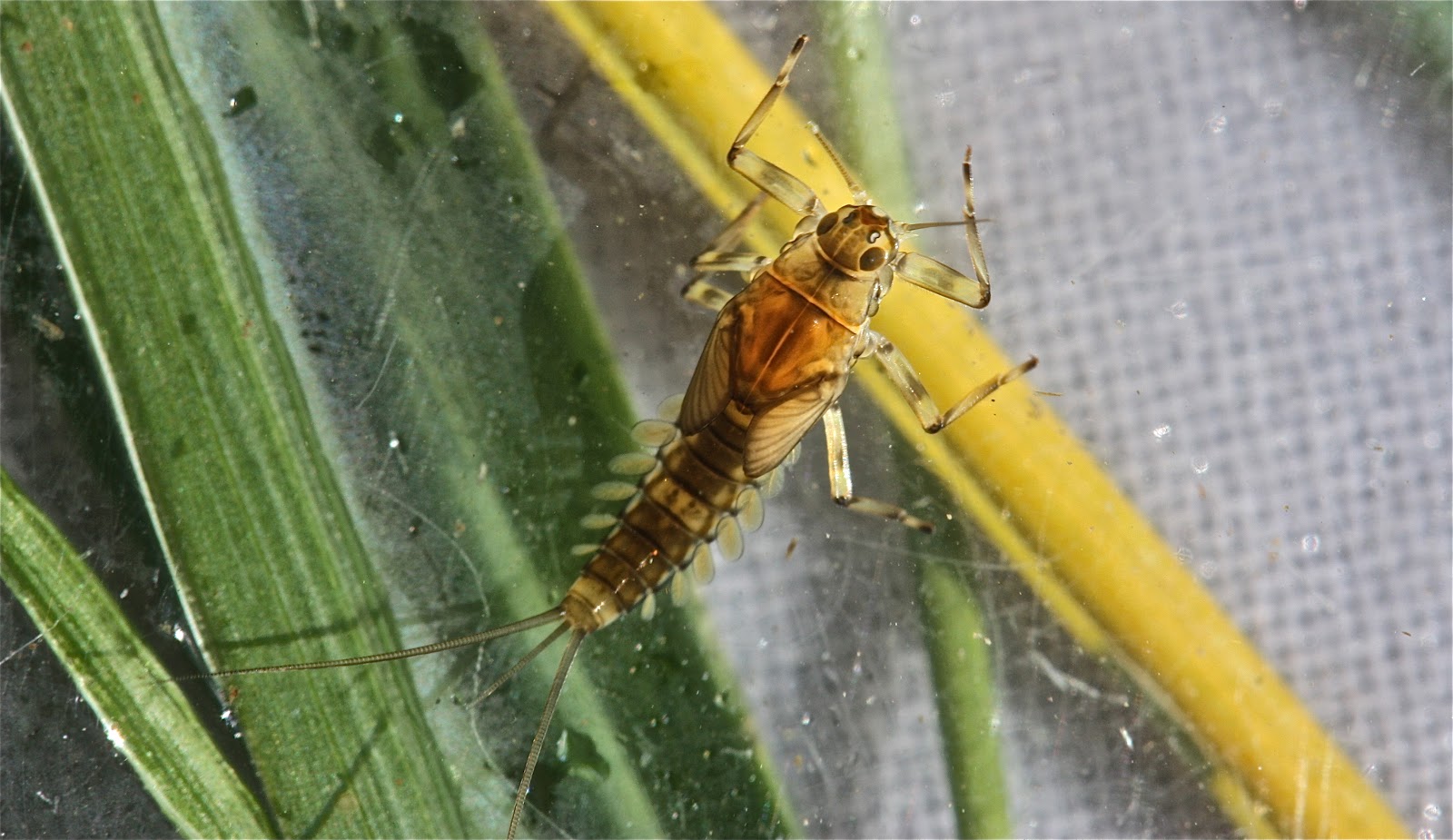
1. Epeorus pleuralis -- and note that the one is already mature (black wing pads).
2. A couple of Isoperla nr. namata nymphs.
3. And a Uenoid caddisfly larva.
4. Oh. And I also saw -- as I'm seeing elsewhere -- quite a few spiny crawlers.
_______________
(Below: B. tricaudatus nymph found at the Rapidan River on 1/18. Incorrectly ID'd as B. pluto.)
Subscribe to:
Posts (Atom)


