Wednesday, April 18, 2012
Going, Going -- Well, Not Quite Gone: "Yellow Sallies" (Isoperla namata)
I took this photo of a "Yellow Sally" last year on May 14.
"Yellow Sallies" are the adult, terrestrial form of the Perlodid stonefly Isoperla namata. At the moment, they're hatching throughout central Virginia. The hatch will continue into May, but I'm now seeing very few nymphs in the streams that I visit (I only saw one yesterday at Buck Mt. Creek).
I've been taking photographs of these nymphs -- this species -- every month, beginning in November last year. So, I have a good set we can use to trace the changes this insect goes through as it develops. Let's look at the following photo -- which I took one week ago on April 11 -- as a reference point to use as we go along.
The nymph in this photo is fairly mature -- the wing pads are starting to darken. Remember that I. namata Perlodid stoneflies have a dark transverse band on the head, from which two black lines drop down to the rear ocelli (lines in front of eyes). Often, there are two dark spots/lines at the rear of the head, though on some nymphs these rear spots/lines are missing. There are three stripes on the abdomen (this is true of all Isoperlas), two on the sides (lateral) and one in the middle -- the middle "line" is made by a sequence of "crosses" on each of the abdominal segments. Finally, when the nymph is mature, the rear wing pads angle away from the body more sharply than the front wing pads (note the angle of the arrows) -- but this is true of all Perlodid stoneflies.
Sample 1: November 8, 2011
Since the head pattern has not yet developed, I can't be positive of my identification. But, it was an Isoperla, and since I. namata is the first Isoperla we see at the start of any new season, I think I. namata is a reasonable guess. Features: 1) it is possible to make out the lateral stripes on the abdomen (click on the photo to enlarge it): 2) note that the rear edges of the wing pads at this point seem to be straight across, if not convex in shape.
Sample 2: November 18, 2011
We can see all three abdominal stripes. And on the head, the light spot at the front of the head is starting to show, and we can start to make out the "dark spots/lines" at the rear of the head. Note that the rear edges of the wing pads are starting to bow inward, more true of the rear wing pads than the front wing pads.
Sample 3: December 13, 2011
While the abdominal stripes are not very clear on this nymph, the head pattern is starting to round into form. We can see the transverse band, and we can see the black lines dropping down from it touching the rear ocelli, though they're still on the "thick" side at the moment.
Sample 4: December 26, 2011
The head pattern looks much the same as on the previous nymph. But note how you can distinctly make out the "crosses" forming the middle abdominal stripe.
Sample 5: January 4, 2012
No doubt about this nymph being Isoperla namata. The three abdominal stripes are prominent now, and the head pattern is well defined. However, note how the two "lines" that drop down from the transverse band on the head are still rather "thick" -- i.e. they've not really thinned into lines. Wing pads are still straight across on the back edges, though bowing in slightly.
Sample 6: December 21, 2011
One significant change: those lines that connect with the ocelli are thinning out as the pale space between them widens. Rear edges of the wing pads remain much the same.
Sample 7: February 2, 2012
The abdominal stripes are fully formed, and the head pattern is fully developed -- but, note that this is one of the I. namatas that does not have the dark spots/lines at the rear of the head. Big changes: 1) color -- the nymph is now a pale yellow/orange, shades that will soon be enriched; and 2) rear edges of the wing pads -- note how they are bowing/arcing in towards the middle.
Sample 8: February 23, 2012
Note the wing pads: they are much longer, and the rear wing pads have started to flare away from the body. The front and rear wing pads now move away from the body at different angles.
Sample 9: March 9, 2012
Richer colors. The lateral abdominal stripes are a little bit thicker, while the "crosses" in the middle stripe stand out in a prominent way. The wing pads are longer and more fully patterned than those in the previous picture.
Sample 10: March 28, 2012
This is a nymph that is fairly mature: the wing pads have started to darken.
Sample 11: April 11, 2011 (I had to go back to last year's collection for this one.)
Fully mature and ready to turn into the adult terrestrial that we see at the top of the page!
Tuesday, April 17, 2012
"Drunella" Day at Buck Mt. Creek
After telling you how rarely we see this genus -- Drunella (remember the "muscular" fore femorae with turbercles on the leading edges) -- of spiny crawler mayfly, I found three of them today right off the bat! And, my guess was that they were three different species. Note how the nymph in the photo above is basically brown with no banding on the leg segments. Now look at the second.
Quite different, wouldn't you agree? Prominent banding on the femorae and tibiae, with patterns of colors on the wing pads and abdominal segments.
The third? This one we've already seen in the Doyles River (look back to the 4/9 entry) -- Drunella walkeri. Note the anterolateral projections that stick out on either side of the head.
So back to the first two nymphs which differ dramatically in appearance. I've just looked at them with the microscope, and I can't see a single anatomical difference in terms of the features used for identification.
Both have paired dorsal tubercles that are very clear on segments 5-7. Both have long occipital tubercles.
And both have a "long posteromedian tubercle on [the] mesothorax" (Beaty, "The Ephemeroptera of North Carolina," p. 25).
That essentially brings us to a choice between D. allegheniensis and D. tuberculata. Let's see how Beaty describes each of these species.
D. allegheniensis -- nymphs 8-9 mm; frons with a dark horizontal band; head with long occipital tubercles that diverge apically; long posteromedian tubercle on mesothorax; abdomen with paired dorsal tubercles always well developed on segments 5-7. Common in the summer in the mountains and foothills.
D. tuberculata -- nymphs 7-9 mm; head with long occipital tubercles not divergent apically; frons without dark transverse band; abdomen with paired dorsal tubercles always developed on segments 5-7. Collected in spring and summer from rivers. Uncommon.
I'm undecided about the ID of our two nymphs. On the one hand, I'd be surprised if there's something "uncommon" in Buck Mt. Creek, and the "tubercle on the mesothorax" is only mentioned with D. allegheniensis. But, I cannot see a dark horizontal band at the front edge of the head (frons). Nor can I say for sure that the "occipital tubercles diverge apically". So, let me sit on the fence for the moment and get back to you with the details when I work this one out. Difference in colors and patterns? Is it a male and a female?
_____________
Other photos today.
1. An Epeorus vitreus flatheaded mayfly. They're now all over the bottoms of rocks in this stream. (Same insect; different lighting.)
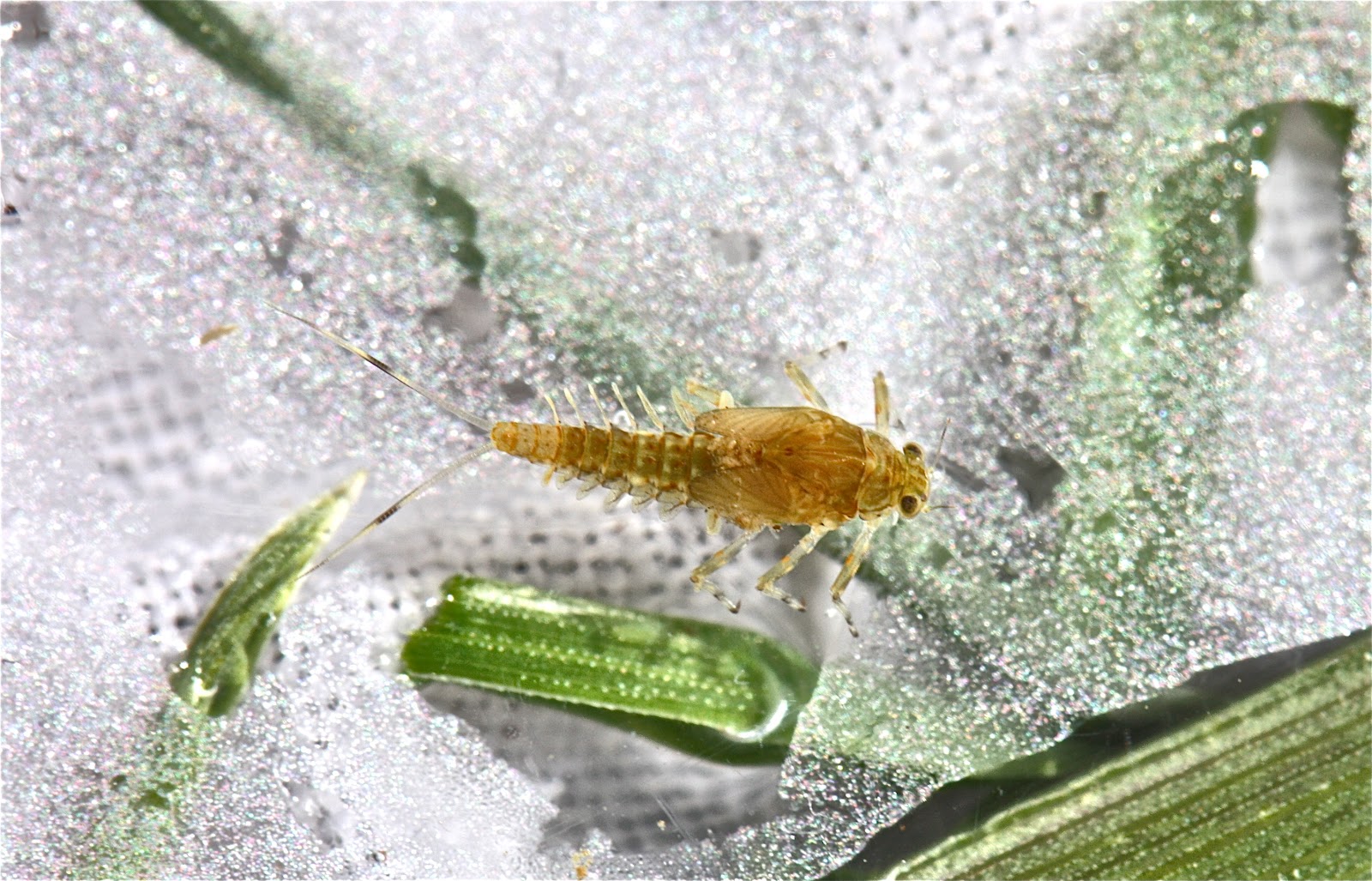
2. A tiny Plauditus dubius small minnow mayfly -- a female. (Not the best of photos). On key features of P. dubius nymphs, see the entry posted on 4/10.
3. And a very small -- and I do mean small! -- Baetis intercalaris small minnow mayfly, the first I've seen this season. Note: three tails with prominent banding.
When it grows up it will look something like this and the "parentheses" marks ( ) on the abdominal segments will be easier for us to see.
Friday, April 13, 2012
The Baetis tricaudatus Hatch is Well Underway in the Mountains
(Above: photo of a newly emerged B. tricaudatus small minnow mayfly sent in by one of our readers.)
My friend who lives in Sugar Hollow has been finding lots of Baetis tricaudatus small minnow mayflies, both nymphs and adults. So, we decided to meet up today and check out a new trib that flows into the Moormans. You'll recall that B. tricaudatus is a very intolerant small minnow mayfly (1.5) that is typically found in small mountain streams.
While the dominant taxon was, as expected, the spiny crawler mayfly, there were quite a few B. tricaudatus nymphs: I found 4 having looked for about 20 minutes. Two were fully mature with black wing pads, and two had very long wing pads and clearly did not have long to go. Two of the defining characteristics of this particular species are easy to spot in the photos below: 1) the middle tail is less than 1/2 as long as the two lateral tails, and 2) there is a pale, sometimes interrupted, line that runs the length of the abdomen.
In this one, a B. tricaudatus nymph comes face-to-face with a young, Isoperla holochlora Perlodid stonefly.
The most common stonefly I saw in this stream was the Perlodid, Diploperla duplicata: I saw at least 20-30. But I did find two I. holochloras, and it's easy to see in these photos how I. holochlora and I. nr. holochlora differ. Note how the large yellow spot on the head merges with the yellow line of the labrum -- not what we saw yesterday.
A couple of other nice finds.
1) This freeliving caddisfly larva which I think is R. carolina -- but I need to do some microscope work on this to be sure.
And, 2) a Limnephilid (Northern case-maker), genus Pycnopsyche, which has moved on from its case made of leaves to one that's quite substantial. I think this taxon is also starting to hatch since I'm starting to find empty cases.
_________
Yet another beautiful stream in Sugar Hollow to which we'll surely return. So many streams -- so little time.
Thursday, April 12, 2012
Isoperla nr. holochlora ("nearly" holochlora): the Rapidan River, Where Else?!
This is the insect I was hoping to see today at the Rapidan River, and I found it as I was thinking about heading home. Perlodid stonefly, Isoperla nr. holochlora (going by Steven Beaty), which means it's similar to Isoperla holochlora, but not quite the same. How do they differ? The main difference is that on I. nr. holochlora the large yellow spot in the middle/front of the head comes to a point anteriorly but does not merge with the yellow line crossing the labrum; on I. holochora nymphs it does.
Pictures.
Isoperla holochlora:
Isoperla nr. holochlora:
You might also notice that the three abdominal stripes that ID Isoperla are easier to see on I. holochlora than they are on I. nr. holochlora. But, they were very easy to see on this immature I. nr. holochlora that I found today in the same set of riffles.
Isoperla nr. holochlora is a Perlodid stonefly that I've only found in the Rapidan River. Not only that, I've only found it in what I call "location 2," a set of riffles that I explore that are .3 miles downstream from where the Rapidan flows out of the National Park. I found this "teenager" last year on May 4th in this same set of riffles.
Isoperla holochora has a tolerance value of 0.7; Isoperla nr. holochlora is 0.0.
______
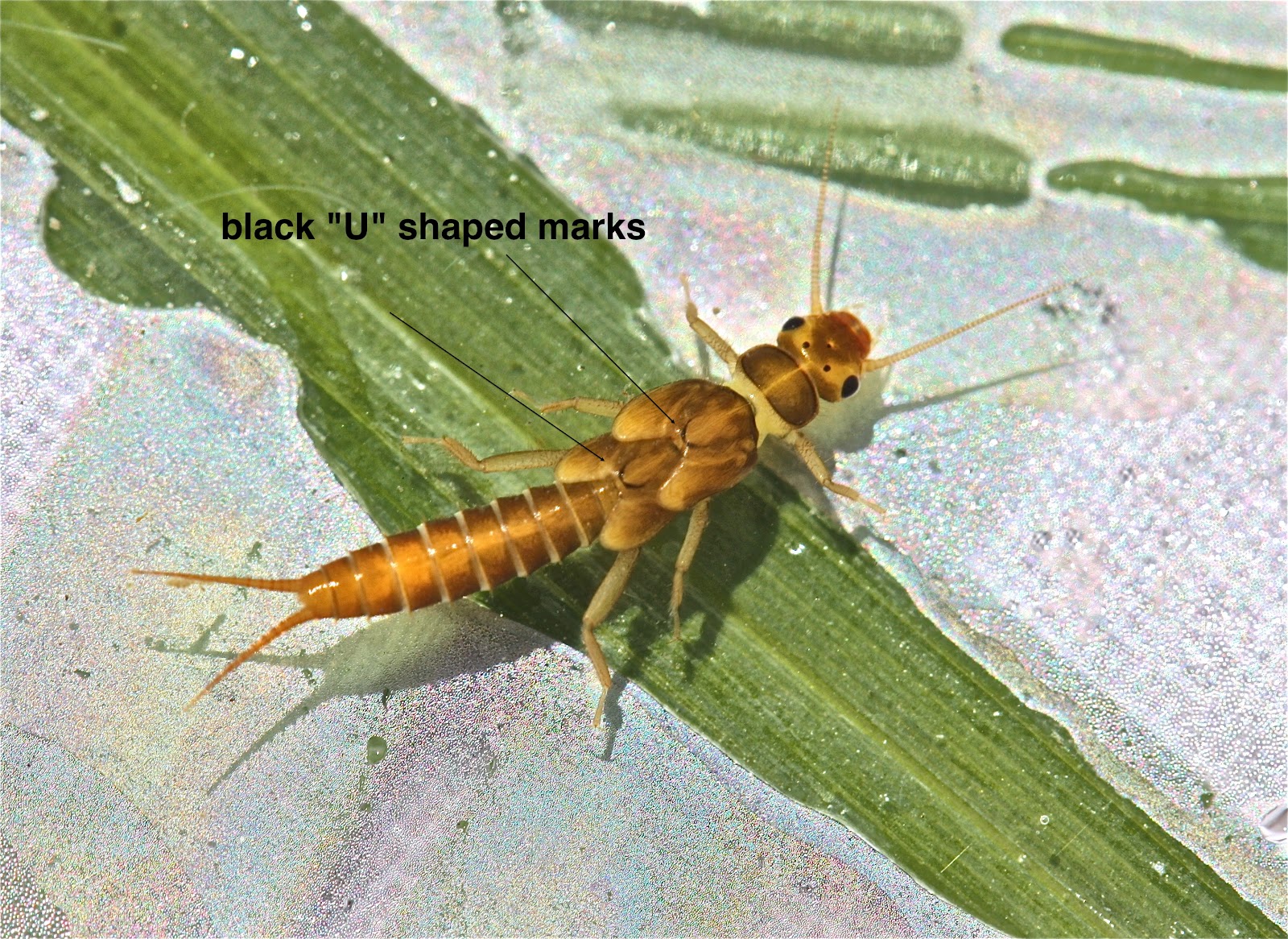
I found a wealth of insects today -- as I always do when I go to this stream -- including a lot of Green stoneflies (Chloroperlids) that are now maturing into full hatching colors. I took photos of two of them.
As you can see, the second is a bit further along than the first given the black "U" shape that has appeared where the wing pads diverge.
#1
#2
Beautiful insects. And there were more...
1. A very colorful brushlegged mayfly (Isonychia bicolor): these mayflies mature in mid summer.
3. Perlodid stonefly, Isoperla namata. There were still a lot of these nymphs in the leaf packs -- but I also saw a lot of adults flying around.
4. Common stonefly, Paragnetina immarginata. Since this is the only place that I find this particular species, I always like to get one or two photos.
I also saw large numbers of Giant stoneflies (next year's class), Epeorus pleuralis flatheaded mayflies, Roach-like stoneflies (Peltoperlids), and freeliving caddisfly larvae (R. fuscula).
_________________
(Below: looking downstream at "location 2" on the Rapidan River.)
Tuesday, April 10, 2012
"Plauditus dubius" Small Minnow Mayflies (male and female): Making the Case
The nymph in the photo above is a female Plauditus dubius small minnow mayfly (Doyles River, 4/9).
The nymph in the photo below -- clinging to the back of an E. vitreus flatheaded mayfly -- is a male Plauditus dubius small minnow mayfly (Buck Mt. Creek, 4/5).
Let me see if I can convince you.
While we have seen the small minnow mayfly genera Acentrella, Baetis, and Heterocloeon, this is the first time we've encountered a Plauditus nymph. For the genus ID, let's turn to Steven Beaty ("The Ephemeroptera of North Carolina," p. 11).
"Genus Diagnosis: Segment 3 of labial palpi subquadrate, with medial margin almost straight (not receding from base); tibia and tarsi without row of long hairs; no hind wing pads; two caudal filaments." He adds, "Found mostly in the Mountains with some Piedmont records."
That both of these nymphs have two caudal filaments (tails) is clear from a look at the photos. For the absence of long hair on the tibia and tarsi -- here is a close-up of one of the arms of the female.
No hair visible on the tibia or tarsus, only on the femora. (Remember that dense, long setae on the femorae, tibiae and tarsi is a key feature of Acentrella nymphs.)
But the critical feature that we have to see is the shape of the third segment of the labial palps. I hope you can see it in the following photo -- this is a very small insect with a very small head! Note that the inner edge (medial margin) of the labial palp is indeed virtually straight.
(I hope you'll trust me when I say that this nymph had "no hind wing pads" -- I forgot to take a photo.)
So, we are looking at Plauditus nymphs, but how do we know they are Plauditus dubius nymphs? Back to Beaty's descriptions (still on p. 11).
"P. dubius -- nymphs 3.0 - 3.5 mm; segment 9 with dark lateral dashes; caudal filaments with narrow dark median band; two color patterns: male - enlarged medial spot on tergite 2 with 5-7 often dark; paired submedian spots on 3, 4, 8, 9 (spots on 5 obscured); sternites with lateral tracheation and segments 3, 5-7 often tinged with reddish brown; female -- median spots on tergites 2 and 6, paired submedian spots on tergites 3-5, 7-9; tergites 5-7 may be slightly darker than other tergites which are generally pale overall."
We can clearly see the "narrow dark median band" on the caudal filaments on both of our nymphs. For the dark lateral dashes on segment 9 look at the photo below (this is of the female).
Sure enough. Now let's look at the color pattern on the abdominal tergites of the male.
If you enlarge the photo -- click on it -- I think you can see everything that Beaty describes. There is an enlarged medial spot on tergite 2; segments 5-7 are dark; there are paired submedian spots on segments 3, 4, 8, and 9, while the spots on 5 are obscured. I can even show you the lateral tracheation on the sternites -- though this is a view of the ventral side of the female.
_______
What about the colors and patterns that we find on the female?
Again, please enlarge the photo for best results. There are "median spots" on tergites 2 and 6; there are "paired submedian spots" on tergites 3-5 and 7-9; and tergites 5-7 are slightly darker than the other tergites "which are generally pale overall."
Pretty cool. Another species of small minnow mayfly to add to our list and to continue to look for in our better streams. (The tolerance value of the Plauditus dubius group is 2.2.)
(Oh. Donald Chandler has also posted a photo of a female Plauditus dubius: it looks exactly like mine. Go to: http://www.discoverlife.org/mp/20p?see=I_DSC241&res=640.)
__________
Subscribe to:
Posts (Atom)