Thursday, May 10, 2012

Isoperla transmarina?: A New Species at the Rapidan River


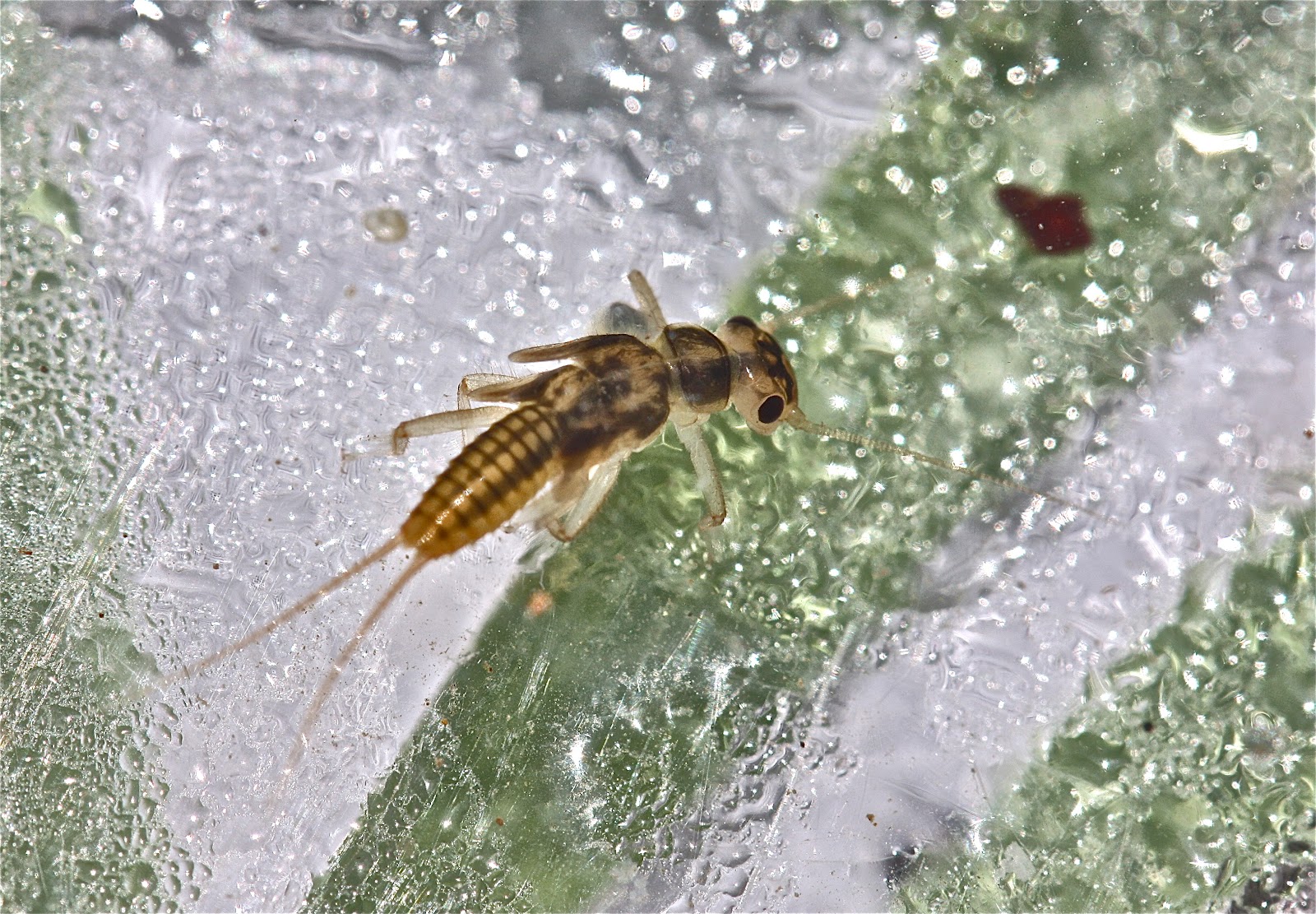
Lots of exciting finds this morning at the Rapidan River, though photography was a struggle with the sun going in and out of the clouds.  Most exciting for me -- a new species of Isoperla Perlodid stonefly.  I think it's I. transmarina, but I need to do further research before I decide that for sure.   I'll see if I can get Steven Beaty to have a look at my photos.

There are three features that -- for me -- point in the direction of I. transmarina.  1) The "width of [the] triangular pale spot in [the] ocellar triangle [is] about one half the distance between the lateral ocelli..."   2) The "pale area anterior to [the] median ocellus [is] enclosed...or not enclosed and open in front..."  And 3) The "longitudinal abdominal stripes [are] subequal in width, with narrow pale borders."  (all quoted from Steven Beaty's "The Plecoptera of North Carolina," p. 24.)  Those features are noted in the following photo.


The pale borders on the abdominal stripes are very clear.  More to come once I've more thoroughly studied this issue.  Now on to some other neat finds.  (I'd say the most common insect I saw today was still the spiny crawler mayfly -- E. dorothea -- with brushlegged mayflies coming in a close second.)
_____________

1.  Another Northern case-maker caddis -- genus Pycnopsyche -- who had made yet another spectacular case.


This is one of the things I was hoping to find today, and I took a lot of pictures.


I love finding these cases.  But you have to be on your toes to spot them since they are built to blend in with their backgrounds.

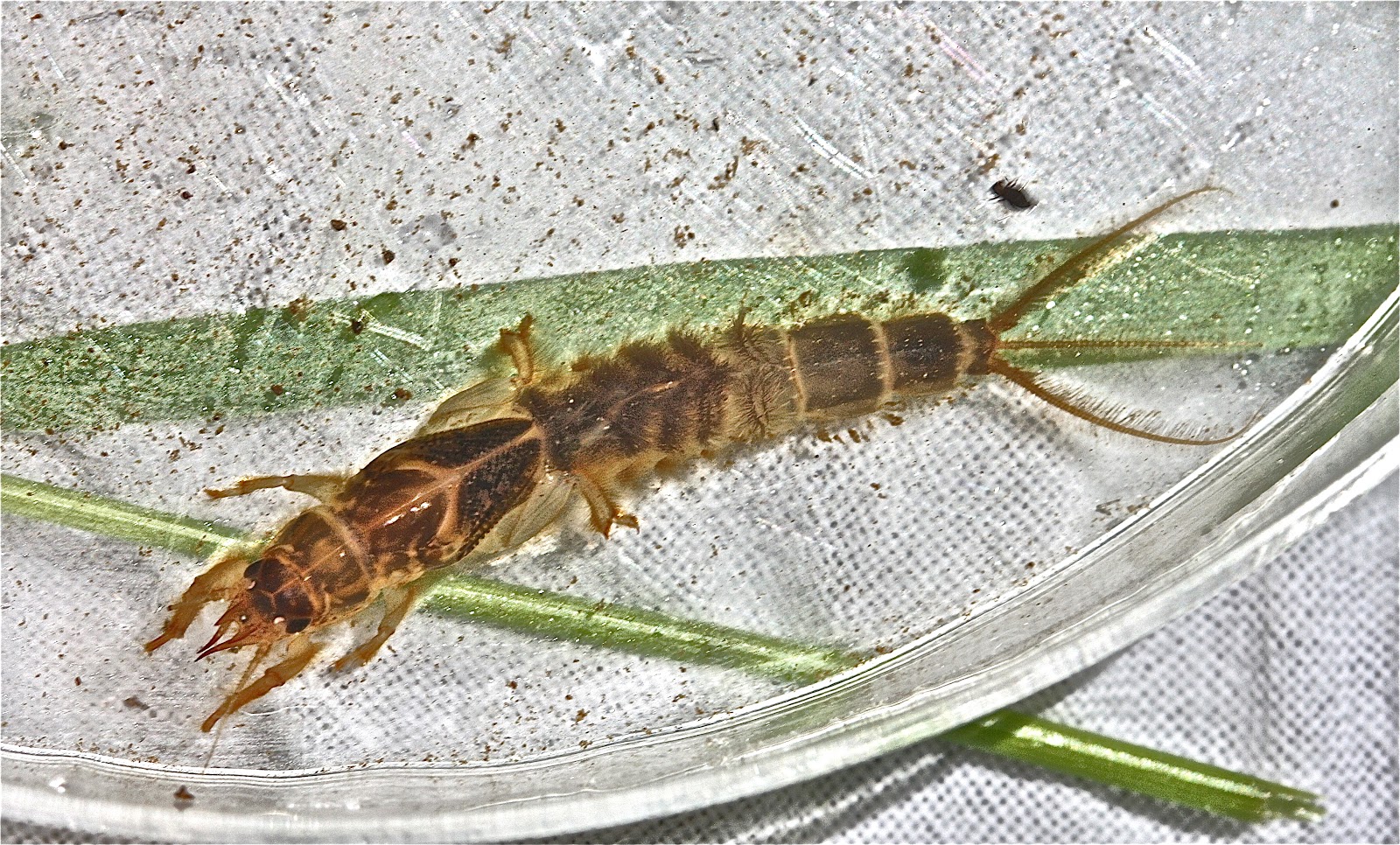
2. Perlodid stonefly, genus Remenus.  I saw quite a few, and they're much more mature than those we're finding in Sugar Hollow (note how the wing pads are flaring out from the body).


3. A mature Peltoperlid stonefly, genus Tallaperla: I think a lot of them have already hatched.


4. A mature Isoperla namata Perlodid stonefly, the only I. namata I saw.


5. And here is one of the many brushlegged mayflies I saw, and I saw a lot of BIG brushlegged nymphs that look like they're ready to hatch.  (Note the long wing pads on this one.)


And here's a great close-up of the "brushy" front legs.


______________

I also saw a lot of I. holochlora Perlodids and one, lonely, Acentrella turbida small minnow mayfly.  Now back to the work of sorting and editing photos.

Sunday, May 6, 2012

They Do Make Some Very Strange Cases: Finding an Interesting Limnephilid (Northern Case-maker Caddis)


Now, I have better photos than this, but let's start with the overall view.  Limnephilid (Northern Case-maker caddisfly larva) -- probably genus Pycnopsyche (but I still have to check) -- the case measured 2 1/4" from stem to stern!  (Yes: it was Pycnopsyche.  Larva was 24 mm long.)


I returned to one of our small streams in Sugar Hollow today -- after heavy rain last night there was not much choice about where to go.   I'm not surprised that I found this case-maker today: if you've been reading along over the winter and spring, you'll know that I've been finding lots of Limnephilids in Sugar Hollow all season.  In the winter, the cases I saw were the three-sided cases made out of sections of leaves.  Cases like this.


More recently, the cases I've seen have all been made out of small pebbles: I've seen dozens of these in the last couple of weeks, and I saw two today.  (Remember that Pycnopsyche Limnephilids often use the three-sided leave cases when they're still small but switch to firmer building materials as they mature.)


But we can't be surprised to find a new type of case.  Limnephilids make all sorts of cases, and I found two really neat ones last year at the Rapidan River.  This one:


And this one -- which resembles the one found today.  It's worth noting, on the question of genus, that Thomas Ames (Caddisflies: A Guide to Eastern Species for Anglers and Other Naturalists, p. 253) states that "A patchwork of small woody piece sandwiched between larger sticks is...typical of Pycnopsyche."


Time to get up to the Rapidan River and see what the Limnephilids are up to in that stream this year!
_________

I had hoped to make a morning of stream work today -- but I got caught in the rain and had to head home.  And, we've had overcast skies all day long, so the photos I got aren't the best -- but they'll do.

1. A flatheaded mayfly, Epeorus pleuralis, a small one, but one that's mature.


2. Spiny crawler mayfly, E. dorothea, and again one with black wing pads that's ready to hatch.


3. And in my tray, I found a tiny, tiny, small minnow mayfly that must have been clinging to our Northern case-maker's case.  It was too small (2 mm)  to photograph even using my macro lens.  So, I decided to see what I could do with a live insect using my microscope.  What a challenge!  I'd get ready to hit the shutter and that mayfly would scoot!  This is the best I could do.


And a side view:


The genus is Acentrella, of that I'm pretty sure, but that's as far as I'd go at this point.  I think from now on I'll stick to "macroinvertebrates" and leave the "microinvertebrates" alone!
_________

Another view of our Limnephilid.  Remember that the larva itself is less than half the length of the case: it's 1/2 -- 3/4" long.  (Live photo is from a larva found last year.)


Friday, May 4, 2012

A Shocker and a Mystery at Buck Mt. Creek


And I do mean a "shocker"!  The flatheaded mayfly Heptagenia marginalis.  This is a insect I expect to see in the summer -- July and August -- not in May.  I saw the first one last year on July 25!  True, everything's showing up early this year because of the mild conditions we've had in the winter and spring -- but this one took me by surprise.

When I first saw it I thought it must be a genus Leucrocuta -- but the head is too small (see the entry for Tuesday).  And, the yellow on tergite 8 is characteristic of Heptagenia nymphs.  But I wasn't sure about the ID until I downloaded the pictures.  Remember that there is fibrilliform (small, feathery filaments) behind the gill on tergite 7 on Heptagenia nymphs: that fibrilliform is missing on Leucrocuta.  Look closely at the final gill on this nymph in the photo below and you can actually see the fibrilliform there -- a small dark thread.  (Click on the photo to enlarge it.)


If that doesn't work, here is a microscope view.


This is one of my favorite flatheaded mayflies, and it's nice to see them early this year.  Later, they'll look something like this.


As for the mystery...  I was hoping to see some small minnow mayflies today: our summer species (B. pluto, A. nadineae, B. intercalaris, and H. curiosum) should show up anytime now.  And I did find two small minnow mayflies -- but I'm not sure what they are!  They were very small (3-4 mm) and different colors (male and female?), and at first I thought they were Plauditus dubius nymphs.  But the abdominal colors don't match that at all.  And they are not genus Heterocloeon -- no forecoxal gills.  Acentrella turbida?  Possibly.  But I need to do more microscope work to see if I can figure this out.  In any event, here are some photos -- not the best since the nymphs were so small, and the light conditions today were less than ideal.


(Note added 5/5/12:  They were indeed Acentrella turbida.)
____________

The other insects I saw were not unexpected.  I saw lots of Epeorus vitreus flatheaded mayflies, which are getting fairly mature, and I again ran into a number of the large spiny crawlers Drunella tuberculata.


What I did not see were the hordes of the common spiny crawler -- E. dorothea -- that I've been running into of late.  But, May is hatch time for that species, and I think the nymphs are disappearing now from our streams.

Thursday, May 3, 2012

Remenus bilobatus -- and Much More: Stonefly Day in Sugar Hollow


I was able to get some really good photos today, so the best is yet to come.  But let's focus on the "new kid in town": the Perlodid stonefly, Remenus bilobatus.  Not the prettiest Perlodid stonefly we see, but then this isn't a beauty contest!  We're trying to track down the Perlodids we see in our streams and note when they appear.

On Remenus, Steven Beaty has this to say:  "Nymphs small, less than 10mm; head with faint M-shale pale mark; lacinia unidentate, with a widely shallow base and with a single, long tooth." ("The Plecoptera of North Carolina," p. 26.)  The "faint M" on the head and the single tooth can be seen in the following photo:


And for a microscope shot of that tooth --


Beaty cautions to leave the ID of Remenus nymphs at the level of genus, suggesting that, in addition to R. bilobatus, two other species might be found by collectors: R. duffeldi and R. kirchneri.  At the same time, he notes that R. bilobatus nymphs "fit the genus description," and that R. duffeldi nymphs remain "undescribed," and R. kirchneri is a species that is still "unknown" in NC though it has been found in adjacent states -- including VA.  Still, until more is known, I see no reason not to call this Remenus bilobatus.  The NC tolerance value for R. bilobatus is 0.9.

I saw a lot of these nymphs on Tuesday, and I saw them last week at South River as well.  I mistakenly thought they were young Diploperlas, even though I knew that young Diploperlas should not be around at this time of year!  Well, we do make mistakes.  (Earlier entries on the genus Remenus were posted on 5/21/11 and 6/2/11.)
___________

Now let's move on to the prettier insects.  I found three different species of Isoperla Perlodids in this gem of a stream: Isoperla namata, Isoperla holochlora, and Isoperla "X" (i.e., species unknown).  Let's start with the unknown.


This is one of two Isoperlas that I found in this same stream last year which Steven Beaty tells me is unknown and unnamed at the moment.  According to information he provided last year, Boris Kondratieff and Stan Szczytko are in the midst of a complete revision of Eastern Isoperlas -- but this study when it's completed will only discuss the adults.  Were we to collect some of these nymphs and raise them in a lab until they hatched as adults, we might connect them with Isoperlas that are already known and named.  There are people who do that  (i.e. collect and raise the nymphs) -- including Beaty and his colleagues in NC.  Can't say that as an amateur I'm that committed.  Maybe some day.  In any event, it's a beautiful nymph.


2. Isoperla namata.  Not a very good photo -- couldn't get the nymph to lift its head.  But I was surprised to find this species around.


3. Isoperla holochlora, pretty common in our streams at this time of year.  This is a young one.


4. One more Perlodid stonefly-- a mature Diploperla duplicata.  Beautiful colors when they're ready to hatch.


5. A common stonefly, Eccoptura xanthenses.  A couple of photos: this was a beauty.


6. And to finish things up -- leaving the stoneflies behind -- a Limnephilid caddis with an eye for color when selecting the stones for its case.


7.  And, of course, at least one spiny crawler.  With those large red eyes, I would guess it's a male.  (The wing pads look like they're ready to pop!)


__________
Note:  (added, 5/1/16).  The stonefly identified as Isoperla "X," is now called Isoperla sp. VA -- still unknown.  And the stonefly I identifed as Isoperla namata was actually Isoperla orata.  It's a species that I've only seen, after this, at the Rapidan River.
___________

And here's where all of these beautiful insects were found --


Wednesday, May 2, 2012

Ephemera guttulata: The Common Burrower in Our Small Mountain Streams


I know longer see any reason to doubt the ID of the common burrower nymphs that we found yesterday.  They were Ephemera guttulata, and they will be hatching any day now -- perhaps some already have -- as "Green Drakes," in fly fishing terms.  Knopp and Cormier (Mayflies, p 105) point out that "seasonally, the duns are on the water between late May and mid-June."  Perfect.  Note the dark wing pads on the nymph in the picture.

The critical factor to me is the lack of "dark markings" on the abdominal segments.  E. simulans (the "Brown Drake") has them; E. guttulata does not.  Note that tergites 7-9 on the nymph in our picture are uniformly grayish brown.  Now take a look at the same tergites on the E. simulans nymph pictured in Troutnut.com (http://www.troutnut.com/specimen/91).   Totally different.  You can also find a photo of an E. guttulata "shuck" on Troutnut.com (http://www.troutnut.com/fullsize/picture-im_extax/79), and the terminal tergites look exactly like those on our nymph.

Beaty ("The Ephemeroptera of North Carolina," p. 44) doesn't have much on E. guttulata (in fact he urges monitors to stick to genus level ID with Ephemera nymphs).  Still, what he has supports this conclusion.

E. guttulata -- nymphs up to 20 mm: abdomen generally lacking any color pattern.  Collected mostly during spring and summer.  Mountains only.  Uncommon.


The nymph we found was about 1 inch in length -- i.e. around 20 mm -- and it was indeed in the mountains.   The Green Drake is a big mayfly, and I hope we can get some photos of some adults in the near future.


Many thanks to my fellow "amateur entomologist" friend whose research helped us with this ID.  She's the one who noted the photos in Troutnut.com.

Tuesday, May 1, 2012

In the Smallest of Streams, the "Weirdest" of Mayflies: The Common Burrower (Ephemeridae)


Weird -- but beautiful at the same time.  This is a "Common Burrower" mayfly nymph, genus Ephemera, species simulans or guttalata.  This is a mayfly family we rarely see since it spends most of its time burrowed into the substrate.  So, to find them you have to dig, and, as you know, I spend most of my time sifting through leaves and lifting up rocks.  But I wasn't alone today -- and my friend is a "digger"!  She uses a net to sift through the sand and the silt, and it really paid off.  We were working a very small stream in Sugar Hollow, one to which I had not gone before.

The family ID-- Ephemeridae -- is established by the shape of the tusks which "diverge apically" (Beaty, "The Ephemeroptera of North Carolina," p. 44), while the genus ID is determined by the shape of the frontal process: it is not "rounded, conical, or truncate," rather it's "bifid"-- i.e. has two sharp points (Peckarsky, Freshwater Macroinvertebrates, p. 26).  Have a look.


On the genus Ephemera, Beaty also notes that the "ventral apex of [the] hind tibia [is] produced into an acute point." (p. 44)  While we are looking at the "dorsal" side of the nymph in this photo, we can easily see an "acute point" at the apex of the hind tibia.   But this photo also provides evidence for an ID of E. simulans.   It has to do with the wing pads.  On E. simulans, Beaty notes (p. 44), "both fore- and hind wing pads [are] heavily blotched with irregular dark spots." (Click on the photo to enlarge it.)  To have those spots on both sets of wing pads seems to be a feature that only shows up on this species.

Ephemera simulans is an important insect for fly fishermen, especially in the West: it hatches as the "Brown Drake."  Consequently, Knopp and Cormier (Mayflies: An Anglers Study of Trout Water Ephemeroptera, pp. 100-101) have a lot to say on this species, including the fact that "Eastern-region brown drake populations are typically sparse and of less significance to the fly fisher."  Fishermen would not find any trout in the small stream we went to today!  But let me quote them at length on the types of water these insects prefer, and their behavior.

"Brown drake nymphs inhabit slow-moving sections of cold-water streams, rivers, and certain lakes, where they construct U-shaped burrows by digging into substrates of fine sand, gravel, or silt.  The purpose of the burrow is not only to safeguard the nymphs from predation but also to provide the photo-sensitive nymphs protection from the sun's rays.  Avoiding bright conditions, it is only as evening approaches (or during the afternoon of overcast days) that the nymphs leave the shelter of their burrows to embark on their nightly ventures across the lake or river bottom, returning to the safety of the burrows at dawn."

But the ID of E. simulans is far from certain.  A good case could also be made for identifying this nymph as E. guttalata, the "Green Drake."  One reason, E. simulans has "dark markings" (Beaty) on the abdominal segments: this nymph does not.  (Have a look at the E. simulans nymph at Troutnut.com: http://www.troutnut.com/specimen/91).


Also in favor of an E. guttalata ID -- E. guttalata is primarily found in the East, and, according to Knopp and Cormier (Mayflies, p. 105), "Hatches [of the Green Drake] are particularly prolific on waters flowing from the Appalachian Mountains and southern Ontario drainage systems...".

More work to be done.  In the meantime, some more photos of this very interesting find.


__________

We made one other find today that deserves our attention: a very small (4 mm) Chloroperlid (green stonefly) -- genus Haploperla, not Sweltsa.  This is a first for me: until now, I've seen nothing but Sweltsa nymphs in our streams.


How does this differ from Sweltsa?  It's in the shape of the wing pads.  With Sweltsa nymphs, the inner margin of the hind wing pads angle away from the body axis; with Haploperla nymphs, they run parallel to the axis.  Here's a microscope view of the wing pads of the nymph in the photo above.


So, another exciting discovery.

Just a few more photos.

1) A flatheaded mayfly, genus Leucrocuta.  I haven't seen a lot of this genus this year -- but I always find them in these small streams in Sugar Hollow.  (Note the width of the head in relation to the rest of the body.)


2) A pair of Limnephilid (Northern case-maker) caddisfly larvae in pebble cases.  I saw at least 30 of these cases today.  The leaf packs were loaded with them.


and 3) a very small, immature caddifly larva which I thought was a Wormaldia fingernet caddis.  But, seeing the "muscle scars" (dark spots) on the head, I suspect this was a Polycentropodid -- a "trumpetnet" caddis.