Thursday, May 17, 2012

Mystery Insects in Sugar Hollow, I.: The Hellgrammite Nigronia


I'll do this one in two installments since I found two new insects (by genus) today that require identification.  The first, pictured above, is a hellgrammite, genus Nigronia.

The Hellgrammite (dobsonfly) that we normally see is, in terms of the genus, Corydalus, and it looks like this when it's mature:


The family is Corydalidae, on which we find 8 lateral appendages and 2 prolegs at the end, each with a pair of hooks.  It is the gills behind each lateral appendage that makes this Corydalus.

The immature hellgrammite that I found today -- pictured above -- although it has the 4 hooks at the end of its prolegs, is totally lacking in gills.  Here's a microscope photo, ventral view.


So, we leave our "common" hellgrammite behind and move on.  Let me use Peckarksy (Freshwater Macroinvertebrates of Northeastern North America, pp. 174-176) for this one.

If our hellgrammite does not have tufts of gills at the bases of the appendages, we move to the following couplet:

3a.  Last pair of abdominal spiracles (segment 8) at apex of 2 long respiratory tubes extending beyond the prolegs....Chauliodes
or
3b. Last pair of abdominal spiracles not at apex of long respiratory tubes extending beyond the prolegs....4

The question is -- are there "long respiratory tubes extending beyond the prolegs"?  The "tubes" shoot out between the prolegs -- so the answer is "No".  Nothing extends beyond the prolegs save the appendages on segment 8.  (Look again at the photo above.)

4a.  Each spiracle of 8th abdominal segment at end of short, tapered dorsal respiratory tube, about 1 1/2 times as long as wide; larvae without obvious dorsal pattern on head and thorax....Nigronia
or
4b. Each spiracle of 8th abdominal segment on posterior edge of segment, not on tube; larvae with distinct dorsal pattern on head and thorax....Neohermes


Our larva is a Nigronia.  1) Note that, while we could argue that there is some kind of pattern on the thorax on our larva, there is certainly no pattern to detect on the head.  And 2) there are "tapered dorsal respiratory tubes" on our larva and they are indeed about 1 1/2 times as long as wide.  I've pointed them out on the following photo.  (A "spiracle," by the way -- and I'm quoting Peckarsky (p. 427) is "the external opening to a tracheal system" -- i.e. it's the opening at the end of the respiratory tube: don't confuse "spiracle" with "appendage.")


And here is a microscope view of those tubes.


The tolerance value for our common hellgrammite -- Corydalus conutus -- is 5.2: the tolerance value for genus Nigronia is undetermined (rarely seen).
___________

The most common insect I found today in this tiny, pristine stream in Sugar Hollow, was our "species unknown" Isoperla Perlodid stonefly that we've seen here before in the spring.  This one.
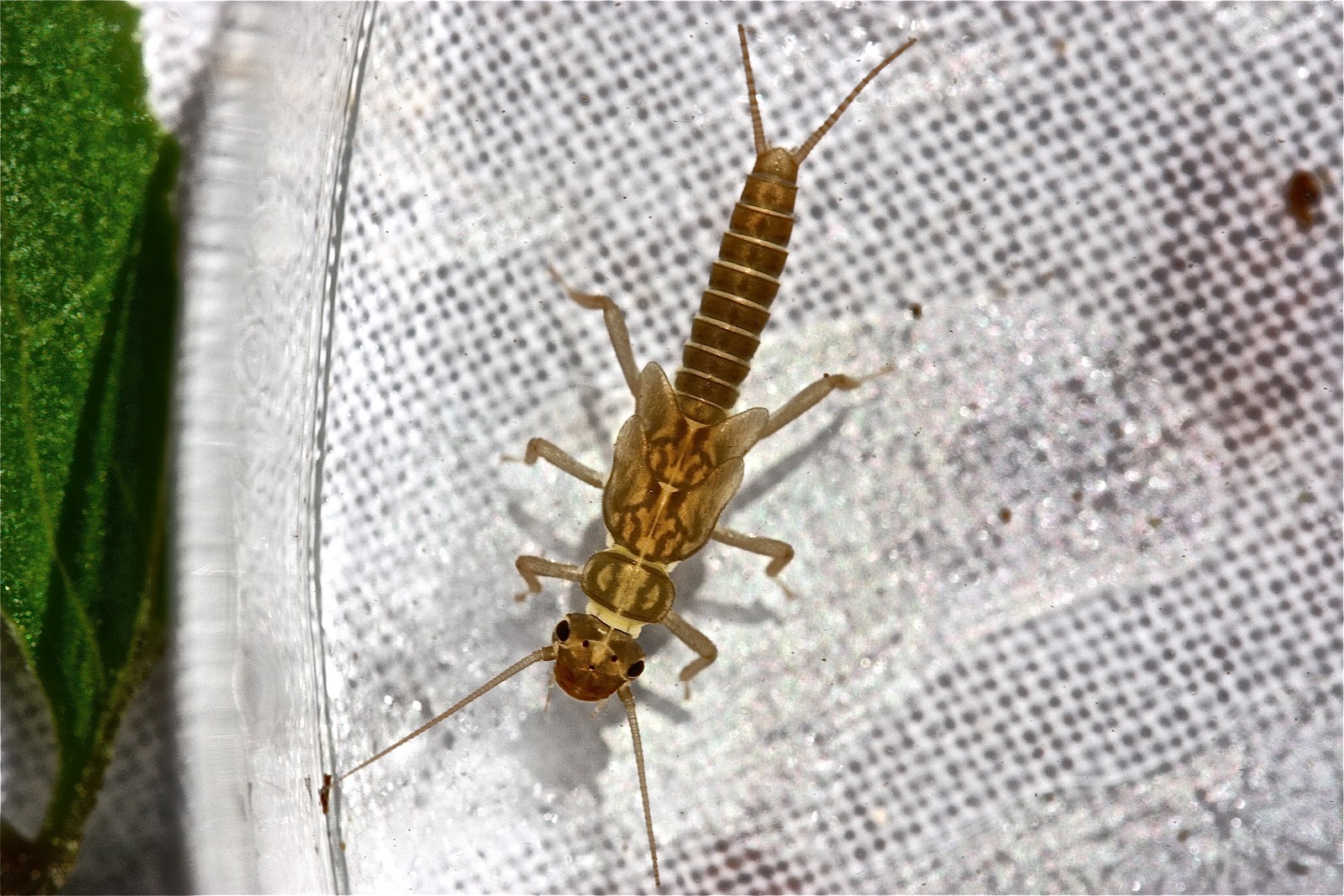

My bucket was full of them when I stopped to take photos.  This is the Isoperla that entomologists have not identified, and we found it in this stream last year for the very first time.


The stream was full of them.  I imagine they'll be hatching in June.

The "shocker" of the day was this guy (or gal):


Yes, it's a Lepidostomatid case-maker caddis.  Why on earth are they still here in May?!  But if you want to step back in time in terms of the seasons, just go to a high elevation, cold water stream.  We've still got winter insects up here.
________________

Installment II.?  Working out the identification of this Chloroperlid (green stonefly) that I found today.
The genus Sweltsa Chloroperlids that filled these streams in the winter are long gone....or so I assumed.


Wednesday, May 16, 2012

And They're Just Out There Crawling Around in Our Streams: Maturing Eccoptura Xanthenses


I just made a quick trip to the Whippoorwill Branch of the Mechums, hoping to find some Stenacron flatheaded mayflies.  Did not see a one.  But I found this beautiful Perlid (common) stonefly, Eccoptura Xanthenses.   I couldn't resist taking and posting some photos.  The colors are unusual.  Almost all Eccoptura nymphs that I see, especially when they're mature, are fairly yellow with brown and black accents.  This one was more orange and brown.  Some photos for you to enjoy.


And this one, where our stonefly is perched atop a Northern case-maker caddis.


Now this is what mature Eccoptura Perlids normally look like:


Whippoorwill Branch is a very small stream, maybe 10 ft. across at the widest.  But in small streams like this you'll probably see more Eccoptura Perlids than any other genus or species.  This is the habitat that they prefer.  And they're maturing right now, the big transformation into terrestrial insects -- for most of these nymphs -- taking place in June and July.  In the mix of branches and leaves (submerged) that I looked in today, I probably saw 20-30 Eccoptura nymphs.  Most of them -- like the two in the photos above -- were getting ready to hatch, but I also saw some small ones.  Next year's crop.  Like most of the Perlids, Eccoptura xanthenses nymphs are "semivoltine," taking two years to go from egg to adult.

Monday, May 14, 2012

Correcting a Mistake Made Last Year: It Was Isogenoides hansoni, not genus Yugus


On March 25th of last year -- 2011 -- I posted a report of some beautiful insects I had found at the Rapidan River in which I identified the stonefly pictured above as a Perlodid, genus Yugus.  That ID wasn't correct: this is a fairly mature Perlodid stonefly, but Isogenoides hansoni.


Regular readers may recall that I found a small Isogenoides hansoni nymph at the Rapidan River in September -- 9/12/11 to be exact.  This one (which I did ID correctly!):


On 10/21, I found one that was a bit more mature.


All winter long, I've been hoping to find a mature nymph, not knowing that I had found one last year that was preserved in my reference collection!  And it was a beauty, even though one of its tails had broken off.


How I arrived at an ID of Yugus last year I no longer remember.  But let's correct that now by working through Steven Beaty's description of the genus Isogenoides, and then the species hansoni.

"Genus diagnosis: Lacinia triangular, bidentate with a distinct knob below the subapical tooth and with a row of marginal hairs approaching base; mesosternum with median longitudinal suture joining fork of mesosternal grooves to transverse anterior suture; prominent submental gills, projecting about three times their basal width; cerci with a dorsal setal fringe; body light brown with contrasting darker brown pattern, covered with clothing hairs."  ("The Plecoptera on North Carolina," p. 22)  Note: the key features are in italics.

1) The photo below shows that the lacinia is indeed "bidentate," with a knob below the subapical tooth.
The "marginal" hairs are difficult to see in this photo -- but they're there; I was unable to get a photo at a good angle.


2) The mesosternum -- showing the median and anterior sutures.


Since the anterior suture/ridge is not very clear in this photo, let's look at a photo of another I. hansoni nymph that I collected.


3) Prominent, long submental gills.  For sure.


The joining of the sutures in the mesosternum along with the prominent submental gills are the key features in confirming an Isogenoides ID.  (See Peckarsky, Freshwater Macroinvertebrates, p. 71.)  Let's return to Beaty on the question of species ID.

"I. hansoni -- nymphs 16-24 mm; large denticles on the ventral mandibular tooth; conspicuous, sharply delineated M-shaped pale mark anterior to median ocellus; ocellar triangle bordered by dark but with pale central spot; dark transverse bands on anterior third of half of terga 1-9 and a dark, transverse band along each posterior margin.  Relatively rare."

I haven't looked at the mandibular tooth.  As for the rest -- the pale M anterior to the median ocellus is clear in all of our photos, as is the dark ocellar triangle with the "pale central spot."  But for emphasis...


And here's a close-up of the abdomen showing and the dark transverse bands at the top and bottom of each of the tergites.

_____________

So there you have it.  As an amateur I do make mistakes, but when I recognize them I always try to correct them.

Saturday, May 12, 2012

Small Minnow Day -- Plauditus dubius -- at Buck Mt. Creek


I keep returning to Buck Mt. Creek in hopes of seeing Acentrella nadineae nymphs, one of the small minnow mayflies we see a lot in the summer.  I thought I had them today -- the colors looked right.  And, I found a lot of them; there seemed to be at least 2 or 3 on every rock I flipped over.  On one fairly large rock, there were five of them huddled together in the same spot.

It was when I uploaded my pictures that I noticed the problem: these nymphs have gray bands on their tails.  They were not A. nadineae nymphs.  My second thought was Plauditus dubius (see the entries posted on April the 10th), and this time I was right.

The one in the photo above is a mature female -- note the small eyes -- while the one in the photo below is a male (large, red eyes).  I think I saw more females than males.


On April 10th, I noted the features we look for in identifying this species, and the gray banding on the tails (caudal filaments) is among them.  For the rest, let me again note what Beaty says about the male colors and patterns.  "male -- enlarged medial spot on tergite 2 with 5-7 often dark; paired submedian spots on 3, 4, 8, 9 (spots on 5 obscured); sternites with lateral tracheation and segments 3, 5-7 often tinged with reddish brown." (Beaty, "The Ephemeroptera of North Carolina," p. 11)  All of those feature can clearly be seen in the following microscope photos.  (Actually, I'd say that almost all of the tergites are tinged with reddish brown.)


And for the tracheation on the sternites (ventral sides of the tergites) --


Plauditus dubius has a tolerance value of 2.2, and it appears to be a significant, late spring "Blue-winged Olive" hatch -- in fly fishing terms -- in Buck Mt. Creek.  But they're tiny, tiny insects, ranging from 3.0 -- 3.5 mm.  Some more photos of that beautiful female.


___________

I didn't look for much else today -- I was after small minnow mayflies.  But I did, of course, find other things, including lots of Epeorus vitreus flatheaded mayflies.  Plus....

1. Another Drunella tuberculata spiny crawler mayfly, one with fairly dark wing pads.  (They like to root around in the silt.)


2. And there were several small Perlesta common stoneflies.  These tend to mature in June and July.


3.  And then there was this...


Pray tell!  It was the first thing that I picked up.  My first thought was "it's a small winter stonefly" -- but that's impossible at this time of year.  Second thought -- a very small Leuctrid (Rolled-winged stonefly), but that too seemed unlikely at this time of year, and I've never seen a Leuctrid in this stream.  But have a look at those tails.


It's a Chloroperlid -- a Green stonefly!  This is the first time I've seen Chloroperlids in Buck Mt. Creek, and it too seems out of season, especially one that's this small.  Elsewhere, in the small streams in Sugar Hollow, the Chloroperlids have been hatching for weeks.  I can't really explain this, but it is what it is.

Friday, May 11, 2012

Holy holochlora! Isoperla holochlora Nymphs Take Over Powells Creek


What else can I say?  They were all over the place -- well, mainly in leaf packs.  Still lots of E. dorothea spiny crawlers in this stream as well, but I think the I. holochlora Perlodids had it today in terms of sheer numbers.

No objection from me.  This is one of my favorites of the Perlodids, and with a tolerance value of 0.7, it's a fair indication that we're looking at a pretty good stream.  Some more photos.


Once again I went to the Powells looking for small minnow mayflies and a Neoperla common stonefly.
No Neoperla, but I did find a number of small minnow mayflies -- and they were small!   I found one Acentrella turbida and two of the following -- which I thought would turn out to be Baetis intercalaris.


As soon as I uploaded my photos, I knew I was wrong.  No pale parentheses marks () on the abdominal segments, and the middle tail is too short.  This is actually a very young Baetis pluto, and one day it will look something like this.


I know that's hard to believe, but we can already see the key characteristics of the B. pluto species: 1) the "middle caudal filament [=tail] is 3/4 to subequal to lateral filaments, usually with distinct dark band on  caudal filaments medially" (Steven Beaty, "The Ephemeroptera of North Carolina," p. 6).  And 2) "tergum 5 [is] relatively pale" (same source).   Have a look.


The way these nymphs change  -- in color and pattern -- as they mature is simply remarkable.  Still, I was surprised to see one so small at this time of year.  One year ago today (5/11/11) I found the following B. pluto nymph in the very same stream (note that the middle tail is broken off).


A couple more shots of our nymph.


One more interesting insect from Powells Creek today.  It's a Glossossomatid caddis larva -- a "Saddle-case-maker" -- a case-maker I associate with the winter.  I'll need to adjust my thinking!  Three good photos.  The first is a dorsal view of the case; the second is a ventral view of the case with the Glosso tucked inside (head at one end, anal prolegs sticking out at the other); and in the third photo, the larva was crawling out of its case.  Unlike most case-makers, the Glossossomatid does not hesitate to abandon its case when it's disturbed.


________________

And we close with a photo that pretty well sums up the day.

Isoperla dicala -- "not" I. transmarina: Our Perlodid from the Rapidan River


Well I thought it was I. transmarina.  But not being sure, I sent some photos to Steven Beaty for comment.  He replied that it looked like I. dicala.  And sure enough that's what it is.  Let's have a look at Beaty's description of I. dicala ("The Plecoptera of North Carolina," p. 23), using photos as we go along.

I. dicala -- nymphs ~ 10 mm; apex of lacinia broad although still narrower than base, with row of setae below subapical tooth.


Yes.  The apex is narrower than the base, and yes, there are setae (hairs) below the subapical tooth.

He continues, "pale marks anterior to median ocellus sometimes indistinct, sometimes with darker border."


I would not call those marks indistinct on this particular nymph, nor does there appear to be a dark border.
But those characteristics are not always present, and this is a judgment call.

Back to Beaty: "body and abdomen often speckled, particularly posterior segments; dark longitudinal abdominal stripes with very narrow pale borders."


No question about the speckling on the posterior segments, and the pale borders are clear as well.

Isoperla dicala nymphs are "collected from the Mountains and Piedmont during the winter and spring" (Beaty, p. 23).  The tolerance value is "undetermined."  (For Donald Chandler's photo of I. dicala, go to:

http://www.discoverlife.org/mp/20q?search=Isoperla+dicala.)


I found two of these nymphs yesterday.  Here are photos of the second which, with one antenna broken off, is not as good as I would like.  They'll have to do.


Another Isoperla species to add to our list of Perlodid stoneflies found in central Virginia.