Thursday, August 9, 2012
A Netspinner That I'll Have to ID When I Return From Vacation
I wasn't really counting on finding a new one this morning when I went to Buck Mt. Creek, but so much for expectations. Unfortunately, I've not yet figured out the ID, and since I'm busily packing for two weeks in the Northwest, I'll have to work on that when I return. This is a species that seems to have no markings/pattern on the top of the head. Here are some additional photos.
The head is dark brown, the nota are dark brown, and so too is the abdomen. It is, for sure, Hydropsyche in genus -- not Ceratopsyche -- which we can tell by the presence of "scale hairs" on the abdominal terga: Ceratopsyche don't have them. In the photo below, the "scale hairs" are the short, wide, black hairs that look something like seeds.
I thought that this might be Hydropsyche betteni since H. betteni "mature larvae usually have a uniformly dark head" (Beaty, "The Trichoptera of North Carolina," p. 75). But H. betteni also "has a low rounded tubercle (bump) on [the] back dorsum of [the] head" (Beaty, p. 75). I looked hard for a bump, but it just isn't there. There is also the fact that H. betteni usually have a "black" head and black nota. I suspect that the netspinner in the photo below, which I found in Powells Creek in the spring of last year, was indeed H. betteni.
__________________
I didn't find a whole lot at Buck Mt. Creek -- netspinners, fingernets, and flatheaded mayflies -- so I decided to stop at the Moormans on my way back to town (where the Moormans flows under Free Union Road). Here the taxa was varied. Lots of netspinners, lots of fingernet larvae, small minnow mayflies (H. curiosum), a few spiny crawlers (S. serratoides), and all sorts of flatheaded mayflies (e.g. Epeorus vitreus, Heptagenia marginalis, Maccaffertium ithaca). Oh, and lots of small hellgrammites, something I also saw at Buck Mt. Creek.
There was no question about the ID of the common netspinners here: they were clearly Hydropsyche venularis, the same species I found in the Rivanna last weekend (tolerance value, 5.1). The head pattern clearly gave them away.
Remember that the two pale spots on the frontoclypeus (top of the head) often merge to form a single stripe. I looked at three different larvae -- all three were the same.
In this last photo, the head pattern looks a little bit different, but it's just the camera angle. In any event, the yellow "rectangular" marks at the back of the head are easy to see.
One other photo. This is a beautiful flatheaded mayfly, Heptagenia marginalis. It's still a young one -- note the short wing pads -- but the colors are fully developed. Love the way they spread those tails!
_________________
I'm off to Montana early Saturday morning -- the annual fly fishing trip -- and them I'll move on to Portland where my daughter gets married on 8/25. Somewhere in there I'll probably squeeze in some time for getting some photos of some of those different EPT species that we see in that part of the country.
Back to posting entries at the end of August or the start of September.
Sunday, August 5, 2012
The "Nymph of Many Colors": Acentrella Nadineae -- North Fork of the Moormans
This is an entry I wasn't going to write, not being real happy with the quality of my photos. But, I can't resist posting some pix of this beautiful A. nadineae nymph.
I made a quick trip to the North Fork of the Moormans on Friday morning mainly looking for netspinners that I could ID to the level of species. But I also found some small minnow mayflies: B. intercalaris, A. turbida, and A. nadineae. At the moment, I'm finding A. nadineae nymphs in quite a few streams (good streams), but there seems to be something special about the ones that live in the North Fork of the Moormans: they're covered with red and orange markings that are especially vivid. There is one photo that I want to show you that is not a very good photo -- not much of the nymph shows up in sharp detail -- but it makes the point about color.
Is it any wonder that this is the nymph that I like to find in the summer? A couple more views:
________________
I did, by the way, find some common netspinners - it would be difficult to look at rocks in any stream at the moment without finding these larvae. When I took these photos, I thought it was a species I had not seen before.
But I was wrong. The larvae I found were Ceratopsyche sparna, the same species I had discovered two weeks ago in PA. The key? There are three pale spots on the head (frontoclypeus), one in the center, the other two "anterolateral" to it (i.e. in front of it and to the sides).
________________
I have a good friend who spends a lot of time looking for insects in the North Fork: she too has been struck by the brilliant colors of the A. nadineae nymphs that she finds in that stream. I don't think she'll mind if I finish with one of her super close-ups of one of the nymphs she collected. This is a "live" photo, by the way. It was later returned to the stream.
Saturday, August 4, 2012
Hydropsyche venularis: The Common Netspinner that Flourishes in the Rivanna
I was on a mission today: collect, photograph, and identify the common netspinner (Hydropsychidae) that
flourishes in the Rivanna during the summer. If you pick up a rock that's covered with that gnarly vegetation and wait a few seconds, you'll see them starting to move all over the place. Of course, I can't really be sure that there's only one common netspinner species in the Rivanna, and I plan to see what I find at other sites very soon (I was at Darden Towe Park this morning), but I suspect that this is the main one we see. It is, as you might expect, fairly tolerant (TV = 5.1); it's also "very common and widespread" (Beaty, "The Trichoptera of North Carolina," p. 76).
Let's look at more photos before we get down to the work of determining species ID.
Close-up of the head:
Ventral view:
________________
Beaty (p. 76) is not very helpful on identifying this species since he does not go into a lot of detail. He does note that H. venularis can be confused with H. rossi, so let me begin with his description of H. rossi (which is also very brief): "... rows of muscle scars on side of head not curved dorsad posteriorly; yellow band behind eye separates dorsal and ventral pigmentation." That yellow band is very clear in the close up of the head that we just saw. Look again.
So we can probably determine the ID as H. venularis using Beaty, but for greater detail, let's turn to Schuster and Etnier's "A Manual for the Identification of the Larvae of the Caddisfly Genera Hydropsyche Pictet...," pp. 96-97.
Their description begins "Frontoclypeus with two pairs of yellow spots anterolaterally; anterior spots larger than posterior spots. Spots often fused to form two, large, anterolateral spots." This feature is not necessarily clear in our live shots, but it is clear in a microscope photo, where the spots are almost fused into one.
Also visible here are the "Two, large, posterior, sub-rectangular spots on top of genae." Their description of the rows of muscle scars on the side of the head is phrased in this way: "Laterally behind eye, bronze with many small, yellow spots [i.e. the muscle scars] on four or five rows."
I'll note one final feature from their description: "Posterior half of frontoclypeus with minute spine-like setae located in yellow pockets." Sure enough. (Click to enlarge to see those "spine-like setae".)
Mission accomplished. But I do want to look at more Rivanna netspinners over the summer to see if this is the only species around. It was the only one that I saw this morning.
_________________
Other photos taken this morning --
1) Some nice shots of a male Heterocloeon curiosum small minnow mayfly.
And 2) our summer spiny crawler -- Serratella serratoides (missing one of his tails).
________________
But this is the one I was after: Hydropsyche venularis.
Thursday, August 2, 2012
Macrostemum -- the "Uncommon" Common Netspinner: Back to the North Fork
It's the strangest common netspinner we see in our streams, and the only place I've ever seen them in large numbers is the North Fork of the Rivanna below Advance Mills. There's obviously something unique in the habitat there: I often find 6-8 per rock.
If you've not seen them, they'll shock you -- they're big. They're long and they're fat, and I've been with stream workers who don't have a clue what they are. Still, if you flip them over and take a look at that belly, there can't be much doubt about the ID.
Common netspinner (Hydropsychidae), genus Macrostemum. (I'll turn to the problem of species ID in a minute.) Macrostemum larvae are unique in a number of ways, in addition to being chubby and long (10 -- 22 mm) and an odd color of green. 1) They have a "carinate, flattened head." (Steven Beaty, "The Trichoptera of North Carolina," p. 77) I.e. there's a U-shaped ridge that goes around the top of the head, and the top of the head is flat -- in fact it's almost "depressed" or "concave."
And 2) there is a "dense fringe of setae on [the] foretibiae and tarsi." (Beaty, p. 77)
Both features also show up in this microscope photo that I took last year.
The genus Macrostemum is commonly known as the "Zebra caddis," no doubt because the adult is striped like a Zebra, with lines of tan and black. I was hoping to find one today for this entry, but that didn't work out. You might check out Tom Murray's photos on Bugguide.net: http://bugguide.net/node/view/13140/bgimage?from=24. Thomas Ames also has a very nice photo in his book on Caddisflies, p. 147.
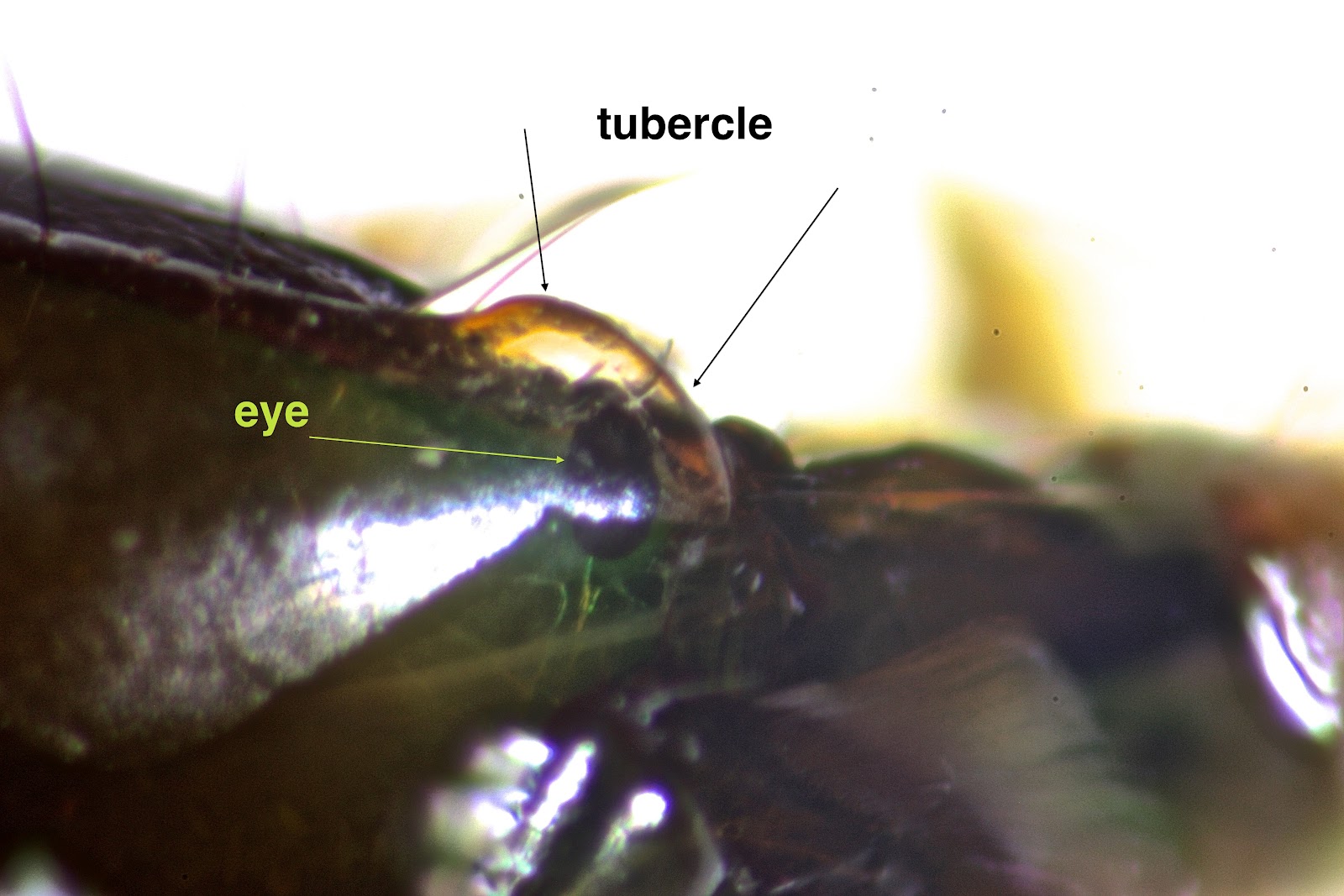
And now, for the problem of species ID. There are only three Macrostemum species in North America, one of which -- M. transversum -- is rare. So realistically, our choices are M. carolina or M. zebratum. Both have a reddish brown head, and on both the back of the carina is "even" -- i.e. there is no bump or tubercle there. So far, our larva could be either one.
M. carolina and M. zebratum differ in only one way -- the size of the tubercles near the eyes. Are they large (= M. carolina), or small (=M. zebratum)? Here are two photos of the tubercle at the top of the eye.
(Click to enlarge.)
Is it large or small? Obviously we have no way to tell. Large and small are relative terms that require a point of reference, something we don't have.
There is one other approach to species ID. M. zebratum larvae are supposed to be 22 mm long when they're mature: M. carolina are presumably smaller since both Beaty (p. 77) and Ames (p. 148) claim that M. carolina adults are relatively small -- Ames says "The species [as an adult] "doesn't get much bigger than 14 mm." The largest larva I collected today was 16mm, but I don't know if it was fully mature. Will it continue to grow? Will it reach 20-22 mm?
Best to leave this alone -- which, in the end, is what Beaty advises! More photos below.
Wednesday, August 1, 2012
Ceratopsyche bronta and Ceratopsyche morosa: More Netspinner Identifications
So the rule is: when you find a common netspinner that appears to be Hydropsyche in terms of the genus (key features: 1) forked fore trochantin, and 2) two large sclerites posterior to the prosternal plate) and you wish to ID it to the level of species, be sure to check the descriptions for:
1) Ceratopsyche larvae in Steven Beaty's "The Trichoptera of North Carolina," pp. 72-73
and
2) Symphitopsyche larvae in Guenter A. Schuster and David A. Etnier, "A Manual for the Identification of the Larvae of the Caddisfly Genera Hydropsyche pictet and Symphitopsyche ulmer in Eastern and Central North America," pp. 1-60 (published in 1978). (Be sure to look at p. 25 for excellent drawings of common larval head patterns.)
Both sources are available online. Symphitopsyche is apparently no longer used as a Hydropsychidae genus name, and remember that what some entomologists call Ceratopsyche others ID as a "type" of Hydropsyche. As an amateur, this disagreement appears to me to be a matter of "splitting hairs" -- which it actually is! (See the previous entry.)
__________________
Using those sources, I have now identified two additional common netspinners that I have found in our streams. In fact both of these were found in the Moormans River in Sugar Hollow.
1. Ceratopsyche bronta, or, if you prefer, Hydropsyche bronta. This is the larva pictured at the top of the page. In that photo, you can see all that you need to see for this species ID. Quoting from Beaty: "...head with 3 distinct transverse stripes with cental stripe expanded mesally and often with light spot in middle; nota with anterior and posterior transverse dark bands." (p. 73) The head pattern is definitive, though the "light spot" in the middle band may or may not be present (Schuster and Etnier, p.39). Our larva does have the light spot:
And there are clearly dark anterior and posterior bands on the pronotum, mesonotum, and metanotum.
________________
2. Ceratopsyche morosa, or, Hydropsyche morosa. Pictured below.
Again, the head pattern is definitive for the species. From Beaty: "...head with 5-6 pale spots in checkerboard pattern on frontoclypeus (top of head) and usually with three small white spots at posterior angle of frontoclypeus." Here is a close-up of the top of the head.
Perfect. He adds another feature that we can see if we turn over the larva and look at the "chin": "...stridulatory areas [the striations that the larva rubs to make a "warning" noise ] on venter of head darkly pigmented." Sure enough.
(For Schuster and Etnier's more detailed species description (their S. morosa), see pp. 41-43 in the "Manual.") Both of these netspinners, by the way, are fairly intolerant: both have a TV of 2.3.
If you find the right sources to use, once impossible tasks can become fairly easy. Below: ventral views of C. bronta and C. morosa.
Subscribe to:
Posts (Atom)