Tuesday, August 28, 2012

Two Confirmations, One Change (Serratella tibialis): Insects from Montana and Oregon


In identifying the insects I recently found in Montana and Oregon, I noted that some of my ID's were provisional -- precise identification to the level of species would require microscope work at home.  Having now done that microscope work, I can confirm two of my identifications -- but there is one that has to be changed.

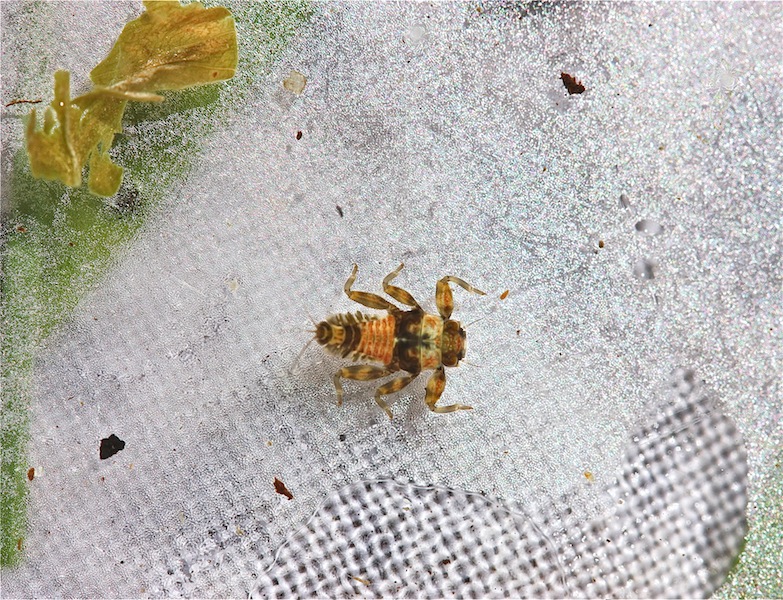
The mayfly nymph in the photo above -- and the more mature nymph, same species,  in this photo --
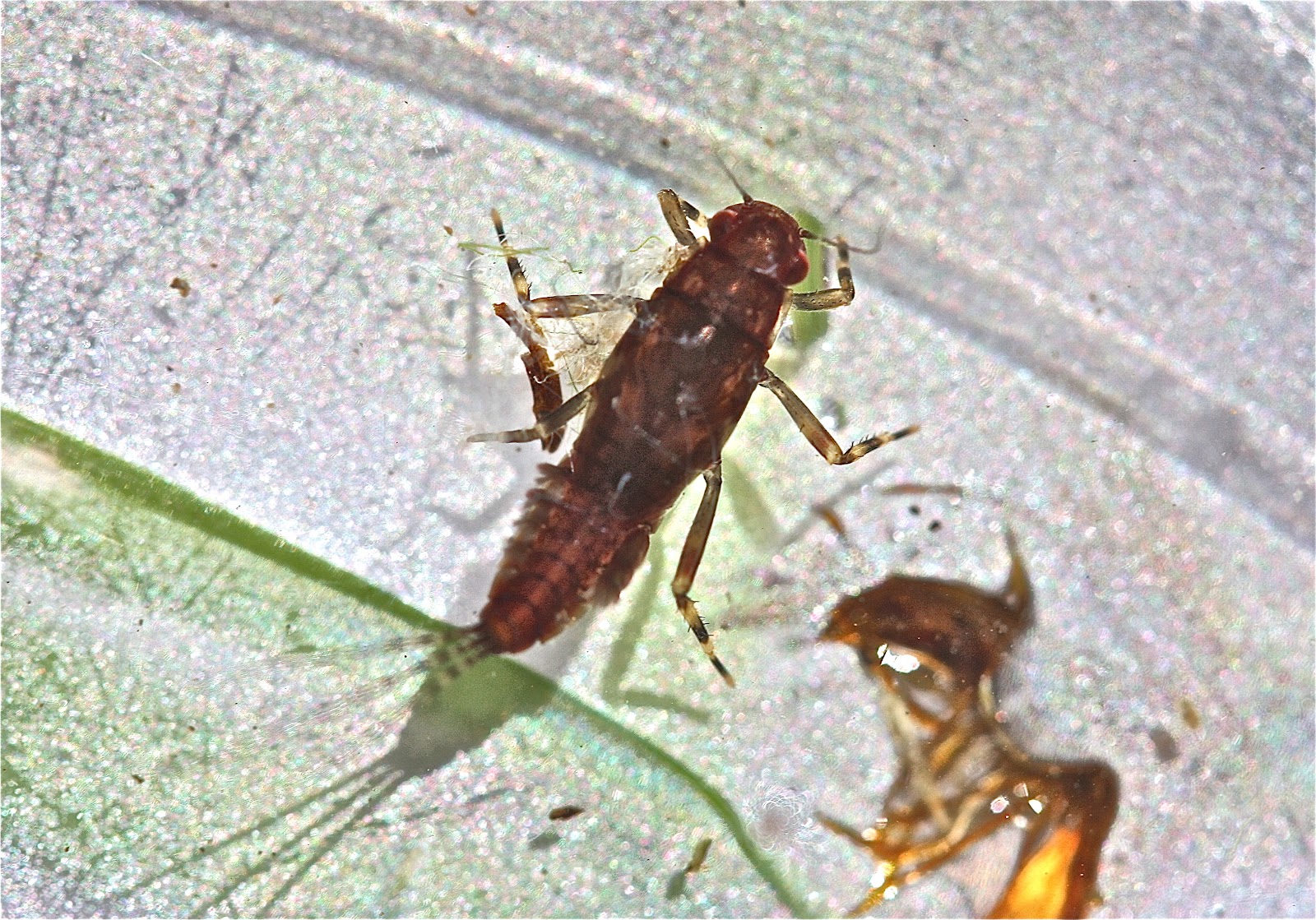

 is not Ephemerella dorothea infrequens (the Pale Morning Dun), rather, it keys out to Serratella tibialis -- for fly fishermen, the Red Quill, or the Small Western Dark Hendrickson.  Remember that the difference between Ephemerella and Serratella spiny crawlers is primarily a matter of the hair on the tails: Ephemerella tails have a long silky fringe -- Serratella tails have only tiny black spiky hairs.  Take a look at this close-up of the tails on the second nymph pictured above.


Very clearly the tails of Serratella.  For the ID of S. tibialis, I turn to the description in "Fly Fishing Entomology: Pacific Northwest Mayflies."  "Abdominal segments 2-8 w/small sharply pointed tubercles on hind edge; rear edges of middle abdominal segments straight; often w/dorsal stripe down middle of abdomen; dark/light banding on legs."

The stripe down the abdomen is very clear in both of our photos, and we can see the banding on the legs in these photos as well.  For the "pointed tubercles" on segments 2-8, look at the following photos.


and


While the tubercles on segment 2 are not very clear in the photo of the abdomen of nymph #1, they can be seen in the second photo -- a photo of the more mature nymph of the two.  (Click on the photo to enlarge it: the tubercles show up as two, tiny black dots -- but they're hard to see.)
______________

For the confirmations -- the stonefly nymph in the photo below from the Salmon River in Oregon is, indeed, Calineuria californica.


And the stonefly nymph in this photo -- from the Clark Fork River near Missoula, MT -- is, indeed, Claassenia sabulosa.


1. On the Calineuria nymph -- there is only one species of Calineuria, C. californica, so all we have to prove is that this nymph is a Calineuria nymph in terms of the genus.  For this we must turn to Merritt, Cummins, and Berg, ed., An Introduction to the Aquatic Insects of North America (4th edition).  On p. 325-7 in that key, we can start our ID by looking at the occiput (back of the head).

55  Occipital spinules in a sinuate, irregularly spaced row, more or less complete behind ocelli.


That would be "yes," so we move to 56.

56  Ab terga with fewer than 5 or no intercalary bristles...Hesperoperla
56' Ab terga with more than 5 intercalary bristles...57

In the photo below, the caramel colored dots are "intercalarly bristles," and there are clearly more than 5 on each of the terga.


57 ... posterior fringe of Ab terga with numerous long setae whose length is three-fourths or more the length of Ab segments...Attaneuria
57' ...posterior fringe of Ab terga with numerous long setae whose length is one-fourth the length of Ab segments...58

In the photo above, I've drawn an arrow to the posterior fringe of one of the terga, and I'd say they are about 1/4 the length of the terga.  We move to 58 where the question becomes -- do the cerci have a "prominent dorsal fringe of long silky hairs"?  Look at the first photo above of our nymph.  Yes, they do have such a fringe.

With  couplet 59, we reach the difference between Doroneuria and Calineuria.

59  Dorsum of Th and Ab with a mesal, longitudinal row of long, fine, silky hairs; Ab7 sternum usually with incomplete posterior fringe...Doroneuria
59' No mesal longitudinal row of silky hairs on Th-Ab dorsum; Ab7 sternum usually with a complete posterior fringe...Calineuria


Our nymph does not have a "mesal, longitudinal row of long, fine, silky hairs," but Ab7 sternum does have a complete posterior fringe.  Calineuria -- specifically Calineuria californica.
______________

2. The identification of this nymph as Claassenia sabulosa is much easier.  Again, there is only one species of Claassenia in the Northwest -- C. sabulosa -- so we just have to show that this is a Claassenia nymph in terms of the genus.


Having established that the occiput has a "transverse row of regularly spaced spinules," and that it has three ocelli, not two -- both of which we can see in this photo -- we move to couplet 53 in Merritt, Cummins, and Berg (p. 325).

53  Ab terga with more than 5 intercalary bristles...Claassenia


The carmel colored spots are intercalary bristles, and clearly there are more than 5 on each of the terga.
Claassenia sabulosa.  Some of you may recall that I found a  mature C. sabulosa in Rock Creek near Missoula last year.


It really turns into a very colorful nymph.

_______________

Below: 1) the Clark Fork River near Petty Creek; 2) typical scene on the Blackfoot River.


Monday, August 27, 2012

Arctopsyche grandis: An Important Common Netspinner in the Northwest


The common netspinner caddisfly larva in the picture above was one that I found -- you may recall -- in the Blackfoot River on 8/14; the one in the photo below is the one that I found in the Salmon River in Oregon on 8/19.


They turned out to be the same species, Arctopsyche grandis, and the yellow stripe that goes through the center of the head and the thorax is an important key to this identification.

Arctopsyche common netspinners can be found in the East, but according to Steven Beaty ("The Trichoptera of North Carolina," p. 72), they are only found in the mountains, and they're uncommon.

Let's work on the species ID by starting with the genus ID, using Beaty's description:

Ventral genae of head entirely separated by apotome which narrows posteriorly; thick sa2 and sa3 setae on abdomen not arranged in tufts...Usually collected on large bouders and in fast currents.

We might add that unlike the two genera we commonly see in Virginia -- Cheumatopsyche and Hydropsyche -- this is a genus in which the larvae have a single point on the fore trochantin; i.e. the fore trochantin is not "forked."  That feature is visible in one of the photos I took on 8/19.


In another photo I took of that same larva at the Salmon River, we have a clear view of the ventral genae and the apotome that "narrows posteriorly":


And here are microscope photos of the ventral apotome of both of the larvae.

Oregon:


Montana:


For the thick setae at the sa2 and sa3 positions that are "not arranged in tufts," I can provide the following microscope shot:


The setae are clearly "thick," but there are no clusters of tufts.  (To see what those clusters would look like -- on Parapsyche larvae -- look at Figure 18.79 in Merritt, Cummins and Berg, p. 492.)

For the species ID of grandis, I had to turn to "Fly Fishing Entomology: Pacific Northwest Caddisflies" (http://www.flyfishingentomology.com/PNW%20Caddisflies.htm), where we find the following on Arctopsyche grandis: "All males and most females have a yellow stripe that goes down the middle of the top of the head and thorax."

Arctopsyche grandis.


A. grandis is a common and important netspinner in the northwest, one for which fly fishermen had better have imitations.  Gary LaFontaine said the following on this species in his well-known study, Caddisflies (p.232):

"This is the most abundant and widely distributed western species in the genus.  It is a mountain caddisfly, associated mainly with pristine rivers and streams over 1,500 feet in elevation.  It is common in the Cascade range throughout Oregon, Washington, and British Columbia; in both the Siskiyou and Sierra Nevada ranges of California; in the Rocky Mountains, down the continental spine, through Montana, Colorado, and Wyoming; and in the Sangre de Cristo Park, and San Juan mountains of Colorado and New Mexico.  A. grandis is one of those special insects that is worth making the focus of a fishing trip because it gets the best trout in a river interested in feeding."
____________

Below, the "pristine" waters of the Salmon River near Welches, Oregon.


Wednesday, August 22, 2012

Drunella doddsi, Calineuria californica -- and more: The Salmon River near Mt. Hood


On Sunday, 8/19, my son-in-law to be (the wedding's on Saturday) took me fishing on the Salmon River in Welches, OR.  The scenery was spectacular, and the water was gin clear and freezing cold -- but the fish that we caught were small.  So, I decided to see what I could find under the rocks.  Lots of spiny crawlers and lots of small minnow mayflies, with the occasional common stonefly and common netspinner.

1. The colorful nymph in the photo above is a spiny crawler mayfly -- Drunella doddsi.  I've only seen them in the northwest, where they're apparently fairly common: they hatch as Red Quills.  The body is flattened, and the abdomen -- as in the photo above -- is yellowish brown.  This particular nymph was extremely tiny: I'm happy that I was able to pick it up and keep it intact.  Another photo:


And yet a third photo, in which you can see an even smaller D. doddsi nymph next to an average common netspinner.  (Can't say I actually saw this nymph when I was taking this picture.)


2. The "common netspinner" (Hydropsychidae) in the photo above is one that I can't identify with any precision until I get home where I'll have the use of my microscope.  I've noted the "gular suture" in this photo since that may be a key to genus ID: it appears to be fairly rectangular, an indication that it may be a Parapsyche, the same netspinner genus I found out here in the fall (see the post of 11/4/11).   But, I don't want to push that until I can work on the ID in greater detail.  Here's a better view of the larva.


3. The common stonefly (Perlidae), Calineuria californica.  This is a new one for me.


 If you look back to my post of 11/4/11, you'll see that I found a stonefly in a small stream close to Mt. Hood that I identified as Doroneuria in terms of the genus.  I thought that this nymph might be the same.  Very important to that ID is the lack of anal gills and the fact that the setal row at the back of the head (occiput) is "laterally interrupted."  Have a look at the head of our nymph: there is indeed a gap between the setae at the sides of the head and the dark line of setae right in the middle.


But I was bothered by the fact that the lateral (rear) ocelli are surrounded by a large yellow oval.  So, I decided to look into this further.  In my search for more information, I found an important article that is available on-line: the authors are Bill P. Stark and Arclen R. Gaufin, and it's entitled "The Species of Calineuria and Doroneuria (The Great Basin Naturalist, 34:2, June, 1974).   In describing Calineuria californica they note -- "head with distinctive large yellow spot covering ocellar area." Bingo.  Then I looked up Calineuria californica on Troutnut.com where Jason Neuswanger notes that "their lateral ocelli (simple eyes) in a pale background, separates them from Doroneuria." (http://www.troutnut.com/hatch/1050/Stonefly-Calineuria-californica-Golden-Stone).

Neuswanger notes further that "Calineuria californica is the largest western species of the Perlidae family, with female adults approaching 40 mm in some locales. This species is perhaps better known by anglers under its former scientific name, Acroneuria californica. It is the primary Golden Stonefly hatch of the West Coast states."

The Golden Stones have already hatched here in the West, but, the nymph that I found is clearly immature: it will be maturing over the winter and hatching next year.


4. Spiny Crawler mayfly, Ephemerella dorothea infrequens.


 I may revise this identification once I've been able to examine my specimens closely -- but this is a species we'd expect to see in Western streams at the moment.  For fly fishermen, this is the well-known mayfly, the Pale Morning Dun (PMD).

There was no doubt in my mind of the Ephemerella identification, so for species identification, I looked at the "Mayflies of the Northwest" mentioned in my last entry.  There, on E. dorothea infrequens, we find: "Body uniform brown color, abdomen w/weak, light markings; no abdominal tubercles."  There are other features noted on this ID that I need to check when I get home, but the colors seem right, and I cannot see any tubercles on the abdomens of these nymphs.

________________

This will have to do it for posts from the Northwest.  Wedding arrangements will be taking up the rest of my time.  Back to work in VA next week.


Saturday, August 18, 2012

A Montana Sampler


I did a whole lot of fishing last week -- but I did find time to collect, and photograph, a few insects.  I'd like to say I can identify everything right down to the level of species, but alas, my microscope is back home in Virginia.  So, in this entry I'll just post some of the photos I've taken.   Full species ID will have to await future study.

Before I begin, let me note the sources I'll use to determine genus and species ID, though I am sure of the genus ID of all of most of the insects I've found.

A. For genus ID, we must use Merritt, Cummins and Berg, An Introduction to the Aquatic Insects of North America (2008 edition).   The EPT genera we find in the West often differ from those we find in the East.

B. For species ID of the EPT we find in the Northwest, go to flyfishingentomology.com, a wonderful site maintained by Roger Rohrbeck.  There you can find the following keys:

1. Fly Fishing Entomology: Pacific Northwest Mayflies (Ephemeroptera): http://www.flyfishingentomology.com/PNW%20Mayflies.htm
2. Fly Fishing Entomology: Pacific Northwest Stonelfies (Plecoptera): http://www.flyfishingentomology.com/PNW%20Stoneflies.htm
and
3. Fly Fishing Entomology: Pacifici Northwest Caddisflies (Trichoptera):
http://www.flyfishingentomology.com/PNW%20Caddisflies.htm
______________________

1. The spiny crawler mayfly in the photo at the top of the page is genus Drunella (note the tubercles/bumps on the leading edges of the femora).  This is a genus we have in the East, but I don't think that we have this particular species (that's something that I have to check).  From the descriptions we find at the Fly Fishing Entomology website, I would guess that this is a Drunella coloradensis, or a Drunella flavilinea -- apparently the two are difficult to tell apart.  Neither has tubercles on the head; both have banded tails.  The banded tails are very clear on this photo:


As you can tell from the wing pads, this nymph is fairly mature.  The adults of this species go by a number of names: the Dark Olive Dun, Lesser Green Drake, Western Green Drake, Slate-winged Olive, and Autumn Green Drake --just to mention a few.
________________

2. Another spiny crawler mayfly -- and in this case I know the species ID -- Timpanoga hecuba.


This is another spiny that will be hatching in the near future: Montana fly fishing guides refer to this as the "Hecuba" hatch -- it's a big, red mayfly.  T. hecuba is very distinct because of the shape of its head: this is known as having a "complete frontal shelf".  I've pointed that out, as well as the large operculate gills on segment 4 that cover the rest of the gills, in the following photo:


It's a strange one!
________________

3. A Giant stonefly which is either Pteronarcys californica or Pteronarcys dorsata.  In either case, it will hatch as a "Salmonfly."  Since the salmonfly hatch is essentially over in western Montana, this is either a "late bloomer" or a nymph that will hatch sometime next year.


Were we back East, I'd say for sure that this is P. dorsata because of the sharp points on the corners of the pronotum.  But this seems to be part of the genus description of Pteronarcys nymphs in the West.  I hope further work will help me to pin this one down.  I found this nymph in the Blackfoot River, by the way, a river famous for its salmonfly hatches.

________________

4. A small minnow mayfly (Baetidae).


This is the only small minnow species I saw, and I'm not even sure of the genus.  Again, were we back East, I'd say it's a Baetis -- it has three tails.  But there more small minnow genera out West, and I need to work on this one in some detail when I get home.  Here's a small minnow that was already mature.  I think this is the same species as the nymph in the previous photo, but I don't want to say that for sure.

________________

5. A common netspinner larva, family Hydropsychidae.


I found the light stripes on the head and pronotum quite striking.  Again, I can't be sure of the genus, to say nothing of species: all of that requires microscope work.

________________

6. On final photo, this one of a Perlid -- common stonefly.  This photo was taken with my little Canon PowerShot camera -- we were floating a river, and I didn't have my good camera along.


From the "Flyfishing entomology" descriptions, I would guess that this is a Claassenia sabulosa nymph.  The key features to look for are the complete setal row at the back of the head and the "M" shape in the middle of the head.

Lots to work on when I get home.  But, I'm in Oregon now and plan to go fishing -- and look for more insects -- in a local stream tomorrow.
________________

And then there was the Osprey that perched high up on a pine and watched us have lunch on the banks of the Blackfoot.  (Had to use the telephoto lens for this one, of course, the macro lens wouldn't have done me much good!)


Oh yes -- and we did catch some fish, all of which were released.