Thursday, October 4, 2012

EPT Species List for Central Virginia: Photos of All Other Stoneflies


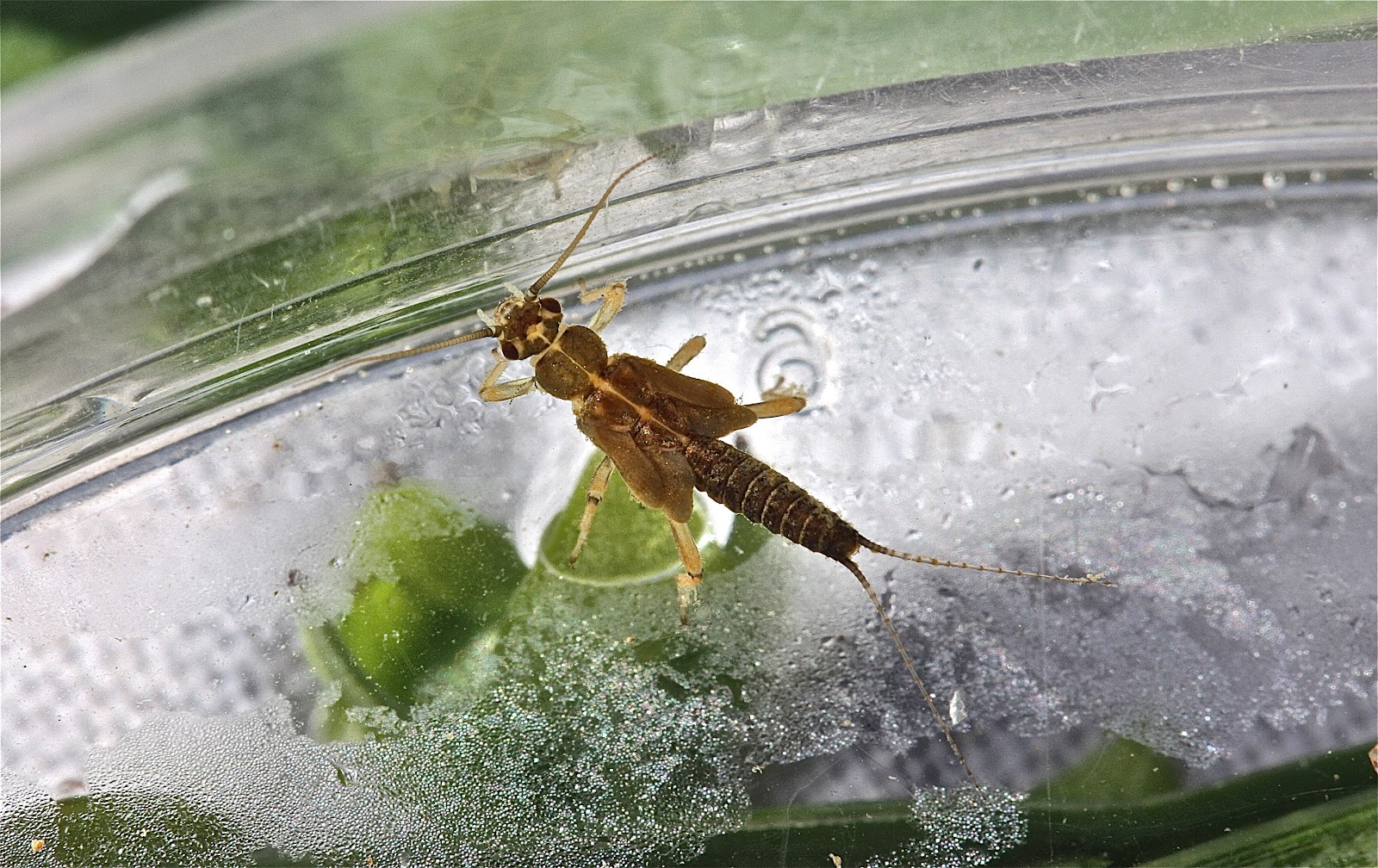
In the photo above -- the Giant stonefly Pteronarcys californica, the "Giant Salmon Fly," a species that does not occur in the East.  I found this one in the Blackfoot River near Missoula, Montana this summer.

Photos of the Perlid and Perlodid species we find in our streams have been posted in earlier entries.  These are photos of species from the other Plecoptera families.

Capniidae (Small Winter Stoneflies)

1. Allocapnia pgmaea.  Size: ~5-10 mm.  Season: Late Fall through Early Winter.  Included are photos of more than one species.

male:


female:


2. Allocapnia mystica.


3. Paracapnia angulata.  Size: 6-8 mm: Season:  Winter.

fairly mature
mature


Leuctridae (Rolled-winged Stoneflies)

1. Leuctra.  Size: 6-9 mm. Season: Late Fall through Winter (I've also seen some in the Summer, possibly a different genus or species).


Nemouridae (Forestflies)

1. Amphinemura delosa.  Size: 5-8 mm; Season: Spring.

mature

2. Prostoia completa. Size: 5-6 mm; Season: Winter.


3. Ostrocerca truncata?  Size: 6 mm.


4. Soyedina sp.  Size: 6.5-8.5 mm; Season: Winter.


Taeniopterygidae (Large Winter Stoneflies)

1. Strophopteryx fasciata.  Size: 9.5-10 mm; Season: Winter.


2. Taenionema atlanticum.  Size: 6.5-11 mm. Season: Winter.

fairly mature
fully mature

3. Taeniopteryx burksi/maura.  Size: male, 8.7-9.5 mm: female, 10-12 mm; Season: Winter.

immature
fairly mature
fully mature


Chloroperlidae (Green Stoneflies)

1. Alloperla.  Size: not given by Beaty; Season: Winter into Spring.


2. Haploperla brevis.  Size: ~7 mm. Season: Winter into Spring.


3. Sweltsa.  Size: 7-8.5 mm. Season: Late Fall through Winter.

young
fairly mature
mature


Peltoperlidae (Roach-like Stoneflies)

1. Peltoperla. Size: 8-11 mm; Season: Winter and Spring.

mature

2. Tallaperla.  Size: 7-10 mm; Season: Winter and Spring.

mature


Pteronarcyidae (Giant Stoneflies)

1. Pteronarcys biloba.  Size: 35-50 mm; Season: Fall and Winter.

fairly mature
mature

2. Pteronarcys proteus.  Size: 35-50 mm; Season: Fall and Winter.

young
fairly mature

3. Pteronarcys dorsata.  Season: Summer through Fall.


Should "Clioperla clio" be "Isoperla" clio?


I'm perplexed, and I have a question for the professional entomologists who follow this blog: do Clioperla and Isoperla nymphs differ enough to justify the existence of two different genera?  I am an amateur at this, so I have no authority whatsoever to question established classifications.  But let me make my case: I think there's good reason to shift Clioperla clio (there's only one species of Clioperla in North America -- i.e. clio) into the Isoperla camp, making it Isoperla clio.

Here is the case.  There are three anatomical features used to distinguish genera of Perlodid stoneflies: 1) the presence or absence of submental gills; 2) the shape/form of the mesosternal ridge; and 3) the shape/form of the lacinia.

1) Neither Clioperla nor Isoperla has "submental gills" -- these:


2) Clioperla and Isoperla nymphs have the very same type of mesosternal ridge.  Reading from Peckarsky (Freshwater Macroinvertebrates, p. 71), "Posterior ends of arms of mesosternal ridge meet posteriorly, forming a forked- Y pattern."  It looks like this:


3) The laciniae on Clioperla and Isoperla nymphs look exactly the same.  From Peckarsky (p.71), "Lacinia rounded from 2nd tooth to base."  They look like this:


The only distinction between the genera is the pattern formed on the abdominal terga.  Again, let me read from Peckarsky: "

45a. Dorsal abdominal segments with alternating transverse or longitudinal light and dark stripes or bands...Isoperla
45b. Dorsal abdominal segments uniform, brownish except for a few small light spots (which may be longitudianl rows) ... Clioperla

Here's an Isoperla namata on which we can clearly see the longitudinal stripes:


And here's a Clioperla clio, on which we can see the "light spots" which also form longitudinal rows:


Here's the problem:  the so-called "stripes" on Isoperla nymphs are often formed by a combination of "dots"!  On the I. namata nymph pictured above, the central stripe is made up of a series of crosses, which are actually two dots with a line down the center.  That's clearer in the following photo (click to enlarge):


Now look at the terga on this fully mature Clioperla clio nymph:


True, these are "light" spots and a line, not "dark" spots and a line -- but does that minor difference warrant a separate genus?

And, what do we do with the center "stripes" on Isoperla similis nymphs (and the lateral "stripes" are simply "dots" as they are on the C. clio) -- they're light, not dark!


Again, the "stripe" is really a combination of a line and a couple of dots.
_______________

I really don't see why Clioperla clio is in a class of its own.  Should it not be just another species of Isoperla?  Counter arguments are clearly invited.