Sunday, October 7, 2012

EPT Species List for Central Virginia: Photos of Common Netspinners


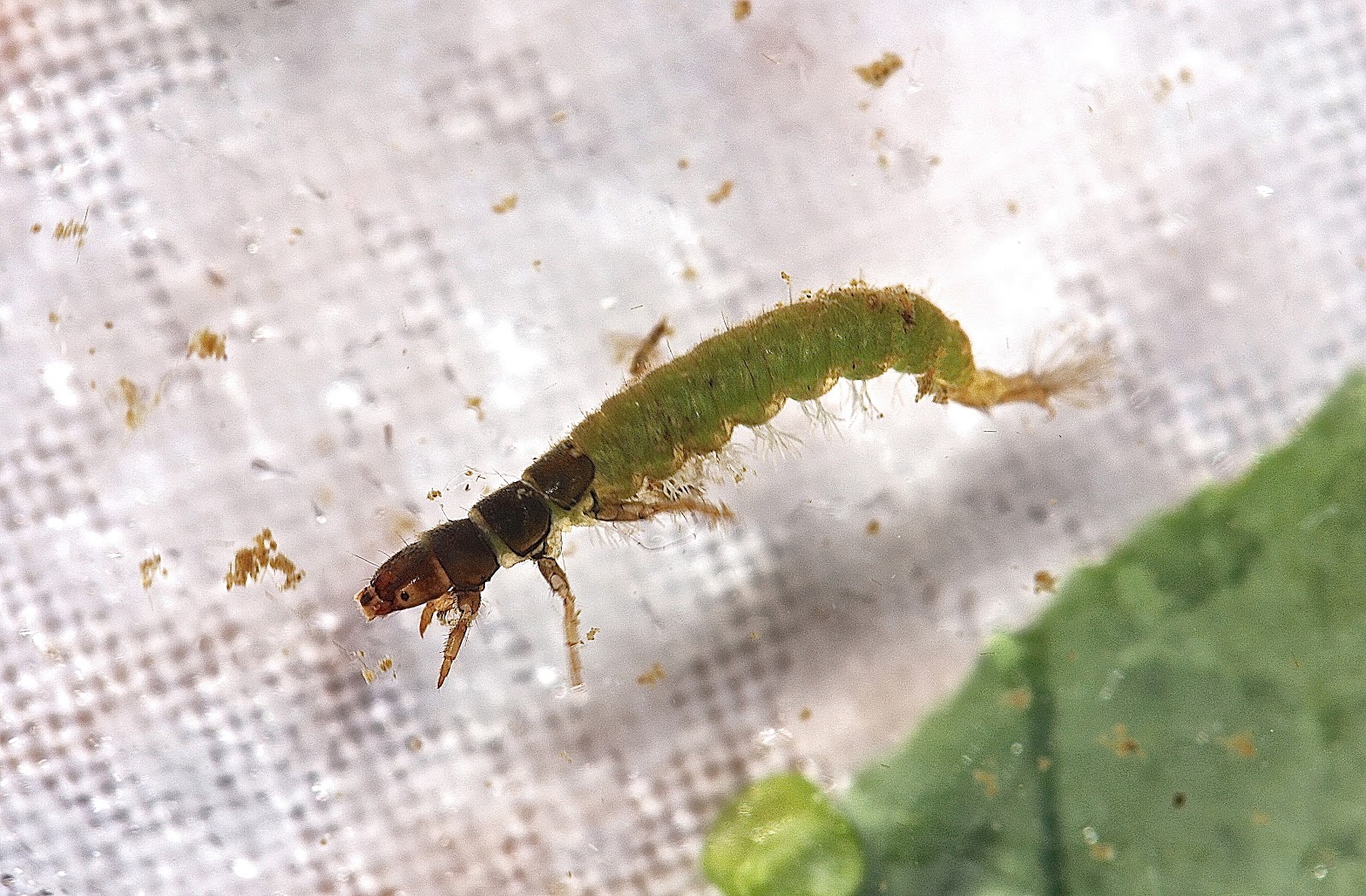
In the photo above -- the common netspinner Arctopsyche grandis from the Blackfoot River near Missoula, Montana.  The genus Arctopsyche does occur in the East, but I've not yet found it in our streams.


III. Trichoptera: Annulipalpia (continuation)

Hydropsychidae (Common netspinners)

1. Ceratopsyche alhedra. Size: not given by Beaty; Season: Summer


2.  Ceratopsyche bronta. Size: not given by Beaty; Season: Summer.


3. Ceratopsyche morosa, morosa form.  Size: 14 mm; Season: Summer.


4. Ceratopsyche morosa, bifida form.  Size: 14mm; Season: Fall.


5. Ceratopsyche slossonae.  Size: 16 mm; Season: Summer.


6. Ceratopsyche sparna.  Size: not given by Beaty; Season: Summer.


7. Cheumatopsyche.  Size: up to 13 mm; Season: Summer.


8. Diplectrona modesta.  Size: 15 mm; Season: Winter into Spring.


9. Hydropsyche betteni.  Size: 16 mm; Season: Spring and Summer.


10. Hydropsyche rossi.  size not given by Beaty; Season: Summer.


11. Hydropsyche venularis.  Size: size not given by Beaty; Season: Summer.


12. Macrostemum.  Size: not given by Beaty -- large; Season: Summer into Fall.


Saturday, October 6, 2012

EPT Species List for Central Virginia: Caddisfly Photos, Part I.


In the photo above -- an unidentified common netspinner found last year in Missoula, Montana.

Entomologists divide caddisflies (Trichoptera) into three different groups: Spicipalpia, Annulipalpia, and Integripalpia.  These names refer to the nature of the terminal apex of the maxillary palps on the adults: spica = pointed; annulus = ringed; integra = entire/complete (see Glenn Wiggins, Caddisflies: The Underwater Architects, pp. 12, 107, 123, and 151).  With a focus on the lives of the larvae, Wiggins argues that the Integripalpia caddis are the "portable case-makers": the Annulipalpia caddis are the "fixed-retreat-makers" (which make nets for collecting their food): and the Spicipalpia caddis are "closed-cocoon-makers," making special cocoons for pupation.  (Wiggins, Caddisflies, pp. 12-28)
In terms of the caddis larvae that we see in our streams, the Spicipalpia group is comprised of the "free-living caddisflies" (Rhyacophilidae), the so-called "saddle case-makers" (Glossosomatidae), and the so-called "purse-makers," or "micro caddisflies" (Hydroptilidae).  He argues that Glossosomatids and Hydroptilids are not true case-makers.  (For his argument, see, especially, pp. 28-28 and 65-71.)

I will present my photos of caddisfly larvae, by species, in three different entries: 1) the Spicipalpia
families and two of the Annulipalpia families -- the fingernets (Philopotamidae) and the trumpetnet makers (Polycentropodidae);  2) the third Annulipalpia family -- the common netspinners (Hydropsychidae); and 3) Integripalpia -- i.e. all of the case-maker families.
_________________


III. Trichopera: Spicipalpia

 Rhyacophilidae (free-living caddisflies)

1. Rhyacophila carolina.  Size: not given by Beaty; Season: Winter into Spring.


2. Rhyacophila fuscula.  Size: large; Season: Fall, Winter, Spring

immature
early instar -- head pattern not fully developed
mature
cocoon: larva in pupation

3. Rhyacophila nigrita. Size: not given by Beaty; Season: Winter and Spring.


4. Rhyacophila glaberrima.  Size: 12 mm??; Season: Winter.


5. Rhyacophila ledra/fenestra.  Size: 14 mm; Season: Winter and Spring.


6. Rhyacophila sp. (banksi complex?)


Glossosomatidae (Saddle-case makers)

1. Glossosoma nigrior.  Size: 4-5 mm; Season: Winter and Spring.

dorsal view of case
ventral view of case revealing larva stretched over its "saddle"
dorsal view of case: larva crawling
larva emerging from case
larva outside of case: note "stubby" prolegs


Hydroptilidae ("purse-makers," micro caddisflies)

1. Hydroptila (?).  Size: up to 5 mm; Season: Summer.  (Note: I've never seen one larger than 2mm.)

microscope photos of preserved specimen
larva next to grain of rice
_______________

III. Trichopera: Annulipalpia (in part)

Philopotamidae (fingernet caddisflies)

1. Chimarra.  Size: up to 12.5 mm; Season: Late Summer into Early Winter.


2. Dolophilodes distincta.  Size: 11-12 mm; Season: Fall and Winter.


pupa in cocoon: note that cocoon is covered by a "dome" of pebbles

3. Wormaldia.  Size: up to 14.5 mm; Season: Winter and Spring.


Polycentropodidae (Trumpetnet caddisflies)

1. Polycentropus.  Size: up to 25 mm; Season: Spring and Summer.


Friday, October 5, 2012

Acentrella Turbida: A Small One to Start off the Season


The small minnow mayfly, Acentrella turbida, is "bi-brooded," hatching first in the spring, with the offspring produced by that hatch, showing up in our streams in the fall.  I've said before (see the entry from 9/30/11) that I think of A. turbida as our "fall" small minnow mayfly since it's the most common Baetid that I see at this time of year.  If you look at enough small minnow nymphs, you'll come to recognize this one as soon as you see it: A. turbida nymphs are small, they have two tails, and the thorax is very broad.  This was a young one, and I'm impressed with my camera for getting fairly sharp photos.  This nymph was only 2 mm long!  At maturity, A. turbida nymphs measure 4-6 mm.  We should see a lot of them this month and next.


I was at the South river this morning, up in Greene county, where I saw very little other than common stoneflies of various sizes -- and our small minnow mayfly, of course.  Well, there were also Odontocerids (Strong case-makers) hanging around.  Curiously, they were in leaf packs; I normally see their cases on the tops of the rocks.

Some photos:

1. Common stonefly (Perlid), Paragnetina immarginata.  This is the first time I've seen these in a stream other than the Rapidan River.  Still fairly small.


2. Common stonefly, Acroneuria abnormis, one that had just recently molted -- but it's already starting to darken.


3. Odontocerids -- Strong case-maker caddisfly larvae -- Psilotreta libada.


4. And a Giant stonefly -- there are a lot of them in this stream.  This looks to be the same species that we find in Sugar Hollow, the one we think is Pteronarcys scotti (see the entry for 2/2/12), but that ID is not unproblematic.  According to Beaty ("The Plecoptera of North Carolina," p. 28), the lateral hooks on abdominal segments 6-8 of P. scotti are "appressed and not conspicuous."  On these nymphs, the hooks are clearly "appressed" on segments 7-10 -- but the hook on segment 6 is pretty darn clear to me.


And looking eye-to-eye!