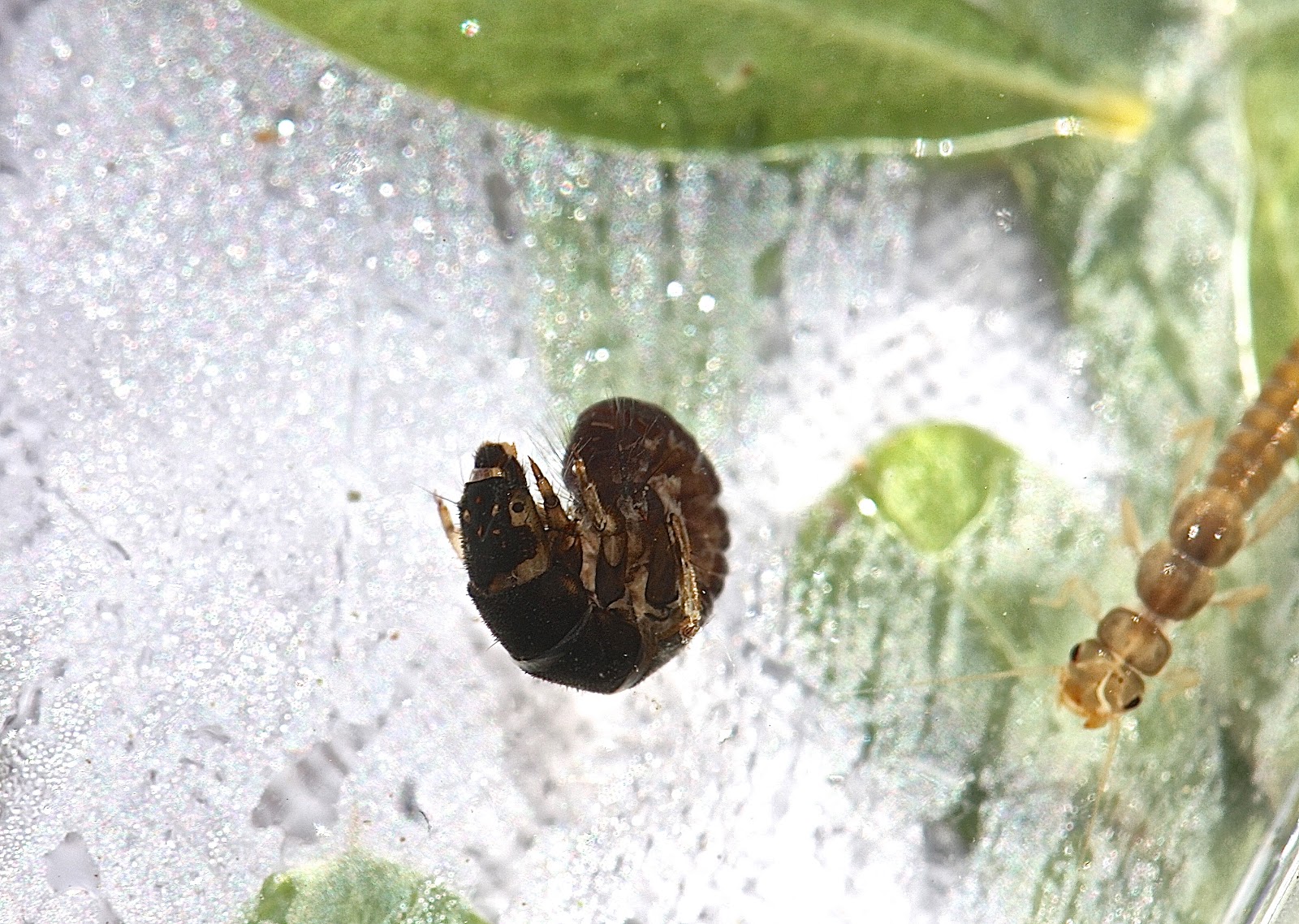
I'm not sure we can -- well, I'm not sure that "this" amateur can. Beaty warns us not to attempt it, noting that "There are at least eight species of
Allocapnia in North Carolina many of which are undescribed as nymphs" ("The Plecoptera of North Carolina," p. 1). Clearly, this must also be true for many of the
nineteen Allocapnia species that Stewart and Stark (
Nymphs of North American Stonefly Genera, pp. 118-119) note as attested in the state of Virginia. Still, we do have nymphal descriptions for at least
some of the species that occur in our state, and I think that is true for the two species that I've been finding in local streams.
I think I am seeing
Allocapnia pygmaea and
Allocapnia mystica. But my conclusions, at the moment, are tentative at best. To be certain of my ID, I need to have fresh specimens of mature nymphs of these species, something I won't see until later this year and/or the beginning of next. Thus, this is an issue that I will revisit in a later blog entry. What I argue today is a hypothesis, based on some evidence, but a hypothesis that needs further testing.
The key studies on which I'm relying are these.
1. Peter W. Claassen,
Plecoptera Nymphs of America (North of Mexico) (The Thomas Say Foundation, 1931), pp. 111-116.
2. P.P. Harper and H.B.N. Hynes, "The Capniidae of Eastern Canada (Insecta; Plecoptera),"
Canadian Journal of Zoology, 49: 921-940, 1971.
3. Bill P. Stark & Joe W. Lacey, "Larvae of the Winter Stonefly Genus
Allocapnia (Plecoptera: Capniidae) in Mississippi, USA,"
Illiesia, 1(3):10-20, 2005.
This source is of limited use, for me, since it relies on data garnered by using an electron scanning microscope.
Claassen describes
A. pygmaea,
A. recta,
A. granulata,
A. vivipara,
A. incisura, and
A. mystica.
Harper and Hynes describe, and provide a key for
A. granulata,
A. illinoensis,
A. maria,
A. minima,
A. pechumani,
A. pygmaea,
A. recta, and
A. vivipara.
Stark and Lacey describe, and provide a key for
A. aurora,
A. mystica,
A. starki, and
A. virginiana.
_______________________
1.
Allocapnia pygmaea. (Photos taken last year.)
female:
male
This is the most common small winter stonefly I see, and both Claassen (p. 113) and Harper and Hynes (p. 936) say that
A. pygmaea is the most common
Allocapnia species, period. Claassen gives the length as "up to 8 mm" (p. 112); Harper and Hynes give a range of 6 to 7.5 mm. The following nymph from my preserved specimens was exactly 6 mm, and it's very mature.
Now let me read from Claassen's detailed description of
A. pygmaea, noting features that we can see in our photos. "General color brown, becoming darker as the nymphs mature (
yes). Head slightly wider than pronotum (
yes)...hind ocelli about twice as close to the eyes as to each other (
yes)...Pronotum about as wide as long (
yes)...front margin convex, hind margin nearly straight."
Yes, as we can see in this microscope photo:
He continues "Wing pads large; front ones far apart, directed backward and parallel to the body; hind ones much wider than the front pair (
all true)...Abdomen nearly cylindrical, uniformly brown in younger nymphs but transversely banded in mature ones." Yes, and we can see that banding in the microscope photos above, and in this microscope photo as well.
Harper and Hynes add one other thing that is important, for which take a look at the male in the photo above. "Supraanal lobe of mature male nymph large, about twice as long as the 10th segment." (p. 936) That shows up very clearly in the following microscope photo of our 6 mm preserved nymph.
That's the best case I can make so far for this ID. For fuller documentation I need a mature, fresh specimen on which I can look at setal and bristle patterns (very important in the work done by Harper and Hynes).
_______________
2.
Allocapnia mystica. Photos taken last year -- unless otherwise noted.
male
(Note: this is the same species I found on 11/1 in Buck Mt. Creek, the one with the very small wing pads. This one:)
My case for this species ID is weaker than that for
A. pygmaea since professional descriptions are not easy to find. Still, let me read from Claassen, who notes that his description is taken from an article written by Theodore H. Frison -- "Fall and Winter Stoneflies or Plecoptera of Illinois," 1929. "Nymphal male. -- Similar in general form, color, and structure to
A. vivipara." (But note:
A. vivipara nymphs
do not have wing pads.) "Wing pads conspicuous, fore wing pads overlapping base of hind wing pad. Dorsal lobe-like protuberance at apex of abdomen [i.e. the supraanal lobe] nearly twice as long from base of anal cerci to apex as length of ninth dorsal segment."
Since Claassen notes that
A. mystica and
A. vivipara are "similar in general form, color, and structure," it's worth noting some of the things he says about
A. vivipara: "Length of body up to 8.5 mm [the one I found three days ago was 8 mm] ... General color brown with the appendages somewhat lighter in color. Head slightly wider than pronotum...Pronotum a little longer than wide [look at our photos] widened posteriorly; front angles more narrowly rounded than hind ones." (pp. 114-115) The pronotum description is right on the money with the nymph in our pictures.
Not much to go on. However, as we noted on 11/1, the fore wing pads on the nymph in the photo directly above just barely overlap the base of the rear wing pads. Remember this photo:
We can also see the very long supraanal lobe clearly in all of our photos.
Finally, one other thing -- this from the key provided by Stark and Lacey: "Posterolateral aspect of developing male 10th tergal margin truncate, dorsal margin straight....
A. mystica." The "posterolateral aspect" again refers to the supraanal lobe: we can see in this photo that it is indeed "truncate" (straight/flat, not rounded), but we cannot tell from this perspective if the dorsal margin is straight.
On the size, Harper and Hynes -- agreeing with Claassen -- note that
A. vivipara nymphs -- which are similar to
A. mystica -- are 7-10 mm long (p. 937). The nymphs of this type that I've seen have all been quite long. And as I've already noted, the one I found on 11/1 was already 8 mm, and it wasn't mature.
_______________
That's the best I can do at the moment. I have hunted in vain for a photo of an
A. mystica nymph to compare with those that I've taken: no luck so far. I
have found other photos of
A. pygmaea nymphs, and they're a perfect match for the nymphs that I'm finding. Go to Bugguide.net where you'll find
A. pygmaea photos posted by Tom Murray and Donald Chandler.
Oh. One other thing. The nymph in the photo below, found on 1/5 of this year, might be a third species. Unusual color of the body and wing pads, and the wing pads seem abnormally large.
_______________
(Had my "scholar's" hat on today. I hope to post a "normal" blog entry tomorrow, reporting on happenings at the Rapidan River.)