Sunday, December 2, 2012

Caddis day at Lickinghole Creek: Uenoids and Glossosomatids (Saddle-case makers)


(Note: It's very unusual, in my experience, to see a "live" Uenoid" caddis larva crawl this far out of its case.)

I haven't been to Lickinghole Creek in Crozet for quite awhile.  But I know that it's a pretty good stream for Uenoids, so yesterday I paid it a visit.  I was right.  Every fairly large rock I picked up had 10-15 small cases clinging to it.  But I also found quite a few Glossosomatids (Saddle-case makers), so let's have a look.

I. Uenoids.


I thought this was an interesting case, so I took quite a few photos of this particular larva -- and I'm glad that I did.  It turned out to be a new species which I think is Neophylax consimilis.  On N. consimilis, we read in Beaty ("The Trichoptera of North Carolina," p. 86):

N. consimilis -- well developed clavate ventral gills on abdominal segment 1; head and legs dark brown or with stripe or pale area...underside of head usually dark; spines on anterior pronotum needlelike.  Mostly a Mountain taxon.  Common.

I can't say this is N. consimilis for sure --  I need to get a bigger specimen (this larva was 5 mm long) to check the anterior edge of the pronotum -- but everything else is there.  We can see the "dark brown legs and head" in the picture at the top of the page, while the dark underside of the head is clear from another live photo:


For the clavate gills, we need a microscope photo:


You can also see in this photo that there is a small, orange dot in the center of the head between the eyes.  That turned out to be a small "bump" or "tubercle."  I'll have to check with Beaty to see if that can be found on this species.  But, the only other species that seems to have this "semi-blunt" tubercle on its head is N. toshioi, and N. toshioi lacks the clavate gills.  Anyway, at the moment, at tentative ID of N. consimilis.

When I went home and did my microscope work, I discovered that one of the Uenoids I kept was quite different: clearly not N. consimilis.  (Note: Beaty says that "Often 2-3 species of Neophylax will co-occur." (p. 87)  Clearly true for my findings at Lickinghole Creek.)  Look at this strange one.


Very pale coloration, and muscle scars on the back of its head and the tibiae as well.  Note that it too has clavate gills.

This one puzzled me for awhile.  But have another look at the Neophylax oligius larva photo that I posted just a few days ago.


The contours of the pale "stripe" that runs the length of the head are much the same.  So, I think this odd colored larva is an N. oligius larva that has just moved to a new instar, a larva on which the full colors have not yet developed.  (I'm checking on that with Beaty as well.)
_______________

II. Glossosomatids.


Most of the Glossos I saw had fairly large cases: this case was 12 mm long and 6 mm wide; the larva inside was about 10 mm.  And this larva is doing what Saddle-case makers commonly do when you put them into a bowl, it's climbing out of its case, something other case-makers never seem to do.    We should not be surprised.  The Glossosomatid is the only "case-maker" that abandons its case when it outgrows it and builds a new from from scratch (well, from pebbles and sand!).  But then remember -- the Glossosomatid is not a "true" case-maker: it's a "Spicipalpia" caddis, not an "Integripalpia" caddis.

Here's a dorsal view of the case of the larva in the picture above -- a real beauty -- though Glossosomatids don't seem to be meticulous builders.


I got some goods photos of a second Glosso, though in the dorsal view of the case, we see two other critters: a small Clioperla Perlodid stonefly sitting atop the case with a common netspinner larva (Ceratopsyche bronta) right in front.


And then there was this one, with a Cheumatopsyche netspinner crawling into the top of the case while the Glossosomatid exits the back!


Remember that all of our Glossosomatids are Glossosoma nigrior in terms of the species.
_______________

To close out -- a couple more photos of the C. bronta common netspinner, one that's easy to recognize because of the pattern on the head and the nota.


Thursday, November 29, 2012

Varieties of the common stonefly (Perlid) Acroneuria abnormis: back to the Rivanna


I had a doctor's appointment this morning that took me close to Darden Towe Park, so I decided to make a quick stop at the Rivanna.  The dominant taxon this morning was, as it was last week, the large winter stonefly Taeniopteryx burksi/maura, and I'll post some photos of one of those nymphs in a moment.

But I want to focus attention today on the common stonefly in the photo above, a nymph that I also found in the Rivanna.  This is one of the larger common stoneflies I've found recently with a body of 17 mm, cerci of 18 mm, and antennae of 13 mm.  So, from "tip-to-toe," as it were, this nymph measured 48 mm, roughly 2 inches (1.89 in., to be exact)!  It is probably an Acroneuria abnormis in terms of the species, the most common "common" we see, but let's come back to that in a moment.

In his description of Acroneuria abnormis nymphs, Steven Beaty notes that there are two different forms ("The Plecoptera of North Carolina," p. 14).

A. abnormis -- male nymphs 15-20 mm, female nymphs 25-30 mm; 1) dorsum of head with a well defined M-shaped head pattern, sometimes with interruptions; posterior margins of abdominal tergites light, dark tergal bands irregular; or 2) dorsum of head without M-shaped head pattern and abdomen uniformly brown; anal gills always absent.  Widespread and nymphs occur year round.  (I've added the 1/2 notation for clarification.)

Type 1 is the one that I normally see.  It looks like this:


The "M" pattern on the head is very clear -- not "interrupted" in this case -- as are the light colored posterior edges of the abdominal tergites.  There are no anal gills: rather, there is a fine silky setae on the inner sides of the cerci (tails) at the base.

As I browsed through my photos a short while ago, I also found, I think, a picture of the alternate form of A. abnormis: no "M" pattern on the head, and the abdomen is uniformly brown.  This was found on August 8 last year (2011), that means it was still on the "young" side, and the head pattern and abdominal colors could change.  Still, it does look quite a bit different than the nymph in the photo above: note the difference in the width and the length of the pronotum.


Now, let's look again at our nymph from this morning.


It's almost a hybrid of the two types that Beaty describes.  The abdomen appears to be "uniformly brown," but there does appear to be an "M" pattern on the head -- in this case "interrupted."


I sent a copy of this photo to Steven Beaty, and he was kind enough to reply.  His guess -- going by the photo -- would be that it is the "dark morph" of A. abnormis, but, he notes something important for us to remember.  There are still species of Acroneuria common stoneflies for which the nymphs have not been described (in his documents, he notes this is true for A. arida and A. petersi), so, ultimately, we have to be careful to declare an ID for a nymph that does not quite fit into the mold.

Interesting.  I should also note that I had found a similar common stonefly in the Rivanna at Crofton on 11/20 (last week).  Same abdomen, same head pattern, and same odd shaped pronotum -- very wide and somewhat narrow.


At first I thought this might be A. arenosa, another species on which the abdomen is totally brown.  But, A. arenosa has anal gills, the nymphs I am finding do not.  Always something new to explore.
______________

And now for some pix of one of the large winter stoneflies that I found this morning.  This is a male, and it was 8 mm: that's quite a change from the first one I found back on 10/28 -- one month ago -- which was a mere 1.5 mm!


_______________

("Dirty nymphs" -- All of the nymphs that I found this morning were "dirty," covered with silt.  The Rivanna River runs very muddy in times of high water, and I'm afraid in the fall and the winter, the leaf packs never clean up.)


Tuesday, November 27, 2012

Back to Uenoid species ID -- and a report from Sugar Hollow


I. Let me begin with the report.  I have not had very good luck in my recent stream visits: I haven't found a whole lot of insects, and I haven't found the insects I was hoping to find.   Last Wednesday (11/21) I went to the Rivanna at Crofton, looking for the Giant stoneflies that live in that river so I could check on the species ID.  I found nothing but large winter stoneflies (T. burksi/maura) and a few common stoneflies (genus Acroneuria) -- nothing to photograph.  On Friday (11/23) I tried the Rivanna at Darden Towe Park -- the exact same result, and the large winter nymphs were "dirty," in mudded up leaf packs.  That afternoon, I headed to Buck Mt. Creek, and you all know the results of that trip.

Yesterday, I decided to go to one of the small mountain streams in Sugar Hollow where I was sure I'd find a variety of small Perlodids -- I did not find a one, and again I did not see a lot of insects. But I did take a few photos.

1. The flatheaded mayfly, Maccaffertium merririvulanum -- tolerance value 0.5 -- the species that I've only found in these small mountain streams.  Identity is established by the pale "V" shapes on terga 5, and 7-9.


2. A fairly large fingernet caddisfly larva, genus Dolophilodes.  Genus ID is established by the asymmetrical (wavy) frontoclypeal apotome (front edge of the head).


3. Also visible in the photo above -- a freeliving caddisfly larva, Rhyacophila nigrita.  For the ID, note that the leading edge of the pronotum is darker than the rest of the pronotum.


4. And a Chloroperlid stonefly, genus Sweltsa.


I found other things of which I did not take any pictures: Giant stoneflies, big and small; small winter stoneflies, but nothing mature; common stoneflies, both Acroneuria and Eccoptura; and a few Peltoperlids (Roach-like stoneflies).  But I didn't see a single Perlodid, and the water was low, and the leaf packs aren't really forming.
__________________

II.  Now on to the question of Uenoid species ID.   The Uenoid case-maker (caddisfly larva) at the top of the page was found on 2/18/11 in Elk Run, a small tributary to Buck Mt. Creek.  The species is Neophylax oligius.

Let me tell you how I arrived at this species ID.  First, as I believe I mentioned last time, the caddisfly family Uenoidae consists of 5 genera: Farula, Neothremma, Sericostriata, Neophylax, and Oligophlebodes (see Glenn B. Wiggins, Larvae of the North American Caddisfly Genera Trichoptera), 2nd edition (Toronto: University of Toronto Press, 1996), pp. 413-415.)  The only genus that occurs in the East is Neophylax.  So, if you find a nice Uenoid case like the one at the top of the page -- with 3-4 large pebbles on each side of the case -- you not only know it's a Uenoid, you know it's a Neophylax Uenoid.  If you do not have the case, only the larva, you'll want to look for two things: 1) the leading edge of the mesonotum is "emarginated" (dented -- "anteromedial emargination"), in the shape of a "W," and 2) the ventral apotome is "T" shaped.


Steven Beaty lists a total of 10 species of Neophylax that might be found in North Carolina ("The Plecoptera of North Carolina," pp. 86-87).    However, his work group has never seen three of the larvae -- N. aniqua, N. atlanta, and N. kolodskii,  and two other species -- N. concinnus and N. toshioi -- have been found in parts of Virginia but not yet in North Carolina.  Of the rest, three species are said to be "common," the other two rare.  Common: N. consimilis, N. mitchelli, and N. oligius -- the "most common Neophylax in NC" (p. 87): uncommon: N. ornatus and N. fuscus.

The two most important characteristics used in establishing Neophylax species ID are 1) the presence or absence of ventral "clavate" gills on the first abdominal segment, and 2) the color of the head.  Let's look at the ventral side of the larva that lived in the case in the photo at the top of the page.


Clavate gills are gills that are wider at the tip than they are at the base (to me, they look like little balloons), and this larva clearly has them .  The front of the head is dark brown with a large, medial, yellow stripe.  Let me read from Beaty's descriptions:

N. oligius -- well developed clavate ventral gills on abdominal segment 1; yellow stripe on head, but varies, should be greater than 1/2 head length...underside of head usually testaceous [shell like].  Mountains and Piedmont. ... Most common Neophylax in NC.

I'd say that's what we've got.  And judging from the specimens that I've preserved over the years, I'm inclined to think that N. oligius is also the most common Neophylax in VA.  Almost every larva I have in my vial of Uenoids has the gills and has the yellow stripe on its head.

But, I have found additional species, some whose heads/faces are totally brown.  E.g. this one I found in South River on 1/4 at the start of this year:


and, the small Uenoid I found at Buck Mt. Creek on Friday had a brown head, and it did not have clavate gills.  (Only three of the possible species, by the way, do not have clavate gills: N. concinnus, N. toshioi, and N. fuscus.)


So, I have something fun to work on over the winter.  Can we identify all of our Uenoids to the level of species?  Stay tuned.


Friday, November 23, 2012

Good News and Bad News from Buck Mt. Creek


The good news is that I found quite a few Uenoid case-makers (caddisfly larvae) in Buck Mt. Creek this morning: the bad news is that someone is messing around with the stream.

Bad news first.  Buck Mt. Creek has changed dramatically since I was last there less than three weeks ago.  While the water is clear,  the bottom is, all of a sudden, silted up.  Rocks are covered with silt, the submerged leaves in the stream are covered with silt, and the grass-like vegetation that covers the bottom in places -- the long kind that sways back and forth with the current -- looks like it has "clouds" of silt on everyblade.  Result:  I didn't see a whole lot of insects, and most that I found -- whether in leaf packs or on the bottoms of rocks -- were covered with sand.  The brush-legged mayfly nymphs that I saw had turned pale in color: I'm not sure what that means -- but it can't be good.  If there are readers in the Charlottesville area who know what's going on, I'd sure like to find out about it.  It was very, very discouraging.  This is/was an excellent streams for insects.

Now, back to our Uenoids.  This is a caddisfly larva that makes its case out of grains of sand and small pebbles, and we see a lot of them in local streams during the winter.  You'll see their cases, normally, on the tops of the rocks -- they'll look like light-colored dots.  When its case is put upside down, the larva look like this.


The Uenoid genus we see in our streams is Neophylax, one of five genera noted by Wiggins in the caddis family Uenoidae (Glenn B. Wiggins, Larvae of the North American Caddisfly Genera (Trichoptera), 2nd edition [University of Toronto Press, 1996]).   But "Uenoidae" is a relatively new caddisfly family, and in 1977, in the 1st edition of Larvae of the North American Caddisfly Genera, Neophylax was listed as a Limnephilid (Northern case-maker) genus.

Uenoid cases are commonly tapered like the one in the photos above, and they often have 3-4 larger pebbles on each of their sides as we can see in this photo.


The cases that I found this morning were still very small, measuring 5-6 mm: the larvae inside were smaller still, about 3.5 mm.  And here's what the larva will look like when it slips out of its case.


Like most Limnephilids, the Unenoid has lateral humps on the first abdominal segment; there's a dorsal hump as well which we could see by turning this over.  But the key feature we need to see for certain ID is a "T" shaped sclerite on the underside of the head.   For a photo of this, see the entry posted on 12/21/10.

We'll be seeing Uenoids all the way through the winter, and I hope to be able to nail down the "species" ID sometime soon.  Beaty describes 10 Neophylax species that are found in North Carolina ("The Trichoptera of North Carolina," p. 86).


_______________

My other findings this morning?  A few small winter stoneflies, genus Allocapnia, but not a lot, and some Helopicus Perlodid stoneflies.


Thursday, November 22, 2012

Whoops! Make that Nigronia serricornis


The hellgrammite/fishfly that I found yesterday at the Lynch was Nigronia serricornis, not Nigronia fasciatus.  I just discovered my mistake as I was looking for verification of the fasciatus ID.  The two species -- serricornis and fasciatus -- are similar, but they are distinguished from one another by the position and size of the respiratory tubes on segment 8.  These:


The tubes on N. fasciatus are relatively close together and long, extending beyond the end of segment 9; those on N. serricornis are "lateral" -- at the edges of the segment, and they are short, less than 1 mm in length.  This distinction is made in an article published in Entomological News in 1965 (R. Duncan Cuyler, "The larva of Nigronia fasciatus (Megaloptera: Corydalidae), pp. 192-195.)  On p. 194, Cuyler has this to say:  "Larvae of Nigronia fasciatus closely resemble the larvae of the more widespread Nigronia serricornis Say, and a third undescribed species.  It differs from these mainly in the greater length and closer proximity of the caudal respiratory tubules.  In the other species the respiratory tubules are mid-lateral in position, conical, and less than 1 mm in length."  The tubules on the nymph I found yesterday are less than .5 mm in length though that nymph was certainly not yet mature.

For more evidence on the ID of N. serricornis, I urge you to look at the illustrations of the respiratory tubes of N. serricornis and N. fasciatus in Merritt, Cummins and Berg, An Introduction to the Aquatic Insects of North America, on pp. 429 and 431.  Those of N. fasciatus clearly extend beyond the end of abdominal segment 9; those of N. serricornis do not.  Here is a microscope view of those of the nymph I found yesterday.


One final bit of evidence for us to consider.  Take a look at the Nigronia serricornis photos of Jason Neuswanger in Troutnut.com (http://www.troutnut.com/hatch/3357/Hellgrammite-Nigronia-serricornis-Fishfly), and note the length of the respiratory tubes.

My apologies for the mistake -- amateur at work.  The tolerance value of Nigronia serricornis is 4.6.
_______________


Wednesday, November 21, 2012

One strange looking Hellgrammite: Nigronia fasciatus


(Note: This hellgrammite is mistakenly identified in this entry.  It should be Nigronia serricornis.  See the following entry.)
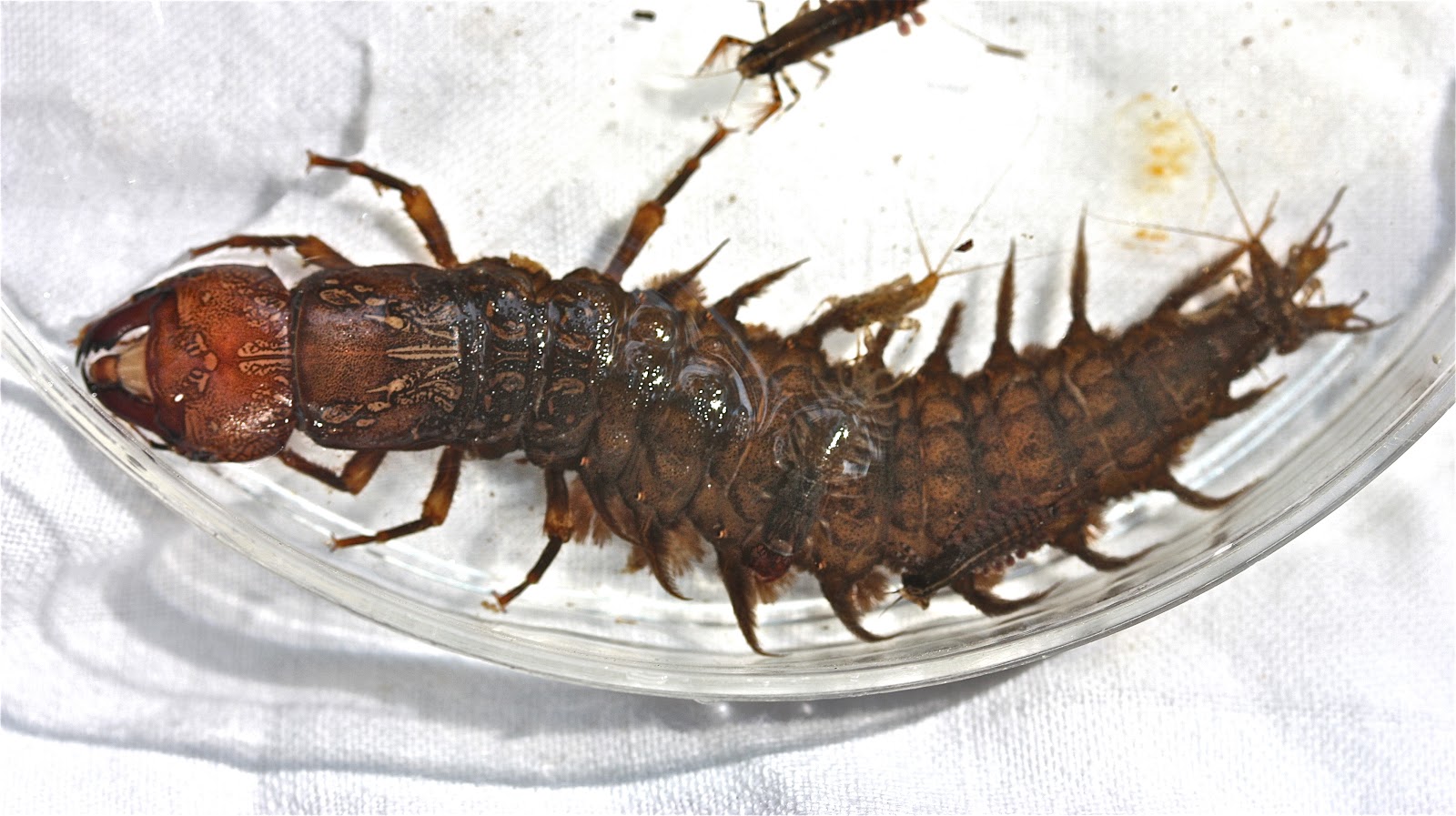
Of course I should be talking about small and large winter stoneflies and all those Perlodid stoneflies that are showing up now -- but we'll be seeing them in a regular way in the weeks ahead, and this is an insect that we see only rarely.  It's a hellgrammite -- a "fishfly" if you prefer -- family Corydalidae, species, Nigronia fasciatus.  This is not the hellgrammite that all of us are used to seeing on the rocks in the streams.  That would be this one...


This is genus Corydalus, and it's got some pretty mean jaws (some of us have found out the hard way!).  The genera are similar in a couple of ways: both have two pairs of hooks at the end of the anal prolegs, and both have "filaments" sticking out from the abdominal segments.  But Corydalus has something you don't see on Nigronia nymphs -- clustered gills between those filaments.


Nothing like that on our Nigronia nymph.


I've already posted an entry on this type of fishfly (5/17 of this year), so I'd refer you back to that entry for the details on how we arrive at the genus ID.  Essentially it has to do with finding a pair of "respiratory" tubes at the end of segment 8 (dorsal side).  These:


Or these:


And note the size: 1 1/2 times as long as wide.  Nigronia.  The species ID, fasciatus, is determined -- as I recall (I can't locate my source at the moment) -- by the amount of separation between those tubes.  And one more photo, since the two pairs of hooks at the end of the prolegs are not clear in my live photos, here's a closeup microscope view.


Nigronia fasciatus.  This one is from the Lynch River.  Size: 25 mm.  Tolerance value: 6.1.

_____________________

So much for the "beast," let's have a look at a "beauty."


The Perlodid stonefly, Clioperla clio.  The Lynch was loaded with them.   Note how the posterior edges of the wing pads are really starting to bow, and of course, the colors and patterns are starting to richen as we watch them start to mature.


In addition to the C. clios, I did find a number of small winter stoneflies today -- one was eaten by this big Clioperla! -- and I found a number of tiny Perlodid stones that I was anxious to photograph and ID.  Unfortunately, on my way back to the car I stumbled and fell, and there went most of my insects!  I did find one still swimming around in my bowl.


A very, very small (2.5 mm) Diploperla duplicata.  I found a fully mature D. duplicata in this very same stream on May 14th of last year (2011).  Quite a transformation.

_______________

Below: a Clioperla clio traffic jam in my petri dish when I was getting my photos.