Saturday, December 8, 2012

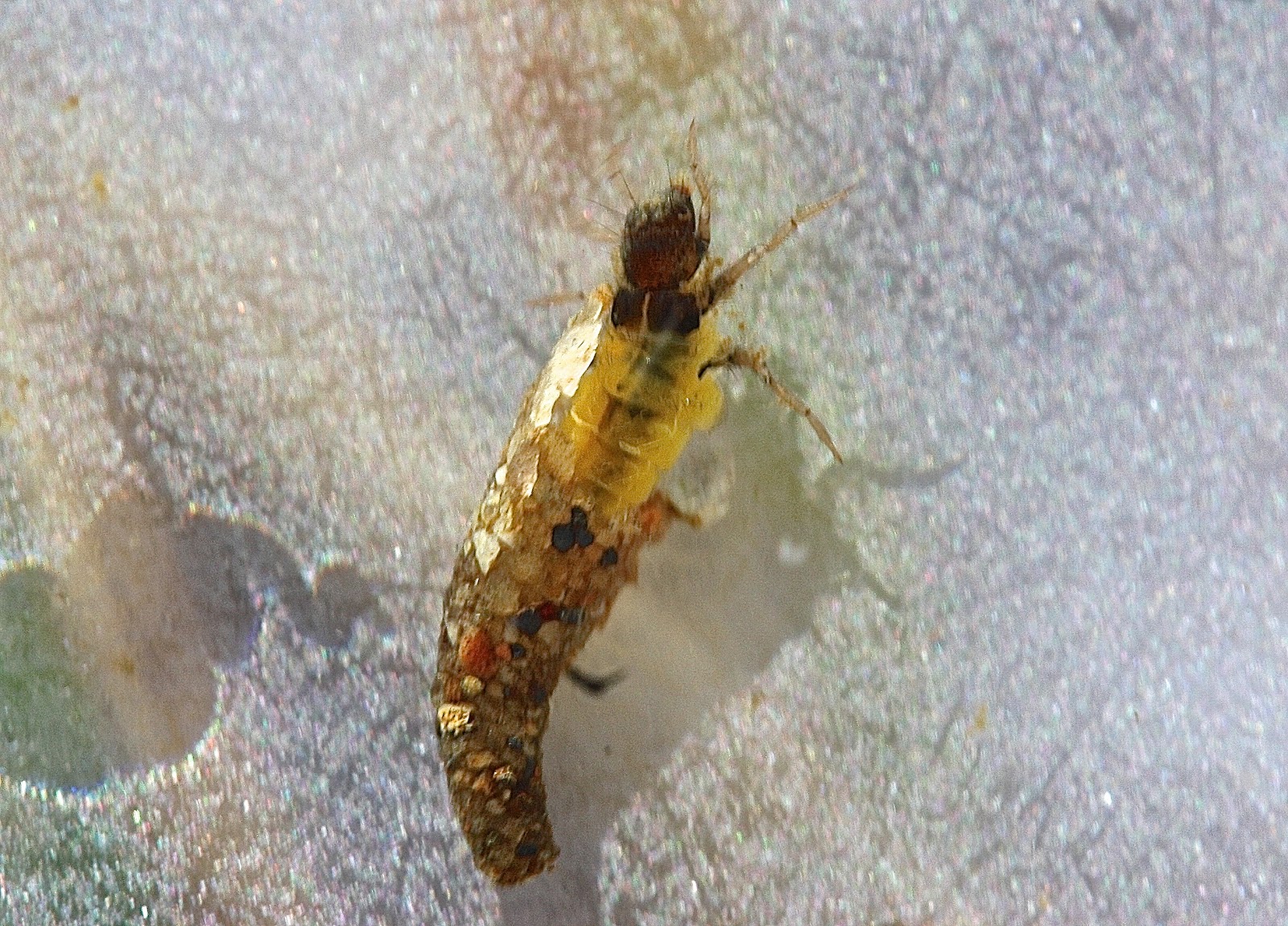
Misled by expectations -- and surprised by a Limnephilid at the Doyles River


I'm now on a quest to find some of the "other" large winter stonefly that populates a lot of our streams -- Strophopteryx fasciata -- and I thought I might find some at the Doyles River this morning.  I didn't .  Well, at least I don't think that I did -- but more on that later on.  What I found were the "usual suspects": large winter stoneflies, Taeniopteryx burksi/maura; small winter stoneflies, genus Allocapnia; common stoneflies, Acroneuria abnormis; Perlodid stoneflies, Clioperla clio; flatheaded mayflies, genus Maccaffertium; and, as I did last week at Lickinghole Creek, I found a lot of Uenoid caddisfly larvae and a lot of Glossosomatids (Saddle-case makers).

I took some photos of the Uenoids -- a lot of photos of the "Uenoid" in the picture at the top of the page: I really liked the case.  Also, I noticed its pale colored legs: the legs on every other Uenoid I've seen so far this year have been dark brown.   The pale colored legs ought to be useful in working out the species ID.

Then I noticed a problem.  Look closely at the leading edge of the mesonotum of that "Uenoid" at the top of the page:


It's straight: it lacks emargination (no medial dips or dents).  The Uenoid emargination is very clear on the Uneoid I featured last week (for a close-up see the entry from 11/27):


My pretty "Uenoid" was not a Uenoid at all: it was a Limnephilid, a "Northern case-maker" caddisfly. The shape of that leading edge of the mesonotum is one of the key things we use to tell the two apart.  Actually, I should have known this was not a Uenoid by the very thing that drew my attention to it: the case.  Most Uenoid cases are fairly rectangular in shape, with 3-4 larger stones attached to each side.  Like this:


The case of this caddis was shaped like a cone:


And the light colored top of the case (pointed down in this photo) was a "hood" under which the larva could hide.


So, lesson learned.  I have to look closely at those little stone cases clinging to rocks in the winter.  Most are surely Uenoids, but there may be a Limnephilid or two among them.  I "expect" to see Limnephilids in the spring -- not the winter -- and they're large: most are Pycnopsyche in terms of the genus.  This is a small one (this larva was only 3-4 mm in length), and the genus ID is something for me to explore -- maybe tomorrow.
______________

A few other photos.

1. A beautiful Perlodid stonefly, Clioperla clio.


2. One of the many large winter stoneflies I found in the leaves -- Taeniopteryx burksi/maura.


3. And then there was this --


When I took this photo, I thought it was just a tiny, small winter stonefly -- but clearly it's not, not with that short abdomen and rather broad head.  A small Perlodid stonefly?  Probably, but with this transparent body, it was impossible to pick out key anatomical features using my scope.

Was it a small Strophopteryx larve winter stonefly?  I don't think so, as much as I'm hoping to see one.  But, we ought to be seeing them soon.  I found this one last year on my birthday -- 12/15.

_______________

And another look at our Limnephilid with its head tucked into its case.


Thursday, December 6, 2012

Finally: Isogenoides hansoni at the Rapidan River


I've been looking for this one since September:  the Perlodid stonefly, Isogenoides hansoni.  The Rapidan River is the only stream in which I've seen this particular species.  I found two small ones last year -- in September and October -- and one mature one the previous year on 3/25 (on which see the entry posted on 5/14/12).  This is an insect that is "relatively rare" (Steven Beaty, "The Trichoptera of North Carolina," p. 22).

It's worth reviewing how we identify this beautiful stonefly -- both genus and species.  Let's follow Beaty's descriptions, but I'll interrupt with pictures to verify the points that he makes.

Genus Diagnosis: Lacinia triangular, bidentate with a distinct knob below the subapical tooth and with a row of marginal hairs approaching base.  Picture.


He continues: mesosternum with median longitudinal suture joining fork of mesosternal grooves to transverse anterior suture.  Picture (in which I've called the "median longitudinal suture" the "median ridge" and the "transverse anterior suture" the "transverse ridge."


prominent submental gills, projecting about three times their basal width.  Yes.


cerci with a dorsal setal fringe (I don't have a photo of that); body light brown with contrasting darker brown pattern, covered with clothing hairs.  The colors of the body are clear from the pictures, though I don't think the clothing hairs show up very well.


On to the species ID, again using Beaty.

I. hansoni -- nymphs 16-24 mm;  large denticles on the ventral mandibular tooth.  (No photo of those; size of this immature nymph was ~ 10 mm.)

conspicuous, sharply delineated M-shaped pale mark anterior to median ocellus; ocellar triangle bordered by dark but with pale central spot; dark transverse bands on anterior third to half of terga 1-9 and a dark, transverse band along each posterior margin.  Relatively rare.
All of those features are visible on this photo of the nymph from today.


Finding an I. hansoni nymph made the trip worthwhile on its own.  But, as always, there were lots of beautiful insects in the Rapidan River.
_______________

1. A brushlegged mayfly, genus Isonychia.  I think they're prettier now than they are when they're fully mature.   Great close-up of the head and front legs in the second photo.


2.  The spiny crawler mayfly, Ephemerella subvaria.  I saw a lot of them.


3. Large winter stoneflies, Taeniopteryx burksi/maura.  One of the most numerous insects I saw.


4. Glossosomatids -- Saddle-case maker caddisfly larvae.  Also quite common.


5. Pronggilled mayflies, genus Paraleptophlebia.  Very common.


6. A free-living caddisfly larva -- Rhyacophila fuscula.


7. A common netspinner -- Ceratopsyche alhedra.  ("Prefers clean streams and fast current.  Mountains.  Uncommon.  Very intolerant."  Beaty, "The Trichoptera of North Carolina," p. 72.)


8. And a Lepidostomatid case-maker.  Odd case.  Normally the building blocks are evenly clipped pieces of bark and/or leaves.

_______________

I'll stop there -- but there was more.  It's a very rich stream with really good insects.  Isogenoides hansoni.


Sunday, December 2, 2012

Caddis day at Lickinghole Creek: Uenoids and Glossosomatids (Saddle-case makers)


(Note: It's very unusual, in my experience, to see a "live" Uenoid" caddis larva crawl this far out of its case.)

I haven't been to Lickinghole Creek in Crozet for quite awhile.  But I know that it's a pretty good stream for Uenoids, so yesterday I paid it a visit.  I was right.  Every fairly large rock I picked up had 10-15 small cases clinging to it.  But I also found quite a few Glossosomatids (Saddle-case makers), so let's have a look.

I. Uenoids.


I thought this was an interesting case, so I took quite a few photos of this particular larva -- and I'm glad that I did.  It turned out to be a new species which I think is Neophylax consimilis.  On N. consimilis, we read in Beaty ("The Trichoptera of North Carolina," p. 86):

N. consimilis -- well developed clavate ventral gills on abdominal segment 1; head and legs dark brown or with stripe or pale area...underside of head usually dark; spines on anterior pronotum needlelike.  Mostly a Mountain taxon.  Common.

I can't say this is N. consimilis for sure --  I need to get a bigger specimen (this larva was 5 mm long) to check the anterior edge of the pronotum -- but everything else is there.  We can see the "dark brown legs and head" in the picture at the top of the page, while the dark underside of the head is clear from another live photo:


For the clavate gills, we need a microscope photo:


You can also see in this photo that there is a small, orange dot in the center of the head between the eyes.  That turned out to be a small "bump" or "tubercle."  I'll have to check with Beaty to see if that can be found on this species.  But, the only other species that seems to have this "semi-blunt" tubercle on its head is N. toshioi, and N. toshioi lacks the clavate gills.  Anyway, at the moment, at tentative ID of N. consimilis.

When I went home and did my microscope work, I discovered that one of the Uenoids I kept was quite different: clearly not N. consimilis.  (Note: Beaty says that "Often 2-3 species of Neophylax will co-occur." (p. 87)  Clearly true for my findings at Lickinghole Creek.)  Look at this strange one.


Very pale coloration, and muscle scars on the back of its head and the tibiae as well.  Note that it too has clavate gills.

This one puzzled me for awhile.  But have another look at the Neophylax oligius larva photo that I posted just a few days ago.


The contours of the pale "stripe" that runs the length of the head are much the same.  So, I think this odd colored larva is an N. oligius larva that has just moved to a new instar, a larva on which the full colors have not yet developed.  (I'm checking on that with Beaty as well.)
_______________

II. Glossosomatids.


Most of the Glossos I saw had fairly large cases: this case was 12 mm long and 6 mm wide; the larva inside was about 10 mm.  And this larva is doing what Saddle-case makers commonly do when you put them into a bowl, it's climbing out of its case, something other case-makers never seem to do.    We should not be surprised.  The Glossosomatid is the only "case-maker" that abandons its case when it outgrows it and builds a new from from scratch (well, from pebbles and sand!).  But then remember -- the Glossosomatid is not a "true" case-maker: it's a "Spicipalpia" caddis, not an "Integripalpia" caddis.

Here's a dorsal view of the case of the larva in the picture above -- a real beauty -- though Glossosomatids don't seem to be meticulous builders.


I got some goods photos of a second Glosso, though in the dorsal view of the case, we see two other critters: a small Clioperla Perlodid stonefly sitting atop the case with a common netspinner larva (Ceratopsyche bronta) right in front.


And then there was this one, with a Cheumatopsyche netspinner crawling into the top of the case while the Glossosomatid exits the back!


Remember that all of our Glossosomatids are Glossosoma nigrior in terms of the species.
_______________

To close out -- a couple more photos of the C. bronta common netspinner, one that's easy to recognize because of the pattern on the head and the nota.