Wednesday, December 12, 2012

Here in force: the large winter stonefly Strophopteryx fasciata


I said it wouldn't be long -- and I was right.  I saw 10-12 tiny, S. fasciata large winter stoneflies in the very first leaf pack I picked out of the stream this morning at Buck Mt. Creek.  They did not look like the nymph in this photo -- this  photo was taken on February 6!  This is what I was finding today: toddlers.


I found them in the decomposing leaves, but I also found them crawling on the bottoms of rocks.  Size: 3-5 mm.   That's very small for a nymph that will reach up to 10 mm before it hatches later on in the winter.


Strophopteryx large winters, unlike Taeniopteryx large winters, do not have coxal gills.  But they do have a distinctive morphological feature: a triangular ventro-apical plate (i.e. a projection at the tip of the underside of the body) -- this.


And even though the nymphs I was finding today were small, the ventro-apical plate was still easy to see in a microscope view.


Another S. fasciata anatomical feature that is easy to see even on very small nymphs is the mottled appearance of the head and the nota (the pronotum and the wing pads).


There is also very clear banding on the abdominal terga.  But this is much more pronounced on nymphs that are more mature.


How do we get to the species ID, Strophopteryx fasciata?  Actually the distinctive features can only be seen on nymphs that are close to being fully mature.  Let's look at Seven Beaty's description ("The Plecoptera of North Carolina," p.7):

S. fasciata -- nymphs 9.5-10 mm; abdominal terga yellow with uneven, dark brown transverse bands on anterior half of each tergite; median row of transverse dark dots on each tergite.

The banding and dots are visible on the nymph in the picture above, but I'll point them out.  (I've also noted the dots on the first photo of the ventro-apical plate.)


So, two of our large winter stoneflies are already here -- Taeniopteryx burksi/maura and Strophopteryx fasciata.  I suspect that the third species is already present as well.  But we only find that one -- Taenionema atlanticum -- in small, very clean, mountain streams.  I won't be surprised to see some tomorrow at South River up in Greene county.
_____________________

I didn't do a lot of exploring this morning since I immediately found what I was after.  But I did find a fair number of T. burksi/maura large winters, along with quite a few Uenoids and Glossosomatids.  There was no need for microscope photos to see that the Uenoid I photographed was Neophylax oligius.  Very distinctive of N. oligius is the yellow stripe on its head.

ventral views:


dorsal views:
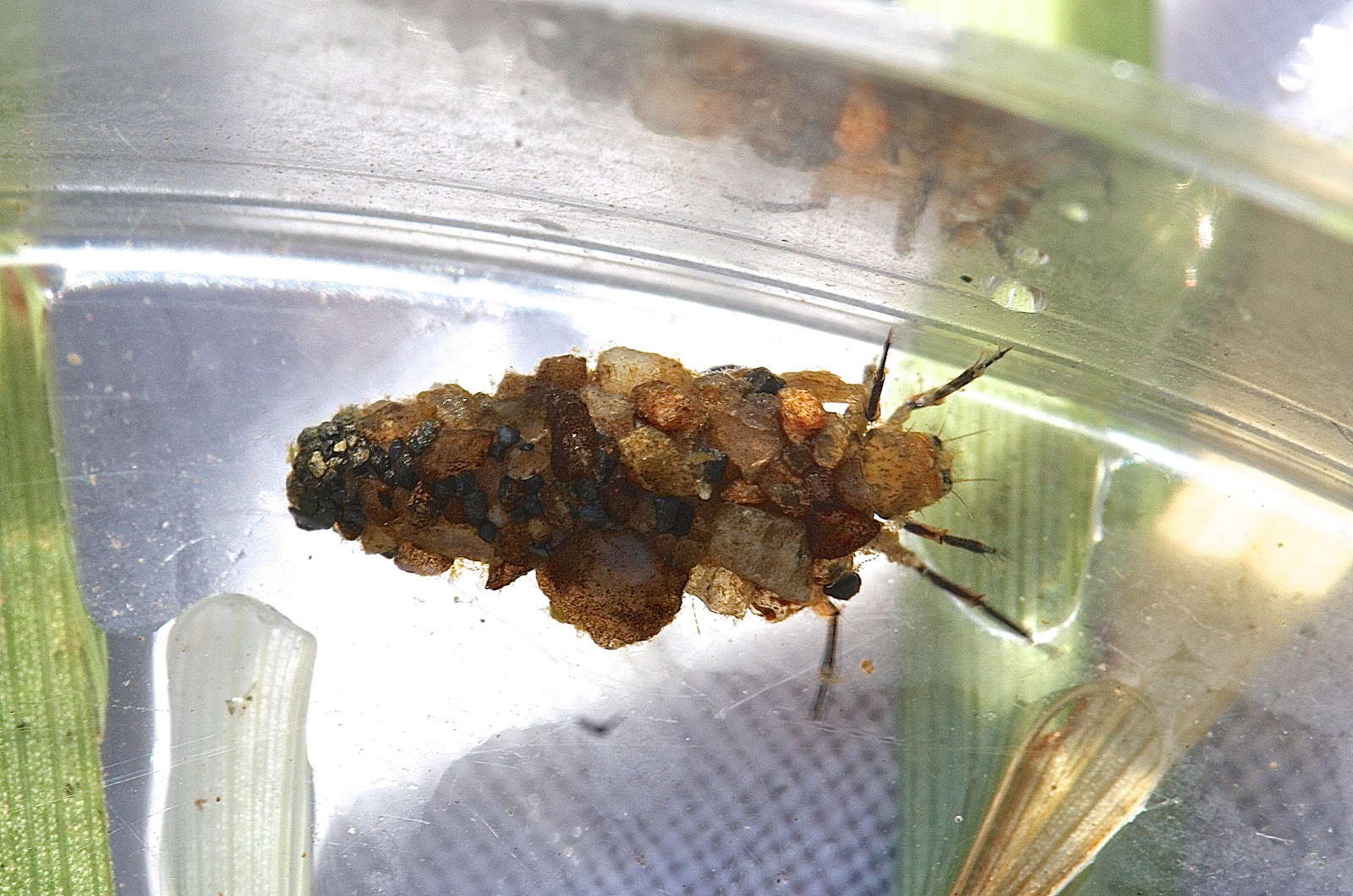


And the T. burksi/maura nymphs continue to grow and spread out those wing pads.


But the find of the day was the large winter stonefly, Strophopteryx fasciata.  I easily saw 50-60 nymphs, so they are coming on strong.


Sunday, December 9, 2012

Almost had it: the Doyles River caddis was Apatania incerta -- family, Apataniidae


On that cased caddis I found yesterday -- Dave Ruiter pointed out that the case just didn't seem right for Limnephilid.  I had to agree.  So, I've continued to work on this one, and I finally figured it out.
This is a new species of caddis for me: family, Apataniidae; genus, Apatania; species, incerta.  In Wiggins' first edition of Larvae of the North American Caddisfly Genera (Trichoptera), (Toronto: University of Toronto Press), published in 1977, Apatania was considered a Limnephilid genus: it was changed to a family (Apataniidae) in his 2nd edition, published in 1996 (see pp. 190-191), in which Apatania is one of five genera, all formerly Limnephilid genera.

Like all members of the Limnephilid (Northern case-maker) family, Apataniid caddisfly larvae have: 1) a pair of mesonotal plates while the metanotum is fleshy; 2) a dorsal hump and lateral humps; and 3) a prosternal "horn," a sharp projection at the base of the head (ventral).  We can see those features in the following photos:


However, Apatania is distinct in lacking sa1 sclerites (dark anteromedial spots on the metanotum): rather, it has a transverse row of setae.


Wiggins had pointed this out in 1977 when Apatania was still considered a Limnephilid genus: "Larvae can be distinguished from those of any other limnephilid in North America by absence of the metanotal sa1 sclerites and arrangement of those setae in a continuous transverse band." (Wiggins, p. 198)  Also relevant to this discussion -- in the Apatania illustrations that Wiggins provides (p. 199), we can clearly see that the rear corners of the mesonotal plates are black, as in the photo above, and the ventral apotome is an exact match to that of the larva found yesterday.  It looks like this:


Now let's see what Beaty says about Apatania (genus) incerta (species) in his discussion of Apataniidae ("The Trichoptera of North Carolina," p. 85).

Genus Diagnosis: Mesonotum with two plates; metanotal sa1 sclerites absent; arrangement of sa1 associated setae in a linear transverse row; head oval and with many secondary setae; mandibles usually with uniform scraper blades (not toothed). Larvae collected fall through winter.  Mountains only.

Case: composed of mineral particles and strongly curved, cornucopia-shaped; larger mineral particles laterally.

The genus description is right on -- though I did not try to photograph the mandibles.  And the case description is exact.


I called it "cone-shaped".


(By the way, you can see the "hood" on the case in Wiggins' illustrations.)  Now let's look at Beaty on A. incerta.

A.  incerta -- larvae 6-9 mm; head dark brown to black; nota brownish-black; anterior metanotal plates replaced by row of about 20 setae; legs yellow brown; anal claw lacking well defined accessory teeth.

The colors of the head, nota, and legs are all clear in the live photos that I've provided.  I can count 20-21 setae in the transverse row on the metanotum.  As for the anal claw: it's tiny, and I can not see any accessory teeth.

_______________

Exciting!  A new one.  I will add this to the EPT lists provided in earlier entries (9/8 and 10/8).  Apataniidae, Apatania incerta.  Common name: Early Smoky Wing Sedge.  Tolerance value: 0.6.


Saturday, December 8, 2012

Misled by expectations -- and surprised by a Limnephilid at the Doyles River


I'm now on a quest to find some of the "other" large winter stonefly that populates a lot of our streams -- Strophopteryx fasciata -- and I thought I might find some at the Doyles River this morning.  I didn't .  Well, at least I don't think that I did -- but more on that later on.  What I found were the "usual suspects": large winter stoneflies, Taeniopteryx burksi/maura; small winter stoneflies, genus Allocapnia; common stoneflies, Acroneuria abnormis; Perlodid stoneflies, Clioperla clio; flatheaded mayflies, genus Maccaffertium; and, as I did last week at Lickinghole Creek, I found a lot of Uenoid caddisfly larvae and a lot of Glossosomatids (Saddle-case makers).

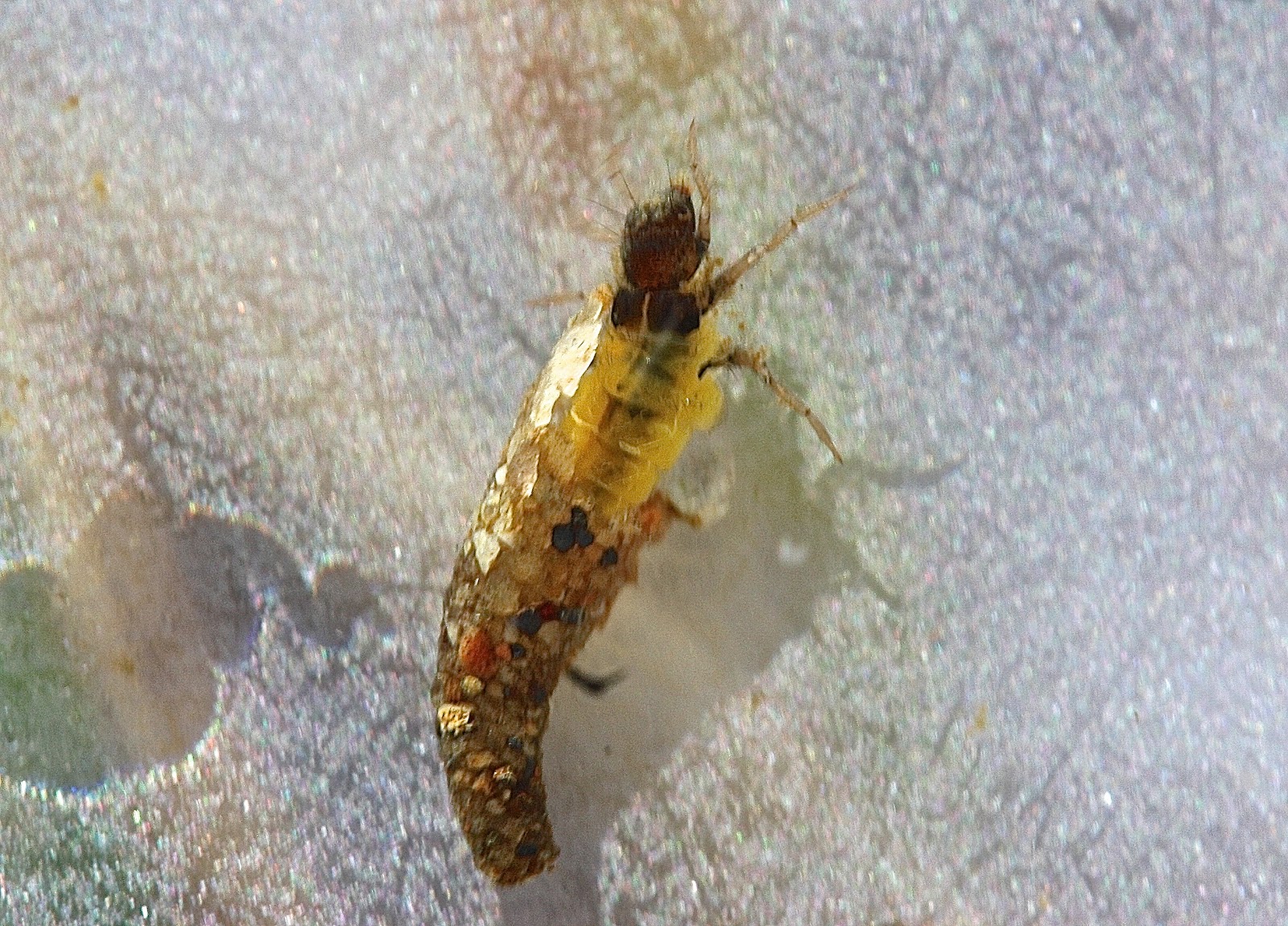
I took some photos of the Uenoids -- a lot of photos of the "Uenoid" in the picture at the top of the page: I really liked the case.  Also, I noticed its pale colored legs: the legs on every other Uenoid I've seen so far this year have been dark brown.   The pale colored legs ought to be useful in working out the species ID.

Then I noticed a problem.  Look closely at the leading edge of the mesonotum of that "Uenoid" at the top of the page:


It's straight: it lacks emargination (no medial dips or dents).  The Uenoid emargination is very clear on the Uneoid I featured last week (for a close-up see the entry from 11/27):


My pretty "Uenoid" was not a Uenoid at all: it was a Limnephilid, a "Northern case-maker" caddisfly. The shape of that leading edge of the mesonotum is one of the key things we use to tell the two apart.  Actually, I should have known this was not a Uenoid by the very thing that drew my attention to it: the case.  Most Uenoid cases are fairly rectangular in shape, with 3-4 larger stones attached to each side.  Like this:


The case of this caddis was shaped like a cone:


And the light colored top of the case (pointed down in this photo) was a "hood" under which the larva could hide.


So, lesson learned.  I have to look closely at those little stone cases clinging to rocks in the winter.  Most are surely Uenoids, but there may be a Limnephilid or two among them.  I "expect" to see Limnephilids in the spring -- not the winter -- and they're large: most are Pycnopsyche in terms of the genus.  This is a small one (this larva was only 3-4 mm in length), and the genus ID is something for me to explore -- maybe tomorrow.
______________

A few other photos.

1. A beautiful Perlodid stonefly, Clioperla clio.


2. One of the many large winter stoneflies I found in the leaves -- Taeniopteryx burksi/maura.


3. And then there was this --


When I took this photo, I thought it was just a tiny, small winter stonefly -- but clearly it's not, not with that short abdomen and rather broad head.  A small Perlodid stonefly?  Probably, but with this transparent body, it was impossible to pick out key anatomical features using my scope.

Was it a small Strophopteryx larve winter stonefly?  I don't think so, as much as I'm hoping to see one.  But, we ought to be seeing them soon.  I found this one last year on my birthday -- 12/15.

_______________

And another look at our Limnephilid with its head tucked into its case.


Thursday, December 6, 2012

Finally: Isogenoides hansoni at the Rapidan River


I've been looking for this one since September:  the Perlodid stonefly, Isogenoides hansoni.  The Rapidan River is the only stream in which I've seen this particular species.  I found two small ones last year -- in September and October -- and one mature one the previous year on 3/25 (on which see the entry posted on 5/14/12).  This is an insect that is "relatively rare" (Steven Beaty, "The Trichoptera of North Carolina," p. 22).

It's worth reviewing how we identify this beautiful stonefly -- both genus and species.  Let's follow Beaty's descriptions, but I'll interrupt with pictures to verify the points that he makes.

Genus Diagnosis: Lacinia triangular, bidentate with a distinct knob below the subapical tooth and with a row of marginal hairs approaching base.  Picture.


He continues: mesosternum with median longitudinal suture joining fork of mesosternal grooves to transverse anterior suture.  Picture (in which I've called the "median longitudinal suture" the "median ridge" and the "transverse anterior suture" the "transverse ridge."


prominent submental gills, projecting about three times their basal width.  Yes.


cerci with a dorsal setal fringe (I don't have a photo of that); body light brown with contrasting darker brown pattern, covered with clothing hairs.  The colors of the body are clear from the pictures, though I don't think the clothing hairs show up very well.


On to the species ID, again using Beaty.

I. hansoni -- nymphs 16-24 mm;  large denticles on the ventral mandibular tooth.  (No photo of those; size of this immature nymph was ~ 10 mm.)

conspicuous, sharply delineated M-shaped pale mark anterior to median ocellus; ocellar triangle bordered by dark but with pale central spot; dark transverse bands on anterior third to half of terga 1-9 and a dark, transverse band along each posterior margin.  Relatively rare.
All of those features are visible on this photo of the nymph from today.


Finding an I. hansoni nymph made the trip worthwhile on its own.  But, as always, there were lots of beautiful insects in the Rapidan River.
_______________

1. A brushlegged mayfly, genus Isonychia.  I think they're prettier now than they are when they're fully mature.   Great close-up of the head and front legs in the second photo.


2.  The spiny crawler mayfly, Ephemerella subvaria.  I saw a lot of them.


3. Large winter stoneflies, Taeniopteryx burksi/maura.  One of the most numerous insects I saw.


4. Glossosomatids -- Saddle-case maker caddisfly larvae.  Also quite common.


5. Pronggilled mayflies, genus Paraleptophlebia.  Very common.


6. A free-living caddisfly larva -- Rhyacophila fuscula.


7. A common netspinner -- Ceratopsyche alhedra.  ("Prefers clean streams and fast current.  Mountains.  Uncommon.  Very intolerant."  Beaty, "The Trichoptera of North Carolina," p. 72.)


8. And a Lepidostomatid case-maker.  Odd case.  Normally the building blocks are evenly clipped pieces of bark and/or leaves.

_______________

I'll stop there -- but there was more.  It's a very rich stream with really good insects.  Isogenoides hansoni.