Saturday, December 15, 2012

Fly Fishermen: Get Out Those Midge Imitations!


Christmas is coming -- the midges are already fat!  Yes, it's that happy season that fly fishermen either love or dread, when we turn to those fly boxes with the size 18-22 hooks -- the midge imitations, larvae and adults.  But as we get older -- I speak from experience -- it's not very easy to thread tippet through the eye of those tiny hooks!

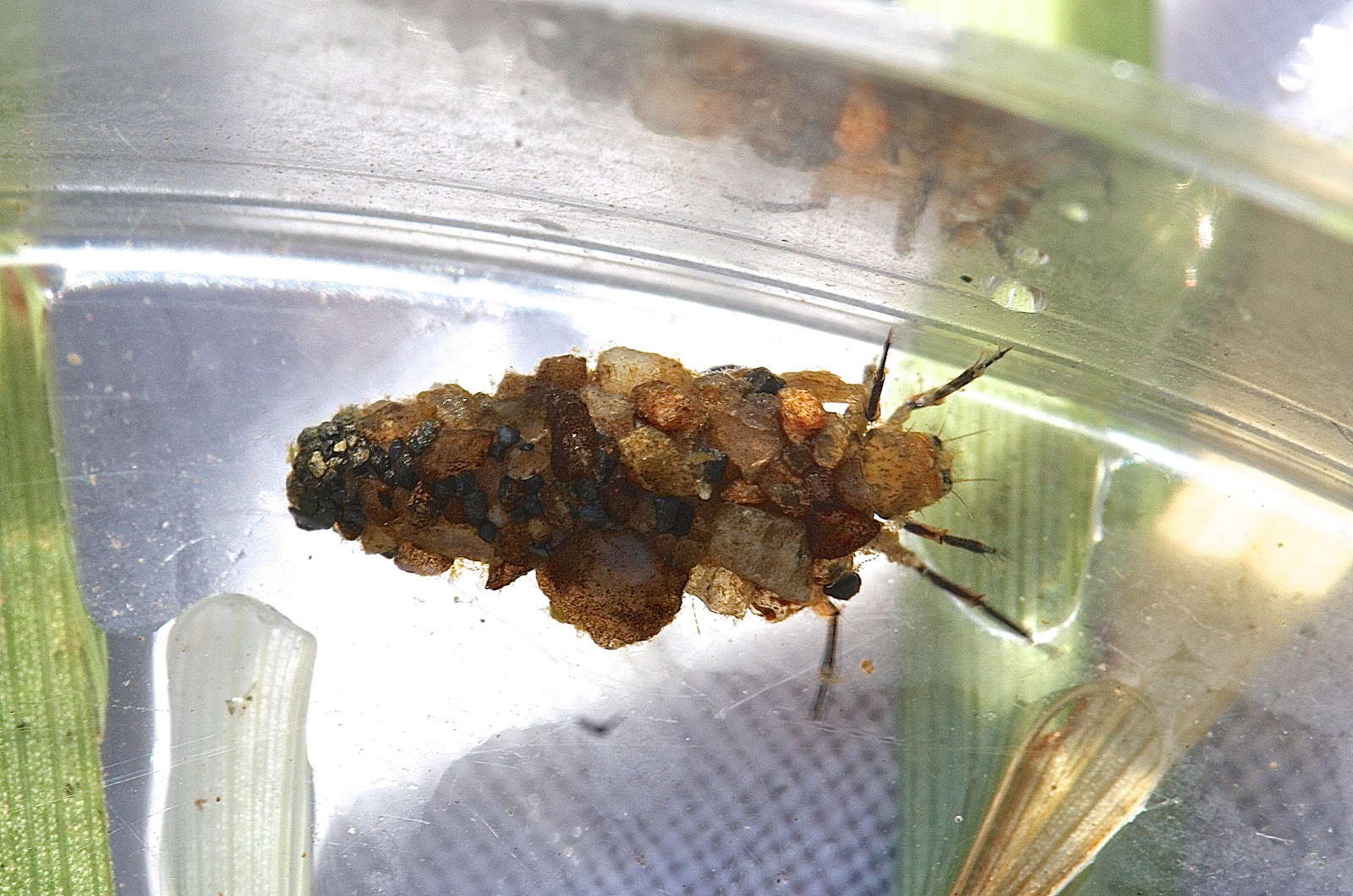
While I'm finding a lot of stonefly nymphs in those leaf packs and on the bottoms of rocks, I'm also starting to see a fair number of midges -- they're getting big now.   This is one that I photographed on Thursday up at South River, but I've been seeing them in just about all of the streams I've explored in the last couple of weeks.   While I didn't measure this larva, I'd guess that it was close to 10 mm.


While there are several families of midges, the midges that we commonly see are "Chironomids," and anyone who monitors streams knows that "The midges (order Diptera, family Chironomidae...) account for most of the macroinvertebrates in freshwater environments." (Robert W. Bode, p. 225 in Barbara Peckarsky, et.al.,  Freshwater Macroinvertebrates of Northeastern North America.)  And we also know, as Bode goes on to say, that "in many aquatic habitats this group constitutes more than half of the total number of macroinvertebrates species present."  Stream samples in spring, summer, and fall, are often dominated by midges, especially samples taken in marginal water.

Can amateurs identify midges to the level of genus or species?  No.  Forget it.  The Peckarsky key lists a total of 151 genera in six subfamilies, and Merritt, Cummins and Berg (p. 847) say that in North America alone there are at least 1200 species -- there may be as many as 2000.  And Bode points out that "Almost all identifications of chironomid larvae require that the specimens be slide-mounted and examined through a compound microscope." (Freshwater Macroinvertebrates, p. 227)  So, they will be "midges" or "Chironomids" in the entries I write.

Stream monitors rarely see what they actually look like.  On a sample net, all they see is a tiny,  clear to yellow filament that wiggles around like a snake when you squirt it with water.  But with a microscope -- or a good macro lens -- we can easily see the head and the eyes and the little "prolegs" (unjointed), one pair in front and one pair in the rear.  We can make them out in this photo taken on Thursday,


but they show up even better in this photo I took in March of last year.


One more thing in what will surely be the only entry I'll be writing this season with a focus on midges --  a lot of fly fishermen use red thread to tie their larval imitations.   There are red midges -- but I've seen very few.  Ninety-nine percent of the midges you're going to see are -- like those in the photos above -- clear to yellow: I also see green ones fairly often.  Red midges are "red" from the hemoglobin in their bodies.  That means they need less dissolved oxygen from the water to live, so you're likely to see them only in water that's severely degraded.  That's not where you'll be finding the trout!
_______________

Another member of the order Diptera (True Flies) that I commonly see at this time of year in the leaf packs is the Crane Fly -- family Tipulidae.  And on rare occasions I find the genus I found in the South River on Thursday.


The genus is Hexatoma, one that is "found in sand or gravel near margins of clear, cool brooks and streams." (Peckarsky, Freshwater Macroinvertebrates, p. 201)  This is a genus I've only seen at the South River, the Rapidan River, and in some small streams in Sugar Hollow.  Most stream monitors never see this one.   The genus we commonly see -- and I see a lot of them at this time of year -- is Tipula, and it's a larva that monitors can spot right away.


Most are grayer than this one, and when the body's constricted (this larva's stretched out) they look pretty chubby.   Actually, they're sort of gross, but the adults can be beautiful things.  Two features stand out on Tipula larvae -- the "welts" that form between the abdominal segments, and the "spiracular plate" at the rear end.  Now look at our Hexatoma.


No welts; no spiracular plate.  At the posterior end of Hexatoma larvae we find four lobes with setae at their tips.  We can see some of those lobes on this larva I found in November, 2011.


But what's really distinctive on the larvae of Hexatoma is the seventh abdominal segment.  It often forms into a bulb: I've never seen this on a live larva, but it's easy to see on a larva that's been preserved.


Very odd.
______________

Next week -- back to stoneflies and mayflies and caddis, I hope.  But, we're being hampered by low water conditions.  A drought watch has been issued for our part of Virginia.  We need rain, but there's nothing in sight.

Thursday, December 13, 2012

Isoperla namata (Perlodid stonefly) and Taenionema atlanticum (Large winter stonefly): both at South River


I was hoping -- and expecting -- to see two new insects (new for the season) at the South River this morning, and see them I did: the Perlodid stonefly, Isoperla namata, and the Large winter stonefly, Taenionema atlanticum. 

I.  I. namata

When the I. namatas mature, they look like the nymph in the photo at the top of the page, a photo taken this spring on 3/26.  Size: ~11 mm.  Those I was finding today, of course, were much smaller (5-7 mm) and much less colorful.  Here are a few of the many I found in the leaf packs.


The nymphs today were at various stages of maturation, which we can see in the development of the distinctive pattern we see on the head of I. namata.  First, have another look at nymph that is fairly mature.  This one was found on 4/11.


Like all Isoperlas, I. namata has three stripes that run the length of the abdomen, and if you look closely you can see those stripes on the nymphs I was finding today.  But, look at the pattern we find on the head.  I. namata nymphs commonly have, as we see here, dark bands that extend from the transverse band on the head back to the rear ocelli, and sometimes, as we also see here, beyond, to the back edge of the head.  Between those bands or bars, the head is yellow.  In the nymphs from today, we can see three stages in the development of that pattern.

1. The backward extension of the dark transverse band has not yet separated into two bars, and the yellow space in between has not yet appeared.


2. The bars extending back from the band have started to divide and some yellow is showing.


3. And in the most mature nymph that I found, the head pattern is fully developed.


Pretty neat!  I. namata, you may recall, is the most common Isoperla Perlodid stonefly we find in our streams, also the most prolific.   It's somewhat tolerant for a stonefly -- 2.5 -- which may explain why we see them in almost all of our streams in the winter and spring.
_______________
II.  And then there were three: the large winter stonefly, Taenionema atlanticum.


These too, are very small at this point, around 5 mm.  T. atlanticum nymphs can also be 11 mm by the time they're mature -- when they look something like this (photo from 2/2).


And this one I found in South River on 1/11 this year.


T. atlanticum is clearly less colorful than T. burks/maura and S. fasciata, the other large winters we commonly see, but it's also the least tolerant of stream impairment, and it prefers small mountain streams.  To date, I've only seen this large winter species in the Rapidan, South River, the upper Doyles River, and in the small streams I explore in Sugar Hollow.

Like all winter stoneflies, T. atlanticum nymphs like to curl up when you put them into a tray --


But if you look closely at the tip of the abdomen in this photo, you'll notice that T. atlanticum nymphs, just like the S. fasciata nymphs that I found yesterday, have a "ventro-apical plate."


Now, there is a Strophopteryx species -- S. limata -- that is uniformly brown, just like T. atlanticum (see Beaty, "The Trichoptera of North Carolina," p. 7).  But you can tell Strophopteryx and Taenionema nymphs apart by the shape of that ventro-apical plate.  The Strophopteryx plate is concave laterally, it curves in:


the Taenionema plate does not.  Plate is broad; sides parallel.

_______________

I got some great pix today of some prong-gilled mayflies, and I'll show them here at the end.  These are genus Paraleptophlebia, and I preserved one, hoping that I can work out the species ID.


These are great because these nymphs still had all of their gills and all of their legs!

Wednesday, December 12, 2012

Here in force: the large winter stonefly Strophopteryx fasciata


I said it wouldn't be long -- and I was right.  I saw 10-12 tiny, S. fasciata large winter stoneflies in the very first leaf pack I picked out of the stream this morning at Buck Mt. Creek.  They did not look like the nymph in this photo -- this  photo was taken on February 6!  This is what I was finding today: toddlers.


I found them in the decomposing leaves, but I also found them crawling on the bottoms of rocks.  Size: 3-5 mm.   That's very small for a nymph that will reach up to 10 mm before it hatches later on in the winter.


Strophopteryx large winters, unlike Taeniopteryx large winters, do not have coxal gills.  But they do have a distinctive morphological feature: a triangular ventro-apical plate (i.e. a projection at the tip of the underside of the body) -- this.


And even though the nymphs I was finding today were small, the ventro-apical plate was still easy to see in a microscope view.


Another S. fasciata anatomical feature that is easy to see even on very small nymphs is the mottled appearance of the head and the nota (the pronotum and the wing pads).


There is also very clear banding on the abdominal terga.  But this is much more pronounced on nymphs that are more mature.


How do we get to the species ID, Strophopteryx fasciata?  Actually the distinctive features can only be seen on nymphs that are close to being fully mature.  Let's look at Seven Beaty's description ("The Plecoptera of North Carolina," p.7):

S. fasciata -- nymphs 9.5-10 mm; abdominal terga yellow with uneven, dark brown transverse bands on anterior half of each tergite; median row of transverse dark dots on each tergite.

The banding and dots are visible on the nymph in the picture above, but I'll point them out.  (I've also noted the dots on the first photo of the ventro-apical plate.)


So, two of our large winter stoneflies are already here -- Taeniopteryx burksi/maura and Strophopteryx fasciata.  I suspect that the third species is already present as well.  But we only find that one -- Taenionema atlanticum -- in small, very clean, mountain streams.  I won't be surprised to see some tomorrow at South River up in Greene county.
_____________________

I didn't do a lot of exploring this morning since I immediately found what I was after.  But I did find a fair number of T. burksi/maura large winters, along with quite a few Uenoids and Glossosomatids.  There was no need for microscope photos to see that the Uenoid I photographed was Neophylax oligius.  Very distinctive of N. oligius is the yellow stripe on its head.

ventral views:


dorsal views:


And the T. burksi/maura nymphs continue to grow and spread out those wing pads.


But the find of the day was the large winter stonefly, Strophopteryx fasciata.  I easily saw 50-60 nymphs, so they are coming on strong.


Sunday, December 9, 2012

Almost had it: the Doyles River caddis was Apatania incerta -- family, Apataniidae


On that cased caddis I found yesterday -- Dave Ruiter pointed out that the case just didn't seem right for Limnephilid.  I had to agree.  So, I've continued to work on this one, and I finally figured it out.
This is a new species of caddis for me: family, Apataniidae; genus, Apatania; species, incerta.  In Wiggins' first edition of Larvae of the North American Caddisfly Genera (Trichoptera), (Toronto: University of Toronto Press), published in 1977, Apatania was considered a Limnephilid genus: it was changed to a family (Apataniidae) in his 2nd edition, published in 1996 (see pp. 190-191), in which Apatania is one of five genera, all formerly Limnephilid genera.

Like all members of the Limnephilid (Northern case-maker) family, Apataniid caddisfly larvae have: 1) a pair of mesonotal plates while the metanotum is fleshy; 2) a dorsal hump and lateral humps; and 3) a prosternal "horn," a sharp projection at the base of the head (ventral).  We can see those features in the following photos:


However, Apatania is distinct in lacking sa1 sclerites (dark anteromedial spots on the metanotum): rather, it has a transverse row of setae.


Wiggins had pointed this out in 1977 when Apatania was still considered a Limnephilid genus: "Larvae can be distinguished from those of any other limnephilid in North America by absence of the metanotal sa1 sclerites and arrangement of those setae in a continuous transverse band." (Wiggins, p. 198)  Also relevant to this discussion -- in the Apatania illustrations that Wiggins provides (p. 199), we can clearly see that the rear corners of the mesonotal plates are black, as in the photo above, and the ventral apotome is an exact match to that of the larva found yesterday.  It looks like this:


Now let's see what Beaty says about Apatania (genus) incerta (species) in his discussion of Apataniidae ("The Trichoptera of North Carolina," p. 85).

Genus Diagnosis: Mesonotum with two plates; metanotal sa1 sclerites absent; arrangement of sa1 associated setae in a linear transverse row; head oval and with many secondary setae; mandibles usually with uniform scraper blades (not toothed). Larvae collected fall through winter.  Mountains only.

Case: composed of mineral particles and strongly curved, cornucopia-shaped; larger mineral particles laterally.

The genus description is right on -- though I did not try to photograph the mandibles.  And the case description is exact.


I called it "cone-shaped".


(By the way, you can see the "hood" on the case in Wiggins' illustrations.)  Now let's look at Beaty on A. incerta.

A.  incerta -- larvae 6-9 mm; head dark brown to black; nota brownish-black; anterior metanotal plates replaced by row of about 20 setae; legs yellow brown; anal claw lacking well defined accessory teeth.

The colors of the head, nota, and legs are all clear in the live photos that I've provided.  I can count 20-21 setae in the transverse row on the metanotum.  As for the anal claw: it's tiny, and I can not see any accessory teeth.

_______________

Exciting!  A new one.  I will add this to the EPT lists provided in earlier entries (9/8 and 10/8).  Apataniidae, Apatania incerta.  Common name: Early Smoky Wing Sedge.  Tolerance value: 0.6.