Thursday, April 10, 2014

It's a show-stopper: the "common burrower" Ephemera guttulata


What else can you say?  This is a mayfly we don't see very often -- and it's really unique.  Ephemera guttalata, which will hatch as the "Eastern Green Drake."  But forget it fly fishermen -- this small stream in Sugar Hollow doesn't hold any trout.  It's a "common burrower" (Ephemeridae), and the only way to find them is to "burrow" in the substrate -- which is what my friend was doing while I sorted through leaf packs.  We were in the same stream where she found this E. guttalata -- much more mature (much darker with much longer wing pads) -- on May 1, 2012.


Beaty's description reads as follows:

guttalata -- nymphs up to 20 mm; frontal process long, notch deep, approximately half the length of the entire process; body brownish overall; both fore- and hind wing pads heavily blotched with irregular dark spots; abdomen broad, generally lacking any distinct color pattern, both dorsally and ventrally.  Collected mostly during spring and summer.  Mountains only.  Uncommon.  Recorded from GSMNP [Great Smoky Mountains National Park].  ("The Ephemeroptera of North Carolina," revised, October, 2013, p. 84)

Here is a look at the frontal process and the wing pads on the nymph that we found today.


But they show up much better on the nymph from 2012.


Abdomen without a distinct color pattern?  Absolutely.


Ephemera guttalata.  Tolerance value: 0.0.

_______________

But this little stream held some other treasures as well.  Like this caddis case-maker Pycnopsyche gentilis.


Take a close look at that case.  This is the species that often initially makes a three-sided case out of leaves...


But then changes to one that's made out of pebbles.


The one I found today was in the process of making the change.  The rear of the case is still made out of leaves; the front is now converted to pebbles.


Very cool!
________________

One more treat.  a fully mature Perlodid stonefly, Malirekus hastatus.  We've found some lately that have been very close -- but here we have the black wing pads.


Gorgeous!
_______________

One other insect of interest.  We saw hundreds of Roach-like stoneflies, as we commonly do in these streams at this type of year.  But today, we may have had more than one species.

This one is genus Peltoperla for sure.  Note the three dark spots on the meso and metanotum.


And as you can see, there are "double" gills at the rear of the nota.

 This nymph is not Peltoperla: it may be Viehoperla ada.   Viehoperla nymphs have single gills on the thorax, and I could only see one on this nymph.


But to be certain of the ID, I should have preserved it.  Instead I dropped it into the leaves!
________________

Lots of other insects around: pronggilled mayflies, Isoperla similis stoneflies;


 Ameletid mayflies as well (Ameletus cryptostimulus);


And it was a nice, sunny day.

______________________

Oh.  There are still a lot of Uenoids in this little stream: N. aniqua and N. mitchelli.  Caught this mitchelli crawling up over the Pycnopsyche case.


Monday, April 7, 2014

Isoperlas: We may soon have names for our three unidentified species


We've now found three Isoperlas that, to date, remain undescribed and unnamed in the keys we use for Perlodid identification.  One is the nymph in the photo at the top of the page, found last spring in Buck Mt. Creek (also in the Upper Doyles and Rapidan rivers): the other two, pictured below, were found in the headwater streams in Sugar Hollow.

1.


2.


Over the weekend I asked Steven Beaty if there have been any changes in the identification of Isoperla nr. holochlora and in the issue of Isoperla montana/n.sp.  He has relayed some fantastic news (well, for those of us who study these things!).   Boris Kondratieff and Stanley Szcytko have completed work on a revision of the Eastern Nearctic Isoperla and their manuscript is under review.  Beaty notes, "This monograph-like paper (it is over 200 pages with hundreds of illustrations and electron micrographs) describes 20 new species of which about 16 occur in NC and many in VA (including a few that are currently known only from VA)."   Can't wait to get my hands on this one, and I'll post information as soon as I hear that it's published.  Oh.  On the Isoperla montana/n.sp. question, the "n.sp." has been named: Isoperla kirchneri.  For the distinction, we'll have to wait to see this new study.
________________

On the nymph at the top of the page -- I actually found a small one (4 mm) on Saturday at the Rapidan River but didn't know it until I got a microscope view.


In this live view, I thought it was just Isoperla montana/Isoperla kirchneri -- but no.  The abdominal stripes and the lacinia shape match those of the nymph at the top of the page, which, for the moment, I refer to as Isoperla nr. orata.  (For more on this name, see the postings of 5/8/13 and 6/2/13.)

Saturday, April 5, 2014

Looking for Isoperlas at the Rapidan River


Almost all of the Perlodid stoneflies we see in the spring are genus Isoperla, and the Rapidan River is one of the places I go to see multiple species.  To date, I've found -- in the Rapidan -- Isoperla dicala, Isoperla holochlora, Isoperla nr. holochlora, Isoperla montana/n.sp., Isoperla similis, Isoperla orata, and one I call Isoperla nr. orata.  The Perlodid stone at the top of the page is Isoperla nr. holochlora, and it's one that I see only rarely: I see it each year at the Rapidan, and last year I found one in Entry Run in Greene County.  It has a Tolerance Value of 0.0, so you'll only find it in very clean mountain streams.

The "nr." in Isoperla nr. holochlora stands for "nearly":  it's "nearly" the same as Isoperla holochlora, a species that looks like this.


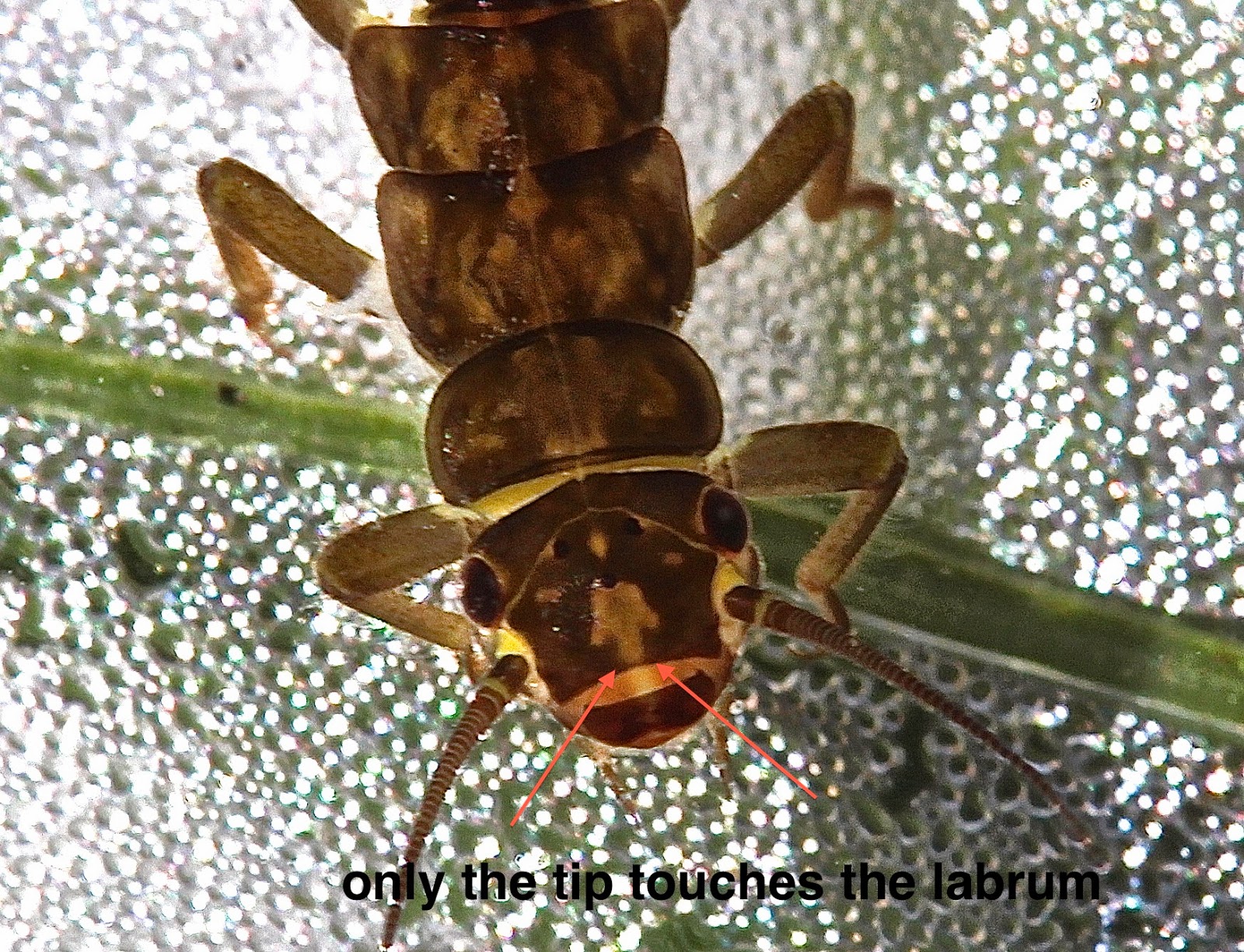
But they differ in two different ways.  Note that on I. holochlora, the large pale spot anterior to the median ocellus is -- in Beaty's words -- "open to the labrum" ("The Plecoptera of North Carolina," p. 23).


Also notice the three dark longitudinal stripes on the abdominal terga.  Now look again at the nymph we found this morning.


The abdominal stripes on this small nymph cannot be detected, and only the tip of the anterior pale spot touches the labrum.


On April 11, 2012, I found this I. nr. holochlora at the Rapidan, one that was much more mature.  A beautiful insect.


The cold temps and high water this winter and spring have really slowed everything down.
_________________

But I did find insects that are getting mature.  The flatheaded mayfly Epeorus pleuralis -- I'd expect that at this time of the year.


And one that surprised me, the pronggilled mayfly, genus Paraleptophlebia.  I saw quite a few nymphs with the tell-tale black wing pads.  They're ready to hatch.


_______________

Other photos:

1. I found just a couple of small minnow mayflies: Baetis tricaudatus.  One was a male...


the other a female.


As with other small minnow mayflies, the males are more colorful, but the females are bigger.

2. Free-living caddisfly larva, Rhyacophila fuscula.  This was a big one, long and fat.


3. Of course I couldn't resist a couple of photos of the Giant stonefly we see in this river -- Pteronarcys biloba.


4. A colorful Chloroperlid (Green stonefly), genus Sweltsa.


5. But the dominant taxon remains the Perlodid stonefly, Isoperla montana/n.sp., and again I saw hundreds of nymphs in the leaf packs.  I only photographed this one: it was darker than most.

________________

The spring Isoperlas are finally starting to show.  It's one of my favorite times of the year.


Thursday, April 3, 2014

Experimenting with lights: taking pictures on cloudy days


I've made an investment -- a new piece of photo equipment --  and today was the first time I used it.   I try very hard to use only natural light in taking my photos.  But since we're averaging 1-2 days of sunlight a week at the moment (!) I've purchased a "ring light" for cloudy days.   Actually ring lights are recommended for use with most macro lenses, and they're almost a must with the powerful 65 mm.  They range in price from $25.00 to $500.00: mine was slightly over $100.00.  And I was pleased with the results.  I stayed with a film speed of ISO 100, trying out a number of shutter speeds (from 1/40 sec. to 1/100 sec.).   Next time I'll try ISO 200 and probably shoot at 1/50 - 1/60 sec.  Have to experiment with the technique, but it sure beats sitting around doing nothing.

And now to that little Perlodid stonefly in the photo at the top of the page.  The find of the day.  We were in Sugar Hollow at a little stream where I've seen this one before.  In May it will look something like this.

5/18/11


5/2/12


This is one of three Isoperlas (genus) that we've found in our streams that remains unidentified at the level of species -- it can't be keyed out.  In the EPT lists that I've compiled, it's called Isoperla sp.1. (See, for example, the entry posted on 10/3/12.)  The head pattern is very distinctive with a large pale area in the ocellar triangle and pale slashes at the rear of the head behind the ecdysial suture.


Maybe this year is the year -- with help from Steve Beaty -- that we'll discover the name of this species.  But it was great to see it again in our streams.

_________________

Common findings today: lots of Peltoperlids (roach-like stoneflies); flatheaded mayflies Epeorus pleuralis, Chloroperlids (Green stoneflies),  the common netspinner Diplectrona modesta, and the BIG Perlodid stonefly Malirekus hastatus.

1. Malirekus hastatus


2. A Green stonefly, genus Sweltsa


3. One of many flatheaded mayflies, Epeorus pleuralis


4. And the netspinner Diplectrona modesta.  Not the best photo, but the "dark U-shaped pattern" on the frontoclypeus (Beaty, "The Trichoptera of North Carolina" p. 74) sure shows up very well.