Sunday, April 5, 2015

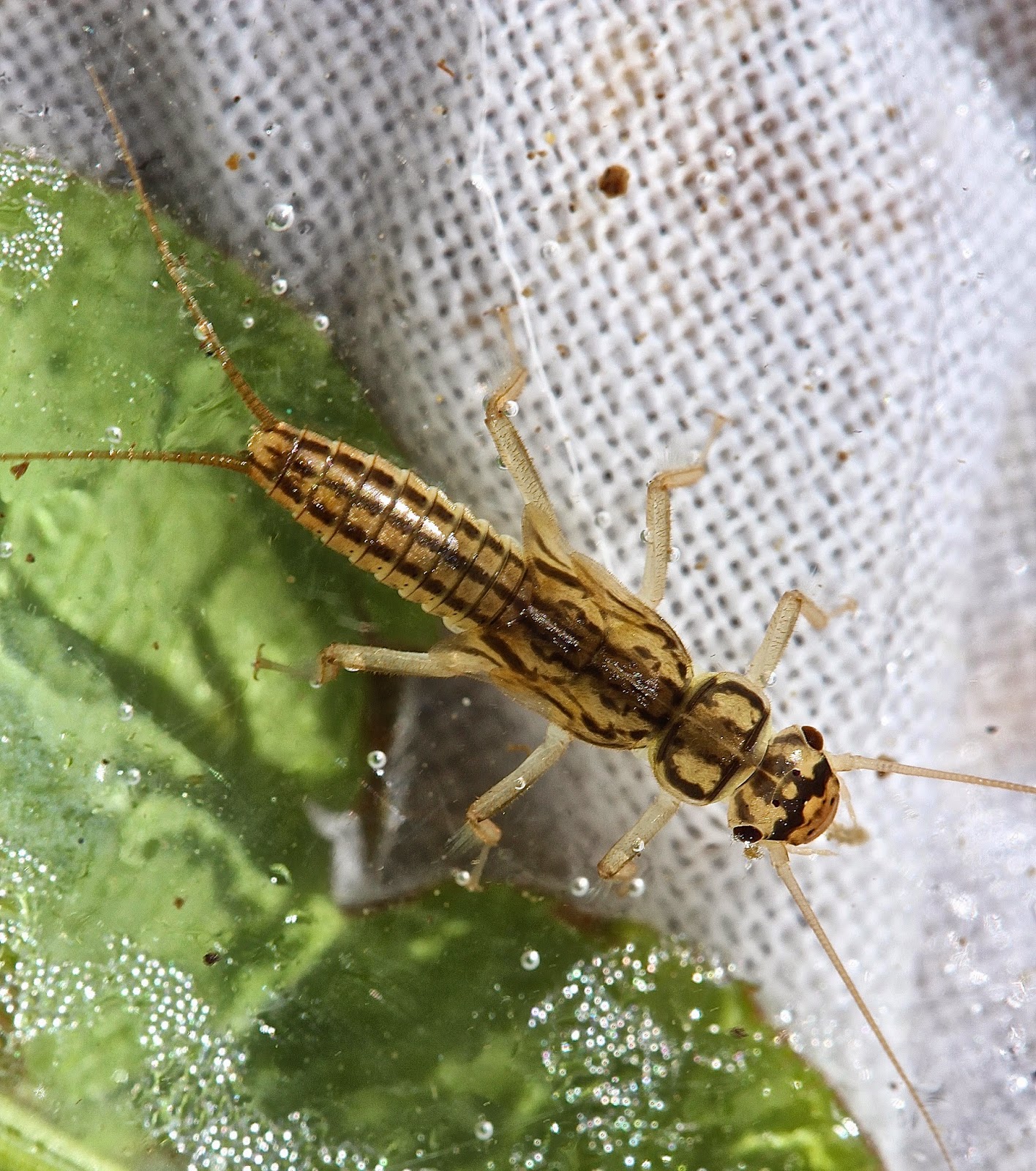
Simply magnificent! A Clioperla clio from Entry Run


Pretty spectacular: the Perlodid stonefly, Clioperla clio, one that's almost fully mature.  One of the signs -- the large pale area at the front of the head is darkening and showing a pattern.

C. clio is an "early" Perlodid that we start to see in October, but it's in April that they get ready to hatch.   This one was from November, 2012.  Look at the difference in color in the central part of the head/face.


I have seen one with fully black wing pads that was clearly ready to go: that was in April, 2012.


But that was a beauty today.

_________________

And there was another Perlodid that was almost fully mature: an Isoperla similis with wing pads that are starting to darken.


The abdominal markings on I. similis and C. clio -- two dots on the left, two dots on the right, and a medial stripe with dots on each side -- are remarkably similar, and I posted an entry one time, wondering why C. clio isn't called I. clio.  As it turns out, it was once called Isoperla clio, but then the name was changed.  As I recall it has something to do with anatomical differences in the adults.
__________________

Entry Run and South River, like just about all of our streams at the moment, is loaded with insects.  Lots and lots of Isoperla montanas, but that's just the beginning.  Today I was finding the flatheaded nymphs Epeorus pleuralis all over the rocks -- lots of them are maturing as well.   There were also mature pronggilled mayflies like I saw at the Doyles, and lots of spiny crawlers -- both E. invaria and E. dorothea.  And there are still some "winter" small minnow mayflies around -- Baetis tricaudatus.


This is also a stream where I see quite a few free-living caddisfly larvae at this time of year, commonly Rhyacophila fuscula.    This one.


I  found one today that had recently molted: the head is lime green, not yet yellow.


One surprise.  I found two Rhyacophila carolina larvae.  This is the first time I've found that species in this particular stream.


The head is golden brown, lacks markings, and is rounded at the rear.
_________________

Good fun.  And it's so nice to see wildflowers filling the woods once again.  One of the first that we see in this part of the state is Bloodroot.


Thursday, April 2, 2015

Some photos from the Upper Doyles River


They do indeed mature, and this nymph will soon spread its wings and fly off of the stream.  The pronggilled mayfly, Paraleptophlebia mollis.   The Upper Doyles River is a good place to go if you want to see the "Blue Quills."


Also "almost" mature, this Chloroperlid (green stonefly) nymph.  The wingpads looked a lot darker when I was taking this picture.

__________________

I was anxious to get home today, thinking I had found a new species of Isoperla (Perlodid stonefly).  Alas, I was wrong.  The nymph in question?


While I was expecting to see -- and did see -- lots of Isoperla montanas (quite soon they'll be flying as "yellow sallies"), this nymph seemed much too light in color to be that species.  But Isoperla montana it was.  Key features: the dark bars in front of and behind the ecdysial suture on the head; the three dark stripes on the abdominal terga; and the three pairs of dots on each abdominal tergite (lateral to each of the lateral stripes and on either side of the medial stripe).


Still, this nymph was somewhat unique in having very thin bars on either side of the pale spot in the ocellar triangle.

The other I. montana nymphs that I saw were the more common yellow.


I'm increasingly convinced -- and Beaty suggested this to me -- that Isoperla montana is really a "complex" which includes a number of species or sub-species.  The variations are simply too many.  (Look again at the posting of 1/25 of this year.)  Are there dark bars on both sides on the ecdysial suture, or only one side?  How thick are those lines?  Are they straight or at an angle?  DNA analysis will probably solve this one for us.  Let's hope someone's working on that.


Thursday, March 26, 2015

Buck Mt. Creek yields the Nemourid stonefly, Prostoia completa (Central Forestfly)


This morning it was not in my plans to go to a stream.  But about 10:00 am the sun popped out, so I was off to Buck Mt. Creek.  And I was rewarded.

This is a small stonefly that I've only seen a few times -- once before at Buck Mt. Creek (3/1/11) and a few years ago at the Rapidan River (downstream from the section I normally visit).  Nemourid stonefly (Forestfly), Prostoia completa, for which the common name is "Central Forestfly."


The Prostoia nymphs are very small -- 5-6 mm when they're mature -- and I had one that was 5 and one that was 6.  The pronotum provides one of the keys to genus ID: "rounded pronotum with no marginal fringe (or of very small spines)."  (Beaty, "The Plecoptera of North Carolina," p. 4)  We can see the those small spines in this picture,


and we can also see a key feature in the species ID: "white spots on head covering both sides of Y-shaped ecdysial line."  (Brigham, Brigham, and Gnilka, Aquatic Insects of Oligochaetes of North and South Carolina," p. 5.20)  No question about it.  Actually that feature shows up quite well in the live shots.


Nice find, and I'm pleased that my photos turned out.  But, I have to admit that the photos I took of this nymph on 3/1/11 were actually better!


Alas!
______________________

The water was high, and as you can probably tell, the leave packs were quite silted up (= dirty nymphs), so I didn't search for a lot having found three P. completas without looking real hard.  But I did find a gorgeous, fully mature Helopicus subvarians Perlodid.


18 mm -- that's a pretty big stonefly!


________________

Sunshine coming for Sunday.  I'll be spending the day in Sugar Hollow.

Saturday, March 21, 2015

Just more beautiful stoneflies from the Rapidan River


The Rapidan River is chock-a-block full of nymphs at the moment, as it always is in the spring.  And this is one of the stoneflies I was hoping to find: Perlodidae, Isogenoides hansoni.  This is still the only place that I've found these beautiful nymphs, and as I suspected, they're pretty close to being mature.  Still,  not yet quite as mature as the nymph that I found on 3/24/11.


I think I'll just focus on photos today, with minimal comments on features we use for ID.   For I. hansoni, the banding on the abdominal terga is clearly distinct, but I always look at the head: "ocellar triangle bordered by dark but with pale central spot."  (Beaty, "The Plecoptera of North Carolina," p. 22)


There you go.


________________

Another treasure today -- an Agnetina capitata (Perlidae) that still has a ways to go before it's mature.


Another species that, to date, I've only found in this river.  Agnetina common stones have a setal row on the occiput and very clear anal gills.  A. capitata has a light area between the lateral ocelli that leads towards the median ocellus and an "apparent"  mid-dorsal longitudinal stripe on the terga.  (Beaty, "The Plecoptera of North Carolina," p. 15)


These nymphs will mature in late May and June.  Found this one last year on 5/24.


But today, those wing pads were just starting to curve.


_________________

And then there was this HUGE Giant stonefly, Pteronarcys biloba.


That big boy would make a real meal for the native Brookies that live in this stream.  It ran about 2 inches.  But it was so active, and so big, that it kept crawling out of my petri dish.  I had to retrieve it a number of times.

________________

Mayflies?  Of course.  I only photographed two, two that were very mature.  The spiny crawler, Ephemerella subvaria,


and the small minnow mayfly that we find only in clean mountain streams, Baetis tricaudatus.


The short middle tail (caudal filament) is very clear in both of those photos.
________________

It's a special river, and these are all special insects.

1. Isogenoides hansoni: "Relatively rare" according to Beaty (p. 22).
2. Agnetina capitata: "Listed by NC Natural Heritage Program as Significantly Rare (2010)." (Beaty, p. 15)
3. Pteronarcys biloba: tolerance value of 0.0.
4. Ephemerella subvaria: "Rare," according to Beaty. ("The Ephemeroptera of North Carolina," p. 28)
5. and Baetis tricaudatus: tolerance value of 1.5.
________________

Off to Buck Mt. Creek on Tuesday where we should find a fair number of Isoperlas (Perlodid stoneflies), and then to the small mountain streams in Sugar Hollow next weekend.

Most common insect today: Perlodid stonefly, Isoperla montana/kirchneri.  The leaf packs are crawling with them at the moment.  I'd look for the "Yellow Sallies" to hatch sometime in late April.


Thursday, March 12, 2015

Still waiting to hear: is it Isoperla kirchneri?


Finally.  The snow has melted and the temps have warmed up.  The bad news?  Most of our streams are too high to wade.  But not so the small streams in Sugar Hollow.

And I found one of the insects I was hoping to see: Perlodid stonefly, Isoperla kirchneri or Isoperla montana -- still no word on Kondatrieff's monograph that, we hope, will settle the matter.   But this is the only "type" of I. montana/kirchneri that I find in these little streams.  Note: no "bars" at the back of the head; wide pale area in the pronotum; and the pale spot in the ocellar triangle is almost completely enclosed.


But I still need to find a nymph that's fully mature to see if these distinctive traits are there right to the end.  For more on this issue, see the entry posted on 1/25 of this year.


_______________

The most common insect I found today was the pronggilled mayfly, Paraleptophlebia mollis.


There were lots and lots of them in the leafpacks.  Ought to be hatching in April or May.  We've talked about the species ID earlier this winter (1/18, 1/21).  To be sure of the ID, we have to look at the mandibles -- microscope work.  "Nymph uniformly brown in color; incisors of mandible strongly directed inward....Paraleptophlebia mollis."  (See p. 3.60 in Brigham, Brigham, and Gnilka, ed., Aquatic Insects and Oligochaetes of North and South Carolina.)  No question about it.

________________

Not much else to get excited about -- but it sure was good to get back to a stream.

Other photos.

1. Leuctridae, genus Leuctra.  Common name, "Appalachian Needlefly"


2. Flatheaded mayfly, Maccaffertium pudicum.  (Commonly found with M. meririvulanum in these small, headwater streams.)