Friday, April 17, 2015

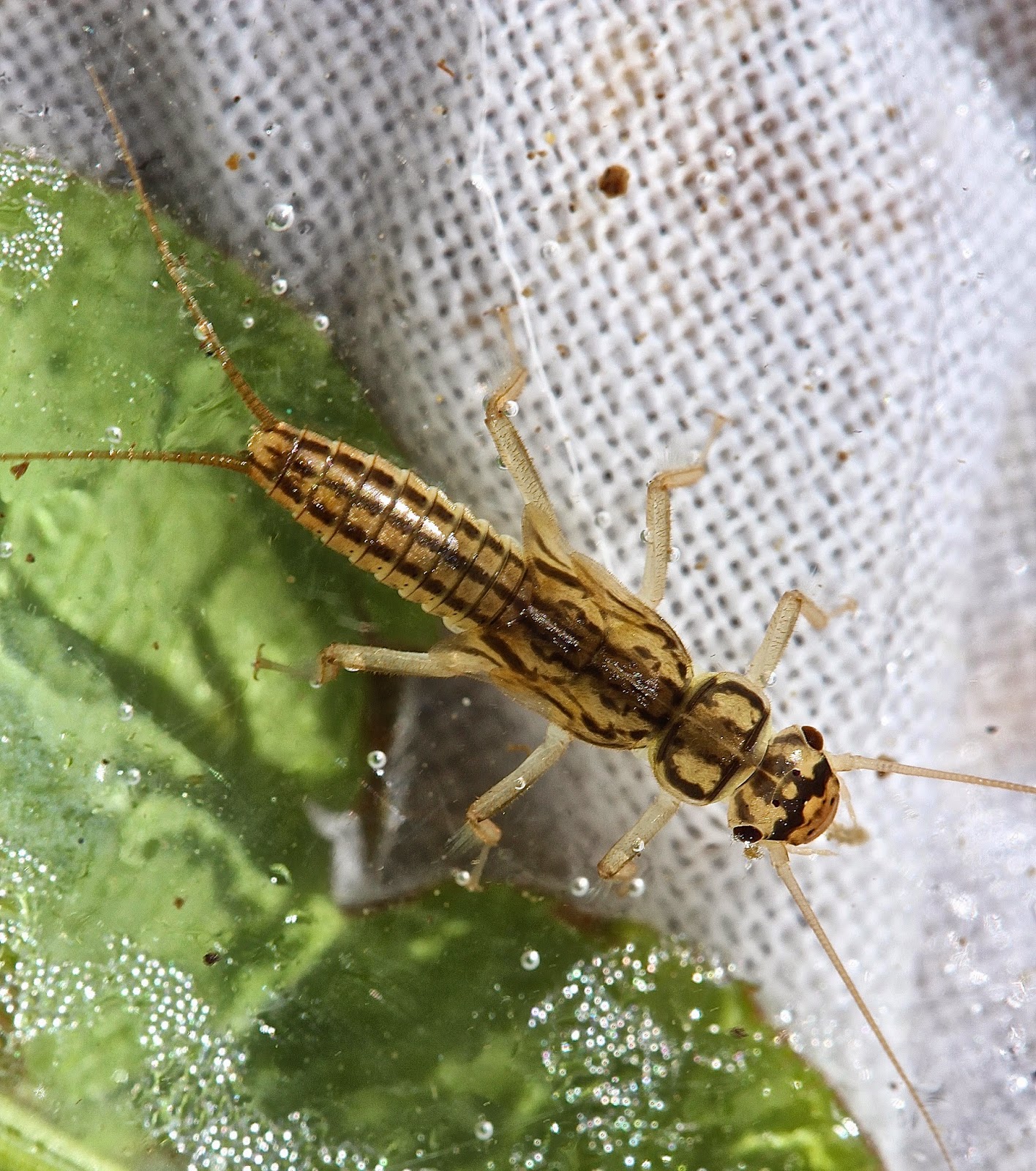
Still a long way to go to sort out the various species collectively known as Isoperla montana


As you know, at the moment a lot of our streams are crammed with these nymphs commonly known as Isoperla montana, nymphs that will be hatching anytime now as "Yellow Sallies."  And if you're a regular reader, you know that for the last year or so, I've been calling these critters I. montana/kirchneri, since I. kirchneri has been distinguished from I. montana, at least as an adult.

I've just contacted Steve Beaty in North Carolina to see if anyone has been able to describe the I. kirchneri nymph: the answer is "yes" and "no"!  Some features have been distinguished in a tentative way, but more testing needs to be done.  Not only that, he mentioned in passing that at least two other species of Isoperla share features in common with Isoperla montana and Isoperla kirchneri.  (He mentioned two species I've never heard of before: I. tutelo and I. siouan.)

Uncle!  As an amateur I can't do much with this: the pros will have to figure it out.  That requires rearing of nymphs, and -- I should think -- DNA testing.  Until then, I intend to use "I. montana group" to cover the various types of nymphs that look so much alike.  It could very well be, that the various types of I. montana that make up this group are actually different species.  Here are the differences that I have been noting.

1. The "paradigm," for me.


This is the nymph that I see most often, and I see it in a great many streams.  Key features: 1) the dark transverse line on the head extends down to the ocelli, creating "bars," and 2) there are also dark bars behind the ocelli, i.e. beyond the ecdysial suture.


2. Type 2.  The dark transverse line does not extend to the ocelli, i.e. there are no bars in front of the ecdysial suture.


3. Type 3.  There are no bars behind the ecdysial suture -- but there may be small "spots."


4. Type 4.  This one also lacks bars behind the ecdysial suture, but, look at the abdominal pattern.  The light spots on the terga are almost completely enclosed creating "cells" that are reminiscent of Isoperla orata.


This is Isoperla orata.


5. And then we have, a) one with very thin bars in front, a nymph that is very light in color,


b) and one with very thick bars at the back of the head,


c) even one where there are no bars at the back of the head but sizeable spots.

_________________

In the end, species distinctions depend on anatomical differences, not differences in the features we see on the head or on the abdominal terga.  So, the features herein distinguished may or may not be important.  In any event, from now on, all of these nymphs, for me, will be part of the "Isoperla montana group."

Off to Sugar Hollow tomorrow.

Sunday, April 12, 2015

It appears to be, for us, another Nemourid -- Ostrocerca truncata....and some other great photos today


So many insects, so little time.  That's what it felt like today in one of our small streams in Sugar Hollow.   And I found a real mix of things.  But the big news -- what appears to be a new, for us, species of Nemourid (Forest Fly), Ostrocerca truncata.


Let's see if I can convince you of the ID.  First on the genus.  From Steven Beaty: "Nymphs 5-7 mm; pronotum with an irregular lateral fringe of moderate spines; anterior thoracic gills absent; fore tibia with two rows of large, heavy bristles along outer margins and a sparse fringe of silky hairs; .... tenth tergite of male extended and apically cleft. " (The Plecoptera of North Carolina," p. 3)

1. This nymph was exactly 6 mm in length.

2. My photos of the "irregular lateral fringe of spines" on the pronotum aren't great.  Still they prove the point.


3.  The "anterior thoracic gills" that are absent are those that we see on genus Amphinemura Nemourids.  These.


4. Spines on the fore tibia.  Definitely two rows on the outer margin.


5. Apical cleft in the 10th tergite.   Yes.


_________________

To identify this to the level of species I have to use data from the following article on Nemourids:  P.P. Harper and H.B.N. Hynes, "The nymphs of the Nemouridae of Eastern Canada (Insecta: Plecoptera)," Canadian Journal of Zoology, Vol. 49 (1971), pp. 1129-1142.  The relevant page for us is 1136 on which they describe the nymphs Ostrocerca albidipennis and Ostrocerca truncata.  Also relevant, figures 26 (on 1136) and 38 (on 1138).

Let me highlight some of the features of O. albidipennis, since the authors note, on O. truncata, "the morphology is almost identical with that of the previous species" -- which was O. albidipennis.

1. "Pronotum nearly quadrate, narrower than head."  Yes.


2. "legs covered with scattered bristles, the longest bristles on the femur about one-third as long as the greatest width of the femur."  I'd agree.


3. "whorls of cercal bristles regular at the base of the cercus, the longest bristles about one-third the length of the segment, but becoming irregular towards the tip of the cercus."  Verified in the following photos.


4.  "ocelli marked as purplish dots in riper nymphs."  Yes.


5. "developing genital organs in the last instar male nymph forming an apical protuberance about as long as broad, as seen in top view (Fig. 39)."    NOT TRUE


Rather, this protuberance is that of Ostrocerca truncata.   "developing genital organs in the last instar male nymph form an apical protuberance which is much longer than wide in top view (Fig. 38). "  Bingo!  The photo of the protuberance on the 10th tergite of our nymph is a perfect match for Fig. 38 in Harper and Hynes (Ostrocerca truncata)

I have to leave this ID as a "tentative" one --  Beaty says we should shy away from working on Ostrocerca species ID.  Still, I think we can make a pretty good case.  (Oh.  Beaty notes -- on Ostrocerca -- "A spring emergent taxon.  Mountains only.  Nymphs are rarely collected."  Guess I got lucky.

________________

Other photos today.  Got some beauties.

1. Mature Malirekus hastatus Perlodid.  19 mm.


2. A fairly mature Chloroperlid (green stonefly), genus Sweltsa.  Note how it has flattened its back legs over the abdomen.


3. Two Pycnopsyche gentilis larvae (Northern case-makers) in various stages of converting their 3-sided cases of leaves into cases of pebbles.


(Note the Isoperla similis nymph in this photo.  I found 8-10 of them today.)

4. A beautiful photo of a Leuctrid (needlefly) nymph.


5. The common stonefly, Eccoptura xanthenses eating a freshly molted Epeorus pleuralis flatheaded mayfly.


6. And a critter I found by scooping up sand from the bottom -- the Spiketail dragonfly (Cordulegastridae) genus Cordulegaster.

_________________

I had expert advice today -- and supervision -- as I was doing my microscope work!


Sunday, April 5, 2015

Simply magnificent! A Clioperla clio from Entry Run


Pretty spectacular: the Perlodid stonefly, Clioperla clio, one that's almost fully mature.  One of the signs -- the large pale area at the front of the head is darkening and showing a pattern.

C. clio is an "early" Perlodid that we start to see in October, but it's in April that they get ready to hatch.   This one was from November, 2012.  Look at the difference in color in the central part of the head/face.


I have seen one with fully black wing pads that was clearly ready to go: that was in April, 2012.


But that was a beauty today.

_________________

And there was another Perlodid that was almost fully mature: an Isoperla similis with wing pads that are starting to darken.


The abdominal markings on I. similis and C. clio -- two dots on the left, two dots on the right, and a medial stripe with dots on each side -- are remarkably similar, and I posted an entry one time, wondering why C. clio isn't called I. clio.  As it turns out, it was once called Isoperla clio, but then the name was changed.  As I recall it has something to do with anatomical differences in the adults.
__________________

Entry Run and South River, like just about all of our streams at the moment, is loaded with insects.  Lots and lots of Isoperla montanas, but that's just the beginning.  Today I was finding the flatheaded nymphs Epeorus pleuralis all over the rocks -- lots of them are maturing as well.   There were also mature pronggilled mayflies like I saw at the Doyles, and lots of spiny crawlers -- both E. invaria and E. dorothea.  And there are still some "winter" small minnow mayflies around -- Baetis tricaudatus.


This is also a stream where I see quite a few free-living caddisfly larvae at this time of year, commonly Rhyacophila fuscula.    This one.


I  found one today that had recently molted: the head is lime green, not yet yellow.


One surprise.  I found two Rhyacophila carolina larvae.  This is the first time I've found that species in this particular stream.


The head is golden brown, lacks markings, and is rounded at the rear.
_________________

Good fun.  And it's so nice to see wildflowers filling the woods once again.  One of the first that we see in this part of the state is Bloodroot.


Thursday, April 2, 2015

Some photos from the Upper Doyles River


They do indeed mature, and this nymph will soon spread its wings and fly off of the stream.  The pronggilled mayfly, Paraleptophlebia mollis.   The Upper Doyles River is a good place to go if you want to see the "Blue Quills."


Also "almost" mature, this Chloroperlid (green stonefly) nymph.  The wingpads looked a lot darker when I was taking this picture.

__________________

I was anxious to get home today, thinking I had found a new species of Isoperla (Perlodid stonefly).  Alas, I was wrong.  The nymph in question?


While I was expecting to see -- and did see -- lots of Isoperla montanas (quite soon they'll be flying as "yellow sallies"), this nymph seemed much too light in color to be that species.  But Isoperla montana it was.  Key features: the dark bars in front of and behind the ecdysial suture on the head; the three dark stripes on the abdominal terga; and the three pairs of dots on each abdominal tergite (lateral to each of the lateral stripes and on either side of the medial stripe).


Still, this nymph was somewhat unique in having very thin bars on either side of the pale spot in the ocellar triangle.

The other I. montana nymphs that I saw were the more common yellow.


I'm increasingly convinced -- and Beaty suggested this to me -- that Isoperla montana is really a "complex" which includes a number of species or sub-species.  The variations are simply too many.  (Look again at the posting of 1/25 of this year.)  Are there dark bars on both sides on the ecdysial suture, or only one side?  How thick are those lines?  Are they straight or at an angle?  DNA analysis will probably solve this one for us.  Let's hope someone's working on that.