Sunday, May 15, 2016

Perlesta stoneflies -- still have to leave them at the level of genus


A little surprised by this one this morning -- not that we shouldn't be finding Perlestas (common stonefly, Perlidae) at this time of year -- this is when we normally see them (May, June, July), but I was in a small mountain stream.  Don't see many Perlids in this type of stream other than Eccoptura xanthenses.  That means that there are Perlestas in most (all?) of the streams that I visit, from these small, first order streams, to medium streams like the Doyles and Buck Mt. Creek, to our large river, the Rivanna.

While most Perlids are multivoltine (life cycle of 2-3 years), Perlesta is not.  It matures, hatches, and mates within the space of a year (univoltine).  And, unfortunately, we're still in the dark on the question of species ID.  As I've mentioned before, Steve Beaty published online a revised version (4.1) of "The Plecoptera of North Carolina" just last year in December.  But his advise on Perlesta remains the same: "LEAVE AT GENUS".  (p.48)  He lists the names of 13 different species but notes that "most of [these] are currently undescribed in the immature stage." (p. 49)  So we wait.  I have no doubt that the species that I found today is not the same as those that I find in the Rivanna.

I had high hopes of finding some new Isoperlas today, but all that I saw was I. holochlora.  Maybe tomorrow at Entry Run up in Greene County.

_______________

Just two other pics from today.  A fairly mature Ameletid: Ameletus cryptostimulus.  (There were a lot of them.)


And a small Leucrocuta flatheaded mayfly, the one that I think is Leucrocuta juno (see the entry of 5/27/15).   Regret that the tails aren't fully intact.


This too, is a species I only see in first order streams.

Thursday, May 12, 2016

Tough conditions -- but an important discovery


Horrible weather!  Rain, clouds, fog, day after day.  But I had to get out of the house.  So, I ventured out to the Upper Doyles River to see what I could find.  Finding insects wasn't a problem but taking photos was a different matter completely.  I took 59 photos today -- I kept 3 to edit.  I sure hope they're right about the sunshine this weekend.

Above, one of the photos I kept and cleaned up a bit.  The "brushlegged" mayfly, Isonychia.  Beaty says we should leave this at the level of genus.  ("The Ephemeroptera of North Carolina," p. 15)  I had 3-4 of these in my net, all of them like this one, very dark = very mature.  These nymphs tend to hatch in June and July in our parts.  Early on, they look more like this.

________________

Another one of my photos, the Perlodid stonefly Remenus.


I believe I've noted before that this is the last Perlodid I see at the end of each season.  We start to see them, end of April/early May, and they hang around until June/July.  Hate to say it, but it's a thoroughly boring Perlodid -- not much to look at in color or pattern.  Alas.  Remenus is the Perlodid with the lacinia that's "unidentate" -- one tooth.

_________________

This is the third photo I kept.


It's a terrible photo, but I wanted it for documentation.   Isoperla orata, and this is the first time I've seen it outside of the Rapidan River.  Note the distinctive abdominal pattern: the pale areas on the abdominal segments are completed surrounded by a dark border.


This species was first described by Frison in his work, "Studies of North American Plecoptera," Natural History Survey Division: Bulletin, 22:2, September, 1942, pp. 323-325.  On the abdominal pattern he said, "Longitudinal dark stripes on abdominal tergites tend to be connected on hind margin of segments by narrow transverse line which gives tergites somewhat the appearance of having cell-like light spots each side of median, longitudinal stripe."  Bingo.  Here's one that I found in late May at the Rapidan River: they'll be maturing real soon.


Until today, I had only found the variant form of this species at the Upper Doyles River, the one on which 1) the median line on the tergites is much more pronounced and 2) the pale spots do not look like cells.  This one.


So at the Doyles River, as at the Rapidan River, the two forms co-occur.
_________________

Praying for sun!
__________________

Oops!  I totally forgot.  A few weeks ago, I was going back through my files and found this.


It's also Isoperla orata, and this one was in one of our small headwater streams in Sugar Hollow!  May 2, 2012.  Guess it's in more of our streams than I thought.

Wednesday, May 4, 2016

The "tiny" Green stonefly (Chloroperlidae), Haploperla brevis


The rain doesn't want to let up.  We've had over 3 inches in the last few days with more on the way.  So, we're very restricted at the moment in terms of the streams that we can explore.  It's a bummer, since this is THE time of year to find so many good insects.  Moreover, the cloudy, drizzly weather makes photography very difficult.  The photos today are not very good: I cranked the ISO up to 400 and used the flash, but that sacrifices detail.  We take what we can get.

I decided to look at the Whippoorwill Branch of the Mechums.  It's very small and tends to stay clear even in rainy weather.  And I was very pleased to find this little stonefly: this is only the third one that I've seen.  It's the Green stonefly, Haploperla brevis.  (I've found it in this stream before.)

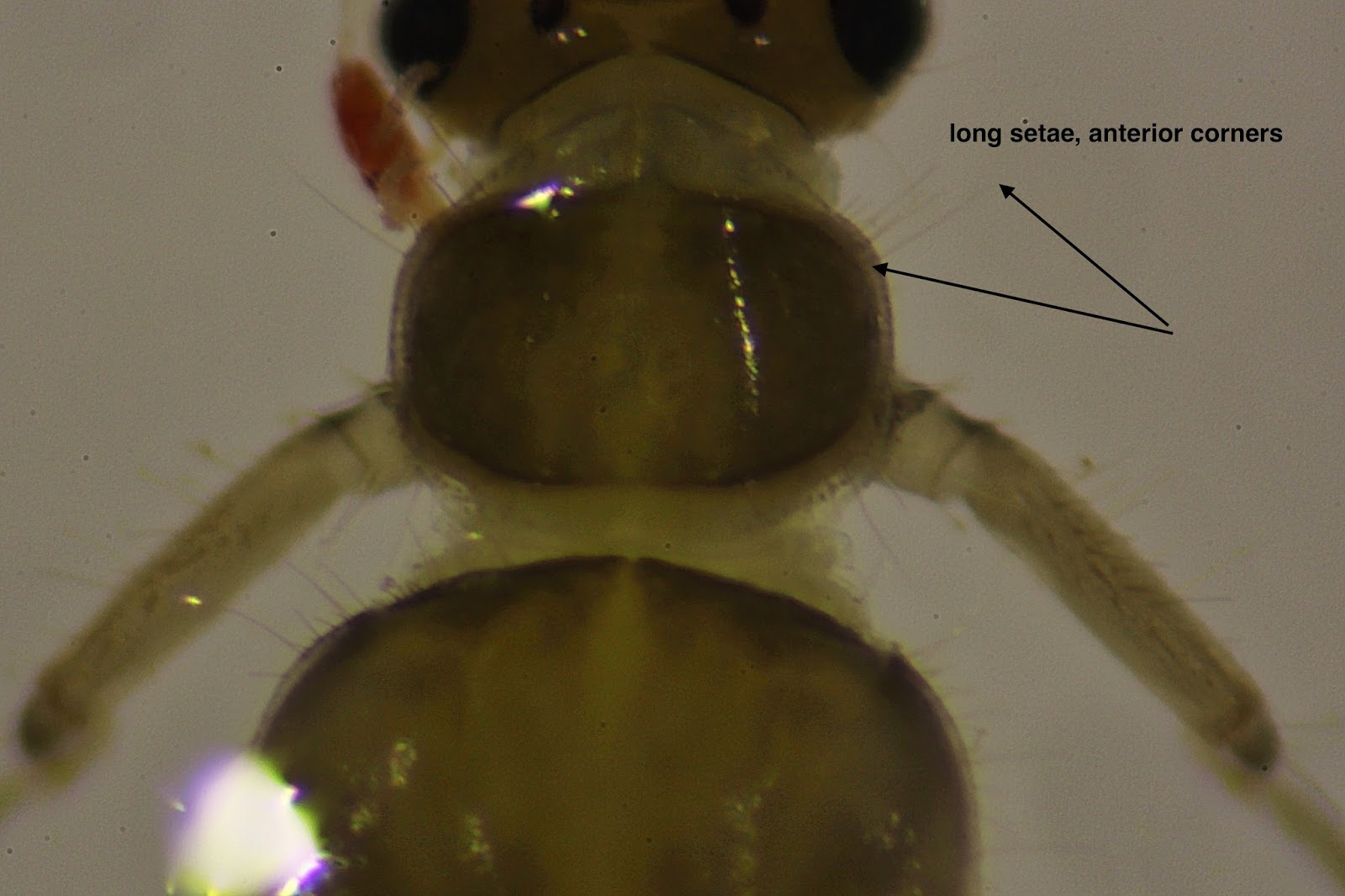
Beaty notes the "key" features as follows: "Genus Diagnosis: Nymphs - 7 mm...pronotum with sparse setae, longest and most numerous at anterior corners; long pronotal fringe hairs are at least 0.3-0.4 times the pronotal width; inner margin of hind wing pads subparallel to body axis; pronotum and tergites lightly setose...body light brown, nearly concolorous." "H. brevis -- fits genus description." ("The Plecoptera of North Carolina," p. 9)  He adds, "Primarily found in gravel and riffle ares of small to medium streams."  That's where I was looking.  Tolerance value for this one is 1.4.

The nymph that I found this morning was very small, only 6 mm, but it's easy to see that, yes, the color is light brown, the entire nymph being much the same color.  For more detail on diagnosis, we need microscope photos.

As you can see, the hind wingpads are subparallel, and in this shot you can see at least 1 seta on the pronotum with many more at the posterior corners.


For the long setae at the corners of the pronotum, we have two photos.  You can judge for yourselves on the length of the longest of setae.  I have no problem calling them 0.3 - 0.4 times the width of the pronotum.


I've wondered this morning about the species ID.  Beaty describes another species -- fleeki -- that is tempting as well.  "pronotum with antero- and posterolateral margins dark, contrasting with light brown almost diamond shaped interior; abdominal tergites with transverse banding along posterior margins slightly widening laterally."  With our nymph, the prontoum has a dark margin, but it's around the entire pronotum save for medial interruptions on the front and back edges.


Moreover, there does not appear to be banding on the terga.   One other thing, apparently H. fleeki has only been found in the "Sand Hills" of North Carolina: brevis is collected "from [the] Mountains and Piedmont.  Think we've got H. brevis.
_________________

I saw a variety of insects today -- spiny crawlers, some rolled winged stoneflies, and lots of fingernet caddisfly larvae.  And there were quite a few small minnow mayflies, which turned out to be Baetis pluto.


There are two features that give this one away.  1) On B. pluto nymphs, there is a pale area/line parallel to the eye, and 2) "tergum 5 [is] relatively pale, [while] segments 6 and 7 [are] almost completely dark."  (Beaty, "The Ephemeroptera of North Carolina," p. 6)

________________

May the sun come out soon and the streams drop and clear.

_________________

Note:  According to Nature Serve Explorer, H. fleeki has only been found in North Carolina.


Monday, May 2, 2016

Still the strangest mayfly nymph that I've ever seen: Ephemera guttalata


Steve Beaty talked me into using a kick net when I sample, and this morning I gave it a try.  Good fun.  I was able to collect insects from rocks, sticks and leaves, and the substrate all at the same time, and move through various spots on the stream before I looked to see what I had in the net.  Dumped everything into a white tray with water in it, and there were a variety of things moving around.   And since we were digging around in the substrate, we found this wonderful nymph that we only find there -- the "common burrower," Ephemera guttalata.

We've found them before -- for previous entries look back to 5/1/12 and 4/10/14.  In those entries, I've noted the features we need for genus and species ID.  But for a quick re-cap....

From Steven Beaty's "The Ephemeroptera of North Carolina," p. 44: "Genus diagnosis: Mandibular tusks divergent apically and curved upward in lateral view; frontal process of head distinctly bifurcate; small gills on abdominal segment 1 forked; abdominal gills held dorsally; ventral apex of of hind tibia produced into an acute point."


This last photo verifies the species ID as well: "E. guttalata -- nymphs up to 20 mm; abdomen generally lacking any color pattern."  He adds, "Collected mostly during spring and summer.  Mountains only.  Uncommon."

That's our nymph -- this nymph was 15 mm --  and I'm beginning to think this species is not all that "uncommon" in these small streams in Sugar Hollow.  Tolerance value: 0.0.


Wednesday, April 27, 2016

Guess it's Cinygmula season: the Rapidan River


When I found this nymph Monday morning, I thought I had something new.  True, it was small (6 mm) like a Cinygmula nymph, but I did not see the maxillary palpi protruding from the sides of the head.  Another look...


I took my time keying it out when I returned home, but in the end, I was forced to conclude that it was Cinygmula subaequalis just like the nymph in Sugar Hollow on Sunday.  Digging around, I found the following comment in Unzicker and Carlson: "maxillary palp usually partially visible at sides of head in dorsal view."  (Aquatic Insects and Oligochaetes of North and South Carolina, 3.70)  So "usual" is the operative word.

In the end, it was the dorsal abdominal pattern that led me to my conclusion.  Though no key comments on this, there does seem to be a common pattern on these nymphs.  1) There are paired submedian dots on each of the segments, and 2) there are 3 light dots on tergite 10.


If we look back at the previous nymphs I have found, we can see the same thing.  Here's the nymph that I found on Sunday,


and it's also clear on this nymph from 2014.


You'll also note that on occasion, there are pale marks on segment 9.  I suspect keys omit these details because the maxillary palpi are sufficient to establish ID.  As you can see, the nymph that I found on Monday is fully mature.  It probably would have hatched out that night.  Perhaps this is why the maxillary palpi are no longer easy to see.
________________

No shortage of insects in the Rapidan at this time of year.  I was not surprised to see an Isoperla orata, one on which the wingpads are starting to blacken,


and as expected, I saw numerous specimens of the nymph we're calling -- for the moment at least -- a "variant form" of Isoperla orata.


I also picked up some small nymphs which I couldn't ID on the spot.  But they turned out to be young Remenus bilobatus.  See more of those later on in the spring.


Sunday, April 24, 2016

The flatheaded mayfly (Heptageniidae) "Cinygmula": East and West


One of those rare days when I actually found the nymph for which I was looking!  This is the flatheaded mayfly Cinygmula subaequalis.  It's only the third nymph that I've found.  The first one was in Entry Run up in Greene County, and this one, like number two, is from one of our small mountain streams in Sugar Hollow.


In their important book -- Mayflies: An Angler's Study of Trout Water Ephemeroptera -- Knopp and Cormier, speaking of the Cinygmula species note that they "are not considered important mayflies by many western fly fishers."  I suspect the same is true in the east.  The nymphs themselves are very small.  The one in the photo at the top of the page was only 6 mm, and you can see by the length of the wingpads that it's fairly mature.

Beaty describes C. subaequalis -- the only species that we find in the east -- in the following way: "Front of head incised medially; maxillary palpi protrude at side of head; all gills on segments 1-7 similar in size and shape...; three caudal filaments."  "In high quality mountain streams."  He adds that "Specimens of C. subaequalis may be reddish in color (especially early instars) or otherwise have variable color patterns." ("The Ephemeroptera of North Carolina," p. 17)  I've noted those features before in previous entries: 3/27/12 and 5/4/14.  Once again, here are the nymphs.  The maxillary palpi are quite distinctive.


_________________

But as we have seen, this is a genus we also find in the west.  In fact, according to Knopp and Cormier, "Entomologists have recorded ten Cinygmula species from western waters, and [only] one species, C. subaequalis, on eastern waters." (p. 171)  And as it turns out, one of the nymphs that I found in Montana was a Cinygumla.


This too was found in a "high quality mountain stream," Grant Creek, a small stream that comes into Missoula right across the street from the hotel in which I was staying.  It looks like this in the summer.


Now, I've done my best to ID this little nymph (8 mm) to the level of species, but to date I've not been successful.  I take it the abdominal color patterns are very distinctive, and as you can see, on this nymph segments 8, and 9 to a degree, are lighter than all of the rest.


Jacob Neuswanger on troutnut.com posts a photo of a nymph from the Chena River in Alaska that matches my nymph completely -- but he doesn't note the species.(http://www.troutnut.com/specimen/793)  Knopp and Cormier, on the other hand, note the color patterns for three western species.  1) C. reticulata: "8mm -- Light reddish brown with light reddish to reddish brown gills."  2) C. ramaleyi: 7-8 mm -- "light to dark reddish brown with tergites 7 and 8 paler in color."  And 3) C. mimus: 9-10 mm -- "Mottled brown to black with tergites 8 and 9 paler in color and often white."  Using the "color," I'd say this is C. reticulata, but using the "pattern," I'd have to go with C. mimus. I can add that Neuswanger posts some photos of a C. ramaleyi (http://www.troutnut.com/specimen/962):  that does not match our nymph.

Still, best to move slowly with the issue of species ID.  I'll keep looking around for additional information, and who knows, maybe I'll find more nymphs next year!
________________

Additional pix from this morning.


Sunday, April 10, 2016

Fairly common -- but what a beautiful photo: Maccaffertium modestum


I'm still struck by Steven Beaty's comment on this flatheaded species -- "Most common [Maccaffertium] species in NC." ("The Ephemeroptera of North Carolina," version 3.3, p. 20)  This is only the third M. modestum nymph that I've seen, and one of the others was in the same stream as this one-- Buck Mt. Creek.  Of course, Beaty is talking about the whole state --I work in a much smaller area.

I won't review the ID details for this species.  However, the ventral pattern is one of the keys --


the pair of dark, oblique, lateral stripes on segment 9, the two large anteromedial dark spots on segment 8, and the pairs of small anteromedial dark spots on the preceding segments.  This matches the ventral pattern of Maccaffertium modestum in Fig. 68 in McCafferty and Bednarik's "Biosystematic Revision of the Genus Stenonema (Ephemeroptera: Heptageniidae), p. 68. Their detailed description of the M. modestum nymph can be found on p. 30 of the same monograph.
________________

The only other insect of interest that I picked up this morning was one of the variant forms of Isoperla orata.  More on that species when I report on insects up at the Rapidan River.