Tuesday, December 20, 2011
Continuing the March into Winter: The Uenoid Case-maker Caddis
I've been remiss in spending all of my time sorting through leaf packs: I've been ignoring the rocks. But it's the time of year when the Glossossomatids (Saddle-case-makers) and Uenoids (no common name) attach their cases to rocks, so I turned some rocks over this morning (Buck Mt. Creek). On one of the large rocks I looked at there were already three Uenoid cases (I also saw a Glossossomatid case, but it was empty).
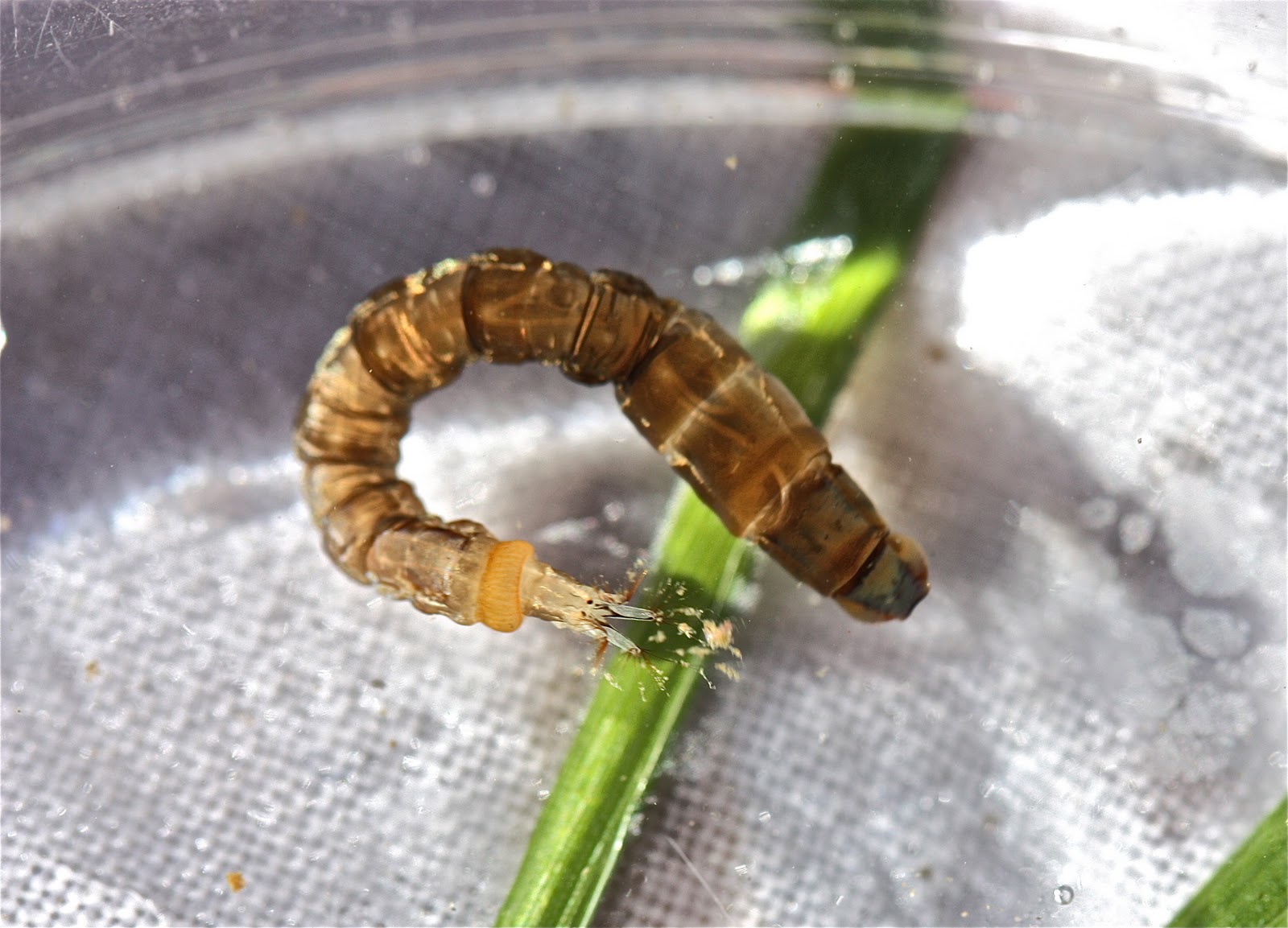
Uenoid cases are made out of small pebbles and sand, and you'll find them in different shapes and sizes (though there are normally three larger pebbles on each side of the case). Of the three cases that I picked up, the one in the photo above had a long, tapered case; the second had a short, tubular case; and the third was shaped like a cone.
Tubular case (with a Large Winter stonefly swimming by).
Cone-shaped case: dorsal view.
Cone-shaped case: ventral view, in which you can see the larva.
Case composition -- in terms of the colors -- will vary, of course, from stream to stream, depending on the raw materials the larvae can use. Uenoid cases in Buck Mt. Creek tend to be blueish gray, not all that attractive, but remember this beauty that I found in Elk Run in the winter last season.
The Uenoid is in our streams in the winter: it's the most common case-maker we see this time of year.
Uenoids tend to pupate and hatch in early spring (though they may be around longer than that in more remote, cold water streams.) In the winter, if you see these cases attached to the tops, sides, and bottoms of rocks, you can be pretty sure that you've found some Uenoids. True, some Limnephilids (Northern case-makers) and some Leptocerid genera (e.g. Oecetis) make similar cases. But Limnephilids show up in late spring/early summer: The Leptocerid (Long-horned case-maker) is a mid-summer larva.
Identification? The shape of the case provides the first clue, especially when you can see the three large pebbles on the sides of the case, as in the photo directly above. But the key anatomical features are three. 1) There are dorsal and lateral "humps" (so a total of three). They're pretty clear in this photo.
2) The leading edge of the mesonotum is "notched" -- to my eye it looks like a "W". (Click on the photo to enlarge it.)
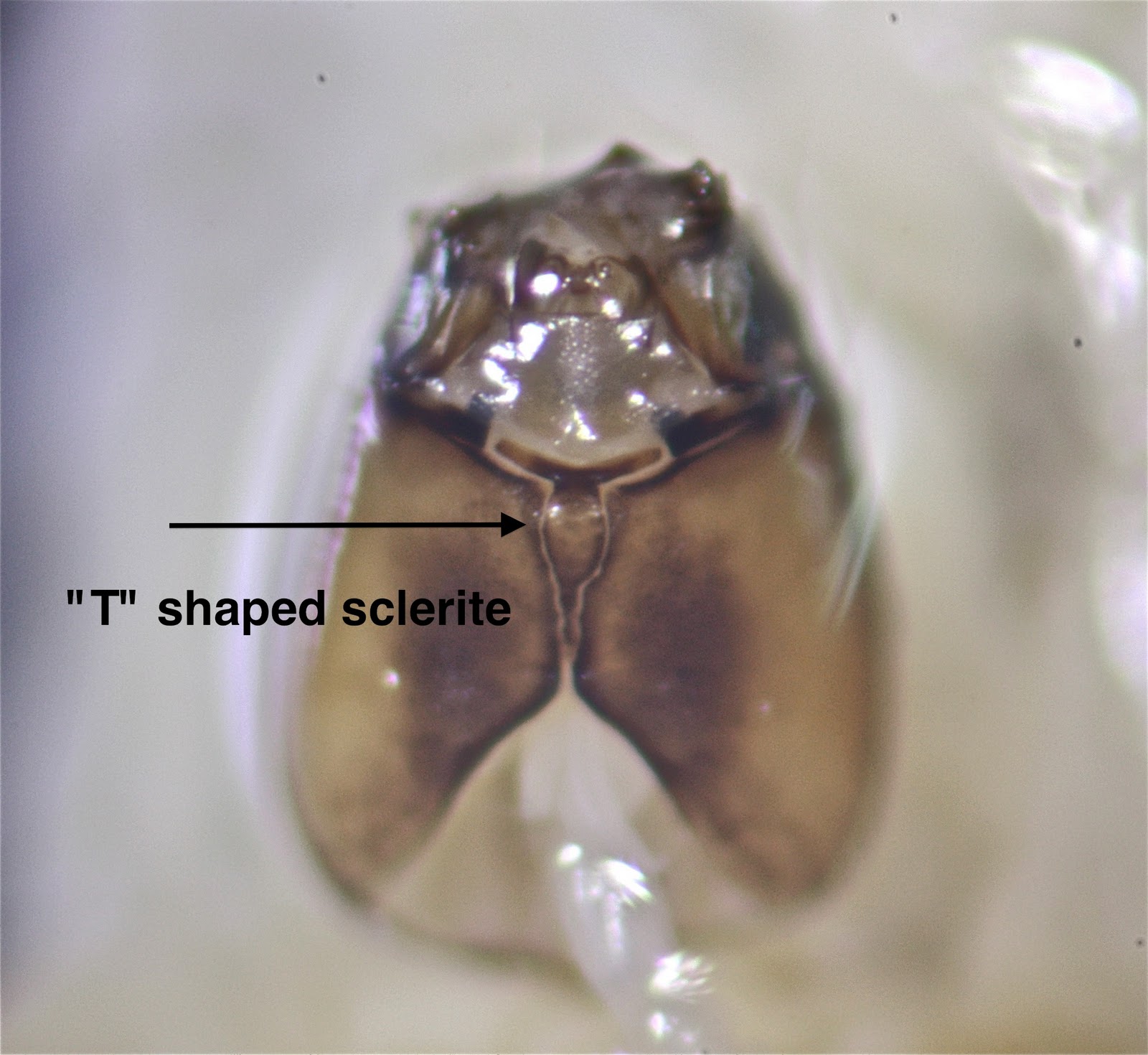
And 3) as Glenn Wiggins pointed out a long time ago (Larvae of the North American Caddisfly Genera (Trichoptera, 1977, p.262), when the Uenoid was still classified as a genus of Limnephilid (Neophylax), "The ventral apotome is distinctly T-shaped." For this we have to look at the underside of the head.
____________
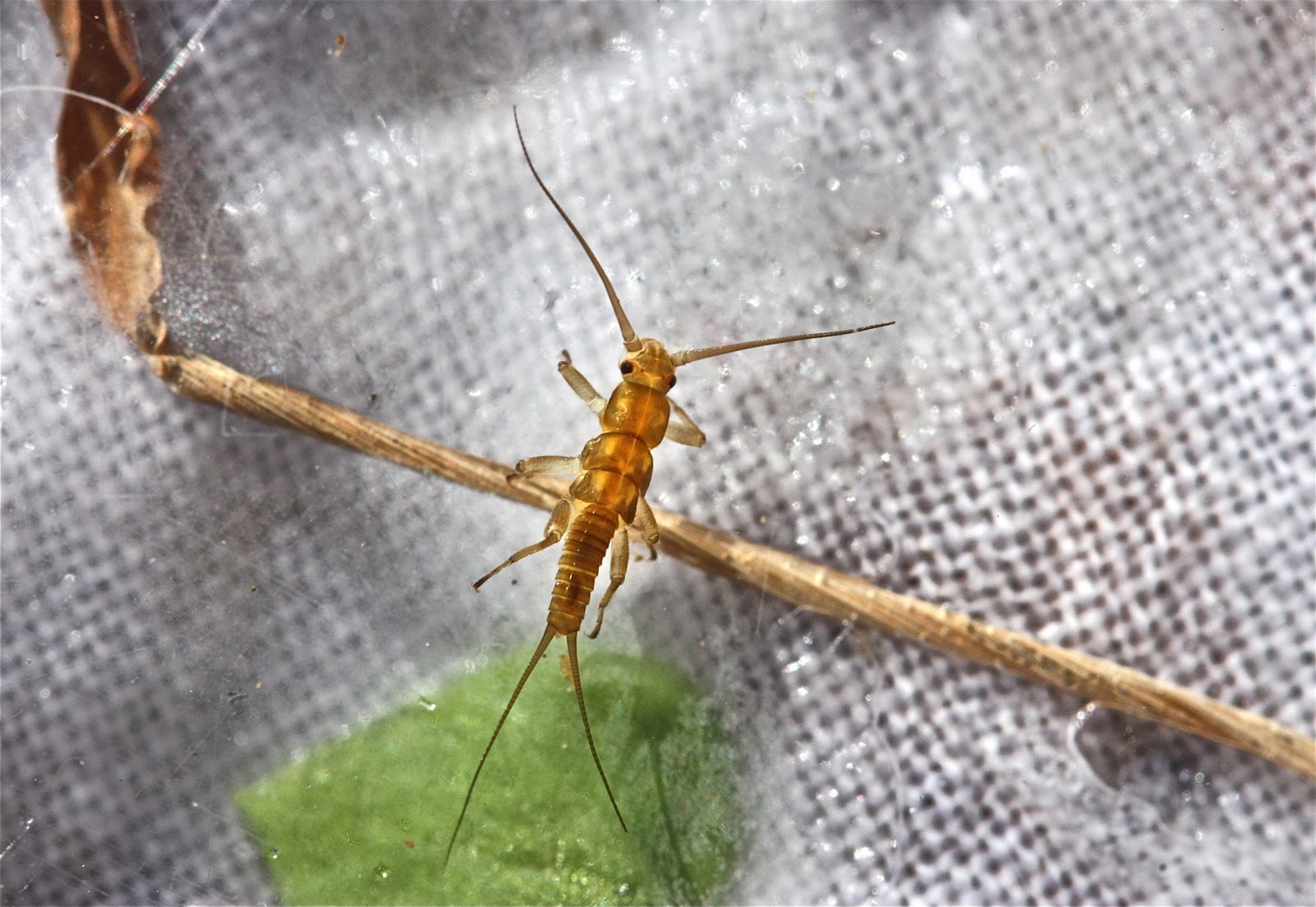
Not a lot else to report from this morning's trip to Buck Mt. Creek. Essentially, I saw what I expected to see: Large Winter stoneflies (both Taeniopteryx and Strophopteryx), Small winter stoneflies, and Perlodid stoneflies -- the genera Helopicus and Clioperla. I left the Clioperlas alone: as soon as you put them into your tray they start to chewing on everything else!
Large Winter: Taeniopteryx burksi
Large Winter: Strophopteryx fasciata
Perlodid stonefly: Helopicus subvarians
Saturday, December 17, 2011
Another First of the New Season: The Mayfly Family Ameletidae
This morning, I made a quick trip to one of the Moormans tributaries that I explore, and as always, I was pleased to see the variety of insects that inhabit these streams. Peltoperlids (Roach-like stoneflies), Pteronarcyds (Giant stoneflies), Chloroperlids (Green stoneflies), Capniids (Small winter stoneflies), Crane fly larvae (two genera: Tipula and Hexatoma), Clioperla Perlodid stoneflies, and more. And I'll focus on the more.
I only found two mayflies today. One was a flathead (Maccaffertium, species TBD), but the other was this Ameletid (genus Ameletus), a mayfly nymph that we only find in small, clean, cold streams. (The stream that I went to this morning was about 6-9' wide.) This is a young one, and we'll be watching these nymphs develop over the winter and into the spring. (Note how the gills stick out to the sides vertically, not horizontally as we see with their brushlegged cousins.)
And, I found a number of Large winter stoneflies -- again Taenionema atlanticum. I found only three of these nymphs last spring, and now I'm running into them all over the place (well, in very good, very small streams.) This is a species of Large winter stonefly that I never saw when I officially monitored streams. But then we never examined streams this tiny in size and, in general, none of the streams that we looked at were ever this good.
And now for the shot of the day -- look at this photo I got of a black fly larva!
I'm not sure I'll ever do any better for a live photo. Note that you can see the "prolegs" very well, and one of the things that indicates the genus on this one -- Prosimulium -- can also be detected: the dark tip of the antenna. (Click on the photo to enlarge it.)
Pretty amazing. Black flies are showing up now: I've seen them in more than one stream. And, this is the genus we normally see in the winter. Prosimulium black flies tend to be less tolerant than the Simulium black flies we see in the spring, summer, and fall. In the NCDWQ list of tolerance values, for species were the values are known, Prosimulium larvae values are 3.6 and 4.5, those for Simulium larvae are 4.9, 7.3, and 9.1.
Peckarsky, et.al., Freshwater Macroinvertebrates, pp. 204-207, note the defining features of Prosimulium in the following way:
"Postocciput nearly complete dorsally and enclosing cervical sclerites; basal 2 segments of antennae pale, strongly contrasting with darkly pigmented distal segments." In microscope photos, those features are readily seen.
Thursday, December 15, 2011
And Then There Were Three: The Large Winter Genus Strophopteryx
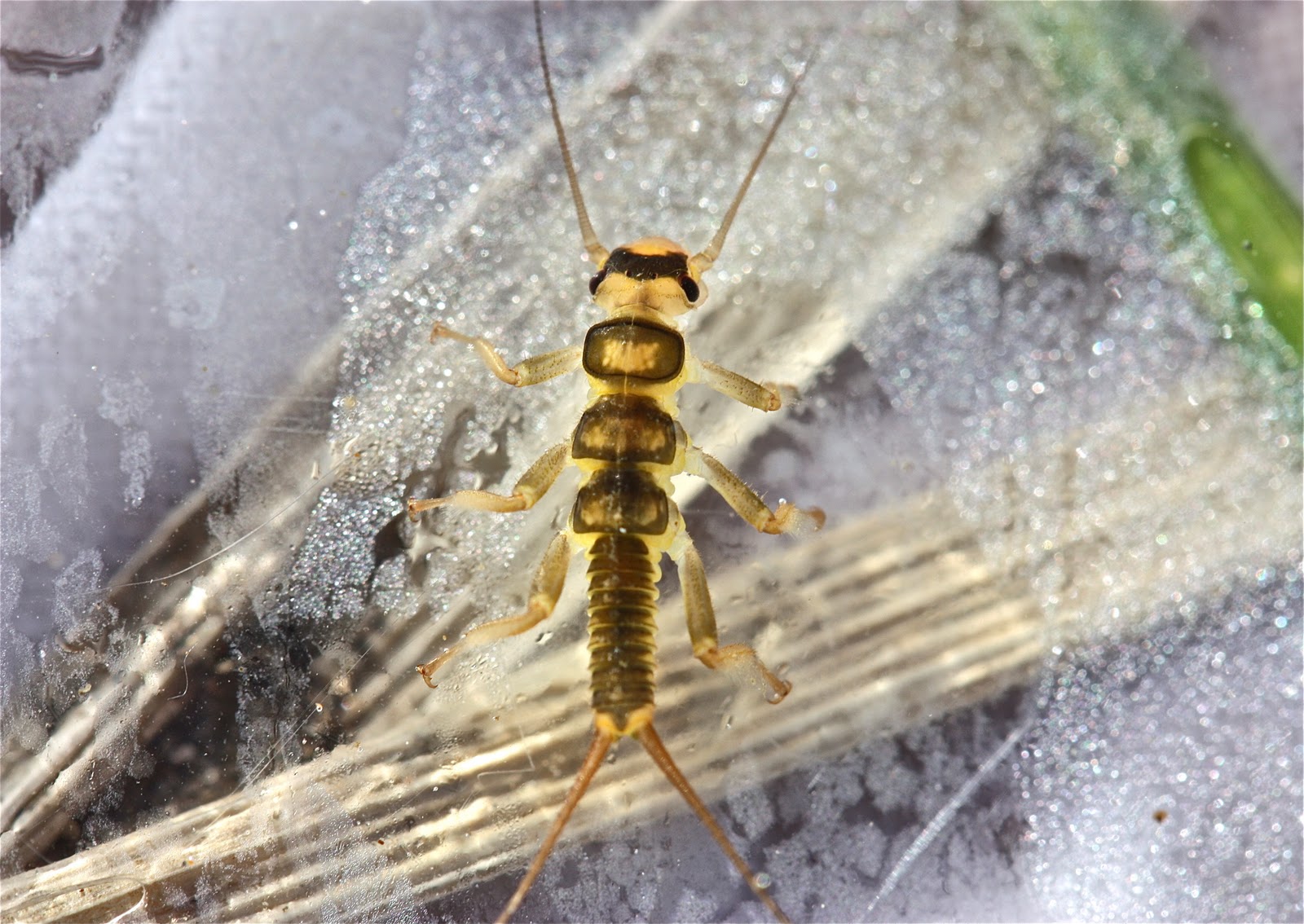
This is the Large Winter genus that we normally start seeing at the start of December -- but I've been unable to get into a lot of my streams because of high, muddy water. Today I finally made it to Buck Mt. Creek where I've found large numbers of these in the past. This is the genus Strophopteryx, and we can ID it right down to species: Strophopteryx fasciata.
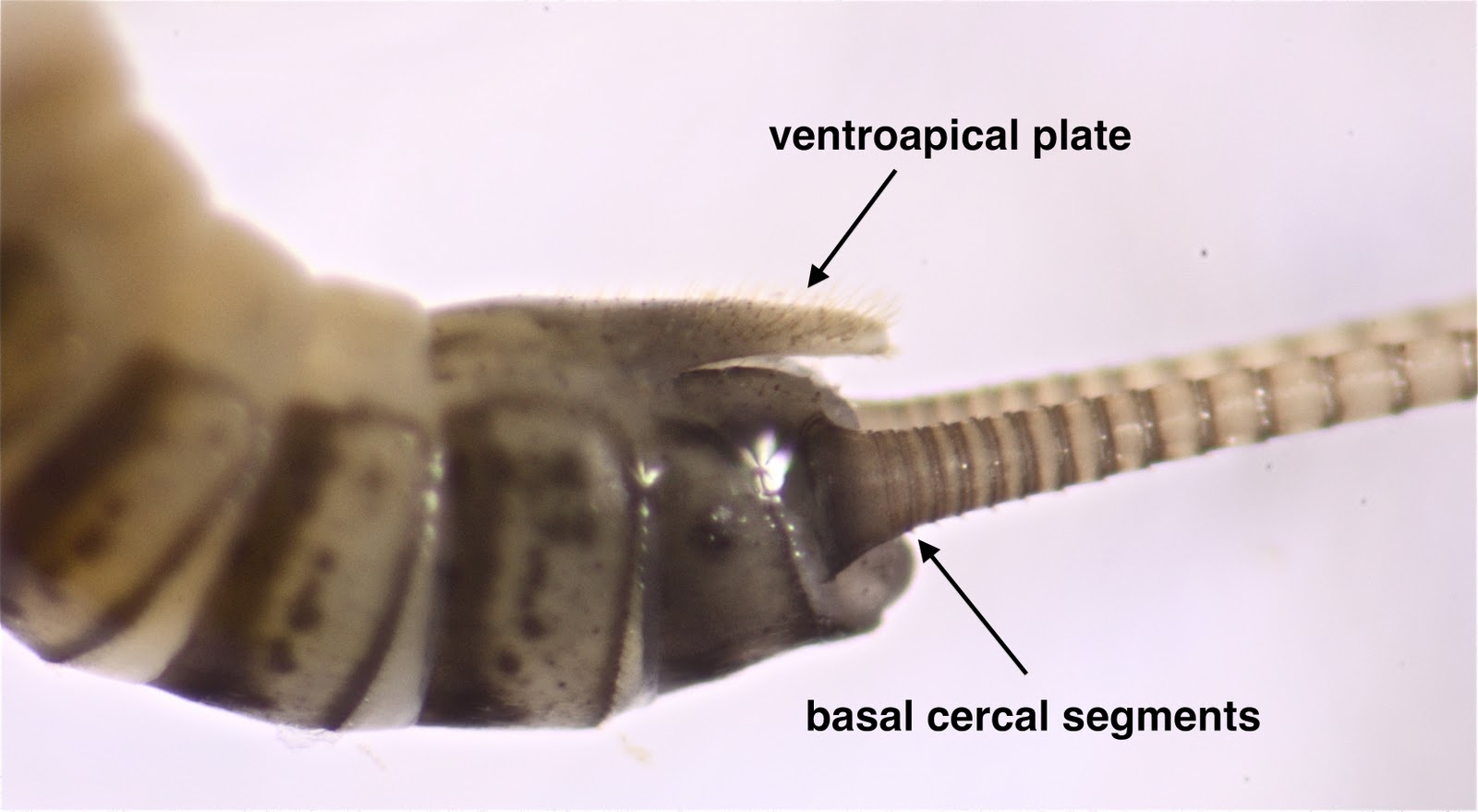
Strophopteryx nymphs are like Taenionema nymphs in having a prominent "ventroapical plate" (and both genera lack the "coxal gills" of Taeniopteryx nymphs). That plate is very clear in this picture.
But, remember that when looked at straight on, the apical plates of Strophopteryx and Taenionema do not look the same. Let me quote this from Beaty ("The Plecoptera of North Carolina," pp. 6 and 7).
For Strophopteryx: "apical half of ninth sternal segment concave laterally." Look at this microscope photo of the "ninth sternal segment" of one of the Strophopteryx nymphs that I found this morning.
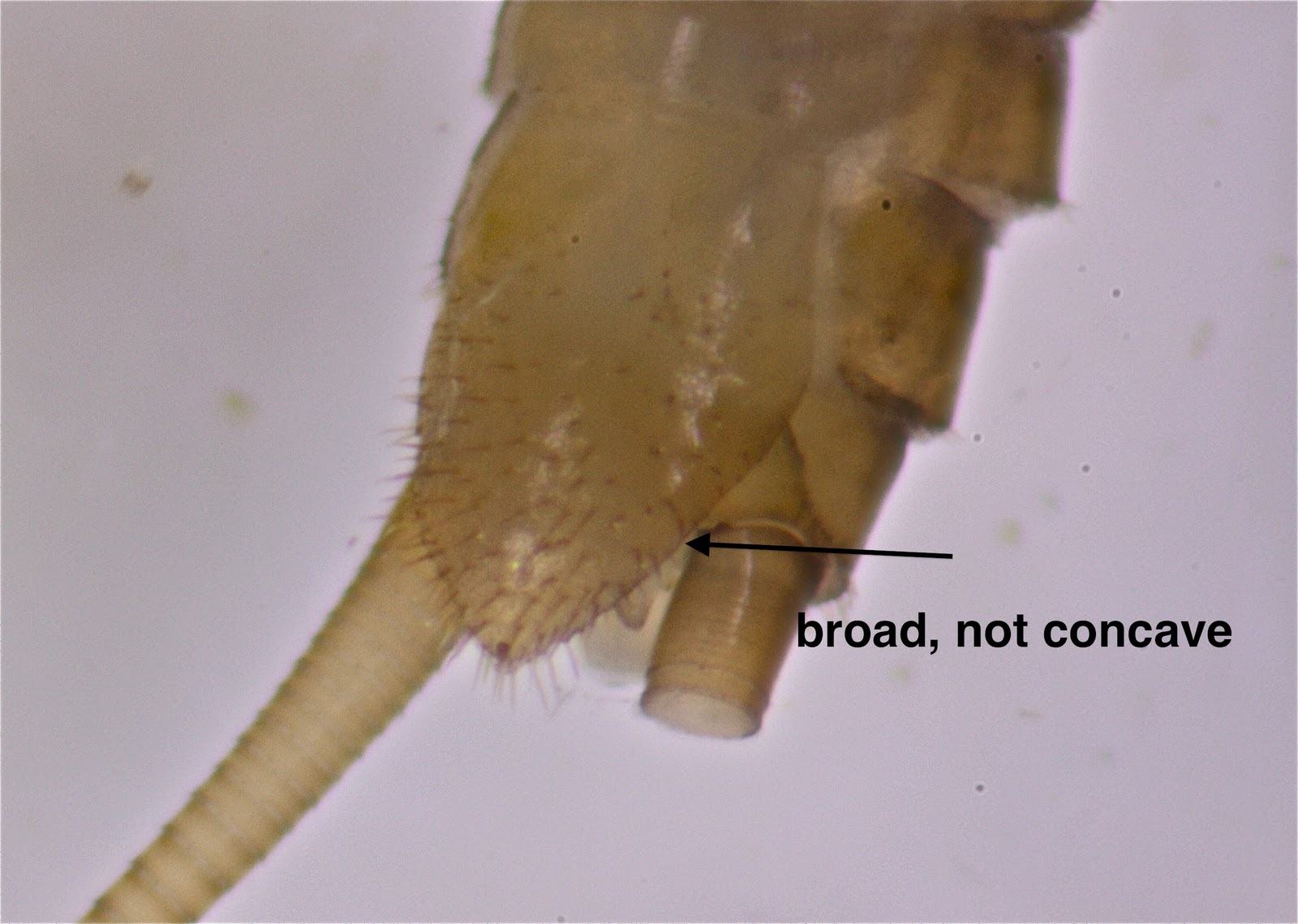
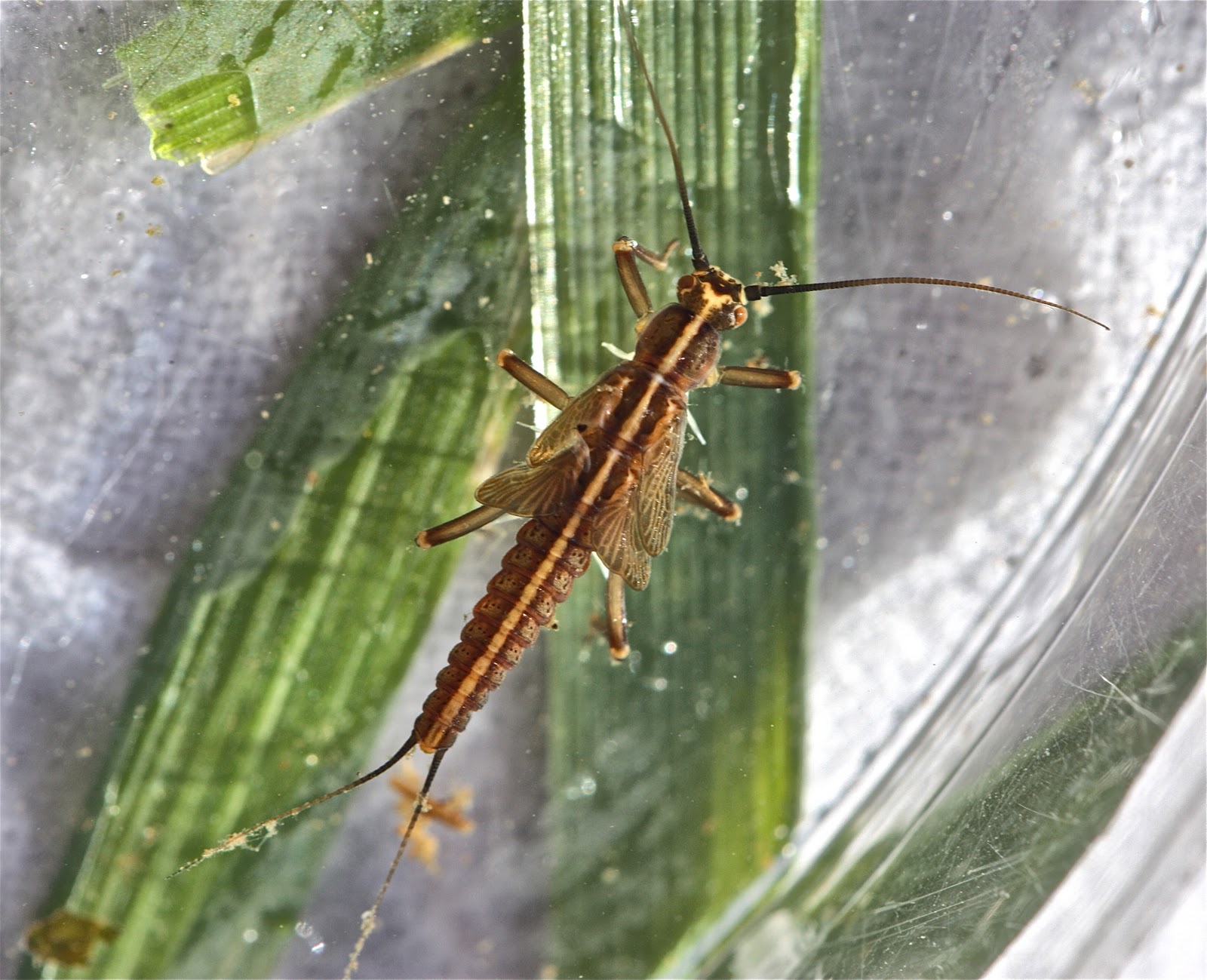
But on Taenionema nymphs (remember the photos from Tuesday), the "ninth sternal plate [is] broad apically." Have a look.
Those photos make it easy for us to distinguish these two genera. (And for good illustrations, look at Stewart and Stark, pp. 237 and 240). But these genera are also distinct in terms of color and pattern. From Peckarsky (Freshwater Macroinvertebrates, p. 67):
18a. Body dark brown, pattern indistinct...Taenionema
18b. Body light brown or yellow, with distinct darker pattern on head and thorax, abdomen distinctly banded....Strophopteryx
Looking at the photo at the top of the page, I'd have to say that this is clearly a Strophopteryx nymph. But how do we know that it's S. fasciata? Well, if you look at Beaty's discussion of Strophopteryx, you'll see that there are only three Strophopteryx species in North Carolina (and I'm guessing in our state as well): S. appalachia, S. fasciata, and S. limata. The nymph in our photo -- just in visual terms -- cannot be S. appalachia, and it cannot be S. limata. In Beaty's description of S. appalachia features, he notes "abdominal tergites lacking median transverse row of dots." Look closely at the nymph in the photo at the top of the page, or, better yet, look at the microscope shot of the ventroapical plate: the tergites on our nymph clearly do have a median transverse row of dots. S. limata is out of the question since for that species the "dorsum [is] uniformly brown."
Now, let's see what Beaty says for S. fasciata: "abdominal terga yellow with uneven, dark brown transverse bands on anterior half of each tergite; median row of transverse dark dots on each tergite; ventral tibial hair fringe present but sparse; no hair fringe on the basal segments of cerci." For the lack of a fringe on the basal segments of the cerci (tails), again look at the microscope shot of the ventroapical plate. For the sparse hair fringe on the ventral tibiae, look at the following photo.
Pretty clear to me that this is indeed S. fasciata. So, all three Large Winter species I normally see in our streams are now present and accounted for.
Strophopteryx fasciata
Taeniopteryx burksi
and Taenionema atlanticum
_____________
It was a "stonefly" day at Buck Mt. Creek. I did find a few flatheaded mayflies and few brushlegged mayflies in the 20 minutes or so I was looking. But, in addition to the three Large Winter nymphs that I found, I found 8-10 Helopicus (Helopicus subvarians) Perlodid stoneflies and probably the same number of Clioperla (Clioperla clio) Perlodids. And I got some very nice photos.
Helopicus
Clioperla
It was a very nice way to spend my birthday!
Tuesday, December 13, 2011
Already? Lepidostomatids in the Rapidan River
The water in the Rapidan River was running high, fast, and cold this morning, but as always at this time of year, the leaf packs were loaded with insects -- nymphs and larvae. The dominant taxon today, hands down, was the pronggilled mayfly (Leptophlebiidae: genus Paraleptophlebia). But the "shocker" today was the Lepidostomatid case-making caddis, the one in the photo above. It's winter, so I should have expected to see them. Still it seems a little bit early.
Lepidostomatids (the genus is Lepidostoma) are normally found in small, mountain streams, in areas that are heavily forested, where they have good access to the leaves and bark they use to make their cases. The case in the photo above is the one that we normally see: 4-sided, made out of evenly cut pieces of bark, with one piece of bark at the "top" to cover the head of the larva. This is the caddis -- you may recall -- that has two lateral humps on the first abdominal segment, but no dorsal hump -- as in the photo below.
The larva uses these humps to stabilize itself against the sides of its case, then undulates its abdomen, helping to create water flow bringing increased oxygen with it. (Though I doubt that they need to do this a lot in this river, especially at this time of the year.) Below, some more photos of Lepidostomatid larvae that I found this morning (there were quite a few). (In the first photo, note the head of the larva in the smaller case to the left peeking out over the top of the case.)
As I had in my last trip up to this river (11/19), I found 3-4 very small Perlodid stoneflies -- without any question the same species that I found here on that previous trip (have a look at the photos in that entry).
Some pictures.
I have a better idea today about the genus and species of these nymphs than I did just one month ago. These are a species of Isoperla. The mesosternal "Y" ridge was very clear when I looked at them with the microscope, and the lacinia was clearly Isoperla. But the real clincher -- the stripes on the abdomen which are starting to show. Have a look:
The three stripes -- one in the middle, two on the sides -- are used to ID Isoperla Perlodids. Can we go further and take a stab at the species? At the moment I'd go with Isoperla namata (or, Beaty would say, Isoperla nr. namata, since this species is not supposed to show up in our region). Look at the head.
At the front of the head, there is an "M" of sorts taking shape, one with a very thick middle. And, in front of and to the sides of the eyes, we see a pale area that is reaching into the darkly pigmented area in the center part of the head. Compare that to this Isoperla nr. namata that I found in the Rapidan River on March 24th of this year.
We'll have to watch these nymphs as they develop over the winter, but I think this is where these Perlodids are heading.
Here are the other insects of which I took photos today.
1) Pronggilled mayflies -- as I noted, the dominant taxon.
2) Small winter stoneflies (though I saw very few, and there were adults flying around in the air -- i.e. they're hatching).
3) Large winter stoneflies (genus Taeniopteryx). Lots of them. They gave the pronggilleds a run for their money in holding on to the number one place. I got some great photos of one of them.
4) Large winter stoneflies -- genus Taenionema: Taenionema atlanticum. I was surprised to see them again so soon, and I found three of them.
5) And finally, I found another Hexatoma crane fly larva. This is clearly a genus that likes the clean, cold water of remote mountain streams.
Subscribe to:
Posts (Atom)