Thursday, February 16, 2012

A Further Note on the I. namata Issue


I've been in touch with Steven Beaty (NC DWQ), and he thinks that the Isoperla namata nymphs that I'm finding in Central Virginia should still, at the moment, be called Isoperla nr. namata.   According to Beaty, the leading authority on Isoperla argues that true Isoperla namata is only found in the Ozarks and the Midwest.  Also, Isoperla "patterns" can vary.  So the three head patterns we saw yesterday still qualify as Isoperla nr. namata.

Those patterns were:

1. The most common, where the dark lines/bands from the transverse band crossing the head extend back to the lateral ocelii and beyond, to dark spots at the back of the head.


2. Nymphs where there are no lines extending from the transverse band back to the ocelli.


3. And the nymphs that I'm finding in Sugar Hollow where there are no dark bands/lines/spots behind the lateral ocelli -- as with the nymph pictured at the top of the page.

So, Isoperla nr. namata it will be.  However, I think it's still worth our while to keep track of the streams in which we find each of these patterns.  There may be habitat differences that account for these variations.

Wednesday, February 15, 2012

Isoperla namata: Comments on a Number of Issues


This picture was taken on 3/24/11 at the Rapidan River in Madison County.  It's the Perlodid stonefly, Isoperla namata, which is the most common Isoperla species we see in our streams -- more, it's the most common Perlodid stonefly we see in our streams.  But there are a number of issues surrounding the ID call of "Isoperla namata" that I think we need to discuss.

1. Let me begin by noting that Isoperla namata is a species that is primarily found in the Ozarks -- Missouri and Arkansas (for the distribution of I. namata, look at: http://www.npwrc.usgs.gov/resource/distr/insects/sfly/usa/468.htm.  (Note that "npwrc" stands for the National Prairie Wildlife Research Center).   In fact, the common name for I. namata is "Ozark Stripetail."
For this reason, Steven Beaty ("The Plecoptera of North Carolina," p. 24) refers to the Perlodid nymphs that are found in NC that "appear" to be I. namata as "Isoperla nr. namata" -- i.e. they look like I. namatas, but I. namata shouldn't occur here (!).  In Virginia, we don't have this problem.  That's because Stewart and Stark, in their Nymphs of North American Stonefly Genera (Plecoptera), p. 412, include Virginia among the states where I. namata is found (AR, IN, KY, ME, MO, OH, PA, VA, and WV.)  


2. There is another species of Isoperla which, in appearance at least, is exactly the same as I. namata, but the geographical distribution is different.  This is Isoperla montana.  This is supposedly found, primarily, in the northeast: CT, DE, ME, MN, NH, NS, NY, ON, PA, and PQ (Stewart and Stark, p. 412).  (Also see, http://www.npwrc.usgs.gov/resource/distr/insects/sfly/usa/466.htm).  Note that the species ID, "montana," has nothing to do with the state of Montana, it refers to that fact that these nymphs are primarily found in mountain streams.   (The common name is "Montaine Stripetail").   Now, if you look up "Isoperla montana" on Bugguide.net, you'll see that these nymphs look exactly like I. namata.  In fact, some have been moved into I. montana from I. namata, for, what appears to be nothing more than geographical reasons.  I.e. I. namata is only found  -- supposedly -- in the Ozarks and the Mid-west (!).

3. Let's get closer to home and look at some of the nymphs that I've found this season and last.  But let me begin with Beaty's description of Isoperla nr. namata (Beaty, "The Plecoptera of North Carolina, p. 24).

"North Carolina specimens have a dark transverse band on head usually without backward extensions to lateral ocelli but sometimes with extensions and with lighter brown areas behind ecdysial line (emphasis added by Henricks): abdominal longitudinal lines narrow; abdominal tergites with a transverse row of 6-8 sometimes faint dots."  He adds, "Isoperla namata is supposedly geographically restricted to the Ozarks and the midwest..."

4. As I have looked through my Isoperla photos from last year and this year, I've found that most match what Beaty calls Isoperla nr. namata, but, with most of the nymphs that I've seen, the dark transverse band does extend to the lateral ocelli.  E.g., in addition to the nymph pictured at the top of the page,

a. 3/28/11, Powells Creek:


b. 4/23/11, Powells Creek:


However, I've also found some nymphs where the dark band does not extend to the lateral ocelli.  For example, this nymph also found at Powells Creek on 3/28:


And, this one -- though I'm not sure where it was found and when:


5.  Now, let's have a look at what I've found so far this season -- noting the dates and locations -- but I'll save the photos of the nymphs that I've found in Sugar Hollow for last.   I've called all of these nymphs "Isoperla namata".   Note how the head pattern becomes clearer with time.

a. 11/19/11 -- Rapidan River.


b. 12/13/11 -- Rapidan River


c. 12/21/11-- Upper Doyles River, the first one that is "clearly" Isoperla namata".


d. 1/4/12 -- South River (Greene County):


e. 1/18/12 -- Rapidan River:

__________

Now, let's have a look at the nymphs I've found in Sugar Hollow, in the small, mountain streams that feed into the Moormans.

a. 1/14/12:


b. 2/2/12:


c. And finally, the nymph that I found on Monday, 2/13/12:


I never saw it until I looked at all of these photos this morning.  The dark spots/lines -- whatever you want to call them -- behind the rear ocelli, and behind the ecdysial suture (that's the line on which the head will split open when the adult emerges) are missing.  True, this could be because those dark spots have not yet developed.  But, note that they are very clear on the young nymphs found on 1/4 in South River and on 1/18 at the Rapidan River.

I'm not sure if this is important -- i.e. if this is a morphological feature that sets the Sugar Hollow Isoperlas apart.  Still, it's significant to me that I've seen this only on the nymphs that I'm finding in these "pristine" streams in the Blue Ridge, in Sugar Hollow.

So now you have some idea of the mysteries entomologists have to work out when dealing with the "Isoperla namata," or "Isoperla montana," or "Isoperla nr. namata" nymphs that we find in our streams.
Still lots of work to be done.
_______________

Below:  a mature I. namata -- April 18, 2011: Long Island Creek, Fluvanna County.


Monday, February 13, 2012

And the Stoneflies Keep Getting Bigger in Sugar Hollow


Could I start with some other photo?!  The Perlodid stonefly Malirekus hastatus, and it was a big one -- close to 1" in length.  And, note how the rear wing pads are flared out from the body; that's a sure sign that these stoneflies are getting mature.

After finding our winter small minnow mayflies (Heterocloeon amplum) last week, I thought I should return to Sugar Hollow this week to check on the stoneflies.  Lots of them, and they're all getting bigger.  Let's have a look.

1. Another, closer, look at this gorgeous Malirekus hastatus.


2. One of two Diploperla duplicatas (Perlodids) I found.


3. Two of the many, many, many Isoperla namatas.  This common Perlodid is becoming a dominant taxon in a lot of our streams as we move into spring. Monitors will be seeing a lot of them in their samples.


4. One of several large winter stoneflies -- Taenionema atlanticum -- that are still present in these small mountain streams.


5. And a "giant" Giant stonefly -- Pteronarcys scotti (I think).


There were some mayflies in the stream.  In fact, the bottoms of rocks were covered with the flatheads, Epeorus pleuralis.   I also found a few Ameletids.  But one of my favorite discoveries this morning was this beautiful aquamarine, free-living caddisfly larva, Rhyacophila nigrita.


The main thing that helps us to pin down this species is the "two-toned" pronotum -- light in the back and dark in the front -- that and the black/brown head.  Previous R. nigritas that I've found in this stream have been whitish gray, e.g. this one from 12/26.


And since I've moved our attention to the free-living caddis, I can say a little bit more about the larva I found here last month (see the entry posted on 2/2).  This one.


This is not R. nigrita; the pronotum is totally different.  And it certainly isn't the "common" Rhyacophila -- Rhyacophila fuscula -- the green one with the "topless" H pattern on a light brown head.  So, I took some microscope photos to help with ID and sent them to Steven Beaty.  Here are the photos.

1. The head -- and note the light colored dots (muscle scars).


2. The pronotum, and note the distinctive "notched" posterior edge.


I'm not really sure if these photos helped him or not, but he thought there was a good chance that this was Rhyacophila glaberrima.   However, to know that for sure, we have to know the length of segment 2 of the maxillary palpi: I wasn't able to figure that out.  If it was R. glaberrima, it's "relatively rare" (Beaty, "The Trichoptera of North Carolina").

So, we've got R. fuscula and R. nigrita in this stream for sure, and possibly R. glaberrima.  I would not be surprised to find additional species of free-living caddisflies on future trips to this gem of a stream.
________________

Below -- and Epeorus pleuralis flatheaded mayfly stays perfectly still as a "net-winged" midge (Blephariceridae) crawls underneath.

Saturday, February 11, 2012

And Yes, The Black Fly Larvae Have "Colonized" a Lot of Our Streams


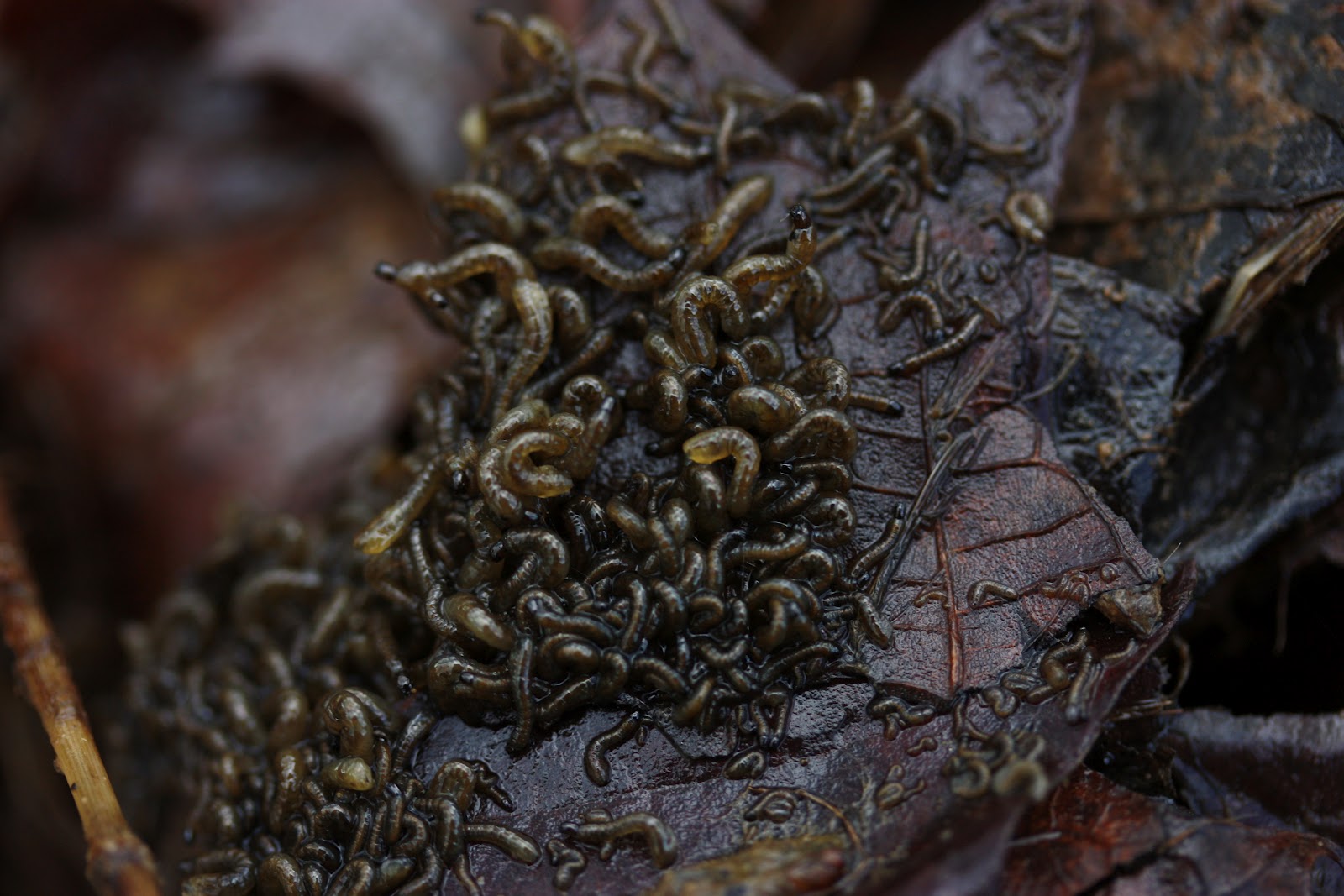
They're actually kind of cute when seen individually.  But that's not how we normally see them.  At the moment, when you look into some of our streams -- e.g. the Doyles River and Buck Mt. Creek -- this is what you're likely to see on the tops of large rocks.


Or sometimes you find them on leaves when you're sorting through leaf packs.


Not very appealing.  Large colonies of black fly larvae (family: Simuliidae) are common in a lot of our streams -- often very good streams -- in the winter.  It's just their season.   The black fly genus I find in the winter (roughly November through March) is Prosimulium (general tolerance value: 4.5); the genus I find the rest of the year is Simulium (general tolerance value: 4.9).   The defining characteristics of Prosimulium larvae are the dark tips of the antennae (click on the photo to enlarge),


and the fact that the "cervical sclerites" (the little black dots at which the arrows are pointed) are enclosed by the postocciput.


(On Simulium larvae, the arms of the postocciput are further apart, leaving the sclerites baldly exposed at the back edge of the head.)

Black fly larvae like to colonize rocks that are in the main flow of the current.  You'll often find them on rocks over which the current spills at the head of a riffle.  This makes very good sense.  Black flies are "filter collectors," in terms of their Functional Feeding Group classification, using their head hairs -- I like to think of them as their "whiskers" --  to "filter/glean" nutrients out of the water: their main source of food.


The large numbers of black fly larvae in our streams at this time of year present stream monitors with a genuine problem.   With their high tolerance values -- Virginia DEQ uses a single value of 6.0 for all black fly genera -- when large numbers of them show up in a sample because someone rubbed the "wrong" rocks, a stream's "score" can plummet.  (I once ended up with 700 larvae from a 1 second net!)   But large numbers of black flies in winter samples do not indicate unhealthy streams.  They're just there at this time of year,  so sampling methods must be devised that make adjustments for this situation.  I'm not proposing a "revised" method: I'm happy that those kinds of matters are dealt with by others!

So, I've done my bit on black flies for the winter -- and now I intend to return to my focus on mayflies, caddisflies, and stoneflies!

Thursday, February 9, 2012

The New Kids on the Block: Nemourid Stoneflies and Small Minnow Mayflies


Just back from Buck Mt. Creek where I continue to find more and more signs of "late" winter -- on February the 9th!!  In my short visit this morning, I found a significant number of small minnow mayflies again, Heterocloeon amplum,  quite a few spiny crawlers (E. dorothea), and a fair number of Nemourid stoneflies -- genus Prostoia -- as in the picture above.  There are still winter insects around -- large winter stoneflies (but I'm only seeing Strophopteryx fasciata, no Taeniopteryx burksi), small winter stoneflies (a small  Allocapnia species), and Clioperla and Helopicus Perlodid stoneflies.  But these winter stoneflies have really diminished in number, and the new kids are taking over the streams.  The other late winter insect that is showing up in large numbers is the Perlodid stonefly, Isoperla namata (which I also found this morning in Buck Mt. Creek).

I'll just post a few photos today.

1. Some more shots of these little Nemourids (Prostoia nymphs are 5-6 mm in length, and this one was close to 6):


2. One of several small minnow mayflies that I picked up, close to 9 mm in length.


3. And one of several Ephemerella dorothea spiny crawlers.


_________

Two comments:  1) Not only am I now finding large numbers of mayflies and stoneflies that I think of as insects that should show up later on, but some of them are already "big."  Note the length of the wing pads on the small minnow in the photo above (and in the photos I posted on Tuesday), and the length of the wing pads on this spiny crawler.  2) The small minnow mayfly in the photos above is a "female," something we can tell from the size of the head and the eyes.  The one that was featured in my last entry was clearly a male.


Adult, terrestrial males, use their large eyes to pick out the females in mating swarms.

Tuesday, February 7, 2012

The Return of Our "Winter" Small Minnow Mayfly: Heterocloeon amplum


My destination this morning was the upper Doyles River.  But I decided to take a quick look at the "lower" Doyles River -- just outside of White Hall -- before I moved on.  That's as far as I got.  The bottoms of rocks and the leaf packs were just loaded with insects.  Stoneflies: I found some common stoneflies -- Acroneuria and Eccoptura -- but there were lots of Perlodids, Clioperla, Diploperla, Helopicus, and for the first time, Isoperla namata.  And, I found both large and small winter stoneflies.   For mayflies:  I saw a few, small, flatheaded mayflies, Epeorus pleuralis, and a surprisingly large number of spiny crawlers (!), Ephemerella dorothea.  Everything seems to be showing up early this year.

But I was most excited by finding quite a few small minnow mayflies -- the same species I saw here (and at Buck Mt. Creek and the Lynch River) last year in the winter.  I'm quite sure this is Heterocloeon amplum, and I'll make the case for that in a moment.  But first, a couple more pictures.


As I found last year, some of these nymphs are olive in color, others a mixture of orange and brown (see the photos posted on 3/2/11, for example).


And here's a nice double with the two colors together.


These were the largest small minnow nymphs I saw all of last year (7-9 mm), and the most prolific.  That will come as no surprise to the fly fishermen: the "blue-winged olive" hatch -- adult small minnow mayflies -- is one of the earliest hatches we see every spring.

Now, how do we determine that this is Heterocloeon amplum?  There's a short way and a long way.  The short way is through a process of elimination.  These nymphs have two tails, so the genus is either Acentrella or Heterocloeon.  Acentrella is out of the question because no Acentrella reaches a length of 7 mm (see the descriptions of Acentrella species in Steven Beaty's "The Ephemeroptera of North Carolina," p. 4).  So we move to Heterocloeon.  Almost all species of Heterocloeon small minnow mayflies have "procoxal gills," gills at the base of the front legs.  Those look like this on Heterocloeon curiosum.


The nymphs that I found this morning do not have procoxal gills, and the only species of Heterocloeon lacking those gills is Heterocloeon amplum.  

That takes care of the "short" method of identifying our nymphs.  But let's try to establish the species ID in a more rigorous way.  Here's what Beaty has to say on H. amplum ("The Ephemeroptera of North Carolina, p. 9).

H. amplum -- nymphs 7-9 mm; unique labial palpi (parallel sided); shortened leg setae; femora, tibiae and tarsi relatively shortened, tarsi slightly dilated apically with wide, pale medial band; gills large, suboval, with rudimentary trachea.  Found in streams to rivers in the Mountains and Piedmont.  Mainly collected during the cooler months.


He also notes that, on this species, the "hind wing pads [are] usually small but sometimes absent."


The smallest nymph in the photos above was 7mm, the largest were 8mm.  The "suboval" shape of the gills and the "rudimentary tracheation" can be seen in our pictures (there's a thin line of pigment in the center of each gill).  Or, better yet, look at this photo (click to enlarge).


For the shortened leg setae (hair), we need a microscope shot.


The same is true if we want to see the wide medial band on the tarsi and the way in which the apex slightly expands.


On the hind wing pads -- they are present on the nymphs that I found, and they are indeed small.


Finally, let's look at the labial palps.


I'd say they are "parallel sided," at least the penultimate segment.  So, I'm pretty satisfied with the call of H. amplum.  And I suspect I'll be seeing a lot more of them through March into April.
______________

Other photos -- it was a good morning for pictures.

1. Perlodid stonefly, Helopicus subvarians.  This was big one -- around 1" -- and note how the wing pads are flaring out from the body (= pretty mature).


2. Perlodid stonefly, Isoperla namata.  These are showing up in large numbers now in a lot of our streams.


3. Helopicus subvarians and Isoperla namata in the same photo.  Quite a difference in size!


4. A small winter stonefly, genus Allocapnia, not sure of the species.


5. Large winter stonefly, Strophopteryx fasciata, one of the brown ones.


6. A Nemourid stonefly, genus Prostoia.  This is the first time I've seen Nemourids in the Doyles.


7. And two of the many spiny crawlers -- E. dorothea -- that I found this morning.