Friday, June 22, 2012

Summer Insects in the Moormans


I took a look at the Moormans this morning -- above and below the first bridge.  The most excitement?
I saw quite a few trout!  I wish they were natives, but that's very unlikely, they've probably drifted downstream from the area stocked by Trout Unlimited for fly fishermen.  But they've managed to find some beautiful pools in this part of the river.

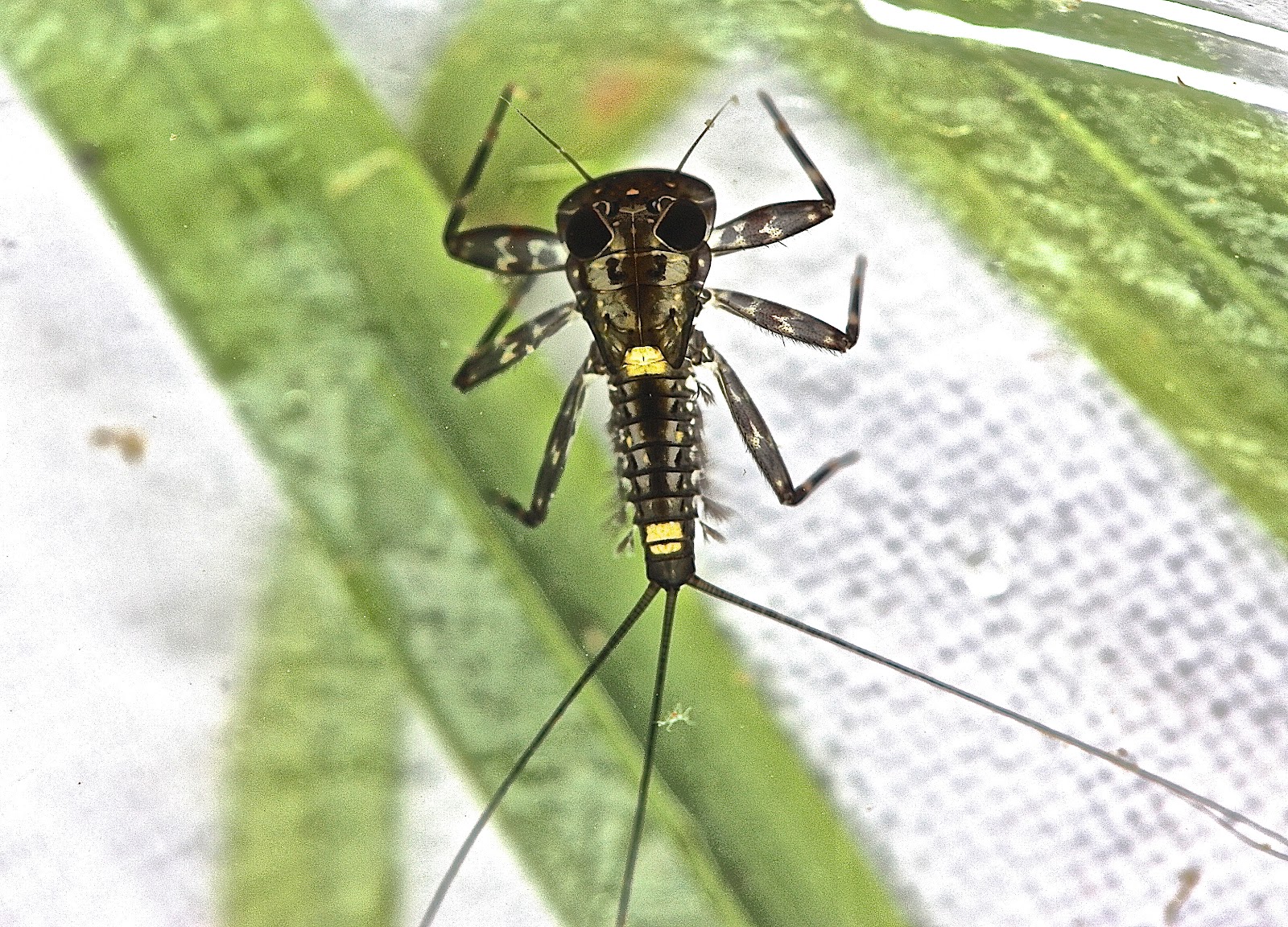
I can't say I found anything very exciting today, though it was neat to see the tiny nymph in the photo above: a "narrow-winged damselfly," family: Coenagrionidae.  This is a part of the stream where I always find "dragons and damsels," as well as a whole bunch of snails: Pleurocerids, Physids, and Planorbids.
I'll start seriously searching for dragons and damsels in the Rivanna anytime now.  Still, it was fun to find this little one in the Moormans, and I also saw some hatched adults flying around.  This is one of the smallest Coenagrionids I've seen.


I also found another nice Darner dragonfly nymph, genus Boyeria, as I did on my last stop at this part of the stream.  Given the length of the wing pads on this one, it will be airborne before very long.


I still saw quite a few Perlesta common stoneflies in the Moormans, both large and small, and one mature Acroneuria Perlid that should have hatched by now.  The rocks were covered with flatheaded mayflies, some E. vitreus, some too small to ID.   And to my surprise, in the leaves -- which is where the stoneflies were crawling around -- I found 3-4 Whirligig Beetles as I did yesterday at Buck Mt. Creek!


But I was again disappointed in my search for small minnow mayflies.  I finally did find a few wiggling around on the rocks.  They turned out to be Baetis flavistriga, the most tolerant of the Baetids we find.  At 4-6 mm, they're also one of the smallest.  The largest one that I found (in the second photo below) was 4.5 mm.


_____________

Below: A mature Coenagrionid (narrow-winged damselfly) from the Rivanna River.  Photo taken last summer.

Thursday, June 21, 2012

Flatheads, Small Minnows, and -- Oh Yes -- a "Whirligig Beetle": Buck Mt. Creek


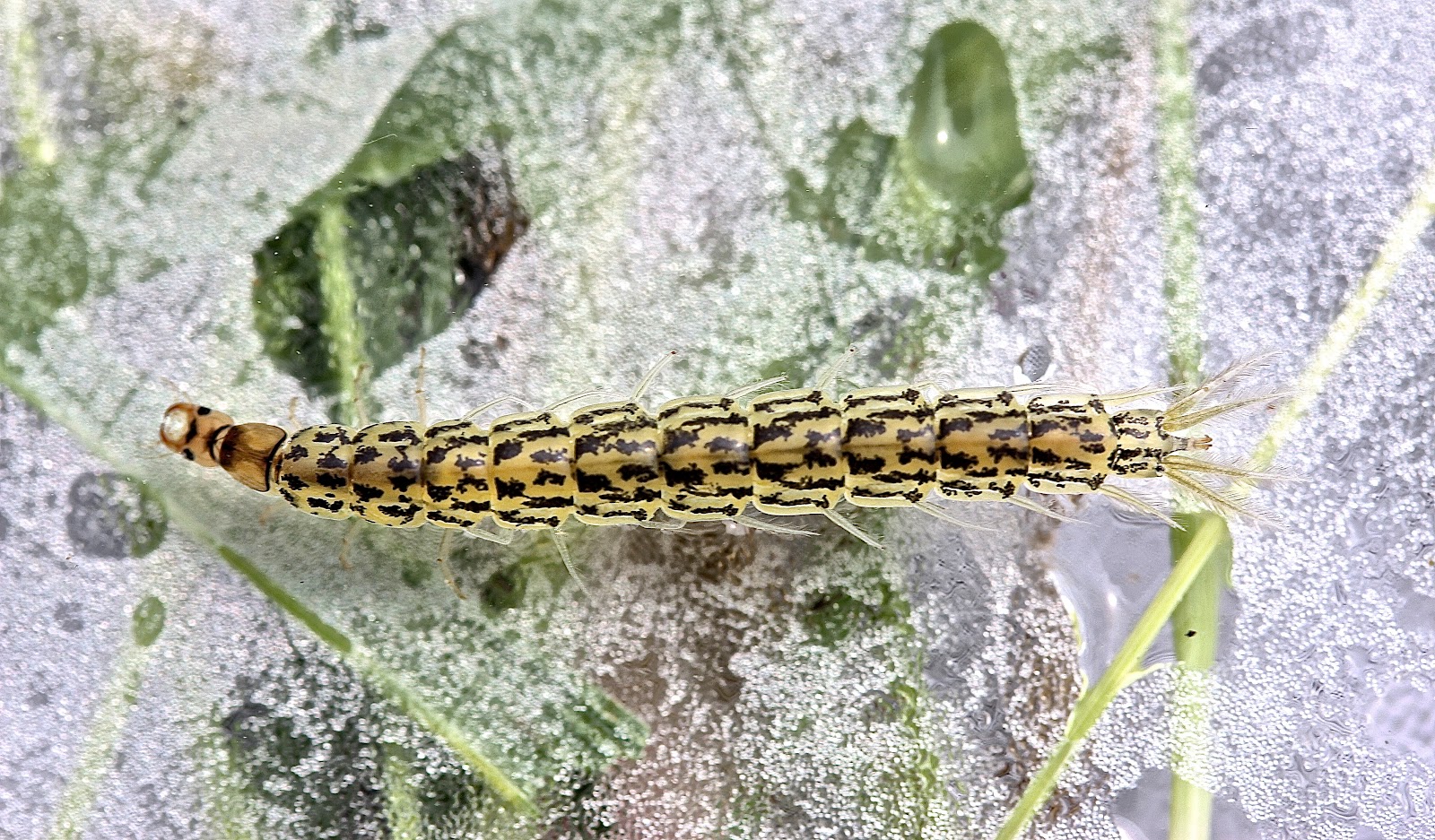
One of the strangest critters we see in our streams -- some of them -- in the summer: a whirligig beetle larva (Gyrinidae), genus, Dineutus.  The genus ID is determined by the shape of the head: if it's "elongate" it's Gyrinus; if it's "semi-circular" it's Dineutus.   Hard to believe that this odd-looking thing turns into a black beetle that, as an adult, swims on the surface.  (For pictures of Dineutus adults, go to: http://bugguide.net/node/view/95/bgimage?from=96.)  The key feature in family ID is the four terminal hooks on the final abdominal segment -- which you can see in this photo if you click on it to enlarge it.
Actual size -- around 1" long.


Gyrinidae larvae inhabit the tangled, coarse vegetation that grows on a lot of the rocks in Buck Mt. Creek in the summer.  So too do immature brushlegged mayflies and common netspinners, the two most common insects that I saw this morning.  On the bottoms of the rocks, on the other hand, it was all flatheaded mayflies and small minnow mayflies.  There are still a lot of Epeorus vitreus flatheads in Buck Mt. Creek -- they'll probably be here most of the summer -- and the Heptagenia marginalis nymphs are also showing up in pretty good numbers.

E. vitreus (a young one):


H. marginalis, also a young one:


On the small minnow mayflies -- I found the same two species I've been finding in my other "small minnow" streams: Baetis intercalaris and Beatis pluto.

B. intercalaris (male):


B. pluto


But, as the song says, "I still haven't found what I'm looking for": the small minnow mayfly Acentrella nadineae.  This one (found in the Doyles River last year on June 23).


They're very distinctive with the orange/red splotches on the terga and the thorax, and by now, I've been to every stream where I found them last year: Powells Creek, the Doyles River, the Lynch River, and Buck Mt. Creek.  I've not yet seen a one.  Just have to keep looking.
_______________

Below:  one of several small, common stoneflies -- genus Acroneuria -- that I found this morning.  This one will mature over the winter.

Sunday, June 17, 2012

Maturity and Mystery: Insects from the Doyles River at Blufton Road


Just when I think that the Baetis intercalaris small minnow mayflies are just beginning to show up in our streams -- and to date, I have only seen young ones -- I find something like this: a beautiful, colorful, fairly mature B. intercalaris nymph!  Compare this to one of the two that I found yesterday at the Powells:


I guess the lesson learned is that these nymphs are in our streams for a long stretch of time.  And although the "main" B. intercalaris hatch occurs here in late summer and fall, we still find some "early birds" that are already mature in May and June.  Whatever the answer, this was a beautiful nymph to find in the Doyles.


But this is only one of four mature insects that I found today.  Obviously, lots of things are getting ready to hatch.  The other three?

1) Common stonefly: genus Perlesta


2) Small minnow mayfly: species, Plauditus dubius (female)


and 3) Flatheaded mayfly: genus Leucrocuta


And there was one other species of small minnow mayfly, not yet mature -- Baetis pluto.


_________________

And now for the "problem child," or, possibly, "problem children."  I found two, very small, flatheaded mayflies that I am, at this point, hesitant to identify to the level of species.  These:


Now, they are clearly Epeorus nymphs in terms of the genus: only two caudal filaments (tails).  And, they appear to be the same species, given the pale/yellow spots on tergites 1 and 2.  Given the 4 irregular pale spots on the leading edge of the head, I'd conclude that they are E. vitreus nymphs.  But, have another look at the two.  First, the one at the top of the photo, the one with the broken tail (nymph 1).


And then nymph 2.


Look closely at the shapes of the heads (fairly rectangular vs. fairly round) and the shapes of the eyes: not exactly the same.  The gills seem to differ as well.  And have a close look at the head of nymph # 1.


It's not only "subquadrate" in shape, there are lateral indentations, and the back edges of the eyes project behind the back edge of the head.

Hmm....   Well, I've got some work to do.  These may turn out to be "variations" on the E. vitreus theme. If not, I'll let you know.  Always like a mystery!
____________

The Doyles River below the bridge at Blufton Road.


And the photographer hard at work on Father's Day!  (Not easy on the elbows and knees.)

Saturday, June 16, 2012

The Common Stonefly (Perlid), genus Neoperla: Back to the Powells


It was one of those pleasant mornings when I actually found what I was looking for -- and I did not have to look very long.  This is the common stonefly (Perlid), genus Neoperla, a genus which, to date, I have only found in Powells Creek in Crozet.  While most of our Perlids are close to hatching, or have already hatched, the Neoperlas tend to hatch in late summer.  So, look for them throughout the summer, and I'd look in "Eccoptura/salamander" type streams, i.e. small streams in which you find a lot of Eccoptura common stones and the salamanders who seem to prefer the same type of conditions.

Neoperla nymphs are unique in two different ways.  1) This is the only Perlid in the U.S. that has only two ocelli -- that's the two black dots at the back of the head.  All other genera have a third ocellus in front of these two -- an "anteromedial ocellus" (front and middle).  2) This is one of the few Perlids that is univoltine, i.e. it has a one year life cycle, so you never see more than one generation in a stream at a time.
(See Steven Beaty's "The Plecoptera of North Carolina," pp. 17-18.)

Here are more photos of two of the nymphs that I found this morning: one was clearly less mature than the other, the wing pads were less developed.


Neoperla nymphs have an even row of setae at the back of the head (occipital ridge), which I have pointed out on the following photo.

__________

While I was content to take these photos and leave -- I had accomplished my goal for the day -- I did continue to sort through some leaves and lift up some rocks, and I'm happy to say that the small minnow mayflies are now showing up in good numbers.  In the Powells I found both Baetis intercalaris and  Baetis pluto.

Baetis intercalaris ("parentheses" marks on the abdominal tergites):


Baetis pluto (tergite 5 is pale; 6 and 7 are dark):


Finally, I did find something I was not expecting to see -- a freeliving caddisfly larva (Rhyacophila fuscula).  I should have thought these had all pupated and hatched by now.


_______________________________________________


Thursday, June 14, 2012

Heptagenia marginalis Flatheads Return to the Moormans


The flatheaded mayflies were well represented today at the Moormans: I was below the bridge on Rt. 601, Free Union Road.  I found a number of E. vitreus nymphs, a lot of a genus I couldn't ID, and one beautiful, fully mature Leucrocuta (pictures below).  But without any question, the most common flathead I saw was the one in the photo above: genus Heptagenia, species marginalis.  This genus is easy to spot by color and shape.  The body is black, with yellow spots on tergites 1, 8, and 9.  And the shape is also distinctive: a wide head, with a body that continuously narrows.  It also has very long tails that it splays widely when it's put into a tray.

Anatomically speaking, it is the gills that distinguish this flatheaded genus.  Quoting Beaty ("The Ephemeroptera of North Carolina," p. 18), "gills of abdominal segments 1-7 similar in shape but 7th gill smaller; gill 7 has fibrilliform portion."  The shape of the gills is pretty clear in the photo above, but here is a close-up view of the fibrilliform (thread-like) part of the gill on segment 7.


For the species ID -- H. marginalis -- we have to see "oblique black lines present on sides of dorsum of abdominal segments."  And there they are.


I am always struck by the length of the tails on Heptagenia nymphs.  Pretty impressive!


____________

Now on to a mature Leucrocuta (the H. marginalis nymphs are still immature -- notice the very short wing pads.)


The nymphs of this genus are a bland gray color most of their lives, but they sure have beautiful colors when they mature.  I was pleased to find Leucrocuta and Heptagenia nymphs on the same day since, in one sense, they are closely related.  As with the gills on Heptagenia nymphs, the gills on segments 1-7 match up in shape, but the gill on the 7th segment is smaller.  But, on Leucrocuta nymphs, the 7th gill does not have a fabrilliform portion.  In this microscope photo, you can see the fibrilliform on the 6th gill, but note how it's missing on gill # 7.


Were you unsure of the ID of a flatheaded nymph, trying to decide between Heptagenia and Leucrocuta, you would have to look behind gill # 7.

I didn't see much of anything else at the Moormans today.  The water was high from recent rains, so perhaps the flatheads -- they're "clingers" -- were the only nymphs able to hold onto the rocks at the moment!

Heptagenia marginalis:


Leucrocuta (I've not yet determined the species ID.  However, L. hebe seems the most likely candidate since Knopp and Cormier [p. 150] say this species normally hatches "from July to early October."):