Tuesday, September 25, 2012

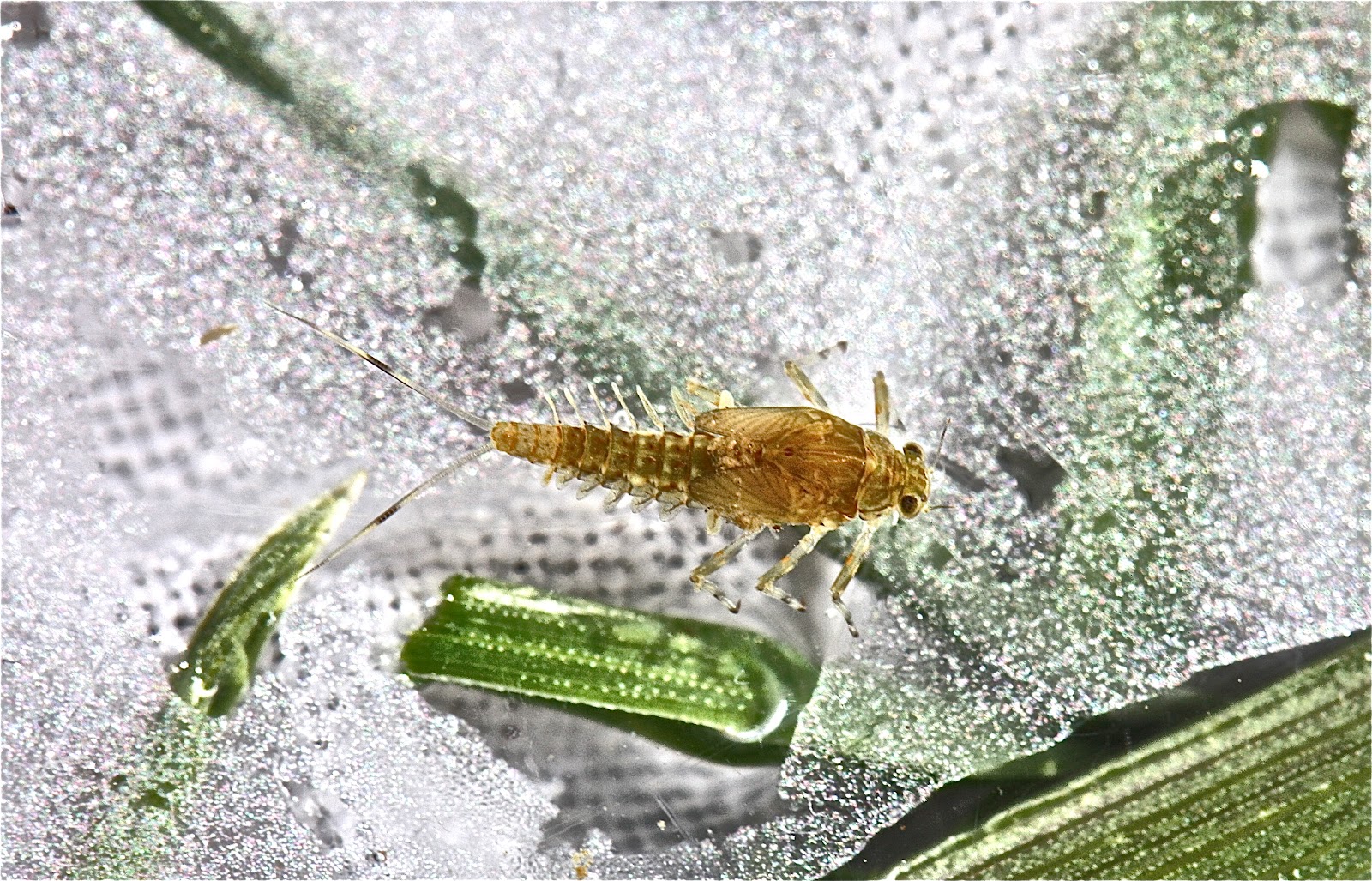
EPT Species List for Central Virginia: Photos of Small Minnow Mayflies


With cloudy weather ahead, and not much water in a lot of our streams, my regular outings might be interrupted this week.  So I thought I might begin work on a project that may be of interest to some of our readers.  I'll post photos of the insects noted in the species list posted on September the 8th.  I'll work through the "orders" in order -- Mayflies (Ephemeroptera), Stoneflies (Plecoptera), and Caddisflies (Trichoptera) and focus on the families one at a time -- where the family contains a fair number of species -- and group the families together when the species noted are few.

For each species, I'll add the approximate size as that is given in Steven Beaty's "The Ephemeroptera (or Plecoptera or Trichoptera) of North Carolina."  I'll also note the time of year when I typically see nymphs of that species (though there are always exceptions).

Keep in mind that colors/hues of individual nymphs may vary by stream -- patterns do not.  Patterns are normally species specific, but in some species, male and female patterns can vary (they're "sexually dimorphic").

I. Ephemeroptera

 Baetidae (Small minnow mayflies)

1. Acentrella nadineae.  Size: 5-5.8mm; Season: Summer -- Early Fall.

a. male

b. female


2. Acentrella turbida.  Size: 4-6mm; Season: Spring, Summer, and Fall

a. male

b. female


3. Baetis flavistriga.  Size: 4-6mm; Season: Summer.

a. male

b. female


4. Baetis intercalaris.  Size: 5-6 mm: Season: Summer and Fall.

a. male

b. female


5. Baetis pluto.  Size: 4-6 mm; Season: Spring -- Fall.

a. male
b. female


6. Baetis tricaudatus.  Size: 5-8 mm; Season: Winter -- Spring.

a. male
b. female


7. Heterocloeon amplum.  Size: 7-9 mm; Season: Winter.

a. male


b. female

8. Heterocloeon curiosum.  Size: 6-7 mm (females larger than males); Season: summer.

a. male

b. female

9. Heterocloeon petersi.  Size: 7-8 mm; Season: Summer.

a. male


10. Iswaeon anoka.  Size: ~ 4 mm; Season: Summer.

b. female


11. Labiobaetis propinquus.  Size 4-6mm; Season: Spring through Fall.


12. Plauditus dubius.  Size: 3.0-3.5 mm; Season: Spring.

a. male
b. female
_______________

Entries to follow on Spiny Crawlers (Ephemerellidae) and Flatheaded Mayflies (Heptageniidae).  Photos for the families Ameletidae, Isonychiidae, Leptohyphidae, Caenidae,
Baetiscidae, Leptophlebiidae, and Ephemeridae will be combined in one entry.

Sunday, September 23, 2012

Small Beginnings: The New Season Starts at the Rapidan River


There were two insects I was hoping to see at the Rapidan River this morning: I only found one -- the spiny crawler mayfly, Ephemerella subvaria.  (I did not find the Perlodid stonefly, Isogenoides hansoni -- maybe next time.)  Now, I could have cropped this photo for a closer view of the nymph -- but that wouldn't do justice to its actual size: 2 mm!  That's small.  By the time these nymphs mature in February and March -- creating the "Hendrickson" hatch -- they will be 8-12 mm, and look something like this (photo taken on 2/17 of this year).


But they really are small at the moment, and I'm pleased that my photos turned out as well as they did.


_______________

It was a morning for finding small insects -- as it should be, we're at the beginning of a new season.  Here are a few more insects that will mature over the winter and hatch next year in the spring.

1. A free living caddisfly larva, Rhyacophila fuscula. This was 1/2" long at the most; at maturity the larva will be well over an inch.


A mature one in the photo below.

_______________

2. Common stonefly, Paragnetina immarginata (I think...), like the E. subvaria mayfly, a taxon I only see in this stream.  I found a lot of them: here are photos of two.   (The clue to a P. immarginata ID, by the way, is the dark, longitudinal bars that run about 2/3 the length of the femora.)


The largest of these was about 1/2" in length: the mature nymph is 1 1/4 -- 1/12" long -- and much more colorful.

_______________

3. Giant stonefly, Pteronarcys biloba.


This is not the first time I've seen giant stoneflies this year, but this is the first nymph that I was big enough for me to ID at sight.  Still, this one was "small," a little over 1" in length.  At maturity P. biloba nymphs are close to 2 inches.  In one of the photos I took, you can see that little E. subvaria spiny crawler: this will give you some sense of how small it was.

_______________

4. A small Leuctrid stonefly, genus Leuctra.  I don't expect to see these much before winter.

________________________

Naturally, I did find some other insects that are still "hanging on" from the season that's now ending up.  These included this "humpless" case-making caddis (Brachycentrid) -- Brachycentrus appalachia:


And that little small minnow mayfly that is literally "hanging on" (!) is a still immature Baetis intercalaris.  Here's a much better photo.


Finally, there was another small minnow mayfly that, as you can see, is certainly ready to hatch: Plauditus dubius, male.

________________

It was a spectacular, early fall morning in the Rapidan valley.  Lots of color -- blues, purples, oranges -- provided by the many flowering bushes.


Friday, September 21, 2012

Leucrocuta hebe: Our "Pale Evening Dun" (PED)


The Leucrocuta flatheaded mayflies I've been finding this summer and fall appear to be L. hebe in terms of the species -- that's the "Pale Evening Dun" (PED) to fly fishermen, an important hatch throughout the summer.  The nymph in the photo above was found in the Doyles River on 6/17; the one in the photo below was found in South River, Greene County, just last week, on 9/12.


This is a small mayfly, 6-8 mm when it's mature, but I begin to see them in the spring when they're very, very small.  I believe I mentioned last year that when they're immature, it's difficult to pick them up with your tweezers without doing some damage: I no longer pick them up at that stage of the game.


Leucrocuta flatheads are typically "collected from small, clean streams, from riffles and pools" (Steven Beaty, "The Ephemeroptera of North Carolina," p. 19).  I see a lot of them in the spring in very small streams, streams that are too small to fish (but there are trout in the Doyles and the South).

Beaty describes the genus in the following way: "Head wider than pronotum (pronotum widest near middle); dark freckles on anterior portion on head; claws with distinct denticles; gills of abdominal segments 1-7 similar in shape but 7th gill smaller; gill 7 lacks fibrilliform portion; three caudal filaments with no intersegmental setae."  (Beaty, p.19)  All of those features -- save for the denticles on the claws -- can be seen in the following photo:


What about the species ID?  Beaty urges us to leave the ID at the level of genus, but he notes L. aphrodite and L. hebe as the species most commonly seen in his state, in addition, "Leucrocuta in the Piedmont are probably aphrodite."

Knopp and Cormier -- Mayflies: An Angler's Study of Trout Water Ephemeroptera, pp. 149-153 -- note that L. aphrodite and L. hebe both hatch out as PED's, though some fishermen call L. hebe the "Little Yellow Quill."  L. aphrodite is common in the East, hatching mainly in the spring; L. hebe is found in the East and the Midwest and hatches in the summer and fall.  They also help us to distinguish the nymphs  (see their chart on p. 152).  The key is the abdominal pattern.  For L. aphrodite "tergites 9-10 [are] paler"; for L. hebe, the color is "grayish brown with paler U-shaped spotting on [the body]."  On the nymphs that I'm finding, tergites 9-10 are not paler than the rest, but there are "U-shaped" spots on the body, especially on terga 4-5 and 7-8.  Note this mature L. hebe that I found on 9/12.


I don't think there's much doubt that the Leucrocuta flatheads that I see in the summer and fall are L. hebe.  For those that I see in the winter and spring -- I'll have to check them closer next year: it's certainly possible that both species show up in our streams.

(For other photos of L. hebe -- both the nymphs and the adults -- see Donald Chandler's posting on Discover Life: http://www.discoverlife.org/mp/20q?search=Leucrocuta+hebe.
_________
Additional photos of L. hebe nymphs:


Thursday, September 20, 2012

Eight Miles Apart, Two Different Species: Acroneuria carolinensis, Acroneuria abnormis


In the photo above, the "common stonefly" (Perlid), Acroneuria carolinensis.  In the photo below, the "common stonefly" (Perlid), Acroneuria abnormis.


I've been itching to get up to the upper Doyles River, but I've been waiting for the water rise.  It has, after significant rain on Monday and Tuesday.  But I can't say that I found a lot of insects: my common complaint at this time of the year.  Things will pick up by the end of this month.  I did find a few "smallish" Giant stoneflies, and a few "smallish" flatheaded mayflies, along with a handful of brushlegged mayflies -- also on the small side at this time of the year.  But I did see significant numbers of common stoneflies almost all of them Acroneuria carolinesis.

So I moved further downstream, making my way back to Whitehall, where I found much the same insects, though there are no Giant stones in this part of the river.  Again, there were common stoneflies in the leaves and on the rocks, but the nymphs that I saw -- like the one in the second photo above -- were all A. abnormis.

The most common, "common stonefly" I see in our streams is Acroneuria abnormis: A. carolinensis, by contrast, isn't common at all.  It's a species I only see in very good streams, or in the best part of a stream, as I found with the Doyles River today.  Acroneuria abnormis has a tolerance value of 2.1; Acroneuria carolinensis has a tolerance value of 1.2.

How do they differ?  Well, let's begin by noting how they're the same.  What makes them Acroneuria nymphs?  This is a genus that's defined by three features: 1) there is, almost always, a pale "M" on the top of the head; 2) there is no setal row on the occiput -- i.e. at the back of the head -- rather, setae is only found behind the eyes; and 3) there is a basal fringe of "silky setae" on the cerci (tails), but no anal gills (though there are some exceptions to this).  We can note those features on both of our nymphs without recourse to microscope views.

A. carolinensis:


A. abnormis:


But how do they differ?  Well the "M" pattern on A. abnormis nymphs is sometimes "interrupted," as it is here.  But the main difference is the abdominal banding: on A. abnormis the posterior margins of the terga are light, anterior margins are dark: with A. carolinesis, just the reverse is true.  (Also note, on the A. abnormis nymph, that the dark tergal bands are irregular in shape, not uniformly "thick." This is key to the species ID.)

Both of these nymphs were still immature, they will continue to grow over the winter, hatching sometime next summer.  Still, these specimens were fairly large: the A. abnormis nymph was about 14 mm; A. carolinesis, about 17 mm.  But both were fully colored and patterned, and it was a treat to get some good photos and put them back into the stream.

A. carolinesis:


A. abnormis:

_______________

For full descriptions of Acroneuria nymphs, be sure to look at Steven Beaty's "The Plecoptera of North Carolina," p. 14.  He gives detail on nine different species.