Thursday, May 23, 2013

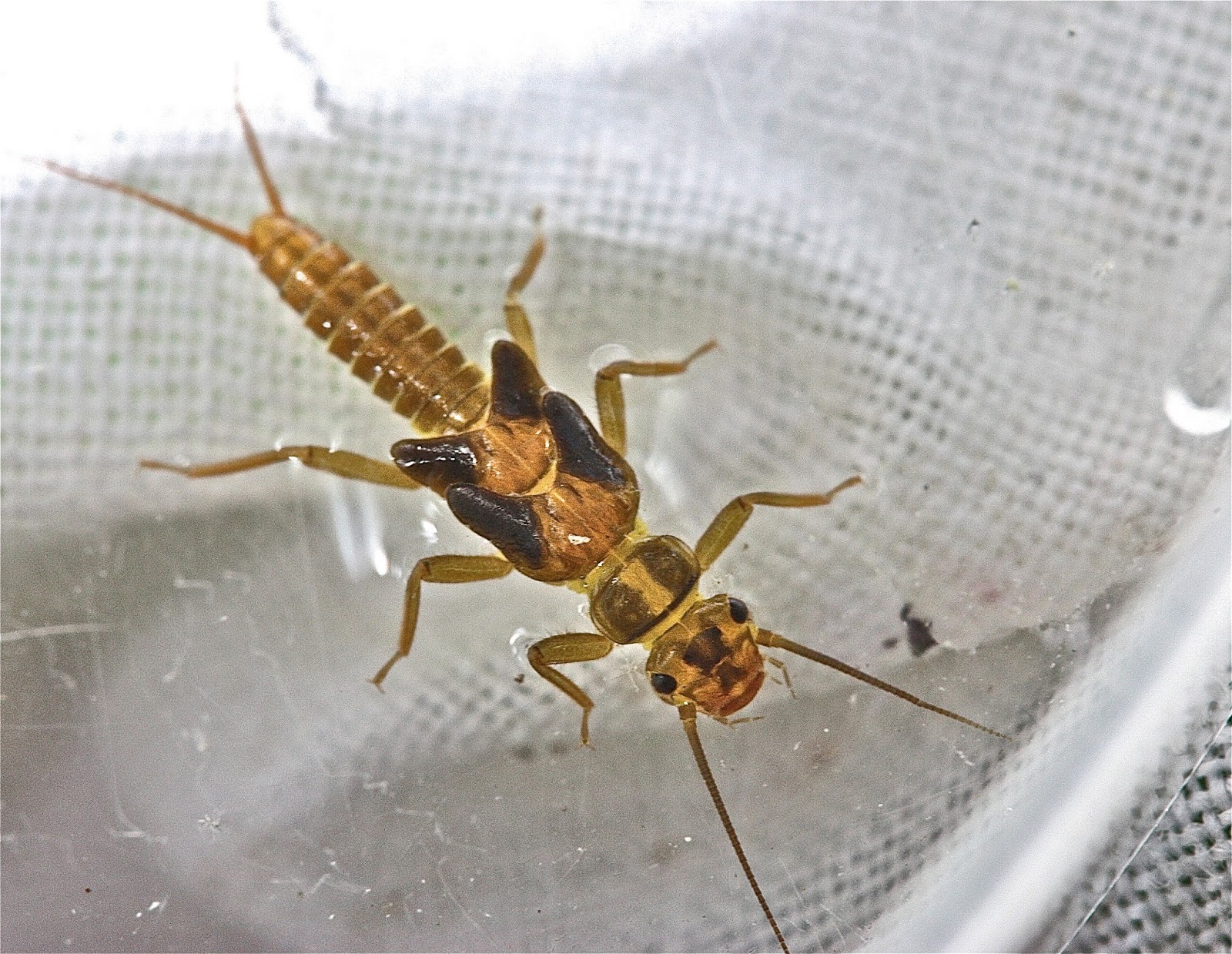
And another genus of spiny crawler at Buck Mt. Creek: Eurylophella


On my most recent trips to Buck Mt. Creek I've seen a lot of spiny crawlers: two species, Ephemerella dorothea and Drunella tuberculata.  Today I saw one E. dorothea and no Drunellas at all -- but I did see four Eurylophellas.   This is a small nymph: of those I found there this morning, the largest -- the one in the photo at the top of the page -- measured about 7 mm.

It is largely those large gills on segment four of these nymphs that let us ID this particular genus.  Beaty ("The Ephemeroptera of North Carolina," p. 28) describes the genus this way: "gills on segment 4 operculate and largely covering the gills on 5-7; paired tubercles on abdominal segments 1-7; abdominal segment 9 distinctly longer than segment 8."   These are the gills:


And the tubercles on segments 5-7 are pointed out in this photo taken last year.


Last year I concluded that I was finding Eurylophella verisimilis at BMC because of those dark gills on 5-7.  I'm no longer sure of that species ID, so let's just leave this at the level of genus.

Here's another look at our nymph...


And here's a shot of one of the small nymphs that I found.

________________

While I was pleased to see Eurylophellas, I was surprised to see this one: a "water scavenger beetle," Hydrophilidae.


The wierd thing is that as I was getting out of my car at the stream, I was thinking about the various beetles I've found at this stream.  I've seen Dryopids, riffle beetles, and whirligig beetles -- but, I said to myself, I've never seen a water scavenger beetle at Buck Mt. Creek.  And of course I found three of them in the first clump of grasses and roots in which I looked!

Water scavenger beetles come in two different shapes.  The other one looks like this:
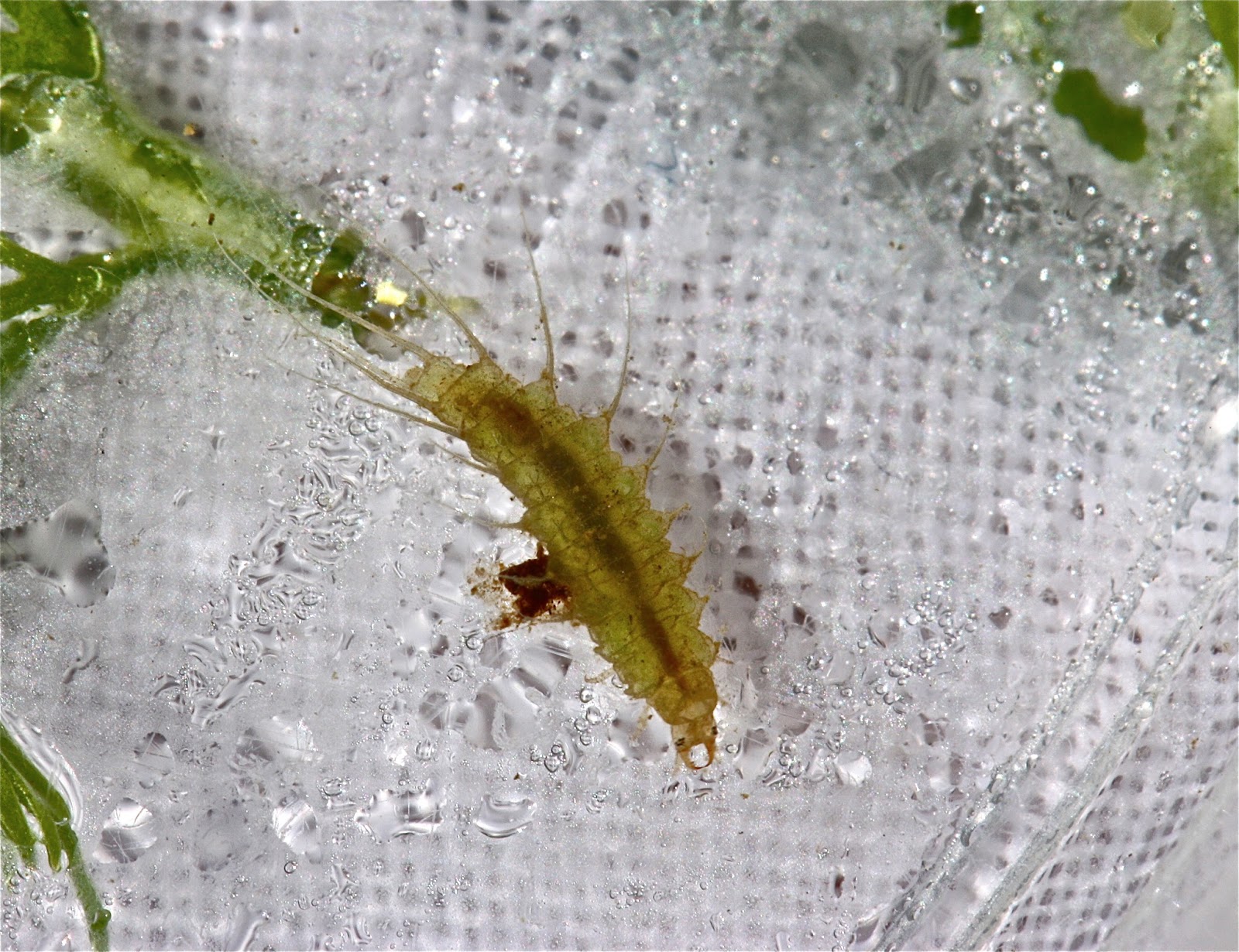

This larva was found in the Moormans river on 9/29/11.  Actually, it's the bodies that differ -- the heads look the same.
________________

Other photos:

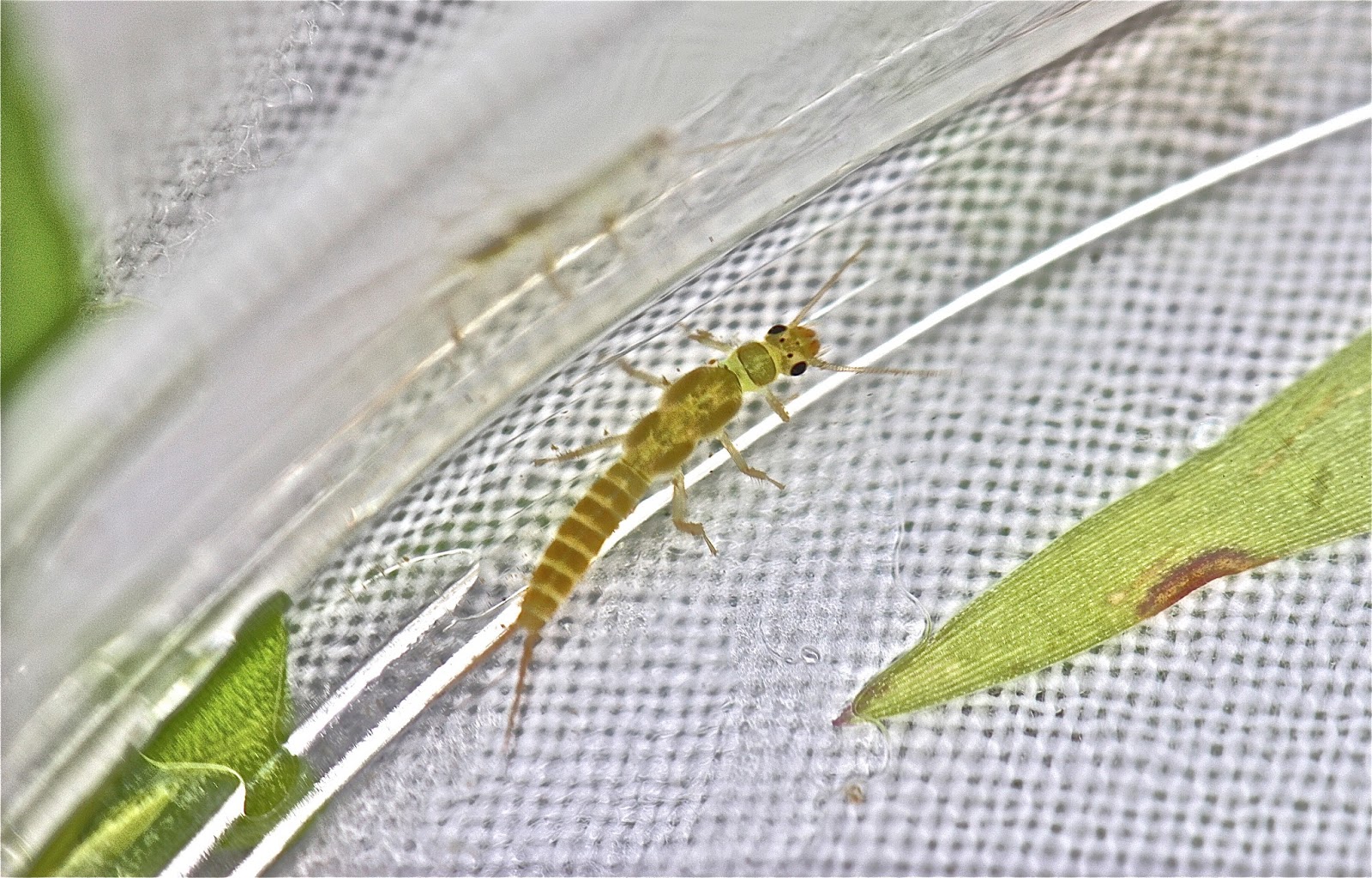
1. Something I was not expecting to see, a green stonefly, genus Alloperla.


Here's a photo of one I found at the Doyles River on May 23rd (!) of last year.

2. Another "long-horned case-maker," presumably the same species I found here before, Ceraclea maculata.  I didn't keep it -- but the head and the case look exactly the same.


3. Our first Perlesta common stonefly of the season.  This is the one that we will be seeing a lot of in June and July.


4. And, "signs of summer," a narrow-winged damselfly nymph (Coenagrionidae), and that odd-looking club-tailed dragonfly, Hagenius brevistylus.


Can you spot the 4th segment on the antenna?  Just barely visible.


I also saw quite a few Darner dragonflies.  We move into summer.

Saturday, May 18, 2013

And the Perlodid stoneflies I've found that are "not" in Buck Mt. Creek are...


1. Isogenoides hansoni -- at the Rapidan River (in the photo above): TV, undetermined (too rare)


2. Isoperla nr. holochlora -- at the Rapidan River: TV, 0.0


3. Malirekus hastatus -- at the Rapidan River and in the small streams in Sugar Hollow: TV, 1.0


4. Isoperla similis -- small streams in Sugar Hollow: TV, 0.8


5. Isoperla sp.1 (species unidentified): small streams in Sugar Hollow: TV, undetermined


6. Isoperla sp.2 (species unidentified) -- small streams in Sugar Hollow: TV, undetermined

________________

(Below -- one of the small streams in Sugar Hollow in which species 3-6 have been found.)


Buck Mt. Creek -- a Perlodid stonefly "factory"


Buck Mt. Creek originates in the northern part of Albemarle county, not far from the boundary of the Shenandoah National Park.  I look for insects 10-12 miles southeast of that location at the junction of Catterton Road and Free Union Road, 2-3 miles east of the town of Free Union.   I remember it being rated a little bit over average when I monitored streams.  Still, my impression is that it's the "richest" stream that I visit in terms of the variety of aquatic insects it holds: mayflies, stoneflies, caddisflies, dragons and damsels, diptera and beetles.  One of these days I intend to compile a list of the EPT species that I've found in that stream since I started writing this blog.

And it's a "factory" for Perlodid stoneflies.  I've found more Perlodid species in BMC (Buck Mt. Creek) than in any of the streams I explore, with the possible exception of the Rapidan River.  So I thought I should publish the list, with photos, noting the tolerance values.  I'll divide them up by season, noting the months when we're most likely to see them.  Most of these photos were taken at Buck Mt. Creek.

I. Fall, Winter: October -- March

1. Clioperla clio: TV, 5.2


2. Diploperla duplicata: TV, 2.8


3. Helopicus subvarians: TV, 1.2


II. Spring: March -- May

4. Isoperla montana/n. sp.: TV, 2.5


5.  Isoperla davisi: TV undetermined


6. Isoperla dicala: TV undetermined


7.  Isoperla sp. (possibly I. orata): TV, 0.0


III. Spring - Summer: April -- June

8. Isoperla holochlora: TV, 0.7


9. Remenus bilobatus: TV, 0.9


Nine species -- well, nine species and counting.  I won't be surprised if this list continues to grow.
Buck Mt. Creek remains one of my favorite streams in the county in terms of insect populations -- and I admit to being partial to Perlodid stones!
________________

(The riffles pictured at the top of the page and in the photo below are the two sites where I find most of these insects.)


Friday, May 17, 2013

Drunella day at the Doyles: Drunella walkeri, Drunella tuberculata (spiny crawler mayflies)


The spiny crawler, Drunella walkeri.  I've seen them before -- in the Doyles River and in Buck Mt. Creek -- but I've never seen one with these incredible colors.  Wow!

Actually, one of the things I was hoping to find today at the Doyles was a Drunella, but I was looking for Drunella cornutella.  This:


I found this one on May 26 of last year at my "upper" Doyles site,  close to the boundary of the Shenandoah National Park, which is where I started looking for insects this morning.  No luck.  But when I stopped at my lowest site on the Doyles, about 1 mile north of White Hall, I found a lot of Drunellas, but D. walkeri (TV, 0.6) and D. tuberculata (TV, 0.0).  But this walkeri was pretty special.


D. walkeri is described by Beaty in the following way:  "nymphs 8-10 mm; body setose; head roughened, with only small occipital tubercles and barely discernible lateral frontoclypeal projections; genae produced into sharp anterolateral projections; forefemur with long hair; abdomen with paired dorsal tubercles always well developed on segments 5-7.  Collected in late winter through spring.  Uncommon in the mountains."  (Steven Beaty, "The Ephemeroptera of North Carolina," p. 26)

The body is indeed very setose (hairy) as you can see in this photo: you can also see the long hair on the fore femora. (Click on the photo to enlarge.)


The genae are quite pronounced on this nymph and really stick out from the front sides of the head. They look like little horns.


And the tubercles on the posterior edges of the abdominal tergites show up as white dots on this particular specimen.


Quite a find.  It was even colorful when I flipped it on its back.


One of those insects that makes your day.

________________

Drunella tuberculata.


Not nearly so colorful as our D. walkeri, but interesting nonetheless.  On D. tuberculata, Beaty has the following things to say. (p. 25)

D. tuberculata -- nymphs 7-9 mm; head with long occipital tubercles not divergent apically; frons without dark transverse band; abdomen with paired dorsal tubercles always well developed on segments 5-7.  Collected in spring and summer from rivers.  Uncommon.  Primarily a Mountain species.

Here is a good view of the occipital tubercles, and they clearly do not diverge apically, they might even slightly converge.  You can also see in this photo that there is no dark band on the frons (the face).


The tubercles on segments 5-7 are well developed though they might not be as clear as I would like in this photo.


(For more detail on how we identify D. tuberculata, see the entry of 4/23/12.)
_______________

Knopp and Cormier (Mayflies, pp. 224-227) do not mention D. tuberculata as important to fly fishermen, but they do list D. walkeri as one of five Drunellas that hatches as the "eastern blue-winged olive."  D. walkeri hatches in the northeast from July through September -- probably in June and July down here.  It must be a fairly big mayfly: BWO's  (vs. "eastern BWO's" are normally small, hatching from small minnow mayflies primarily in the spring and fall.

If you want to look for these nymphs, stick close to shore and look in patches of thick vegetation (leaf packs, root balls, bunches of twigs).   They will be in flowing water, but I never find them out in the fast flow of the stream.  Also look at the bases of patches of grass in the water.  Three of the five nymphs that I found this morning were on a small piece of bark submerged in the water.

They are often dirty, even covered in silt -- like this D. walkeri, one that I also found in the Doyles this morning.  Not all of them are as clean and colorful as the one at the top of the page.  But when you're crawling in root balls with those hairy legs and hairy body, this is what happens!


Thursday, May 16, 2013

Let's give the Spiny Crawlers their due


This morning I went to a small mountain stream in Sugar Hollow, one of the seven that I visit in a fairly regular way.  I saw quite a few Perlodid stoneflies -- Isoperla holochlora, Remenus bilobatus, and that unknown Isoperla on which I focussed last week (5/10).  But the leaf packs were loaded with spiny crawler mayflies -- Ephemerella dorothea from what I could see -- which is true of leaf packs in just about all of our streams at the moment.

It's their time of year.  This may be the single most prolific insect we find in our streams, and they show up in April and May.   When I monitored streams, I remember being disappointed when samples were dominated by spiny crawlers.  That had a negative impact on the "score" of the stream.  In Virginia, to begin with (unless things have changed), all spiny crawlers -- every genus and species -- are given a tolerance value of 4 (scale of 1 to 10), and whenever one insect family accounts for, say, two thirds of the sample, the stream is seen to be lacking in the variety that's always desired (which also brings down the score.  Also, I never found them very attractive.

Point one: scores are bound to be skewed if every genus and species of a particular insect are given the same tolerance value.  Most of the spinys that we see at the moment are E. dorothea with a TV (in North Carolina) of 3.3, but we also see E. invaria (TV, 2.6), Drunella tuberculata (TV, 0.0), and Drunella walkeri (TV, 0.6).

Point two:  at this time of year, we are bound to get samples that are dominated by spinys -- it's inevitable.   And the lack of variety in our samples does not indicate that we're dealing with so-so streams.   The stream that I went to this morning was a head-water stream, a first order stream, one that is filled with quality insects.  Still, this morning, spiny crawlers probably accounted for 75% of the insects I saw.

And point three: if you think that spiny crawlers are "ugly," you're not looking at them very closely (which is true if you're just picking them off of a net).  Look at that beauty at the top of the page.  And here are more photos that I took this morning, all E. dorothea, three nymphs that differed in color and pattern.


Tis the season folks: take a close look and enjoy!
________________

Just one other photo -- a very nice Isoperla holochlora.  They too are very numerous at the moment in these small mountain streams.  Tolerance value: 0.7.