Friday, November 22, 2013

Rolled-winged stoneflies (Leuctridae) and Small winter stoneflies (Capniidae): How to Distinguish the Nymphs


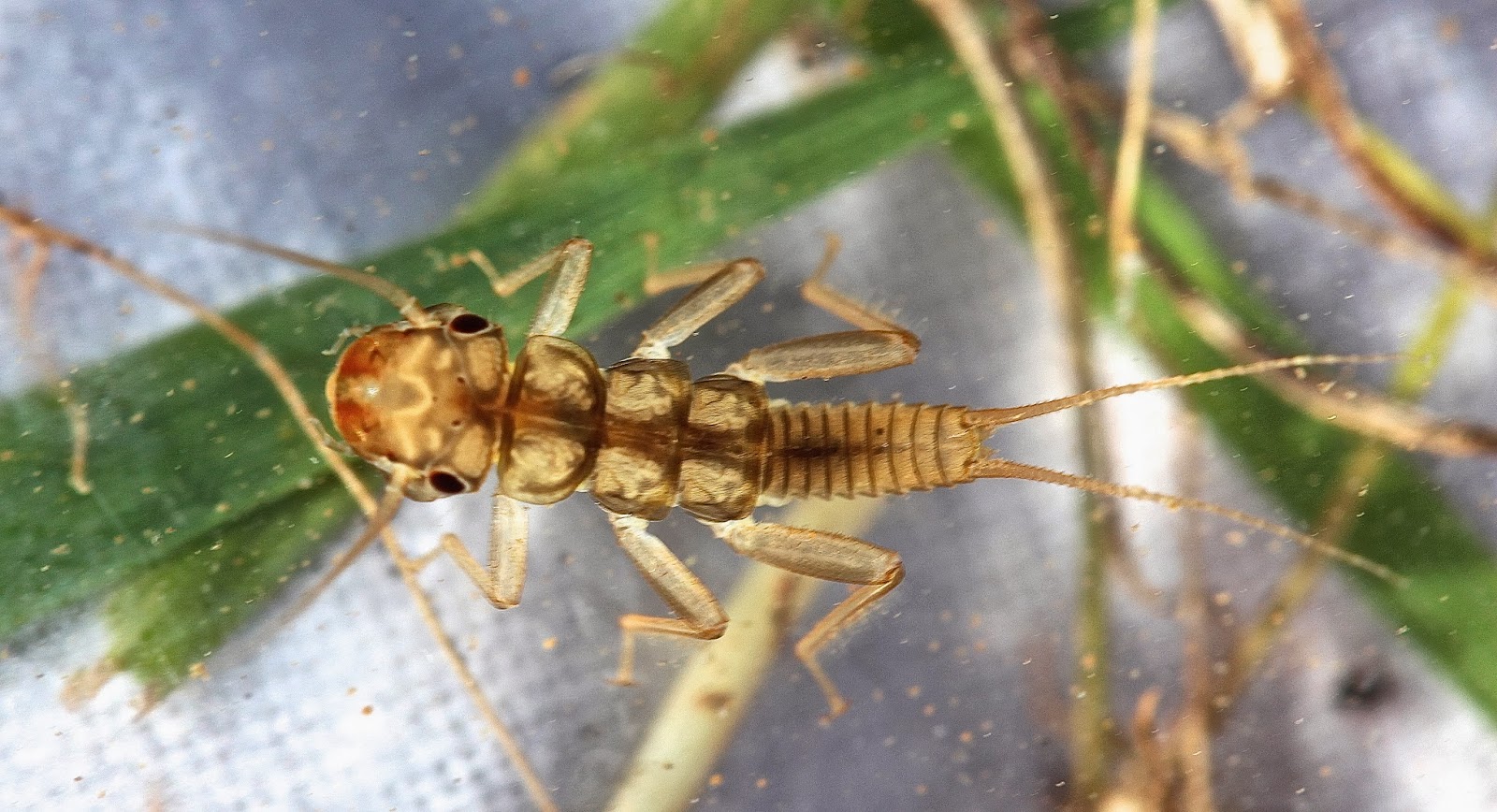
For many stream groups, the fall sampling season is over.  But if you're still out with your tables and nets, or if you plan to look at some streams in the next 2-3 months, there's a good chance that you'll find Leuctrids (rolled-winged stoneflies) and Capniids (small winter stoneflies) at the same time in the same place.  These nymphs can be confused, but you should be able to tell them apart.  Best advice -- look at the wing pads.

1. Rolled-winged stoneflies: genus Leuctra


The wing pads on Leuctrids on long and slender -- finger-like -- with those in the rear being shorter than those in the front.   All four wing pads are uniform in width from beginning to end: the sides are essentially parallel.   However, the front wing pads are widely separated, those in the rear are not, they're close together.  The front wing pads are so wide apart that the inner edges of those pads overlap the outer edges of the rear wing pads.
________________

I've found two genera of Capniidae in our streams, so we must look at them one at a time.

2. Small winter stoneflies: genus Allocapnia


Allocapnia small winter wing pads differ from those of Leuctra in two significant ways.  Note that those in the rear are not the same shape as those in the front: they are wider than those in the front, and the bottoms are flat/truncated.   In addition, while those in the front are further apart than those in the back, the inner edges of the front wing pads do not normally overlap the outer edges of those in the rear.

3. Small winter stoneflies: genus Paracapnia


Paracapnia wing pads are actually pretty close in appearance to those of Leuctra.   The front and the rear are much the same shape.  However, they tend to look more like "tear drops" than "fingers": they are wider at the top than they are at the bottom.
________________

There is one other thing you can look at when you're trying to distinguish Leuctrids and Capniids.  Note the length and shape of the abdomens.   The abdomen of the Leuctrid is long and thin, and like the wing pads, it's the same width from beginning to end -- parallel-sided,  pencil-like.  The abdomen of the Capniid (both genera) is somewhat shorter, and it tends to be slightly wider in the middle than it is at either end -- i.e. it's tapered, cigar-like.
__________________

Now, the wing pads and abdomens tell the tale if you've got a nymph that's mature or fairly mature.   What if you find one that's tiny, one where the wing pads are not very well formed?  Answer: you can't ID them in the field.  Preserve them and take them back to the lab.  And if you're the one who's stuck with the ID work back at the lab, what then do you look for?

Well, you can hope that the shape of the wing pads and/or the shape of the abdomen will be more easily seen with a microscope.  But certain ID depends on seeing "pleural" or "ventrolateral" folds on the abdominal segments.  It can be tough.  But here's what you're trying to see.  (Put the nymph on its back or its side.)

1. Capniids -- all Capniids -- have ventrolateral folds on all nine abdominal segments (See Beaty, "The Plecoptera of North Carolina," p. 1.)  They look like this.


2. Leuctrids have ventrolateral folds on the first four abdominal segments only.  (Beaty, p. 2)


Best I can do.  Good luck!


Tuesday, November 19, 2013

The "Strong-case makers" Psilotreta labida and Psilotreta frontalis: revisiting the issue of identification


I went to the upper Doyles River this morning where I found -- among other things (photos later) -- this Strong-case maker, Psilotreta labida.  If you look back at the entry posted on 10/29 you'll see that I found a Strong-case maker that day that I thought might be the species Psilotreta frontalis -- though at that time I was not totally sure.   I'm now fairly certain of that ID, so I thought I'd take this opportunity to revisit the issue.

1. Psilotreta labida -- Doyles River, 11/19


The head was so black on this larva that at first I wasn't sure it was P. labida, but as it turns out, that's a key to species ID.  Let's review.

P. labida -- larvae up to 13 mm; coloration variable, usually frontoclypeus entirely black with broad stripe extending to occipital foramen and usually darker than P. frontalis; pronotum with dark stripe broad sometimes nearly obscuring ground color; anterolateral pronotal projections long and acute; mesonotum nearly all dark.  Spring fed and larger streams.  (Steven Beaty, "The Trichoptera of North Carolina," p. 97)

Since the nature of the pronotal "anterolateral projections" is a key distinction between our two species, let's look at that first.


No question, they're long and acute.   But is the "frontoclypeus" entirely black, the dark stripe on the pronotum broad, and the mesonotum "nearly all dark"?


Using this microscope view, I'd answer "yes" to all of those questions.  Psilotreta labida.

________________

2. Psilotreta frontalis -- tiny stream at Montfair Farm, 10/29


Now to the larva -- actually there were several -- we found on 10/29.   While the "coloration" of P. frontalis is, like that of P. labida, "variable," Beaty does note some slight differences in the colors of the pronotum and mesonotum.  "dark on pro- and mesonotum confined to middle stripes and lateral edge; pronotum with anterior edge slightly darker than ground color."

In the photos below, the differences with P. labida in terms of the pro- and mesonotal colors are quite pronounced.


The mesonotum, in particular, is quite a bit lighter on P. frontalis.  And then, there are the anterolateral projections on the pronotum: on P. labida they're "long and acute"; on P. frontalis they're "relatively short."


They sure are.

There's one other way to distinguish P. frontalis from P. labida: habitat.   While P. labida can be found in "larger streams," P. frontalis seems to only be found in small head-water streams that are spring fed -- i.e. first order streams.  This point is made by Beaty, but by other authors as well.  Thomas Ames, for example, notes that, in contrast to P. labida,  "P. frontalis favors smaller streams" (Caddisflies, p. 214), and Ernie Schweibert comments "Psilotreta frontalis seems most abundant in small streams."  (Nymphs, Volume II, p. 135)  The stream I explored on 10/29 was one of the smallest streams I've looked in for insects: it was clearly a first order stream.  We do indeed have two Strong-case makers that live in our streams.

One final point.  I sent my "P. frontalis" photos to Steven Beaty and asked his opinion.  He agreed that they looked like frontalis.  However, he added that the real test to see if a larva is labida or frontalis is to check the setal pattern on the head, "particularly the length of seta 15 and 17."  Oh dear!
_______________

Most of the insects I found today at the Doyles could be expected at this time of the year.  Just a few photos.

1. Small winter stonefly, Allocapnia pygmaea.  Seeing small winters in significant numbers now.


2. Large winter stonefly, Taeniopteryx burksi/maura


3. Pronggilled mayfly, genus Paraleptophlebia.  The most common taxon in the river today.


4. Perlodid stonefly, Helopicus subvarians.


5. And this odd-looking Perlodid that had just recently molted.


It too turned out to be Helopicus subvarians!  Should have known it by the "mask" on the face.

Friday, November 15, 2013

Small and large winter stoneflies at Buck Mt. Creek -- and a beautiful common stone, Acroneuria carolinensis


With the clouds moving in for several days, I thought I'd see what I could find at Buck Mt. Creek.  And, at last, I found a fair number of small and large winter stoneflies.  But could I not, not begin with these photos?

The common stonefly, Acroneuria carolinensis.


The key to distinguishing A. carolinesis from the more commonly seen A. abnormis is the abdominal banding.   On A. abnormis nymphs the anterior margins of each of the terga are dark while the posterior margins are light: the banding is reversed on A. carolinensis.  Those bands are fairly easy to see on both of the photos above.

Although this isn't mentioned in any key that I've seen, there seems to be one other way to distinguish these species.  The femora on A. abnormis are uniform in color (gray/brown) without any banding; those of A. carolinesis are light in the middle with dark bands on both of the ends.

A. abnormis:

A. carolinensis

In any event, it was a beautiful stonefly -- and the lighting was good for some photos.
_________________

Small winter stoneflies.  I finally saw them in significant numbers, crawling on leaves in the leafpacks.  You have to be alert for any movement, they really are small stoneflies -- these were ~ 6 mm --and fairly light in color!  But, here's a nice pair.


Beaty cautions to leave the small winter ID at the level of genus -- these are both Allocapnia nymphs -- and as I found out last year, species ID is not at all easy.  Still, last year I felt that I could distinguish two Allocapnia species, A. pygmaea and A. mystica, and I think that's what we have here (pygmaea on the left, mystica on the right).   To see the case that I made, please look back to the posting of 11/4/12.  Clearly A. pymaea is a larger nymph -- with a larger head and larger wing pads -- and note that the pronotums of the two species are not shaped the same.

A. pygmaea (I think)

and A. mystica

I'll review these ID's when I find small winter nymphs that are mature.
________________

Large winter stoneflies.  And I found a fair number of large winters as well, genus Taeniopteryx. Did I mention that the eyes often look red?!


________________

But this A. carolinensis was surely the find of the day.


Thursday, November 14, 2013

Not much action, but some beautiful insects at the Rivanna at Crofton


This morning I decided to go where I knew there'd be water -- the Rivanna River at Crofton.  I didn't see a lot in the insect department: common stoneflies (A. abnormis and A. annulipes), Giant stoneflies (Pteronarcys dorsata), and a number of large winter stoneflies (genus Taeniopteryx).  Pretty much the same collection I saw at Darden Towe Park.  But I found a couple of beautiful stoneflies, so I focussed my efforts on getting good photos.

1. Pteronarcys dorsata -- pictured above.  Size was 22 mm, and note that it's fairly mature (the spread of the wing pads).  But look at those beautiful colors.  Beaty describes the common markings: "each tergite with anterior and posterior abdominal spots sometimes confluent to give the abdomen a longitudinally striped appearance (3-5 stripes possible)".   (Beaty, "The Plecoptera of North Carolina," p. 28.)  I see 4 rows of spots on the abdomen of this particular nymph.  But as you can see, the spots that form the 2, more distinct lateral stripes actually start on the leading edge of the pronotum!


It's a real beauty.


And I got a great shot of the gills: Beaty -- "branched gills present on thoracic sterna and on abdominal sternites 1 and 2." (p. 28)

________________

2. And then there was this magnificent common stonefly, Acroneuria abnormis (14 mm).


Beaty, you may recall, distinguishes two types of A. abnormis nymphs -- one with a distinct "M" pattern on the head (sometimes interrupted) and abdominal banding, and one that is lacking the "M," and is also lacking the abdominal banding, having terga that are "uniformly brown."  (Beaty, "Plecoptera," p. 14.)  I'd have to say this one is a bit of a mix.  There is a light colored "M" on the head, albeit "interrupted," but the abdomen is totally brown.


________________

Saw a number of large winter stoneflies but took only one photo.


Wednesday, November 13, 2013

Low Water in the Small Streams in Sugar Hollow = Tough Conditions


True, it was only 33 degrees this morning when I got to the stream -- but cold fingers go along with the hobby.  Water is low in the small streams I explore in Sugar Hollow: it's been a long time since we've had significant rain.  On top of that, the leaves have really come down, so even where the water is running, it's virtually covered.  I'm not finding insects in the quantity I might otherwise see.

As I did on November the 3rd (same stream), I continued to find Goerids, and as before, they were Goera calcarata.  Distinguishing features -- 1) 3 pairs of sclerites on the metanotum


and 2) no thoracic sternal plates.


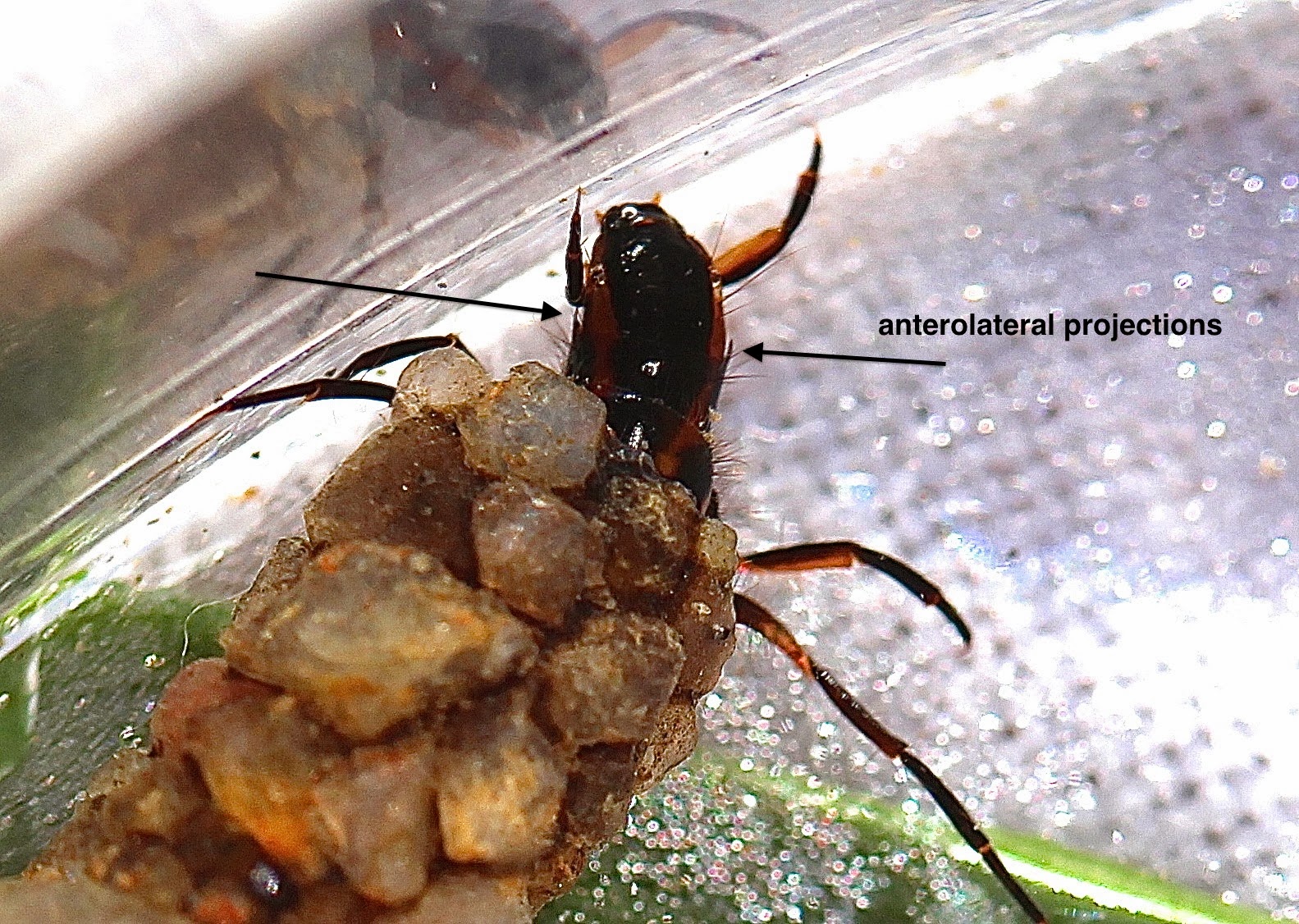
Last year I was quite sure that no Goerids lived in this stream, but now that I know what to look for they're easy to see.    The cases give them away, having 2 large ballast stones on each side, and if you get a close-up view of the head, you'll see the anterolateral projections that stick out from the mesonotum.


Species identification, however, requires preserving the larva to check for the sternal plates and the sclerites on the metanotum.  Bummer!
_________________

Other insects this morning...

1. I continue to find the Perlodid stonefly, Malirekus hastatus, in fact it's the only Perlodid stonefly I've seen so far in these streams.  That's a surprise.


2. And this is an excellent stream for the Giants -- Pteronarcys proteus.  Some of them now are quite large.  Note how the rear wing pads spread out.  This was around 40 mm, maybe a little big longer.  Magnificent critter!


3. And on the bottoms of rocks, there are plenty of flatheaded mayflies, some look to be Epeorus pleuralis -- I'll have to check that -- others, Maccaffertium merririvulanum.  (Note the "V"s on segments 7-9.)