Wednesday, April 16, 2014

The Green Stonefly Haploperla brevis -- and other treasures at the Whippoorwill Branch


After two inches of rain yesterday I didn't hold out much hope for finding good insects this morning -- but I was surprised.

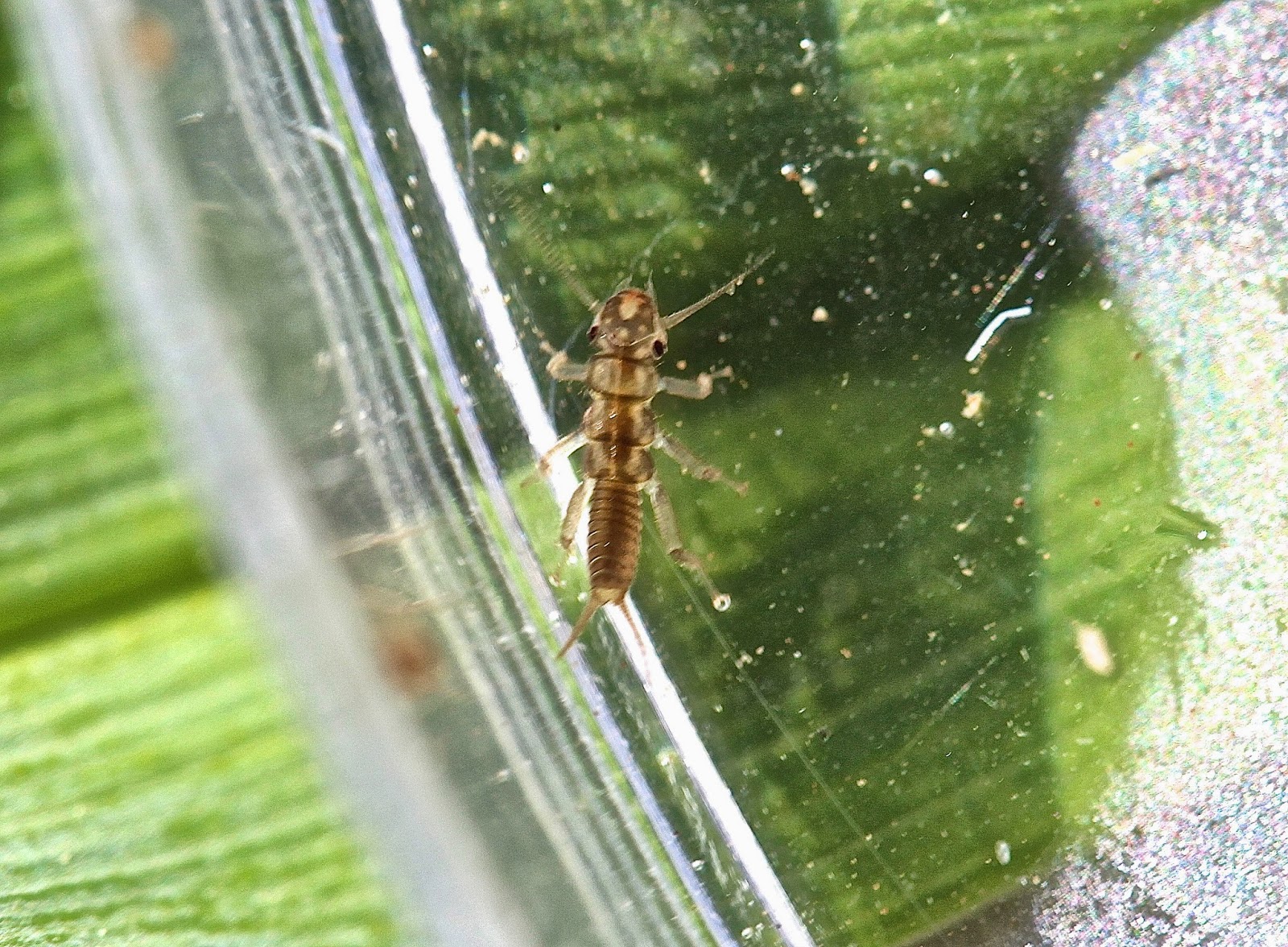
In the photo at the top of the page, the Green Stonefly (Chloroperlid), Haploperla brevis.  Though Beaty says this genus and species is "relatively common" ("The Plecoptera of North Carolina," p. 9), this is only the second one that I've found.


Beaty describes Haploperla in the following way.  "Nymphs ~ 7 mm; cerci without dorsal or ventral intercalary hairs, setae at apex of cercal segments only; pronotum with sparse setae, longest and most numerous at anterior corners; long pronotal fringe hairs are at least 0.3 - 0.4 times the pronotal width; inner margin of hind wing pads subparallel to body axis; pronotum and tergites lightly setose; fore leg with sparse fringe of long setae on tibia; body light brown, nearly concolorous."  "H. brevis -- fits genus description."  Elsewhere, the NC tolerance value is given as 1.4.

1. Our nymph measured about 6 mm.

2. The lack of intercalary hairs on the cerci can be seen in the following photo.


3. And here is a view of the long setae on the corners of the pronotum.  I'd agree that the longest hair that we see is .3 - .4 times as long as the pronotal nymph.


4. The hind wing pads -- and the primary wing pads for that matter -- are indeed subparallel to the body, but we can only see that in a microscope view.   (Note: in many keys, this feature is the defining feature of this genus.)


5. And here we can see the "sparse fringe of long setae" on the fore tibia.


Haploperla brevis.  Made the whole trip worthwhile.

_______________

But I also found the freeliving caddisfly larva Rhyacophila carolina for the first time this season at the Whippoorwill Branch.


R. carolina is distinguished by its golden brown head, the lack of ventral teeth on the anal claw,


and the fact that the head is very wide at the rear -- in fact at that point it's almost as wide as it is long.


R. carolina is part of a group (the R. carolina group) that is found predominantly in the southeast.  The group includes R. fenestra/ledra, a species we also see in the summer.  This one.


TV for R. carolina is 0.4.
________________

Another beauty this morning, a fairly mature common stonefly, Eccoptura xanthenses.  Note how the wing pads are long, and curved at the rear.  This one measured about 17 mm.


________________

But the most common insect today -- the spiny crawler, E. dorothea.  Get ready to be overwhelmed if you're out there taking your samples.


For the species ID, you need a close view of the terga.  There are no tubercles (projections) on the rear edges of the terga on the nymphs of this species.

_________________

But this one was special -- Haploperla brevis.


Sunday, April 13, 2014

Spiny Crawlers: The move from E. invaria to E. dorothea


I went to Buck Mt. Creek this morning hoping the water had dropped.  It hadn't -- still high and a little off color.  Nevertheless, I found a number of interesting things, and I wasn't sure what my focus should be.  But let's start here.

The spiny crawler "explosion" that we see every spring has already begun.   I saw large numbers of them this morning, and the leaves and grasses and root balls in the water will soon be absolutely crawling with spinys.  The species we see in the spring is Ephemerella dorothea, but preceding them in a lot of our streams are the E. invaria nymphs -- which is what you see in the photo at the top of the page.  The E. invarias are on the way out; the one in that photo is fully mature (black wing pads).  It measured 9-10 mm.  I photographed two of the E. dorotheas I found: they were only 5 mm.


If you monitor streams, your samples will soon be dominated by these spiny crawlers -- E. dorothea.  E. dorothea, by the way, hatches as the "Eastern Pale Evening Dun (PED)"; E. invaria hatches as the "Eastern Sulphur Dun."  (On mayfly hatches, see Knopp and Cormier's Mayflies: An Angler's Study of Trout Water Ephemeroptera.)
________________

Feature story number two: two more Isoperlas showed up for the spring.  The first, a very tiny (3.5 mm) Isoperla holochlora.


Note how the pale yellow spot anterior to the median ocellus is fully open to the labrum at the front of the head (vs. what we saw with I. nr. holochlora).  In a normal year, these nymphs would be much bigger by now.  I found this one on 4/24/12.  So we're pretty far behind.


And the other small Isoperla I found was the one I've been calling Isoperla nr. orata on which see the posting of 4/7/14.  This measured ~ 5mm.


I knew what it was when I focussed in with my camera.  Initially, again, I thought it was Isoperla montana/kirchneri of which I saw dozens this morning.  This is I. montana/kirchneri, one that I found on 4/12/13 -- one year ago today.


Compare the patterns on the heads.

I. montana/kirchneri.  Note how the gray bars behind the lateral ocelli extend fully to the back of the head.  Also, the projections on the front on the dark transverse bar are relatively short.


I. nr. orata has a quite different look.  Those projections are long, and the gray bars -- more like spots -- do not reach to the back of the head.


They differ in one other way.  The paired black spots on the abdominal terga on I. montana/kirchneri -- these...


are missing from I. nr. orata.  Just have to know what to look at.
________________

One other insect showed up for the first time.  A small (4 mm) Nemourid, genus Amphinemura, the one with the frilly gills at its neck.   I could see the gills clearly when the nymph turned on its side.  This is the genus I'd like to get down to species.


_______________

And for beautiful insects, hard to beat this fairly mature Perlodid stonefly, Helopicus subvarians.  Saw 4 or 5.


This nymph was probably ~ 20 mm.  Note how H. subvarians dwarfs a typical I. montana/kirchneri Perlodid.

________________________

And farewell to Ephemerella invaria, at least in Buck Mt. Creek, for another year.


Thursday, April 10, 2014

It's a show-stopper: the "common burrower" Ephemera guttulata


What else can you say?  This is a mayfly we don't see very often -- and it's really unique.  Ephemera guttalata, which will hatch as the "Eastern Green Drake."  But forget it fly fishermen -- this small stream in Sugar Hollow doesn't hold any trout.  It's a "common burrower" (Ephemeridae), and the only way to find them is to "burrow" in the substrate -- which is what my friend was doing while I sorted through leaf packs.  We were in the same stream where she found this E. guttalata -- much more mature (much darker with much longer wing pads) -- on May 1, 2012.


Beaty's description reads as follows:

guttalata -- nymphs up to 20 mm; frontal process long, notch deep, approximately half the length of the entire process; body brownish overall; both fore- and hind wing pads heavily blotched with irregular dark spots; abdomen broad, generally lacking any distinct color pattern, both dorsally and ventrally.  Collected mostly during spring and summer.  Mountains only.  Uncommon.  Recorded from GSMNP [Great Smoky Mountains National Park].  ("The Ephemeroptera of North Carolina," revised, October, 2013, p. 84)

Here is a look at the frontal process and the wing pads on the nymph that we found today.


But they show up much better on the nymph from 2012.


Abdomen without a distinct color pattern?  Absolutely.


Ephemera guttalata.  Tolerance value: 0.0.

_______________

But this little stream held some other treasures as well.  Like this caddis case-maker Pycnopsyche gentilis.


Take a close look at that case.  This is the species that often initially makes a three-sided case out of leaves...


But then changes to one that's made out of pebbles.


The one I found today was in the process of making the change.  The rear of the case is still made out of leaves; the front is now converted to pebbles.


Very cool!
________________

One more treat.  a fully mature Perlodid stonefly, Malirekus hastatus.  We've found some lately that have been very close -- but here we have the black wing pads.


Gorgeous!
_______________

One other insect of interest.  We saw hundreds of Roach-like stoneflies, as we commonly do in these streams at this type of year.  But today, we may have had more than one species.

This one is genus Peltoperla for sure.  Note the three dark spots on the meso and metanotum.


And as you can see, there are "double" gills at the rear of the nota.

 This nymph is not Peltoperla: it may be Viehoperla ada.   Viehoperla nymphs have single gills on the thorax, and I could only see one on this nymph.


But to be certain of the ID, I should have preserved it.  Instead I dropped it into the leaves!
________________

Lots of other insects around: pronggilled mayflies, Isoperla similis stoneflies;


 Ameletid mayflies as well (Ameletus cryptostimulus);


And it was a nice, sunny day.

______________________

Oh.  There are still a lot of Uenoids in this little stream: N. aniqua and N. mitchelli.  Caught this mitchelli crawling up over the Pycnopsyche case.