Thursday, May 15, 2014

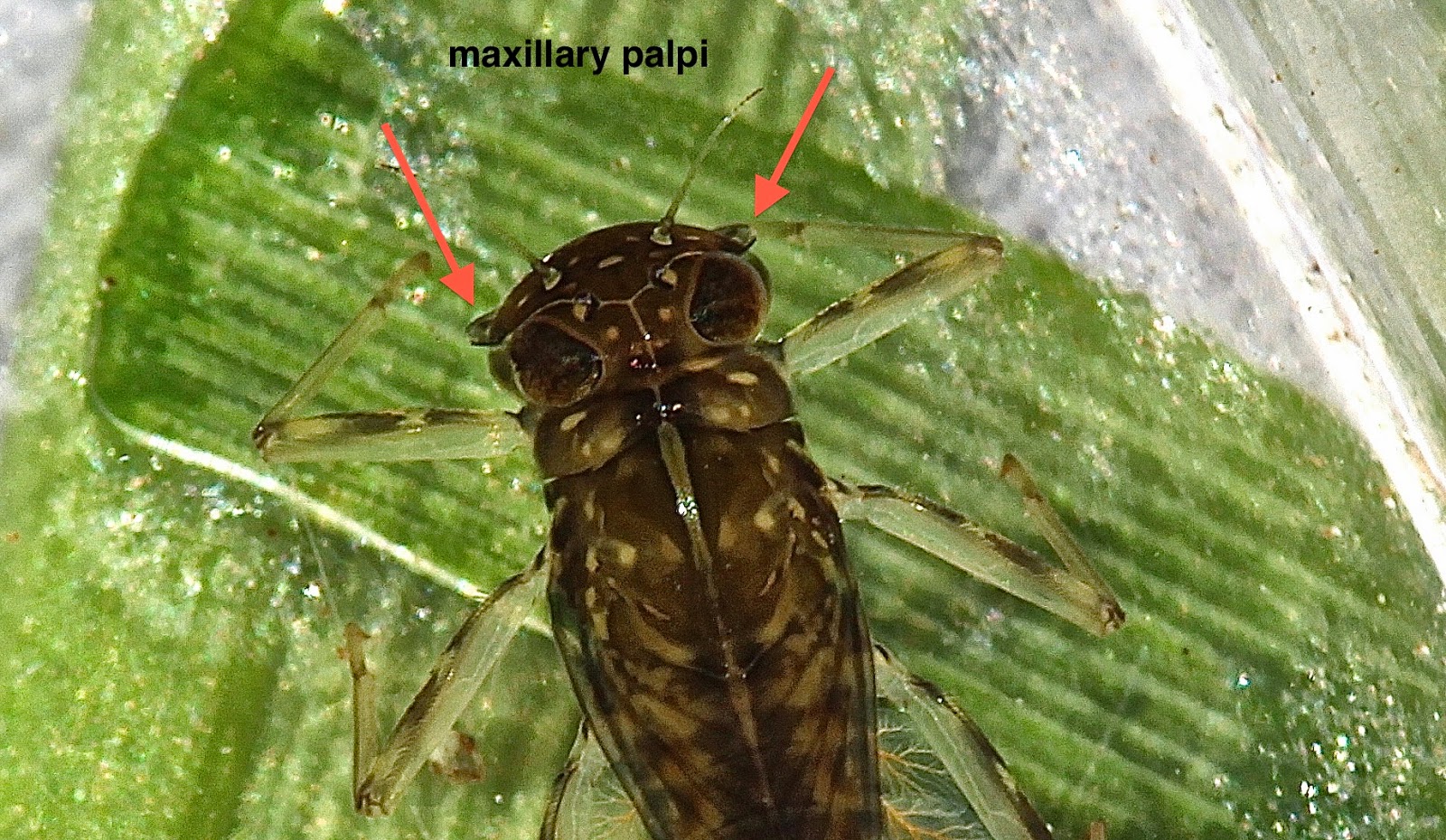
Maccaffertium -- but Maccaffertium what?! Finally back to Buck Mt. Creek


I was excited to see this one this morning, thinking I had found the genus Nixe flatheaded mayfly.  Alas, that wasn't the case:  no fibrilliform behind the gills.  It's a Maccaffertium, but a Maccaffertium I'm quite sure I've not seen before.  What's the species?


Oh, how I wish I could tell you -- but I can't.  I'll keep working on the species ID; maybe send it to Beaty for help.  But Maccaffertium nymphs are notoriously difficult to take to the level of species.  After describing 15 Maccaffertiums in his study of "The Ephemeroptera of North Carolina" (pp. 19-20), Beaty goes on to say, "This group is taxonomically difficult due to interspecies variability and often requires slide-mounts of mouthparts and legs to get a species level identification.  Additionally, many species listed above may actually represent species complexes (particularly M. modestum) and therefore may result in the same species designation for specimens of different size classes and of variable characters.  Immature specimens often do not key well and should, therefore, be left at genus."

We'll see.  The legs have pronounced banding; the caudal filaments (tails) are banded as well; I do not see denticles on the tarsal claws; I do see both hairs and spine-like setae on the maxillary crown.  It was only 7 mm, but it was fairly mature.

________________

Other photos:

1. The spiny crawler mayfly, Drunella tuberculata, the first of the season.


Drunella spiny crawlers have the robust fore femora with tubercles/spines on the leading edge.


D. tuberculata nymphs have paired dorsal tubercles on the head.


It's a nymph that I commonly see at this time of year in Buck Mt. Creek and at the Doyles.
________________

2. A gorgeous, fully mature, Diploperla duplicata Perlodid stonefly.


_______________

3. and 4. A couple of Isoperla Perlodid stoneflies.  The first, I. dicala...


the second, I. holochlora.

_________________

5. And in the bottom left of the photo above, the common stonefly, genus Perlesta, another first for the season.  This is a genus we only see from May through the July.  I found 3-4 Perlestas today: not sure I chose the right one for a photo.

_______________

6. And another first for the season, our "summer" Epeorus flatheaded mayfly, Epeorus vitreus.


The key feature is the "four irregular pale spots on the anterior margin of [the] head" (Beaty, p. 17), but the veination in the gills -- I think -- is also distinctive.

________________

The water's still running high -- with more rain coming tonight.  Ugh!  And, it was dark and foreboding when I set out this morning.  Still, I did get a few peeks of sunlight for photos: the ring light helped as well.

Now back to work on this problematic flathead.


Friday, May 9, 2014

Genus Leucrocuta flatheaded mayflies: an update on species ID


Since I'm starting to find mature Leucrocutas, I thought I might comment again on the problem of species ID.  Steven Beaty ("The Ephemeroptera of North Carolina," p. 19) lists 5 Leucrocutas for North Carolina: aphrodite, hebe, juno, maculipennis, and thetis, but he urges readers to leave identification at the level of genus since the nymphs have not yet been fully described at the level of species.

Having found the nymph in the photo at the top of the page on May 4th, I contacted Beaty (e-mail) to see if work has been done on this issue.  The answer is "yes," but he does not know when that work will be finished and published.  He added that the nymph I had found "might" be L. thetis -- but that ID would be based on a key that is, according to Beaty, "woefully out-of-date."  The book in question: A.R. Brigham, W.U. Brigham, and A. Gnilka, eds., Aquatic Insects and Oligochaetes of North and South Carolina, 1982.   (You can find used copies for around $400.00.)
________________

I think I've found 4 different Leucrocutas to date in our streams.  I'll discuss them by number.

#1

While Beaty is hesitant to do any species ID for Leucrocutas, I have two sources that ID this nymph as L. hebe.  The first is an L. hebe photo published by Donald Chandler on the Discover Life website: http://www.discoverlife.org/mp/20q?search=Leucrocuta+hebe.  The second is the study of mayflies by Knopp and Cormier, Mayflies: An Angler's Study of Trout Water Ephemeroptera.  On p. 152, they describe L. hebe as "grayish brown with paler U-shaped spotting on body."  Those spots are easy to see.

________________
#2


When this nymph is ID'd, the pale spots on terga 1, 7-8, and possibly 9 will probably be used in the description.


Knopp and Cormier (p. 152) describe L. juno as a nymph with "tergites 1, 7, 8, 9 white."  That could be true of the nymph in our picture when it matures.  Clearly, this is a small one, and the colors/patterns are not yet fully developed.  However, this nymph looks nothing at all like the L. juno nymph in a photo by Chandler. (http://www.discoverlife.org/mp/20q?search=Leucrocuta+juno)
________________
#3

Chandler's L. juno looks more like our nymph #3.


This Leucrocuta is one that I've only seen in the small headwater streams in Sugar Hollow.  The femora on this type of nymph are very distinctive: note the two pale dots, one in the middle and one at the tibial joint.  Another feature that might be distinctive -- the paired pale spots on most/all of the terga.

____________________
#4

And number 4 would be the latest species I found, the one that might be L. thetis.  There seem to be 5 pale spots on the femora of this type of nymph, and possibly medial pale spots on some of the terga.  Perhaps those will be used in a key to this species.

__________________

There is another species that we surely ought to be seeing: L. aphrodite.  Beaty notes that "Most Leucrocuta in the Piedmont are probably aphrodite," but he has tells me that the aphrodite nymph has not been described, just the adult.  Knopp and Cormier do describe -- and illustrate -- L. aphrodite: "tergites 9-10 pale."  I haven't seen anything like that, and I don't know on what their description is based.
_________________

So that's where we stand, and I doubt that we'll go any further until the entomologists can figure this out.

Other photos, nymphs 1-4.


_________________

(Quick ID for genus Leucrocuta -- 1) it's the "fat-headed flathead" -- head wider than pronotum; 2) no fibriliform posterior to gill 7.)


Sunday, May 4, 2014

Not your ordinary Flatheaded mayflies: Cinygmula subaequalis and Leucrocuta (aphrodite?)


The flatheaded mayfly, Cinygmula subaequalis.  I found two of them today in two different streams in Sugar Hollow and got pretty nice photos of both.  This is the other.


This is not an insect we commonly see: this is only the 3rd or 4th time that I've found it.  Beaty notes that it's only found "in high quality mountain streams": the tolerance value is 0.0.  C. subaequalis is the only species that's found in NC -- probably in VA as well, though I don't know that for sure.  Here's Beaty's description of the genus.  "Front of head incised medially; maxillary palpi protude at side of head; all gills on segments 1-7 similar in size and shape; fibrilliform portion of gills 2-6 absent or vestigial; three caudal filaments." ("The Ephemeroptera of North Carolina," p. 17)

The maxillary palpi are actually visible when you look down at the live nymph: they sort of stick out like horns.


For the medial incision on the head, we need a microscope view.


We can see the similar size and shape to the gills in both of the photos at the top of the page.  Here are some other good photos since we see this nymph only rarely.


The other flathead I was happy to see -- well, happy to photograph one that was fully intact! -- was this Leucrocuta.  Species?  I can't say for sure.  It could be L. aphrodite, but I only say that because I'm quite sure that it's not hebe or juno.


This is a small insect: this one was fairly mature and measured 6 mm.  But it's easy to pick out by the very wide head.  (Beaty, "Ephemeroptera," p. 19 -- "Head wider than pronotum.")  You may recall that it's distinguished from genus Heptagenia by the lack of fibrilliform at the rear of gill 7.  (In this photo  it's tough to see the fibrilliform behind gill 6 as well.)


________________

Other photos.

1. As I would expect, the most common insect I saw today -- in the leaf packs and the vegetation growing on rocks -- was the spiny crawler, Ephemerella dorothea.


2.  I also saw quite a few Baetis tricaudatus small minnow mayflies -- and that was unexpected.  Many -- but not all -- were fully mature with black wing pads.  This one's still immature.


But aren't these just the coolest photos: both nymphs with the black wing pads.


3.  I did find a few Isoperla Perlodids.  But they're still very small.  The first, Isoperla holochlora,


the second, one of our unknown Isoperlas in terms of the species.  Since it's fairly common out here, I might start to call it -- until we know what it is -- Isoperla sugarhollowis!

________________

A nice day.  But even these headwater streams are still running high.  Don't know when I might get back to Buck Mountain Creek, the Lynch River, the Rapidan or the Doyles -- and it's such a good time of year to find neat insects in all of those streams.

Thursday, May 1, 2014

Immature "October Caddisfly" larvae, Dicosmoecus gilvipes


One of the popular hatches each year for fly fishermen in the West is that of the "October Caddis/Great Orange Caddis" that in Montana at least, normally takes place in September.  In my annual trips to Missoula, I've seen the occasional adult come off of the water and found mature larvae on the rocks in the rivers, but I've never been there when the full hatch is "on." (For photos of the adult see, for example, Troutnut.com, http://www.troutnut.com/specimen/870.)

The cased caddisflies we found in the Washougal on Sunday (Camas, WA), were all immature Dicosmoecus larvae.  The mature larva makes a long, tubular case out of pebbles (~ 30 mm), but the immature larva makes a case out of a mixture of pebbles and sticks to which is attached pine needles.  Pretty clear example of that in the photo at the top of the page.


There is an interesting article on the function of those pine needles which I thought I would cite at the start of this entry.  "We investigated the functional role of cases built by Dicosmoecus gilvipes, a limnephilid caddisfly.  In this species, the 1st through 4th instar larvae build cases with plant material and attach Douglas-fir needles as lateral extensions that resemble vanes on an arrow.  We tested whether the lateral extensions and entire case deterred predators by manipulating lateral extensions and case presence for larvae exposed to large steelhead trout.  No larva with a case (with or without lateral extensions) was consumed during the experiment, whereas all larvae without a case were consumed."   (Michael P. Limm and Mary E. Power, "The caddisfly Dicosmoecus gilvipes: making a case for a functional role," Journal of the North American Benthological Society, 30(2): 485-492, 2011.)

Now to the diagnostic detail.  First from the Flyfishing Entomology website.  "Gills on ab segs w/2, 3, or 4 branches; femur on hind leg w/many long hairs; chloride epithelium (usually a shiny oval) on underside of 1st ab seg; case a long slightly curved untapered tube." (http://www.flyfishingentomology.com/PNW%20Caddisflies.htm)

1. Our larva does indeed have gills of 2, 3, and 4 branches on the abdominal segments.  You can see each type in the following photos, though the quality of my photos isn't the best.


2. And there are indeed many long hairs on the femur of the hind leg.


3. The chloride epithelium oval is not visible on this particular larva which is only 15 mm.  But it should be on segment 2, not 1 (see illustration on p. 215 of Wiggins).  However, I can show you what it will look like when these larvae mature using a larva collected a few years ago in Montana.


4.  We have an immature larva with a case of mixed pebbles and pieces of wood -- it's not yet an "untapered tube".  On the Discosmoeus case, Wiggins makes the following comments: "Final-instar larvae have a case of fine gravel, regular in outline, slightly curved, and often somewhat flattened.  In the early instars cases are largely of plant materials, and transitional example are often collected, demonstrating an abrupt change to gravel." (Larvae of the North American Caddisfly Genera, p. 214)  It's probably fair to call our cases "transitional" since they already have pebbles imbedded.

Other features used for ID are noted by Wiggins.  "These larvae are large and stout-bodied; sclerotized parts of the head and thorax are mostly uniform dark brown to black."  No question about that.


He continues, "there are metanotal setae on the membrane between the primary sclerites."  We can see them on our small larva,


but they show up much better when the larva's mature.


Also from Wiggins, "on segment IX a band of 20 to 40 setae extends ventrad from each side of the dorsal sclerite."

On our immature larva those setae are just barely visible,


much clearer when the larva's mature.


On the species ID, we go back to our website.  1) "Species atripes: Stout spines on front edge of pronotum; miniscule spines covering top of head and pronotum, giving them a fuzzy appearance." 2) "Species gilvipes: Stout spines on front edge of pronotum (particularly at the corners); absence of miniscule spines on top of head and pronotum." (http://www.flyfishingentomology.com/PNW%20Caddisflies.htm).   I'd go with D. gilvipes.  The spines on the corners of the pronotum are very clear: the head does not have a "fuzzy" appearance.

_________________


So there we have it.  Dicosmoecus gilvipes, the "Ocotober Caddis" at an early stage of the game.  Should get some photos of mature larvae when I go to Montana in August.  In the meantime, I can tell my son-in-law what to look for at the Washougal come September!  I imagine the steelhead will be running up the river before very long.