Tuesday, January 17, 2012
On the Genus ID of our Winter Nemourids
This Nemourid stonefly was found in Buck Mt. Creek on 3/1/11, and as you know, I just found a small Nemourid in the same stream on Sunday (1/15/12). In past entries (2/20/11, 2/21/11, 3/2/11, and 3/10/11), I've argued that the our winter Nemourids are genus Nemoura. I now have good reason to believe I was wrong. Shoot! The first clue -- Nemoura is not attested as a genus that's found in Virginia in Stewart and Stark's Nymphs of North American Stonefly Genera (Plecoptera), p. 198. It is primarily a genus that's found in the West, though Nemouras have also been found in parts of the Midwest and in some states in New England.
So, let's go back to Peckarsky (Freshwater Macroinvertebrates of Northeastern North America, p. 67).
The first couplet in Nemourid genus ID questions whether there are gills on the "prosternum" (i.e. "cervical gills"). There are not. We do see "highly branched" cervical gills on our spring Nemourids -- genus Amphinemura (look back to the entries for 3/28, 4/11, 4/15, 4/19, and 4/24).
We move to couplet 21a and b.
21a. Pronotum with a distinct, single lateral fringe of spines of equal length, sometimes longer on posterolateral margins...22
or
21b. Pronotum without a distinct lateral fringe of spines, or fringe irregular with long and short spines interspersed...23
This is where I went wrong last year. Look at the pronotum of one of the Nemourids I kept from last year.
There are tiny spines on the lateral edges, but they are not long enough to be considered a "fringe."
So, we skip couplet 22a and 22b -- which would have taken us to the genus Nemoura -- and move on to 23a and 23b.
23a. Foreleg with a few large spines on tibia and femur; outer margin of tibia with spines of similar length to those on surface and without fringe of long hairs...Paranemoura
or
23b. Foreleg with numerous large spines on tibia and femur; outer margin of tibia with row of large spines and/or fringe of long hairs...24
We need a microscope view of the foreleg -- especially the outer margin of the tibia.
There is very clearly a "fringe of long hairs," so we move on to 24.
24a. Foretibiae without outer fringe of long hairs...25
or
24b. Foretibiae with outer fringe of long hairs...26
We've already concluded that we've got 24b., so we go on to couplet 26, which brings us to a choice between Prostoia and Shipsa.
26a. Dorsal and ventral bristles of cercal whorls [the whorls on the tails] longer than lateral bristles; foretibia with hair fringe and row of stout spines along outer margin...Prostoia
or
26b. Only ventral bristles of cercal whorls longer than lateral bristles; foretibia with hair fringe, but without stout spines along outer margin...Shipsa
Well, you can forget checking on the length of the dorsal and lateral bristles of the cercal whorls -- the foretibiae would have to be slide-mounted to see that, and even then, Beaty says the two genera can be hard to distinguish ("The Plecoptera of North Carolina," p. 4). But, I do think our specimen has "stout spines along the outer margin." These are difficult to see, but I've tried to point them out in this picture.
That would mean that our winter Nemourids -- or at least those I have found up to this point -- are genus Prostoia. And there is another good reason to choose Prostoia over Shipsa: the size of the nymphs. Beaty says Prostoia nymphs are "small, 5-6mm," while Shipsa nymphs are 6-8.5 mm. The largest nymph in my collection is 5mm.
I'll be checking on this genus ID as I find more of these Nemourids in the next month or so. But in the meantime, I'd have to go with Prostoia.
_________
Oh. P.S. In the pronotum photo above, you can make out tiny spines on the surface of the pronotum as well as the sides. That matches the illustration of the Prostoia pronotum found in Peckarsky (#38 on p. 68).
Sunday, January 15, 2012
Finding Glossossomatids (Saddle-case Makers)
It's actually pretty easy. Saddle-case makers (family Glossossomatidae; genus Glossossoma) attach their cases to the tops of rocks, so they're easy to see when you're walking around in a stream. Look for a little oval made out of sand grains and pebbles. Something like this:
But you'll never see the larva until you turn the "dome" over: the larva does all of its eating without exposing any part of its body. With the case turned on its back, using a loupe, you'll see the head at the top of the case and feet sticking out of the bottom: the body stretches over a "saddle" of sand grains that functions much like the plastron in the shell of a tortoise.
Glossossomatids, you may recall from earlier entries, are not true "case-makers": they differ anatomically from things like Lepidostomatids and Uenoids -- the case-makers we see so often at this time of year. They also differ in terms of the way they make use of their "cases". Anatomically, they are like freeliving caddisflies and Micro caddisflies in having sharp points on the terminal segments of the maxillary palps as adults. Together this group of caddisflies is called Spicipalpia (i.e. "spiky" palps). (See Glenn Wiggins, Caddisflies: The Underwater Architects, p. 107, and pp. 20-26.) And in terms of their cases, unlike the true case-makers (known as Integripalpia), when they outgrow their cases, they abandon them and start building all over again. It's when they are "caseless," by the way, that they are vulnerable to trout, and fly fishermen do well when they imitate these freely drifting larvae. (See Thomas Ames, Caddisflies, pp. 89-91.)
Glossossomatids are easy to identify when they're in their cases. But, they are usually out of their cases when you're dealing with preserved larvae you need to ID in the lab. In that case, here's what you do.
Number one, they often assume a "hands up" position (!) when they're preserved.
That's a "dead" giveaway (hmm... guess that has double meaning!). If you don't see that, you have to look at their bottoms where you will see 1) a "sclerite" on the top side of the last abdominal segment:
and 2) you will notice that only the tips of the anal prolegs stick out free from the body, the rest is fused with the final abdominal segment.
This is the first time this season that I've picked up some Glossossomatids: I was at Buck Mt. Creek. I also saw, for the first time this year, this little stonefly --
That's a Nemourid stonefly, genus Nemoura. I hope to go to the Rapidan River next week, where I expect to see a lot of these nymphs, and I'll spend more time on them when we have some better samples to view. (Or, you can look back to the entries of 2/20/11, 2/21/11, and 3/2/11).
My other findings today were large winter stoneflies -- Strophopteryx fasciata -- and, to my surprise, some small winter stoneflies. I photographed two of the small winter stoneflies, neither of which looked like the small winter species I found at Buck Mt. Creek. This one, I found on November 25.
Fairly mature -- note the dark wing pads. But look at the two that I found today.
The one on the right is distinct with that very orange abdomen, while the one of the left, which is fairly big, has wing pads that look like they've "lightened," not darkened. Hmm...? I suspect this is a matter of species and that the species we're finding now (are the two in the photo above the same species?) differ from the one that we found in November. Beaty notes that "there are at least eight species of Allocapnia in North Carolina many of which are undescribed as nymphs" ("The Plecoptera of North Carolina," p. 1). So we should not be surprised if all of our small winter nymphs don't look the same.
"Light" wing pads with maturity might also be true of the large winter stonefly Strophopteryx fasciata. I seemed to see that last year, and it was also the case with the largest S. fasciata nymph that I found today.
Always more things to learn.
_______________
Note: After another look, I'm not really sure the top, right, small winter stonefly in the picture above is genus Allocapnia. But I didn't keep it, so I can't key it out. The hind wing pads don't look right.
Saturday, January 14, 2012
Same Old, Same Old -- With One Important Exception
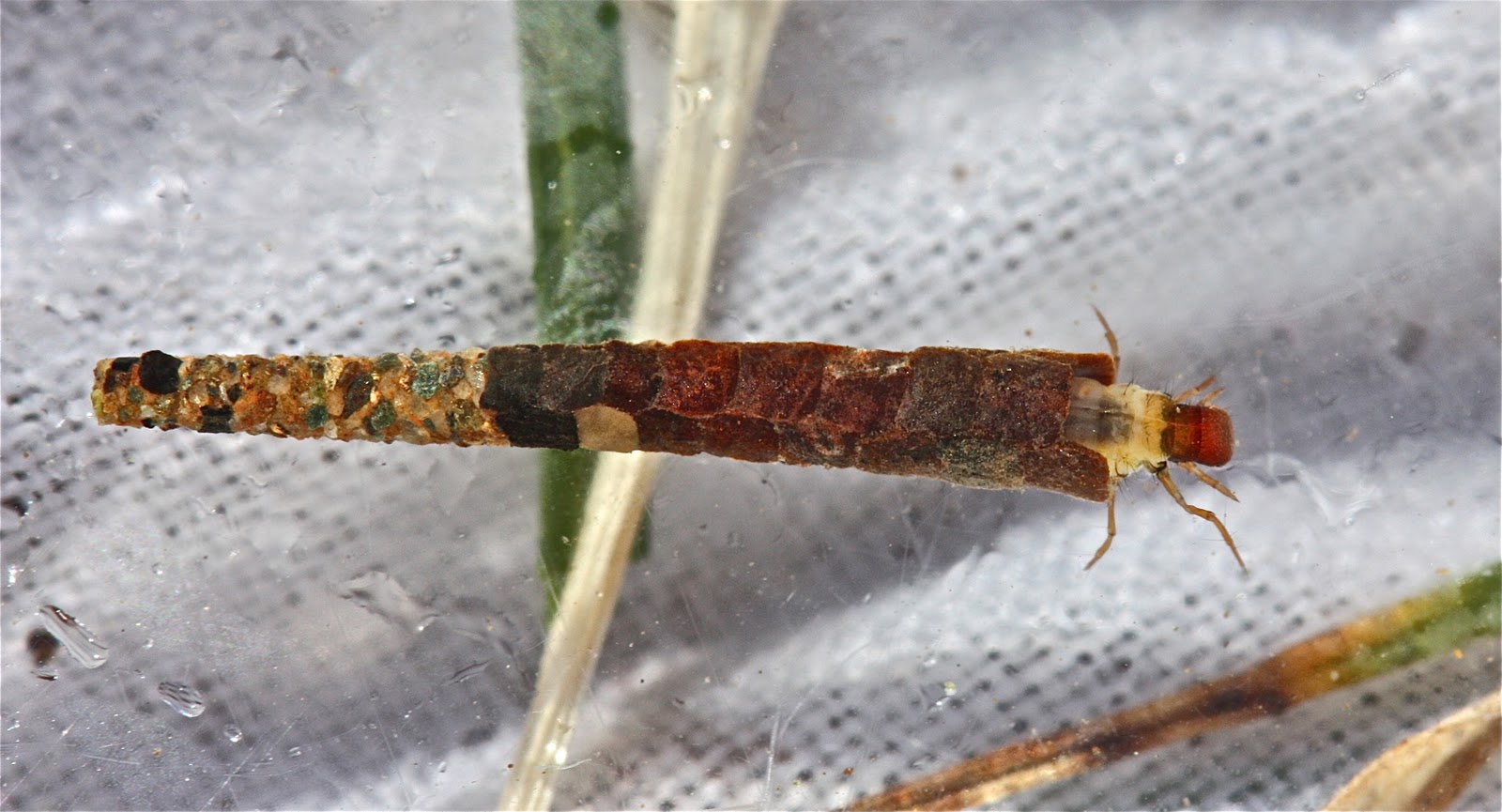
The stream I went to this morning is only one to two hundred yards from the stream I went to on Thursday, and it tumbles into the Moormans from the same side of the mountain. So, I should not be surprised that I pretty much found the very same insects on both of these trips: lots of Chloroperlid stoneflies, Peltoperlids (Roach-like stoneflies), one Isoperla similis Perlodid stonefly, and a lot of large winter stoneflies, all Taenionema atlanticum. But today, I also found two "mixed media" Lepidostomatids (the larva in the photo above.)
Case-maker caddisfly larvae -- with the exception of Glossosomatids (Saddle-case makers) -- stay in the same case right through pupation: i.e. they do not abandon their cases and build something new as they move from one instar to the next. But some, like the Lepidostomatid, will start off with a case of one material but switch to something new as they add on to and enlarge their cases. A fair number of Lepidostomatids will do what this one has done -- start off with a case made of grains of sand, then switch to the more common four-sided case made out of neatly cut sections of leaves and bark. It's like it takes them awhile to remember what a Lepido case ought to look like! This case is a real beauty. Here are a some additional photos.
And here is the second Lepido that I found this morning: this one was a little bit smaller. At first, it was a little bit shy -- but it finally stuck out its head!
Lepidostomatids love the kind of stream that I went to this morning in Sugar Hollow. As Thomas Ames notes "They roam in the slower currents of cool upland streams, near springs, and occasionally along lake shores or even in temporary streams, wherever drifting leaves settle and collect at the bottom." (Caddisflies: A Guide to Eastern Species for Anglers and Other Naturalists, 2009, p. 187.) On their feeding habits he adds that biologists "...have described them variously as leaf-shredders or detrivores, and they are known to eat both algae and the flesh of decaying fish." For the fly fishermen out there -- they hatch throughout the summer beginning in April and May as the "Little plain brown sedge," and Ames recommends that you wait for the adults -- not really worthwhile trying to imitate the larvae!
Some other photos from today's trip.
1. Our Isoperla similis -- another beauty (and note the "clothing hairs" on the wing pads).
2. A smaller Perlodid which, I'm pretty sure, is Isoperla namata.
3. One of many Taenionema atlanticum large winter stoneflies.
4. A gorgeous common stonefly, Eccoptura xanthenses.
5. One of many Chloroperlids (Green stoneflies).
6. And one of the Chloroperlids staring down the Eccoptura common stone. (They're both predaceous -- could it be that they were both thinking of lunch?!)
Thursday, January 12, 2012
Sifting Away Again in Chloroperlid-ville
I don't know what else to call this little stream that flows into the Moormans. This is the third time I've been here, and every time it's been loaded with Green stonefly nymphs (Chloroperlids) -- genus Sweltsa.
But since Sweltsa species have a TV of 0.2, I guess we shouldn't really complain. Pretty clean water.
But there were other insects today that deserve special attention.
1. The large winter stonefly in the picture above -- Taenionema atlanticum. As you know, I've been finding them in a lot of small streams in the Blue Ridge, but this is the first one that I've seen that is real close to hatching: the wing pads are black, so too is the pronotum. I was disappointed that the one tail was broken, but it still makes a pretty nice photo. A couple more shots.
This is the only large winter species I saw in this stream: no Taeniopteryx burksi, and no Strophopteryx fasciata. But the T. atlanticums were here in force. The others I saw were not quite this mature, but they too photographed well.
2. A Perlodid stonefly -- Isoperla similis.
I found a younger one here back in November (entry posted 11/12): this one is showing its mature colors and patterns, and note how the wing pads are starting to angle and arch (hind edges). Beaty ("The Plecoptera of North Carolina," p. 24) describes the head of I. similis in the following way: "...head brown with a pair of pale spots near labral suture, a pale M-shaped mark anterior to median ocellus and pale marks anterolateral to the lateral ocelli." These features show up best in a microscope photo. (Remember that the little black dots are the ocelli.)
He also notes, "Head and body covered with dark clothing hairs." I think you can make out the hair on the head, and you can clearly see the hair on the mesosternum in this shot I took to show the Isoperla "Y" ridge.
The tolerance value of I. similis is 0.8, another sign that we're dealing with a quality stream.
3. A fingernet caddisfly larva, genus Wormaldia.
This won't look like a fingernet caddis to a lot of my readers: fingernets are yellow or orange, right?
True, for the genus Chimarra (the most common genus we see), but not for the other genera -- Dolophilodes and Wormaldia.
This is the first fingernet caddis I've found in these small streams that feed into the Moormans, and it's the first time I've gotten a live photo of this particular genus. Another look.
How do we know that this is Wormaldia? The three fingernet genera are distinguished -- for the most part -- by the shape of the frontoclypeal apotome (essentially the leading edge of the head). The Chimarra apotome is deeply notched:
The Dolophilodes apotome is asymmetrical with a shallow notch on one side or the other.
And the Wormaldia apotome is symmetrical, but either convex or concave. Ours was concave.
In the new list of tolerance values posted by the North Carolina Department of Water Quality, the tolerance values for these genera are: Chimarra = 3.3; Dolophilodes = 1.0; and Wormaldia = 2.4.
4. Another "odd-looking" freeliving caddisfly larva, Rhyacophila fuscula.
This is the same "lime-green" head that I saw on the freeliving caddis that I found in South River on 1/5. On 1/8, with Steve Beaty's help, I noted that that was probably an early instar of the species Rhyacophila fuscula, which should have a head that looks something like this:
Well, we've got another strange colored head, but on this one, that brown/black "topless H" pattern that shows up on the head of this species is already starting to show. This one was easy to call.
That's about it for today. But, oh yes, there were Chloroperlids crawling around in the leaf packs -- lots of them!
Wednesday, January 11, 2012
Index No. 1: Names of Streams
I will index the entries posted so far in a number of ways. Index No. 2 will be by name of taxa.
Entries Indexed by Name of Stream
Buck Mt. Creek: 12/29/10, 1/6/11, 1/25/11, 2/7/11, 3/2/11, 4/2/11, 4/25/11, 5/10/11, 5/31/11, 6/4/11, 6/10/11, 6/19/11, 7/1/11, 7/10/11, 7/30/11, 9/1/11, 11/3/11, 11/18/11, 11/26/11, 12/15/11, 12/20/11, 1/1/12
Buffalo/Roach River: 7/7/11
Doyles River: 2/14/11, 2/21/11, 3/15/11, 4/11/11, 7/19/11, 9/29/11, 10/25/11, 12/12/11, 12/30/11
Elk Run: 2/19/11, 2/20/11
Lickinghole Creek: 12/21/10, 2/12/11
Long Island Creek: 1/5/11, 4/19/11, 12/1/11
Lower Rapidan: 2/24/11
Lynch River: 3/16/11, 5/15/11, 7/2/11, 9/30/11, 10/9/11
Mechunk Creek: 12/15/10, 1/29/11, 6/17/11
Moormans River: 12/26/10, 2/21/11, 6/16/11, 6/25/11, 7/26/11, 8/14/11, 9/29/11, 10/7/11, 10/21/11, 12/30/11
North Fork of Moormans: 1/3/11, 2/16/11, 9/18/11
North Fork of Rivanna: 7/17/11
Old Lynchburg Road: 11/11/11
Powells Creek: 1/17/11, 2/14/11, 3/28/11, 4/15/11, 5/13/11, 6/21/11, 8/2/11, 10/4/11, 12/2/11
Rapidan River: 1/19/11, 2/23/11, 3/25/11, 5/5/11, 6/8/11, 6/30/11, 8/4/11, 9/13/11, 10/6/11, 10/22/11, 11/19/11, 12/13/11
Rivanna River: 6/10/11, 7/12/11, 7/13/11, 7/20/11, 7/28/11, 8/9/11, 8/12/11, 9/4/11, 10/8/11
South River: 1/4/12
Tributaries (4) to the Moormans: 3/4/11, 3/17/11, 3/22/11, 4/14/11, 4/21/11, 5/7/11, 5/19/11, 5/20/11, 6/2/11, 6/14/11, 11/8/11, 11/12/11, 11/25/11, 12/3/11, 12/11/11, 12/17/11, 12/26/11
Upper Doyles River: 2/3/11, 10/10/11, 11/5/11, 12/22/11
Whippoorwill Branch: 3/19/11
Sunday, January 8, 2012
On Second Thought.....Plans for Future Blog Entries
Since I don't see myself giving up my trips to the streams anytime soon, I'll probably continue to put out blog entries. But there will be some changes. At the moment, my plans are:
1) To compile an Index for the entries posted last year. Thus, anyone who wants to go back and look at key entries on, say, Perlodid Stoneflies (in general), or on specific Perlodid stoneflies -- like Clioperla clio -- will know where to look. Included will be entries that spell out how to ID genera and species and entries with important/good photos of the taxon in question. I'll also index those entries that focus on "issues" rather than taxa -- e.g. "Functional Feeding Groups and the River Continuum" (2/28/11).
2) To post fewer entries: one a week, maybe two.
and 3) to focus my trips on looking for particular taxa. Thus, at the moment I'm keen on trying to find Nemourid stoneflies, genus Nemoura (as in the photo above from last year), and the Perlodid stonefly genus Yugus, and I want to track the development of the small minnow mayfly that seems to inhabit a lot of our streams in the winter -- what I think is Heterocloeon amplum. Anyone wishing to know how these taxa were ID'd last year, and what was said about them, will be able to find that information by using the Index. I'll also post what I consider to be exceptional photos -- but I don't plan to account for everything I find on my trips to the streams.
Hope you continue to follow along.
Cheers,
Bob Henricks
Friday, January 6, 2012
Rhyacophila fuscula: an Early Instar
I now have it on good authority -- Steven Beaty (NCDWQ) -- that this odd looking freeliving caddisfly larva I found yesterday is probably an early instar of the species Rhyacophila fuscula -- which is the most common freeliving larva we find in our streams. This one:
One of the distinguishing features of R. fuscula is the dark, "top-less H" pattern on top of the head. This:
And clearly that's missing in the larva I found. But that's probably because the head has not yet darkened in color, nor has the "H" yet developed. What's critical is that the anal prolegs on this nymph are clearly those of R. fuscula which have 1) "apicolateral spurs" (pointed out in the photo below), and 2) anal claws that are dentate -- i.e. they have teeth. These are clear in these microscope photos.
So there you go. A good lesson to learn -- always need to use those microscopes and check things with care.
Subscribe to:
Posts (Atom)