Friday, January 4, 2013

Just the usual "outstanding" "high quality" "beautiful" insects at the Rapidan River: Photos


I've just finished editing 359 photos from my trip to the Rapidan River today.  So, I'll post some of those photos today and go into detail on some of these findings in a separate entry -- posted tomorrow, I hope.  The insects I did not photograph on this trip -- Giant stoneflies (P. biloba); large winter stoneflies (T. burksi/maura); prong-gilled mayflies; Roach-like stoneflies; brushlegged mayflies; and tons of black fly larvae.

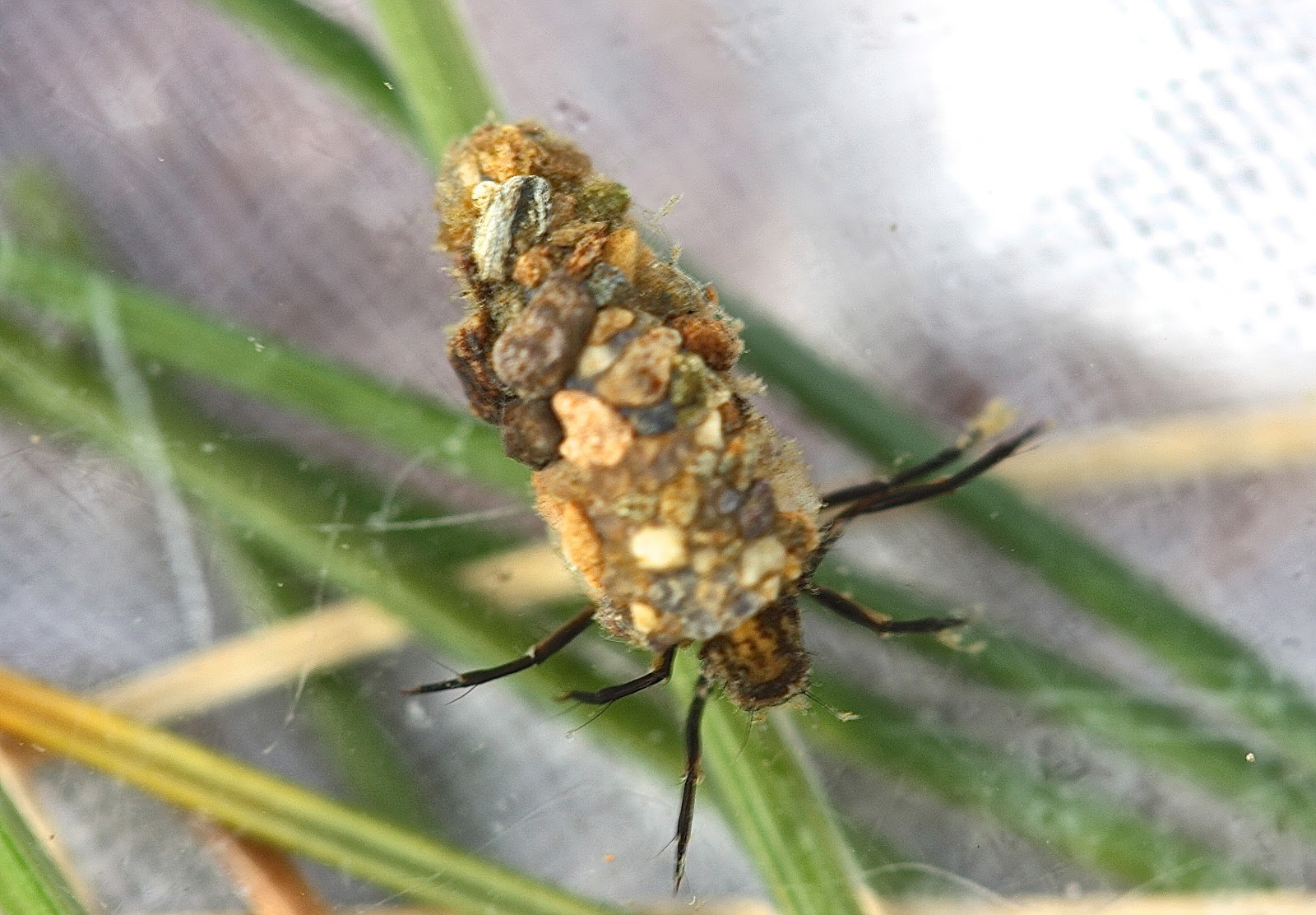
1. In the photo above, a "humpless case-maker," Brachycentrus appalachia and a small case-maker, Apatania incerta.  Below, more photos of each.  I took photos of two A. incerta larvae: I'll distinguish between them.


A. incerta 1:


A. incerta 2:


2. Uenoidae: genus Neophylax.  More on these larvae tomorrow.  This is a species I have not seen in other streams.  It may be N. atlanta -- which is relatively rare.


Uenoid 2:


3. Spiny crawler mayfly: Ephemerella subvaria


4. Spiny crawler mayfly: Ephemerella invaria

1.
2.

5. Lepidostomatid caddisfly larva: genus Lepidostoma


6. And, Perlodid stonefly: Isoperla namata


Thursday, January 3, 2013

Winter Insects at the Lynch River


After looking for insects for just a short while this morning, I wondered why my toes and fingers were freezing.  But when I started my car, I saw that it was only 32ยบ at the Lynch River.  Still, there was enough sunshine for me to take photos, so I had to get out and explore.

I didn't find anything "stunning" today, but I did see a good collection of the insects I expect to see in a lot of our streams at this time of the year.  Perlodid stoneflies: Helopicus subvarians, Clioperla clio, and Diploperla duplicata; flatheaded mayflies; common netspinners, especially Cheumatopsychids; Glossosomatids (saddle-case makers) and Uenoids; midges; and, unfortunately, large numbers of black flies -- "colonies" of them in fact.  I also saw one of the things I was hoping to see -- the small minnow mayfly Heterocloeon amplum, the one in the photo at the top of the page.

H. amplum is the largest species of small minnow mayfly (Baetidae) that I see during the year, and it's one that I normally see in January through March; sometimes into the beginning of April.  Mature H. amplum nymphs are 7-9 mm long: the one in this photo was 6 mm, not yet fully grown.  Still, a lot of the features we use for this species ID are easy to see in this photo: 1) there are two cerci/caudal filaments/tails; 2) the tarsi are "dilated apically" (i.e. they're wider); 3) there is a wide, pale medial band on the tarsi; and 4) there are paired dots on the tergites.


The streams where I go to find this one?  The Doyles, Buck Mt. Creek, and the Lynch.

_____________________

Other photos:

1. Common netspinner, genus Cheumatopsyche.  I saw a lot of them, all of them bright green in color.  I'm increasingly convinced that this is our dominant winter netspinner.


2. Common netspinner, Ceratopsyche alhedra.  I found this larva on the same rock as the Cheumatopsyche just pictured.  There was one C. alhedra on the rock, six Cheumatopsyches.  The head on this species is black with no visible pattern.


And here's a photo of the two netspinners side-by-side in my tray.


3. The Perlodid stonefly, Helopicus subvarians, one that I also see in the Doyles River and Buck Mt. Creek.


4. The Perlodid stonefly, Diploperla duplicata.  I always see a lot of these in this stream.


5. And Uenoids, Uenoids, Uenoids!  They're on the tops of the rocks, the sides of the rocks, and the bottoms of rocks, and the light-colored cases are easy to see.  Here are photos of three different larvae.

dorsal:

ventral:

dorsal:
ventral:

dorsal:
ventral:

As you know all of our Uenoids are genus Neophylax.  But I'm not having a whole lot of luck getting the ID down to the level of species.  The species descriptions given in Beaty ("The Trichoptera of North Carolina," pp. 86-87) do not provide sufficient detail for certain ID while the other source that I use (R.N. Vineyard, G.B. Wiggins, H.E. Frania, and P.W. Schefter, The Caddisfly Genus Neophylax [ROM  Contributions in Scince, 2]) goes into too much detail.  But, this is something I will continue to work on.

Friday, December 28, 2012

Plenty of insects -- but not enough sun for good photos


Well, I mean, that's not a bad photo -- but all in all it was a frustrating day.

A lot of our streams are high and off color since we had some decent rainfall on Wednesday.  So, I went back to my small streams in Sugar Hollow which, coming down steeply from high up in the mountains, are running nice and clear.  And I found lots of insects: Uenoid caddis case-makers; flatheaded mayflies -- Epeorus pleuralis, Maccaffertium pudicum, and Maccaffertium merririvulanum; Giant stoneflies, all sorts of sizes; Green stoneflies; large winter stoneflies -- Taenionema atlanticum, the only species I see in this stream; and, as we see in the photo above, small winter stoneflies -- what I think is Allocapnia pygmaea.  But the sun disappeared -- which means the photography suffers.

But...I did get some shots that are worth showing.

1. More photos of that beautiful small winter stonefly which is almost mature: note the rich colors and patterns and the darkening wing pads.


2. One of the many T. atlanticum large winter stoneflies I saw.


3. A black fly larva -- I've not yet said anything, but I've been seeing a lot of them this year.  In the second photo you can actually see the eyes.


4. And the largest Epeorus pleuralis flatheaded mayfly I've seen so far this year.


But wait a minute -- what's that little nymph swimming next to it in the tray?  Any guesses?  Perhaps a bigger photo would help.


That is one small mayfly, and to help us with the ID,  let me point out four things: 1) the antennae are short, and they form a "Y" at the front of the head; 2) the gills are pointing straight up and down; 3) the body is "cigar" shaped; and 4) the tails/cerci are banded (though one of the three has broken off).  You might also note the shape of the eyes.

Here's one from February, 2011, one that's a little bit bigger, one on which those features show up a lot better.


And here's one from March of last year that I found in the same stream that I went to today.


Ameletidae, genus Ameletus.  I was amazed that I was able to see that tiny nymph flipping around on a leaf -- even more amazed that I got a respectable photo.  Size: 3 mm.   This is an excellent stream for Ameletids -- they live in cool, small mountain streams -- and I always see them here in the winter.  But, I've never seen such a small one before.  Fun!
_______________

Below: a decent photo of one of the M. pudicum flatheads that I found.


Thursday, December 27, 2012

Cheumatopsyche: the common netspinner genus that we "commonly" see in the winter


When I was at the upper Doyles river on 12/23, I found this odd-colored common netspinner larva.  I preserved it, to work on species ID when I returned home, thinking it might be a Ceratopsyche species I had not seen before.  But when I looked through the microscope, I quickly saw that it was a genus Cheumatopsyche which, with a TV of 6.6 is nothing special -- so I ignored it in the blog that I posted that day.  But I think that this might deserve comment.


I generally think of summer as "common netspinner season."  In a lot of our streams, this taxon is the most common insect we see from July through September -- even into October.  The tangled vegetation that grows on the rocks in the Rivanna is so loaded with them at that time of year that it sometimes gives me the creeps!  But, we find a lot of them in all of our streams at that time of year.  And if you look back at the blog entries written during that stretch of time, you'll see that that is when I was working intently on netspinner ID, finding mostly Ceratopsyche and Hydropsyche species.

After October, they just disappear -- well, the big numbers disappear anyway.  At the moment, I don't see many netspinners at all.  True, I found a Ceratopsyche bronta at Lickinghole Creek on 12/2, and I found a Ceratopsyche alhedra at the Rapidan river on 12/6.  But most of the common netspinners I see at the moment are genus Cheumatopsyche.  I can usually tell by the color: most that I see are bright green with a dark brown head and nota.  (Not true, as you can see, of the netspinner I found at the Doyles.)

Is there a reason why this is our "common" common netspinner during the winter?  I think that there is.  As it turns out, Cheumatopsyche larvae commonly start to hatch -- as the "Little Sister Caddis" -- in April, "as early as mid-April in more southerly locations..." (Thomas Ames, Caddisflies: A Guide to Eastern Species for Anglers and Other Naturalists, 2009, p. 131).  But we will continue to see some during the summer.  Again, let me quote from Ames: "Peak flight periods in the East are from April through July, with continued emergence into October." (p. 130)

While most of the larvae of this netspinner genus I see are bright green, they do come in a number of colors, so we can't rely on color to decide on ID.  Certain ID often requires microscope work -- but you often can see the critical features using a loupe in the field.

Look for two things.  1) There is a notch in the leading edge of the frontoclypeus (essentially the top of the head).  This:


2) If you can see the larva while it's on its back, you'll notice that -- in contrast to the Hydropsyche larva -- it lacks sclerites below the prosternal plate.  Let me illustrate:

Hydropsyche:


Cheumatopsyche:


I'll continue to look for common netspinners throughout the winter: that Cheumatopsyche is the most common genus we see at this time of year is a thesis that needs to be tested.   Of course, there is another netspinner we commonly see in the winter and spring -- but only in small mountain streams: Diplectrona modesta.  This one:

________________

Cheumatopsyche photos:

3/7/12 (Whippoorwill Branch of the Mechums)


8/30/12 (lower Doyles River)


12/23/12 (Upper Doyles River)