Sunday, August 3, 2014
But there will be exceptions....
While I don't intend to post entries in a continuous way, I will make exceptions when I find something of interest, and this is an interesting Lepidostomatid.
I found this larva on Thursday (7/31) in the Rivanna at Crofton: the case was attached to a rock. What caught my eye was the shape and composition of this particular case: it's round and composed of coarse grains of sand. It was also quite small -- 6-7 mm.
You'll recall that almost all of the Lepidostomatids we find in the winter and spring have cases that are "four-sided and usually constructed of quadrate pieces of plant material." (Beaty, "The Trichoptera of North Carolina," p. 81) That was also true of the Lepido that I found in this location on July the 8th.
True, Lepdostomatids do make cases of sand grains, especially in early instars, like this one that I found at the Rapidan River in December last year.
But most will switch to the more common four-sided case of leaves/bark as they mature.
There is a chance that this is a genus of Lepidostomatid we have not seen before: Theliopsyche. These larvae are small "up to 6.5 mm", and their cases are "composed of sand grains, curved and slightly tapered." (Beaty, p. 81) The genus we're used to seeing is Lepidostoma. But I'm not really sure. With Theoliopsyche, the "head [is] flattened with [a] carinate ridge" (Beaty, p. 81), something I don't see on this larva.
Also relevant, on Lepidostoma, the ventral apotome is "as long as, or longer than [the] median ventral ecdysial line;" on Theliopsyche, the apotome is shorter than that line. (See, Glenn Wiggins, Larvae of the North American Caddisfly Genera, pp. 155 and 159.) On our larva, the apotome looks longer to me.
I'll continue working on this one. But at the moment, I think it's just another odd Lepidostoma, a species that's quite different than those we see in our small streams early on in the year.
________________
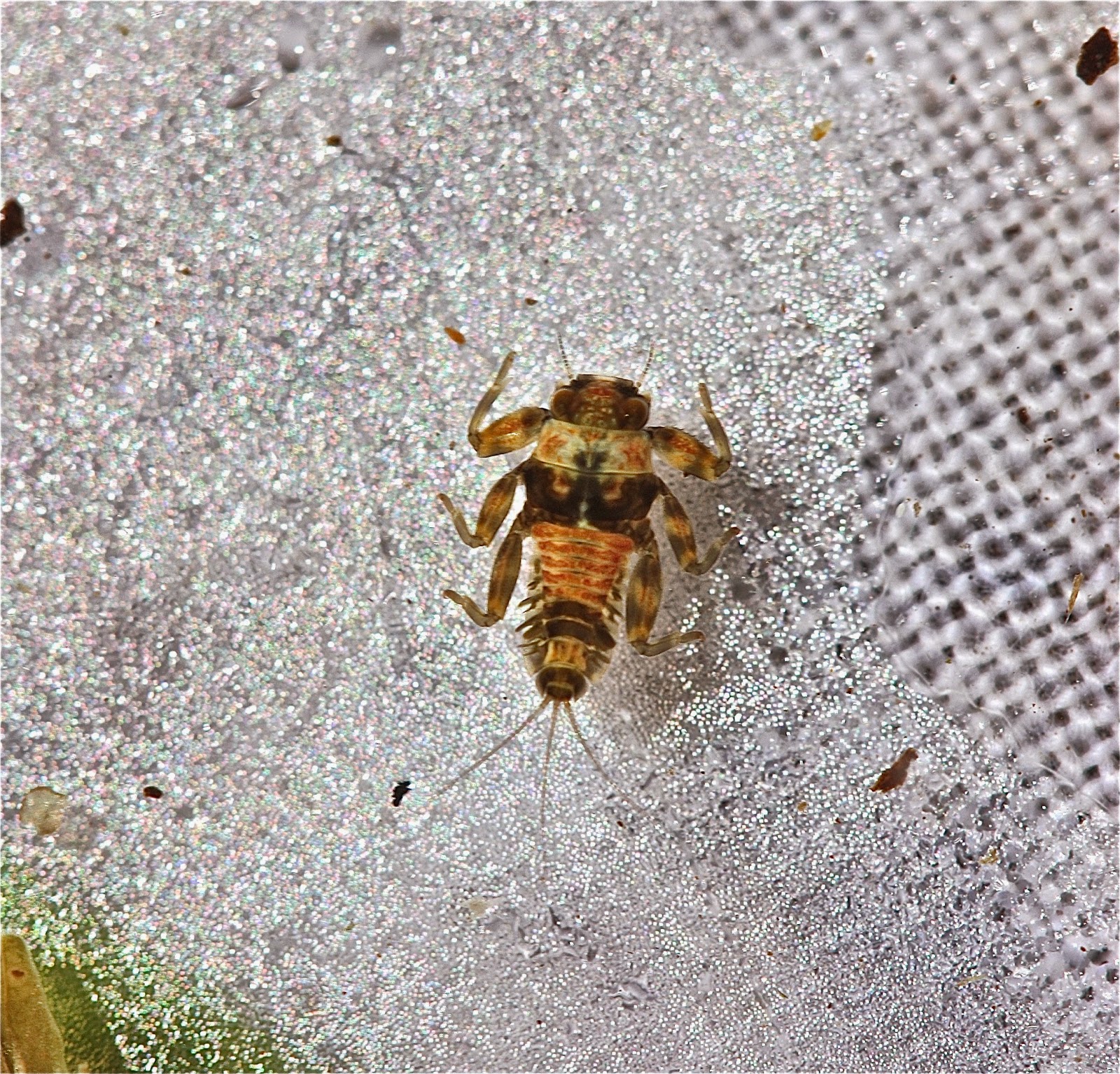
While I'm at it, it's worth noting that I also found a second Heterocloeon petersi small minnow mayfly -- a species that seems to be fairly uncommon. This one was a female, and the Heterocloeon "forecoxal gills" were very pronounced in the only decent photo I got.
More striking is the photo of the male nymph that I found in September, 2012.
Saturday, July 26, 2014
Final Entry
This is the last entry I'm going to post.
It's been a long time since I've found anything new, a new genus or species of mayfly, stonefly, or caddisfly. So I'm just taking photos -- and posting photos -- of insects I've seen so often before, insects that have been ID'd in this blog multiple times. It's time to move on and find something new -- a new challenge, a new passion. But this has been great fun and very rewarding.
A few reminders to end with.
1. The entire list of the mayflies (E), stoneflies (P), and caddisflies (T) that I've found in local streams was posted on 9/8/12. I have done my best to make additions and corrections to that, so it should be up-to-date.
2. Photos of every species -- or genus, if we can't ID the insect to the level of species -- can be found in entries posted from 9/25/12 to 10/8/12. There too, I have made additions and corrections that had to be made.
3. For all of the photos I've taken -- well, the good ones -- you should visit my website at Flickr --
https://www.flickr.com/photos/aquaticinsects_of_central_virginia/sets/ -- and open the album "live photos only."
4. For those of you in the Southeast who wish to continue this work, don't forget the incredible documents compiled by Steven Beaty and the North Carolina BAU (Biological Assessment Unit). They are available on line at: http://portal.ncdenr.org/web/wq/taxonmanual. You can use them on line, or download them and print them.
Best wishes to all of my readers.
Saturday, July 19, 2014
So many colorful insects: waiting for the annual trip to Montana
I've had trouble this summer getting myself to go to the streams. I don't like the hot humid weather, wading in water that's choked with vegetation, soaked with sweat while I wait for the condensation to dry on my lens. All of this when I rather doubt that I'm going to see something new, that I'll be taking of photos of insects of which I all ready have some pretty good pictures.
So I find myself looking forward to that annual fishing trip to Montana. Time to check my leaders and tippet spools, make sure my fly boxes are full -- need lots of "North Fork Specials"! And I'll soon by oiling my reels and cleaning my lines. It's all part of the fun. But so too is the anticipation of seeing those beautiful larvae and nymphs that we don't find in the East and their beautiful patterns and colors. For example...
I. Mayflies
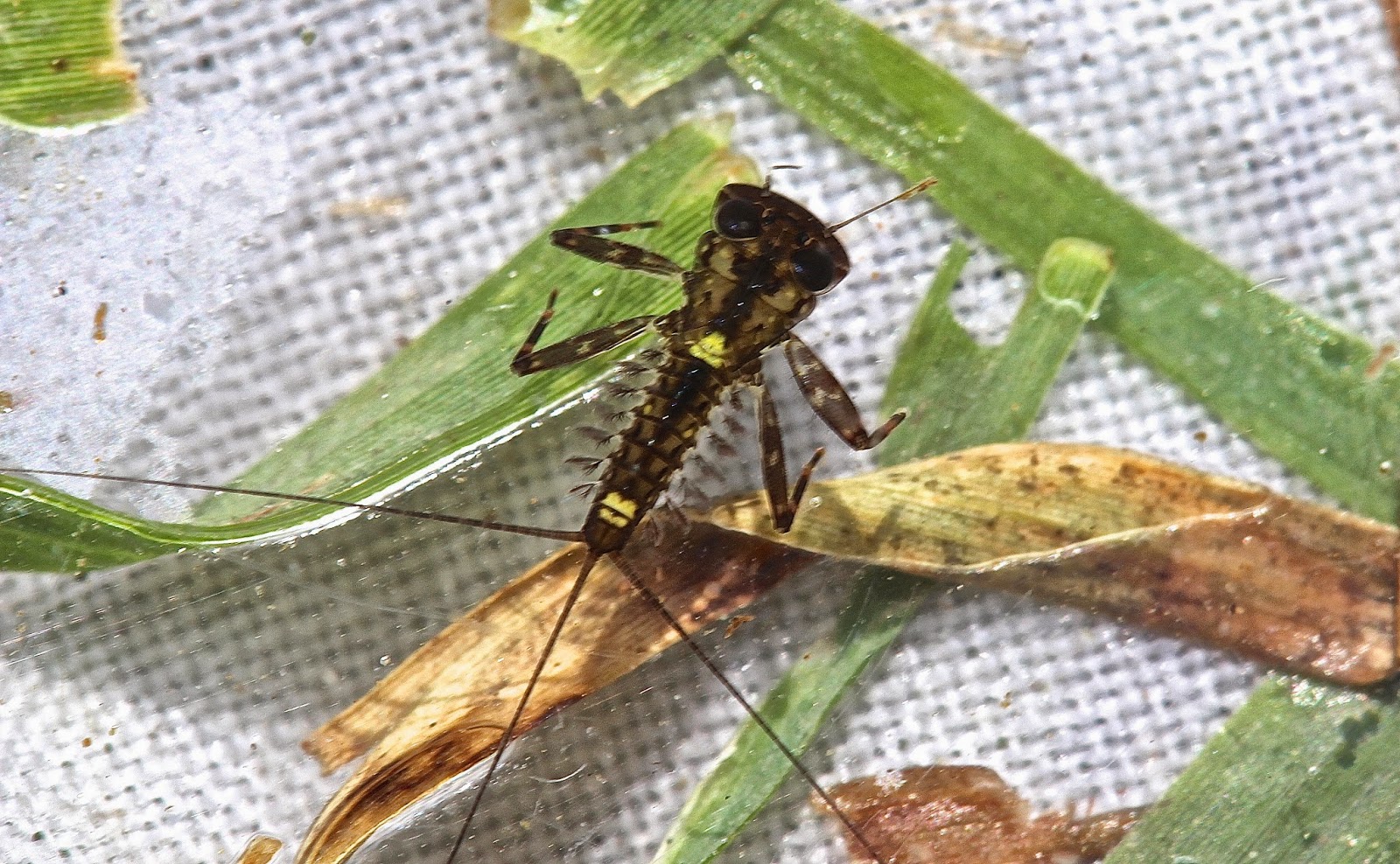
1. That beautiful spiny crawler in the photo at the top of the page -- Drunella doddsi. That's about as colorful as they get -- it's a very small nymph.
2. And the most common insect I see in the small, cold water streams, another spiny crawler, Drunella coloradensis, which comes in all sorts of colors.
4. A flatheaded mayfly that we don't see in the East, Epeorus deceptivus.
5. And another, Nixe simplicioides.
6. Another strange looking mayfly, the pronggilled mayfly with "tusks" -- Paraleptophlebia bicornuta.
7. And one that we do have here in the East, the little stout crawler, genus Tricorythodes (not sure, however, that this is a species we find.)
II. Caddisflies
1. A free-living caddisfly larva that I've seen only once (last summer), Rhyacophila Brunnea-Vemna group.
2. And the fairly common, common netspinner in the streams that I visit, Arctopsyche grandis.
III. Stoneflies
And in Montana, there are still some nice stoneflies around at this time of the year. E.g.
1. The very colorful, Claassenia sabulosa.
2. And, of course, there are still some "Salmon Flies" hanging around, Pteronarcys californica.
________________
So much to look forward to. Does it have to be five weeks away?! Below, the Blackfoot and the Bitterroot Rivers.
Saturday, July 12, 2014
Heterocloeon curiosum (small minnow mayfly) at the Rivanna: summer for sure
When I found this tiny nymph at Darden Towe this morning, I rushed out to take a few photos thinking I might have found the uncommon Heterocloeon petersi -- this one, which I found two years ago in the Rivanna at Crofton.
But I'm pretty sure I was wrong. The little guy -- and it is a "guy" (male) -- in the first photo is probably a small, immature, Heterocloeon curiosum, an insect which is common at this site every summer. When they mature, they look more like this.
Alas! The Rivanna at Darden Towe is still a little bit high, but it's now perfectly safe to wade and scrounge up some bugs, and there were plenty of them to be found. Lots of small flatheaded mayflies, a fair number of common netspinners -- even a whirligig beetle! But let's stick with the H. curiosums since they too were around in good numbers. Here is one of the females I found.
The females, you may recall, are always bigger than the males -- but less colorful. But on the larger female, one of the key features of H. curiosum shows up very well: there is a dark splotch of pigment in the center of each of the gills. Still, to be sure you have the small minnow mayfly H. curiosum, you have to see the little white gills that stick out at the base of the forecoxae. These.
These nymphs are not easy to photograph: they don't stay in one place very long. But, I'll get plenty of shots at good photos from now through September.
________________
Other photos.
1. The common netspinner, Hydropsyche rossi/venularis. I think H. rossi and H. venularis are the only netspinners I see in the Rivanna, and they're fairly tolerant larvae (4.8 and 5.1 respectively). I took photos of two of these insects this morning: one was brown, the other one green.
In the end I wasn't sure if they were H. rossi or H. venularis -- or possibly one of each. The head pattern is much the same on both species: "Frontoclypeus with two pairs of yellow spots anterolaterally" (Schuster and Etnier, "a Manual for the Identification of the Larvae of the Caddisfly Genera Hydropsyche pictet and Symphitopsyche ulmer.., p. 96). We can see those spots in this head shot of the brown nymph.
But to tell the two species apart, we must look at the rows of muscle scars on the sides of the head. Do they, or do they not, "curve dorsad posteriorly" (Beaty, "The Trichoptera of North Carolina," p. 76). Here are two microscope photos. You decide. I'm inclined to say they were H. rossi, but the evidence just isn't certain.
Best to exercise caution: H. rossi/venularis.
________________
2. A whirligig beetle larva, the first of the year: also a difficult photo to get. They wiggle and wiggle and wiggle!
Nasty looking pincers. This one was determined to get ahold of the H. curiosums.
________________
3. And last but not least, a Maccaffertium ithaca flatheaded mayfly: I found two.
It's great to get back into the Rivanna. Every summer I find new things in this river.
Tuesday, July 8, 2014
What are Lepidostomatid case-makers doing in the Rivanna River in summer?
The water in the Rivanna is dropping and clearing -- and really warming up. So I went to the Rivanna at Crofton to see if I could lift any rocks. I could -- but I had to stick close to shore. Still, I saw a lot of insects, though most things are small.
And I found, as you can see, a Lepidostomatid case-maker. I've seen them before in this river, but it's something I don't understand. The genus is the same that we see in the winter in spring -- Lepidostoma -- a larva which makes a four-sided case "constructed of quadrate pieces of plant material" (Beaty, "The Trichoptera of North Carolina," p. 81). Tolerance value: 1.0. We see a lot of these in the winter and spring, but they're always in small, very clean, cold mountain streams, often head water streams. So what are they doing in this big, warm, not so clean river in summer? I assume this is a matter of species, which, unfortunately have not yet been described. Beaty names 22 species in North Carolina. Whatever the answer, they're here, though not in very large numbers.
I have to admit that the cases made by those that I find in the winter are aesthetically much more pleasing. And remember that some begin their cases with grains of sand.
Here's a pair that I found in Sugar Hollow on 3/3/12.
And another from 1/30/12.
I'll have to see what the entomologists say about this one.
_________________
Other photos:
1. The "Rivanna River" Acroneuria abnormis Perlid. No "M" visible on the head, and no banding on the terga. (Have a look at the entry of 10/4/13.) Still very small.
2. A VERY freckled genus Perlesta Perlid. Note the setal row on the occiput and the presence of anal gills (= Perlesta). (Red eyes = male?)
3. And among the many flatheaded mayflies I saw, I found our first Heptagenia of the season: Heptagenis marginalis.
Heptagenia flatheads, as opposed to Leurcrocuta flatheads, have "fibrilliform" on gill 7.
We'll get better photos of this one later on in the summer. This one was taken on 8/8/12.
Subscribe to:
Posts (Atom)